NihontoWatch MonNihontoWatchBETA
MarketEncyclopedia
NihontoWatch Mon

NihontoWatchBETA

Market
Encyclopedia
Overview·Kantei·Designations·Work Types·Signatures·Lineage·School
OverviewKanteiDesignationsWork TypesSignaturesLineageSchool
  1. Schools
  2. Otsuki
  3. Matsuo Gassan

Otsuki Matsuo Gassan

松尾月山

Jūyō
Vol. 28, No. 205 · Tsuba

Otsuki Matsuo Gassan

松尾月山

4 ranked works

ProvinceYamashiroEraBakumatsu-MeijiPeriodMeijiSchoolOtsukiTraditionMachiboriTeacherHideokiTypeTosogu MakerCodeOTS013
4Jūyō Tōken

Kantei

3 descriptive axes: material (a soft-metal and iron ground palette, the records naming shakudo, brass, iron and shibuichi as his characteristic grounds) x technique (high relief finished in colour inlay, supplemented by katakiri-bori, fine kebori, applied suemon and flush inlay) x themes (Otsuki pictorial design, led by figure and warrior subjects). With a thin corpus of four pieces his discriminators are scope-tight and low-n: the Otsuki pictorial high relief is the foundation his work rests on, so the citable personal separators are the records' explicit reading of him as a tsuba-focused hand who excelled at figure-pictures (warrior subjects above all), each flagged accordingly.

Matsuo Gassan was a late- Kyoto metalwork artist of the Otsuki school. The records give his identity in full: his real name was Matsuo Karoku, he was born in Kyoto in Bunka 12 (1815) and died in Meiji 8 (1875) aged sixty-one, and he signed under the studio-go Kongosai and Tososhitei. They make him a pupil of Kawarabayashi Hideoki of the Otsuki school (the teacher as Sasayama Tokuoki), and one record names him a fine hand who honed his skill alongside his fellow Hideoki pupils Tokuoki and Tenkodo Hidekuni. His ground and hand are the Otsuki house manner: , brass, iron and grounds worked in high relief and colour inlay, with katakiri-bori where the design calls for it, and the records read the Otsuki-school quality plainly in his work. The records single out two things as personal to him: that he produced many (rather than the small okite-mono of the Goto house), and that he excelled at figure-pictures, beginning with warrior-pictures (musha-e), and worked widely in birds, animals and the lion. His celebrated piece is a Koromogawa-yakata depicting a scene of the Former and Later Nine Years battles, called one of his representative works. One whole here is unified by -e folk-painting subjects, each charm-bearing. With only four pieces, all Important (), this is a very thin corpus, and the genuine separators from the broader field are scope-tight and low-n. This profile reads his identity, biography and signature chronology from the catalog records only. (Note: the art-name Gassan is also famous as a swordsmith line; this Gassan is a soft-metal fittings maker of the Kyoto Otsuki school, unrelated to that smith lineage.)

Diagnostic discriminators

the records say what he excelled at was figure-pictures, beginning with warrior-pictures (musha-e), and widely also birds and animals; his celebrated Koromogawa-yakata tsuba carries a Nine Years battle scene called one of his representative works, and an Otsu-e koshirae distributes folk-painting figures across the fittings. Named in three of the four pieces. The pictorial-figure manner is partly the Otsuki house register shared with his fellow pupils Tokuoki and Hidekuni rather than a tell personal to him alone, but the explicit reading of him as a figure-and-warrior specialist is the records' description of his own hand. Within a four-piece corpus this is the strongest recurring discriminator, though still low-n

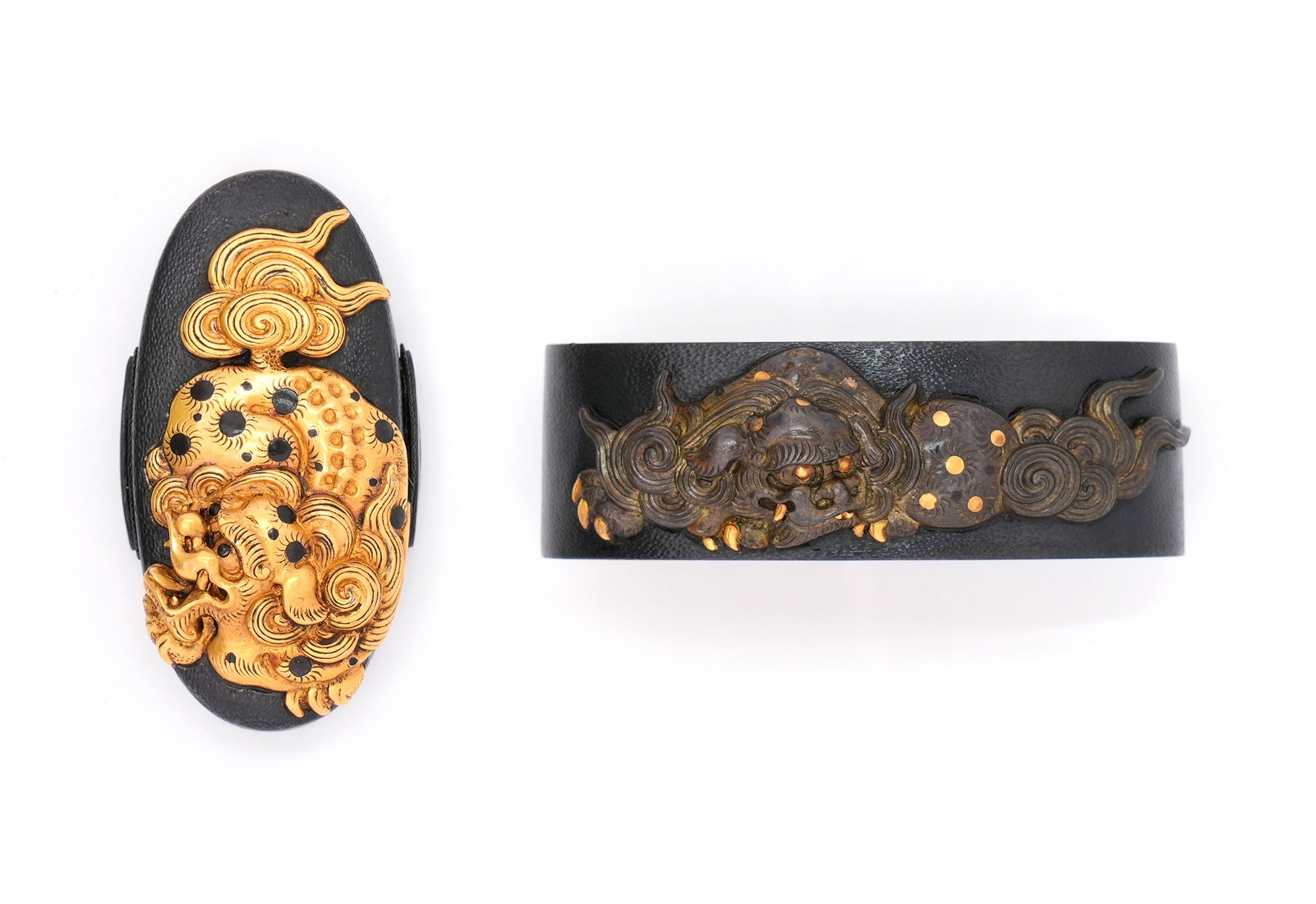
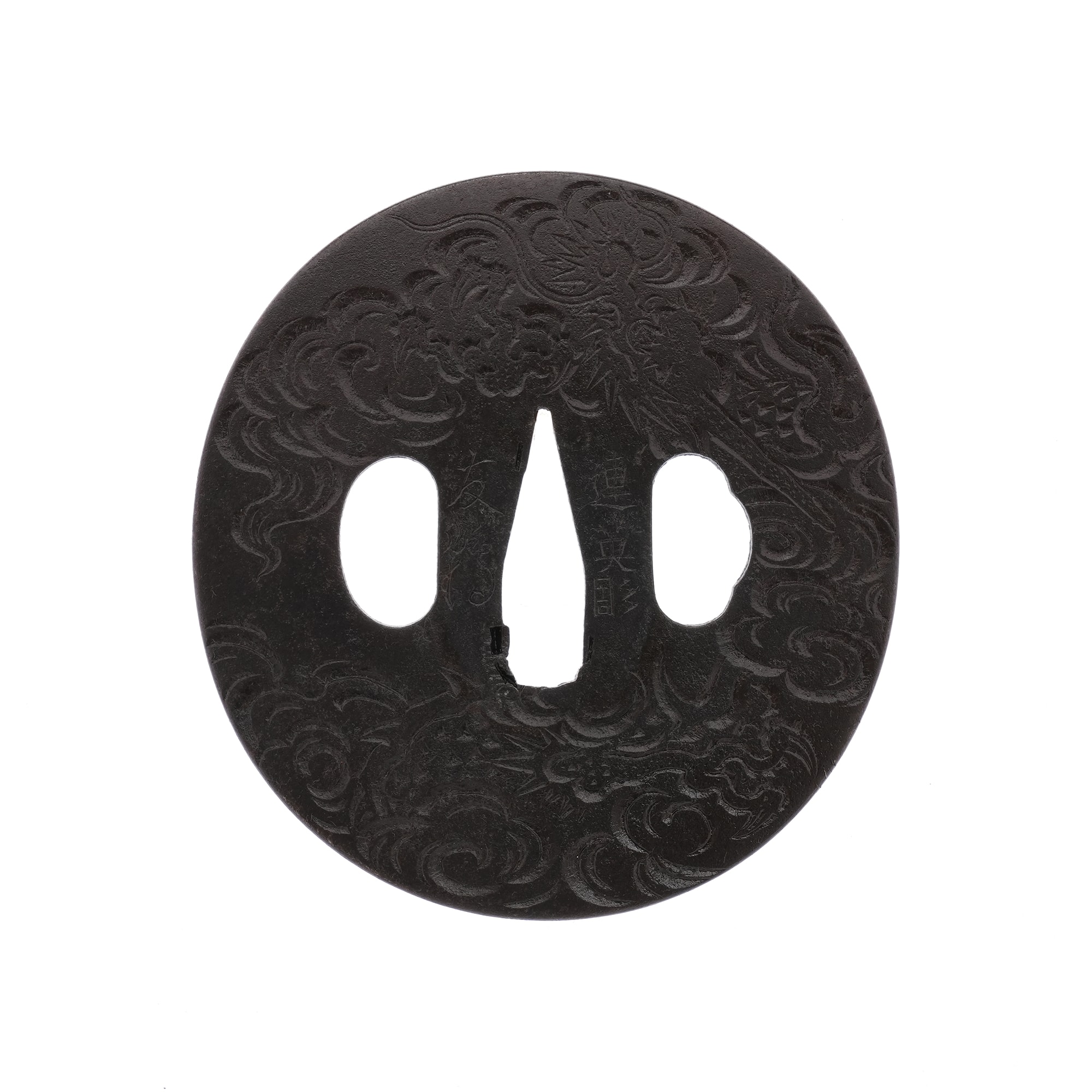
the records twice state that he produced many tsuba, well receiving his teacher's manner; three of the four pieces here are tsuba (the dragon, the peacock-and-fuchi-kashira set, the Koromogawa-yakata), set against the kozuka/kogai/menuki focus of the formal Goto house. Named in two of the four pieces; low-n and so scope-tight

Material (grounds)

The records name his characteristic grounds as , brass, iron and . In this group his are worked on iron (polished) and on a field; the -e carries an polished ground on the and a ground on the , with refined-copper colour. He keeps the ground as a polished or field suiting his pictorial high relief.

Technique

His core hand is high relief finished in colour inlay, the Otsuki house manner, present across the group, supplemented by katakiri-bori and fine (the records say he sometimes shows katakiri-bori), applied , fully-modelled and flush - where the design calls for it. On the dragon and warrior the records praise the controlled balance of gold inlay against the iron field and the minute, sure chisel work; one record reads in his handling the workmanlike processing characteristic of the Otsuki school.

Themes (pictorial)

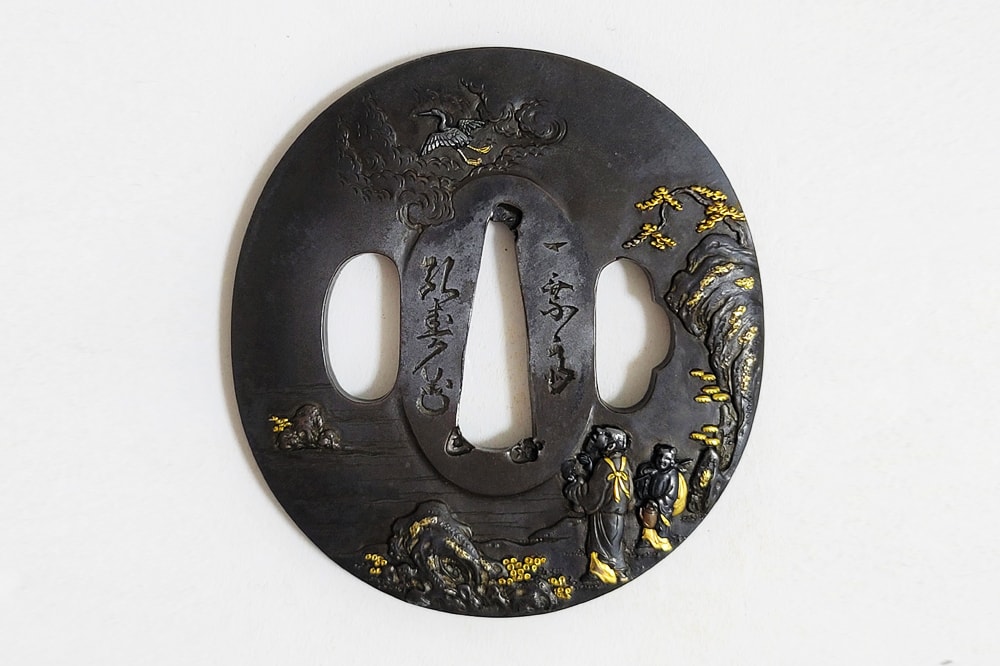
His subjects are the Otsuki pictorial manner carried onto the fitting, led by figures and warriors: a Koromogawa-yakata battle scene from the Nine Years wars (Hachimantaro Yoshiie pursuing Abe no Sadato), a soaring dragon, a peacock, and a whole unified by -e folk-painting subjects (the Wisteria Maiden, Yanone Goro, the praying demon, the falconer, Benkei, gourd-and-catfish, the spear-bearer). The records single out his command of figure subjects and read the Otsuki-school quality in the bold composition and refined finish.

Pictorial figure and warrior design

Figural and warrior subjects laid out across the plate like a painting and worked in high relief with colour inlay, the Otsuki pictorial manner. The records make figure-pictures (warrior subjects above all) his stated speciality, his Koromogawa-yakata battle one of his representative works, and an -e carries the folk-painting figures one to each fitting.

Birds, animals and auspicious creaturesless firmly established

Birds, animals and auspicious creatures, which the records say he also worked widely (birds, the lion, puppies): a soaring dragon worked on iron, a male-and-female peacock set on . A minor register beside his figure work in this thin corpus.

Full iconography

Signature chronology

Placement
Recorded signatures

Documentary note

His signature chronology and the names he carries date and authenticate the work, and the records state his identity explicitly. His core signature is the real-name Matsuo Gassan, often with the suffix character (made); he also signs the go-form Kongosai Gassan and the Kyoto-locative -junin Kongo-Gassan with a , and the bare two characters Gassan appear on one with a tripod-form (kanae) seal-. His real name was Matsuo Karoku, his studio-go Kongosai and Tososhitei; the records make him a pupil of Kawarabayashi Hideoki of the Otsuki school, born in Kyoto in 1815 and dead in 1875 aged sixty-one. The art name Gassan written alone is shared with the famous swordsmith line, but in this corpus it is his soft-metal fittings signature; the real name Karoku and the go Tososhitei are biography-only, never cut as a signature here.

Scholarship

On a single koshirae in this group (one of the four pieces only) the program is taken from Otsu-e, the folk-painting genre sold near Otsu from the early modern period, each charm-bearing subject carried onto a fitting; that one record explains the subject at length as a witty, popular pictorial tradition.

Designations

Kokuhō—
Jūyō Bunkazai—
Jūyō Bijutsuhin—
Gyobutsu—
Tokubetsu Jūyō—
Jūyō Tōken4

Elite Standing

0.02 across 4 designated works

Top 32% among makers

Work Types

Distribution across 4 ranked works

Other
250%
Tsuba
250%

Signatures

Signature types across 4 ranked works

Currently Available

Lineage

TeacherHideoki
Matsuo Gassan

Otsuki School

Other artisans of the Otsuki school

  1. 1.Tokuoki篤興3 for sale22designated
  2. 2.Mitsuoki光興11designated
  3. 3.Hidekuni秀国9designated
  4. 4.Oki/Masaoki/Minayama Oki応起7designated
  5. 5.Harutsura春貫6designated
  6. 6.Motohiro元広1 for sale4designated
  7. 7.Mitsuhiro光弘2 for sale1designated
  8. 8.Hideoki秀興2designated

Matsuo Gassan

Matsuo Gassan(松尾月山) was a maker of Japanese sword fittings (tōsōgu) of the Otsuki school in Yamashiro province, active during the Bakumatsu-Meiji period.

The work follows the Machibori tradition.

Designated works by Matsuo Gassan include 4 Jūyō.