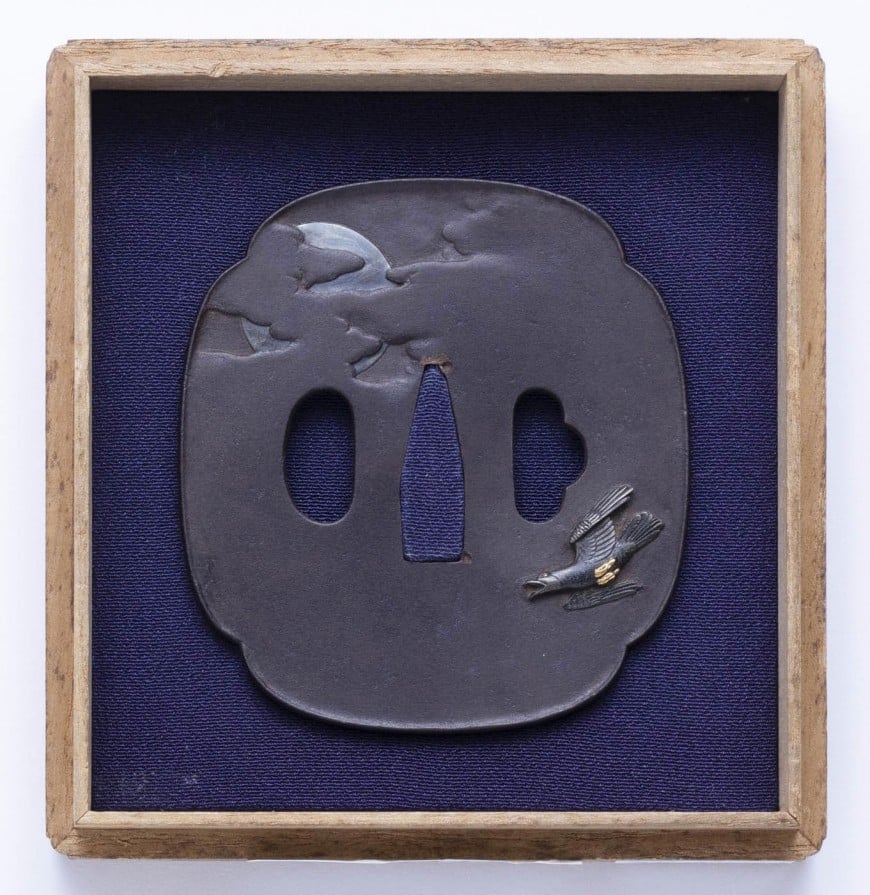
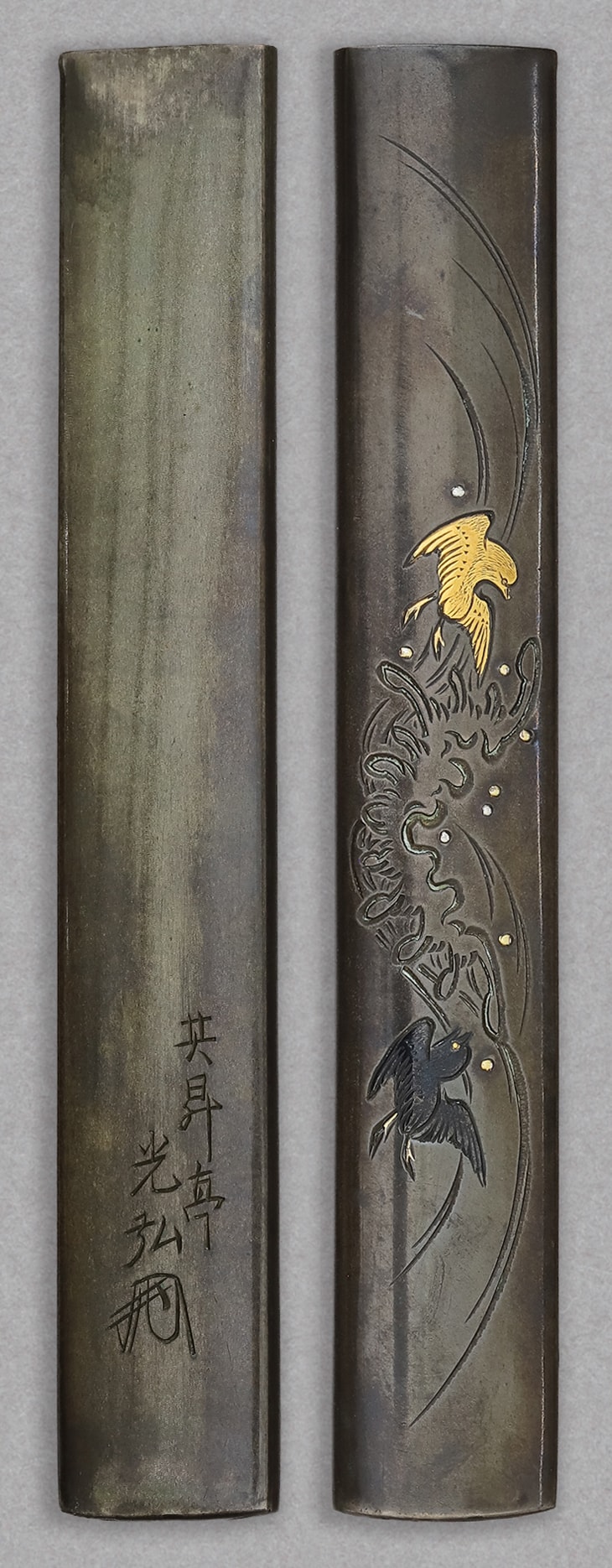
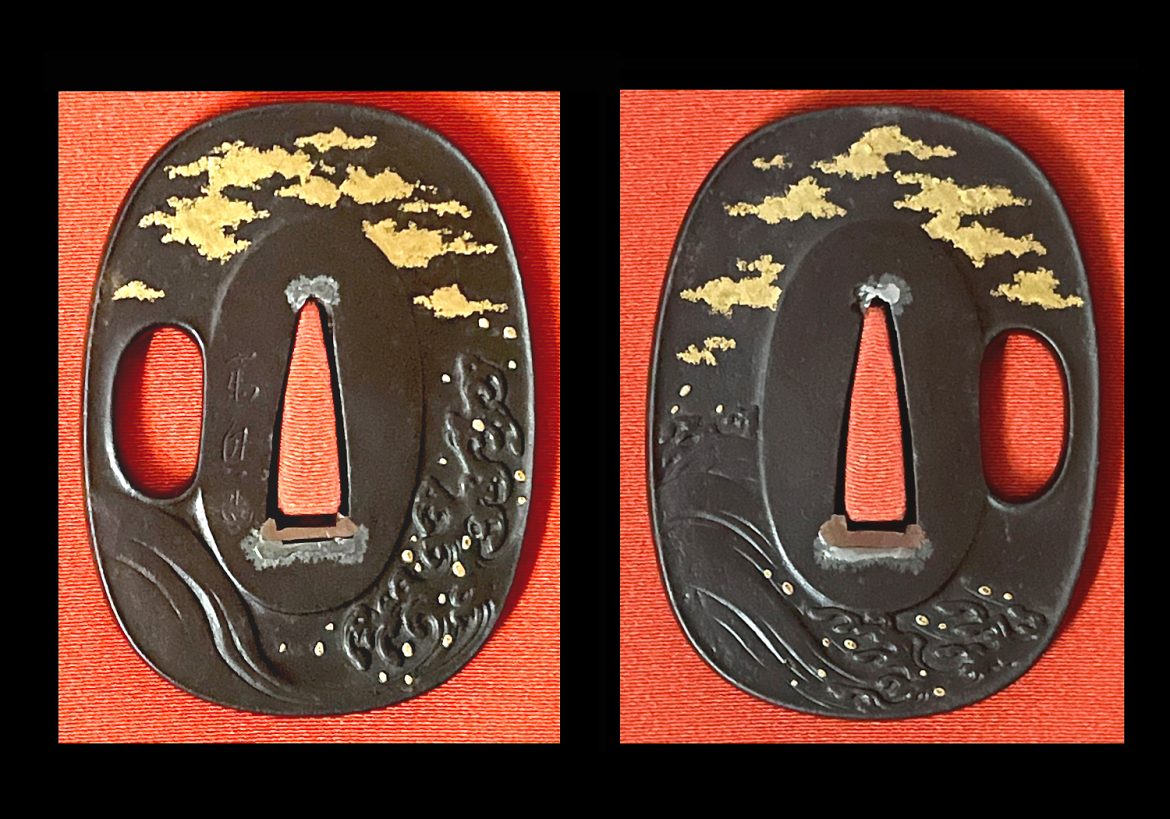
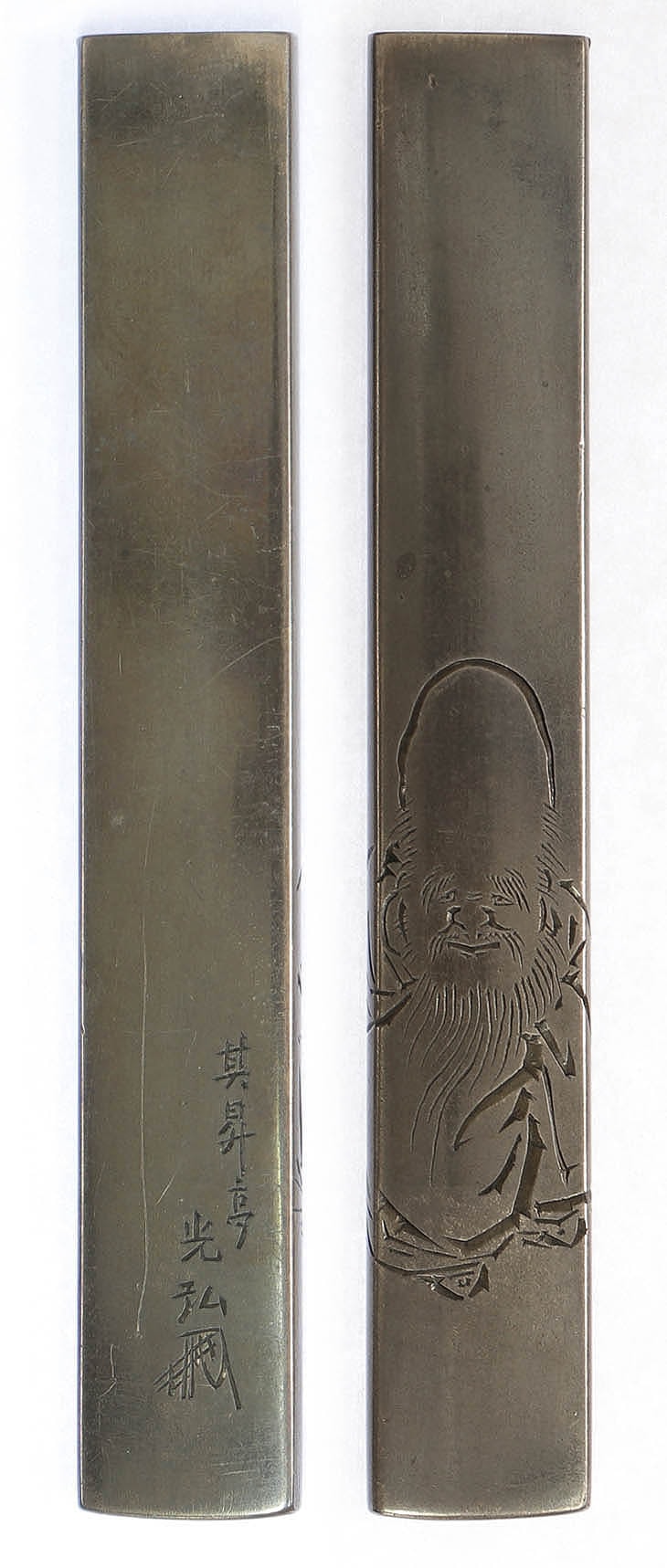
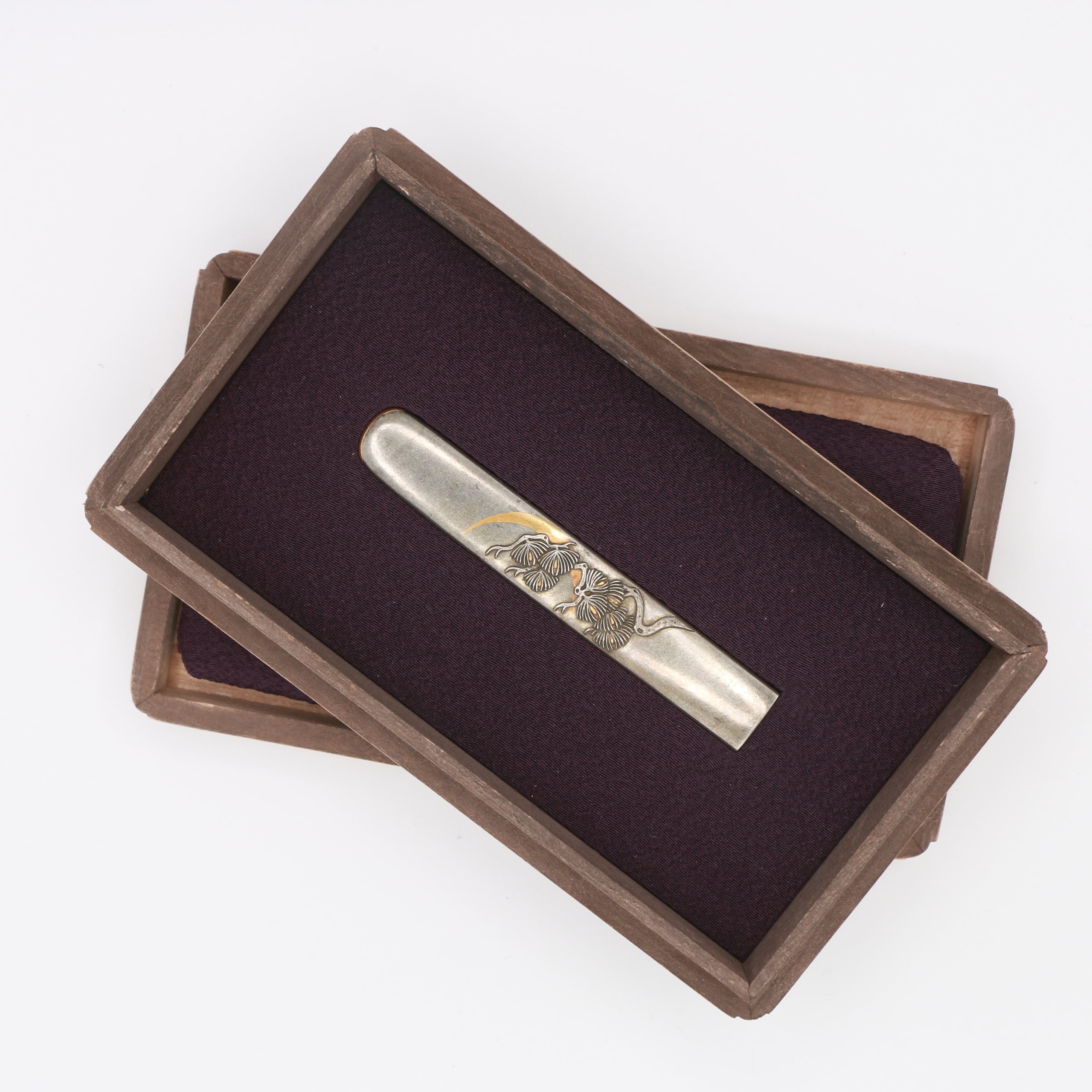
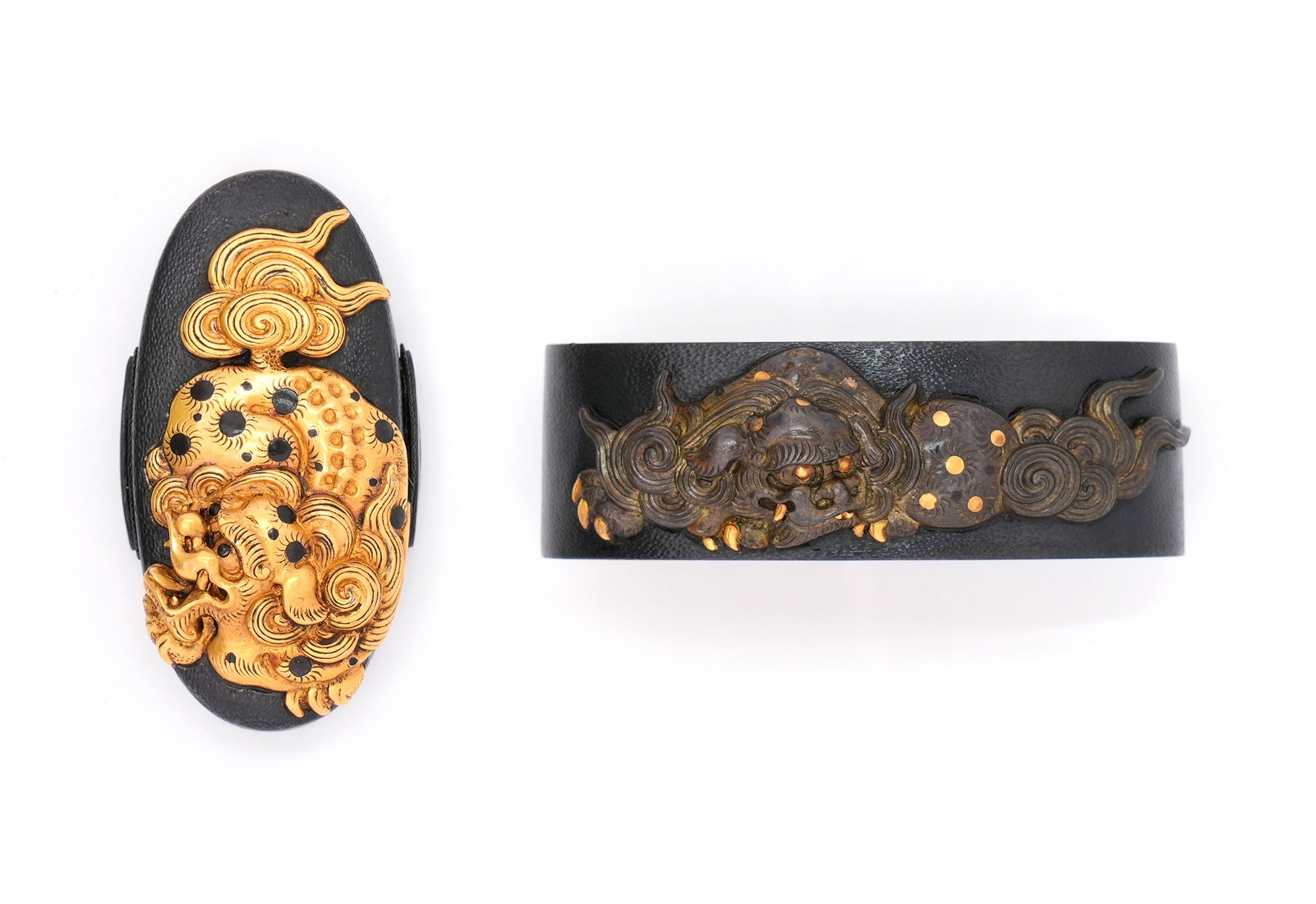
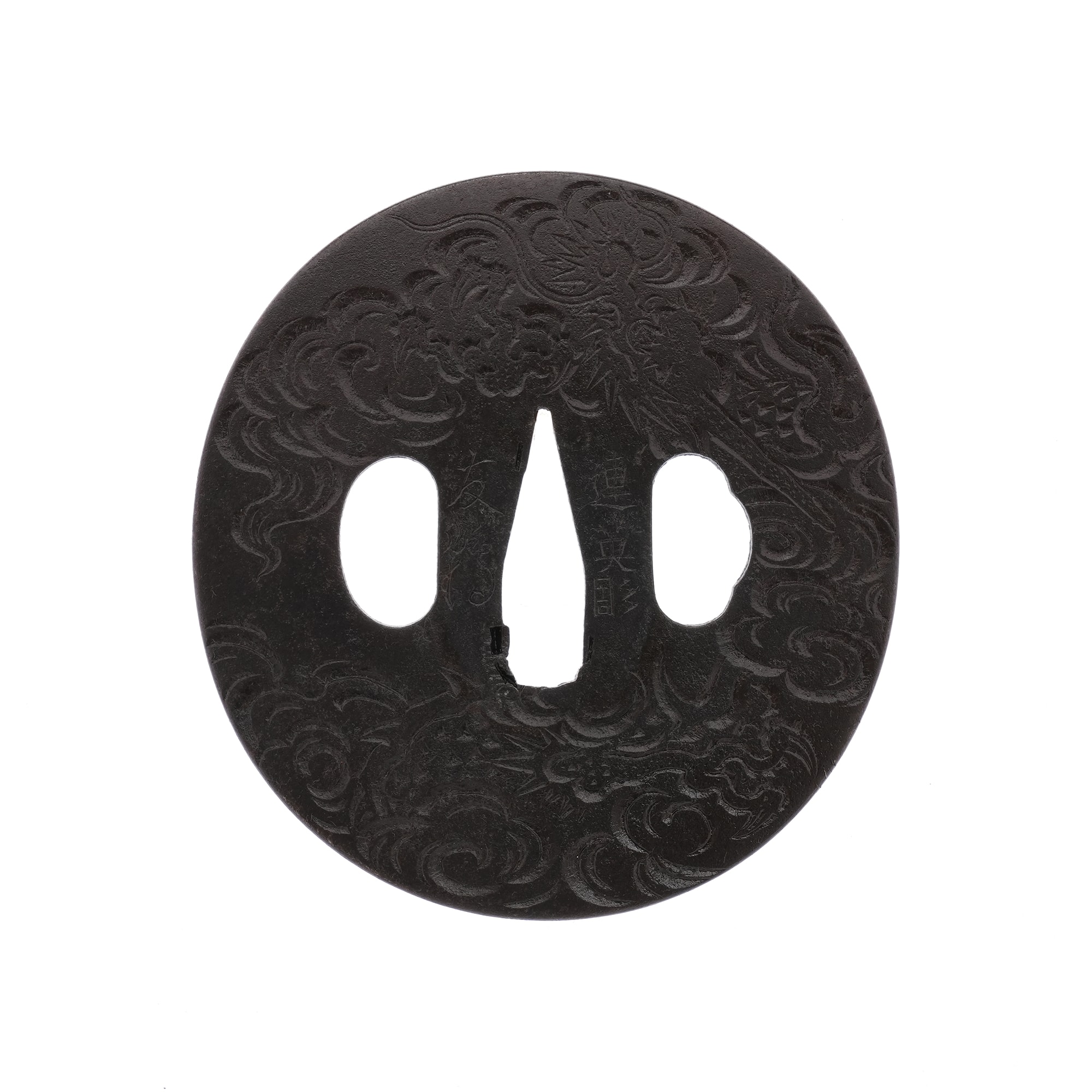
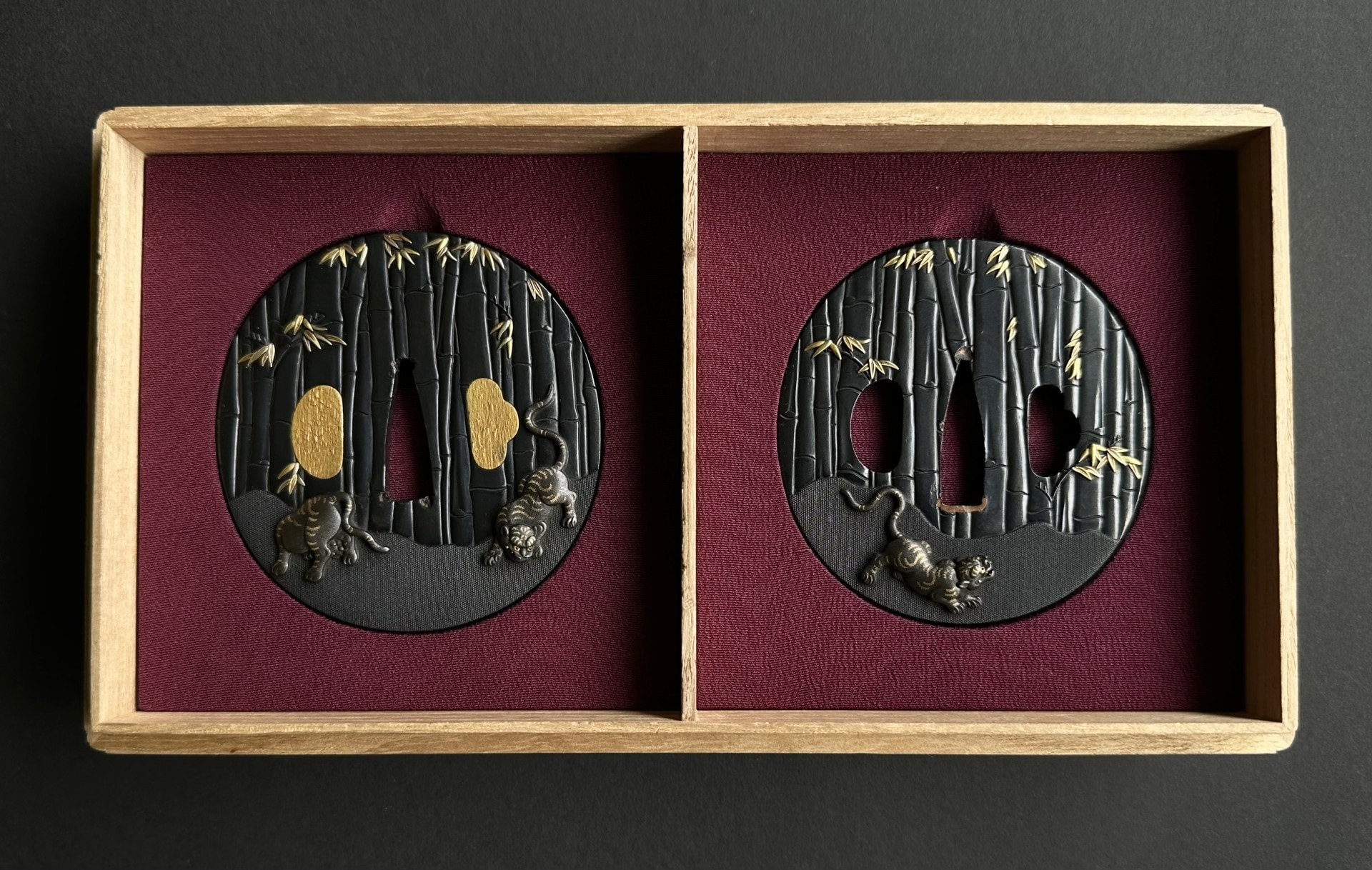
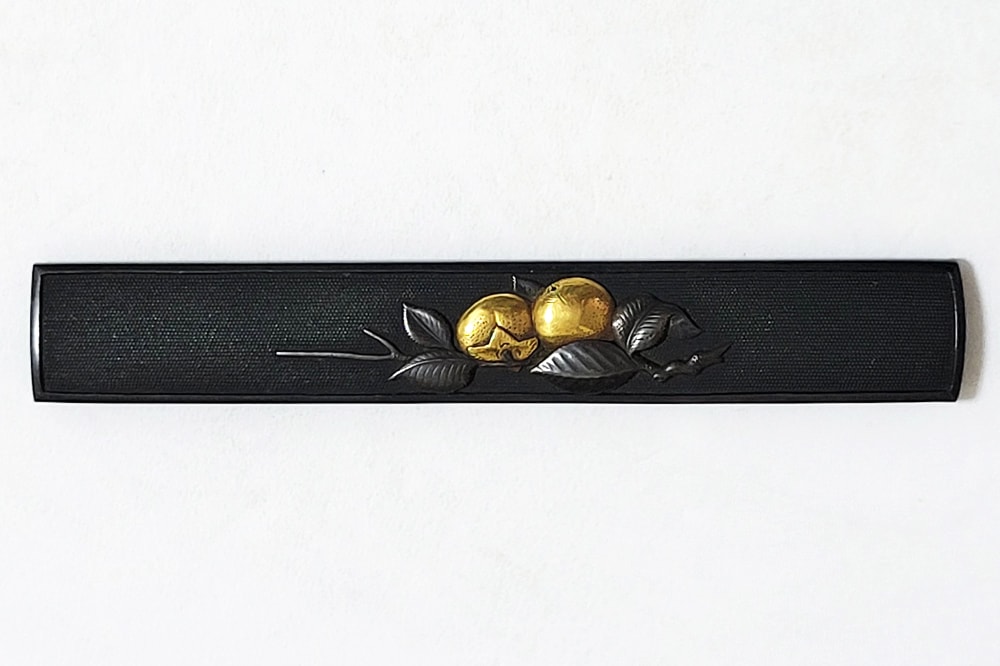
Otsuki Mitsuoki was the son of Mitsuyoshi, the third-generation master of the Otsuki school -- a lineage the consistently identifies as "a distinguished lineage among the Kyoto metalworkers." He was born in Kyoto in Meiwa 3 (1766) and died in Tenpo 5 (1834) at the age of sixty-nine. He studied painting under Kishi Ganku and is said to have maintained close ties with Nagasawa Rosetsu, associations that decisively shaped what the examiners describe as an artistic manner that is, "in the truest sense, painterly." He employed a profusion of art names -- Ryusai, Dairyusai, Ryukomado, and Shiryudo among them -- and signed in varied forms including "Yoshu Mitsuoki," "Gekko Mitsuoki," "Tsuki Mitsuoki," and "Mitsuoki" written with variant characters. His works uniformly bear a tripod-shaped seal (kanae-in) as an impressed mark.
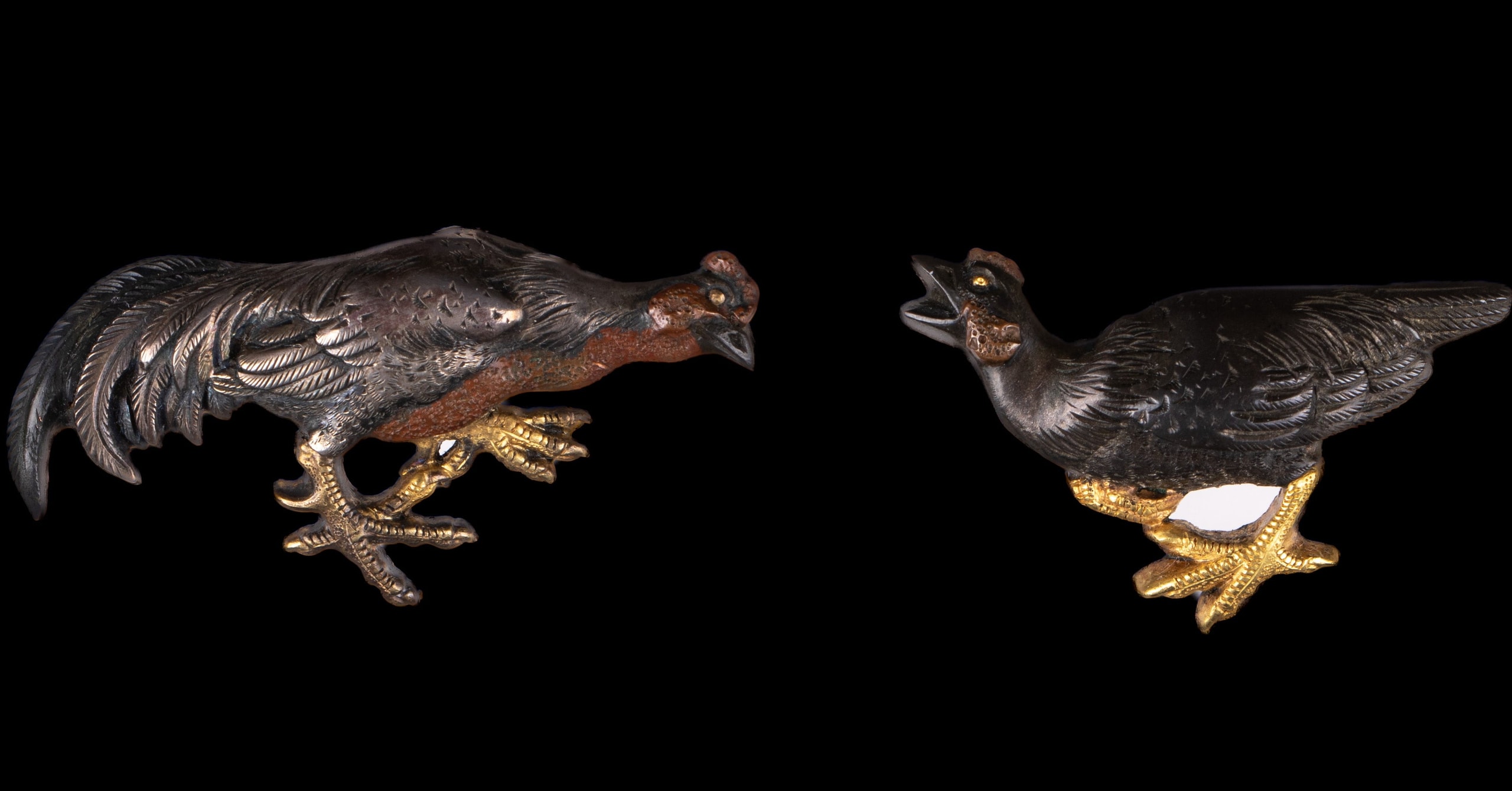
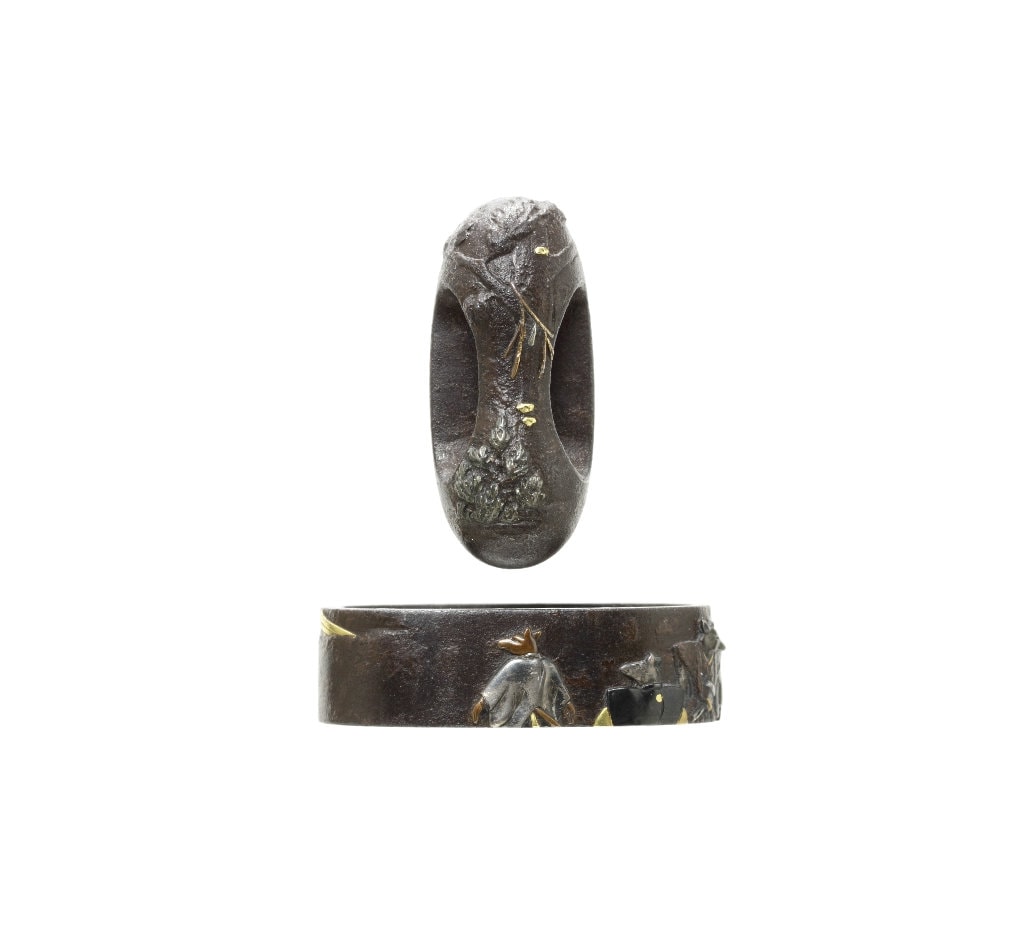
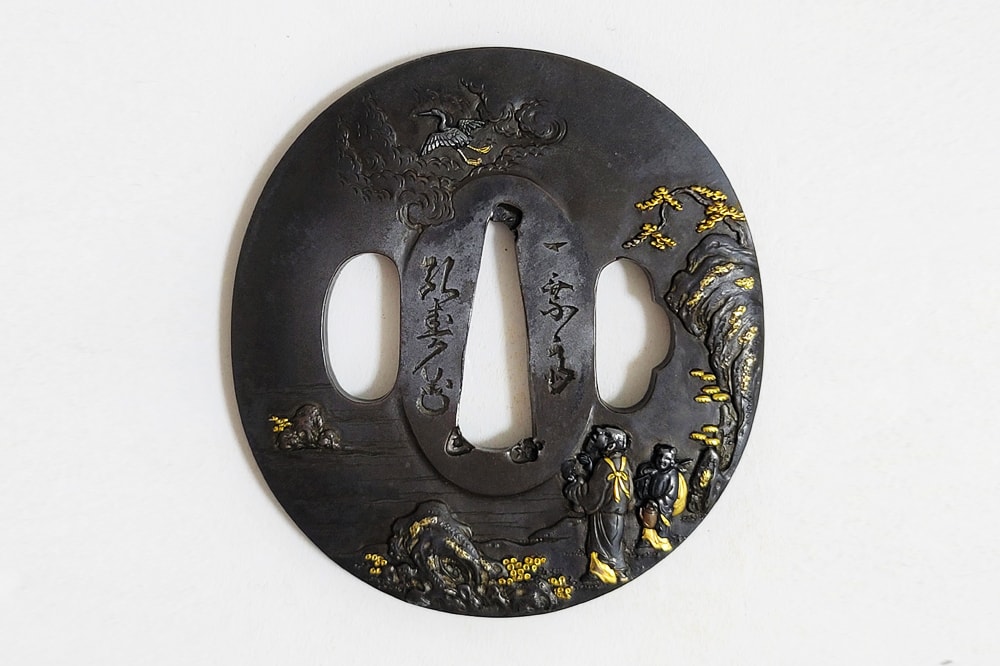
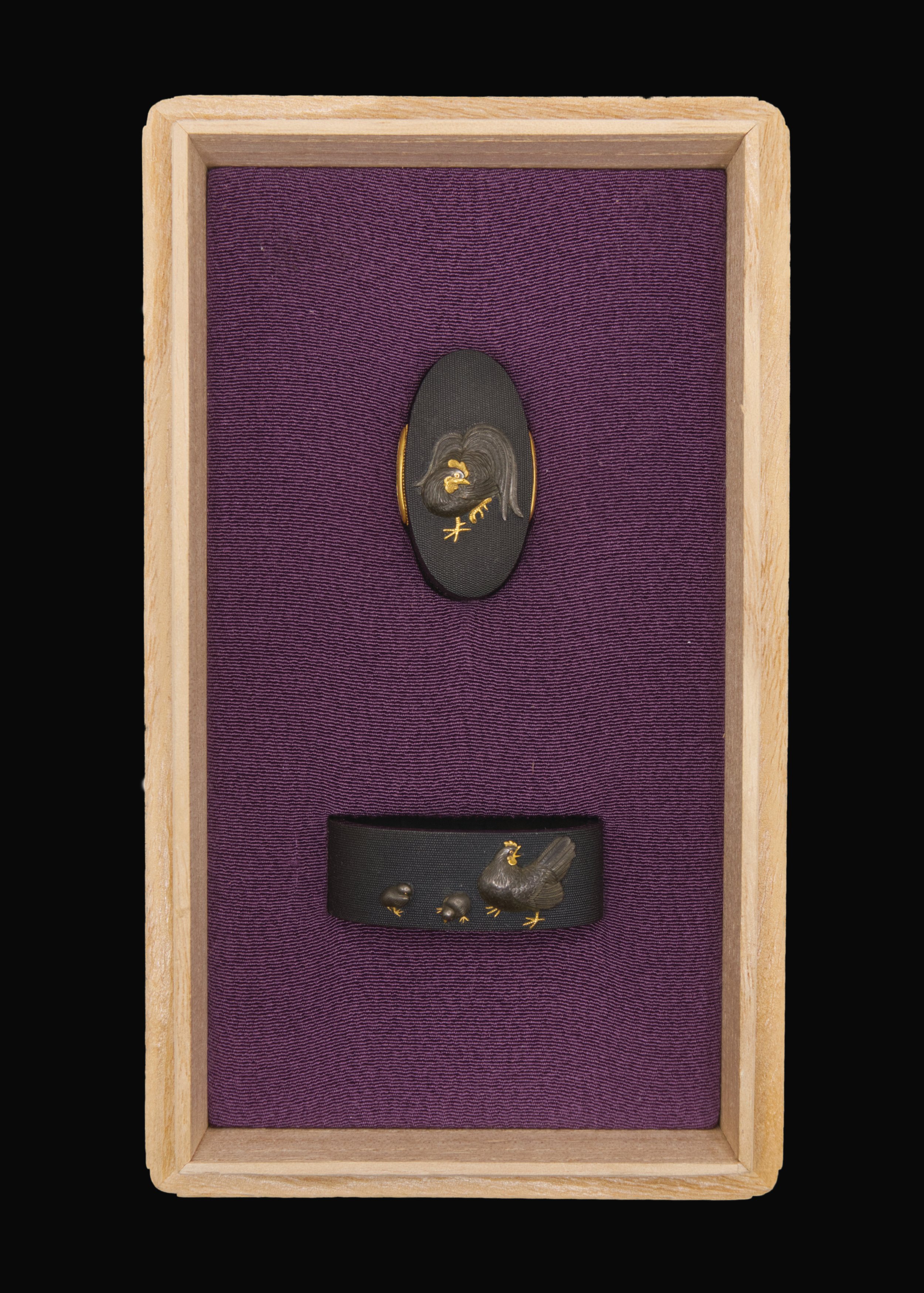
Mitsuoki's technical range encompassed (high-relief carving with polychrome metalwork), (single-chisel engraving), - (flat inlay), and (relief modelling from the plate), all of which the describes as "executed with great skill." He worked across an unusually varied palette of ground materials -- iron, , , , and brass, with the last appearing "especially often" in his oeuvre. His grounds were finished variously as (polished), (fish-roe stipple), (rough), and - (file-mark), each selected to serve the pictorial demands of the subject. On he deliberately varied both outline forms and materials across his production, favouring such subjects as geese amid reeds beneath the moon, snow resting upon reeds, and literary narratives drawn from Chinese and Japanese tradition. The observes that by "adjusting the degree of modeling" he was able to "skillfully convey the tonal gradations of brushwork, as well as mist and the rippling of the water's surface," and that in his works the carving is "remarkably refined, with exceptionally assured and finely textured surfaces." His compositional intelligence is noted for its command of open space, its narrative pull, and its ability to communicate atmospheric depth -- qualities evident in pieces ranging from the Sagisho festival , where figures are rendered "with such verisimilitude that they seem about to step into motion," to the nocturnal cedar scene, where the chisel work "remains taut and intensely controlled down to the very tips of the branches."
The 's evaluative language for Mitsuoki's works converges on several recurring assessments: that his pieces allow the viewer to "fully sense Mitsuoki's abilities"; that his manner is fundamentally "pictorial in spirit"; and that even within compositional restraint or atmospheric stillness, "one senses the maker's earnest seriousness toward the act of creation." The examiners detect in his modelling the influence of the great Kyoto predecessor Myoju and, in his pictorial compositional conception, the influence of Kaneie. His early works, identifiable by a clerical-script-like signature, already display "forceful rich in technique" and "compelling realism," while his later production developed what the characterizes as "a drifting, Zen-inflected flavour" that revealed "a partial glimpse of that longing toward an inward spiritual world." That the consistently position the Otsuki school among Kyoto's most eminent metalworking lineages, and Mitsuoki himself as a figure whose pictorial training and technical mastery produced works of "strong narrative pull" and lyric depth, affirms his standing as one of the foremost chokinshi of the late period.