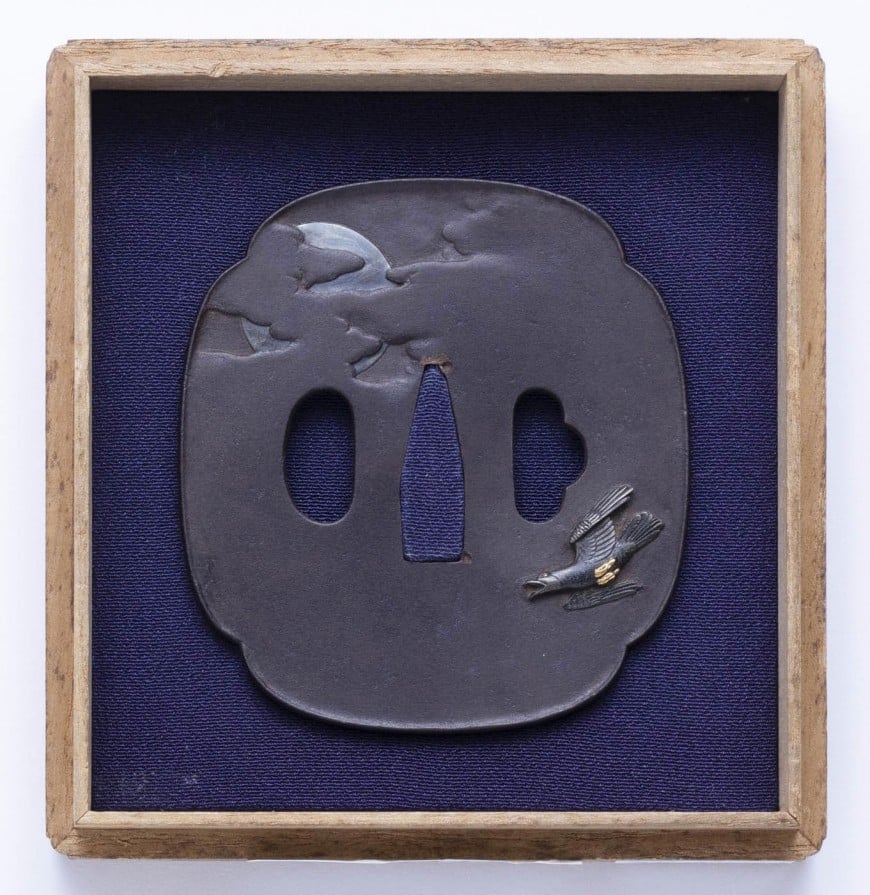
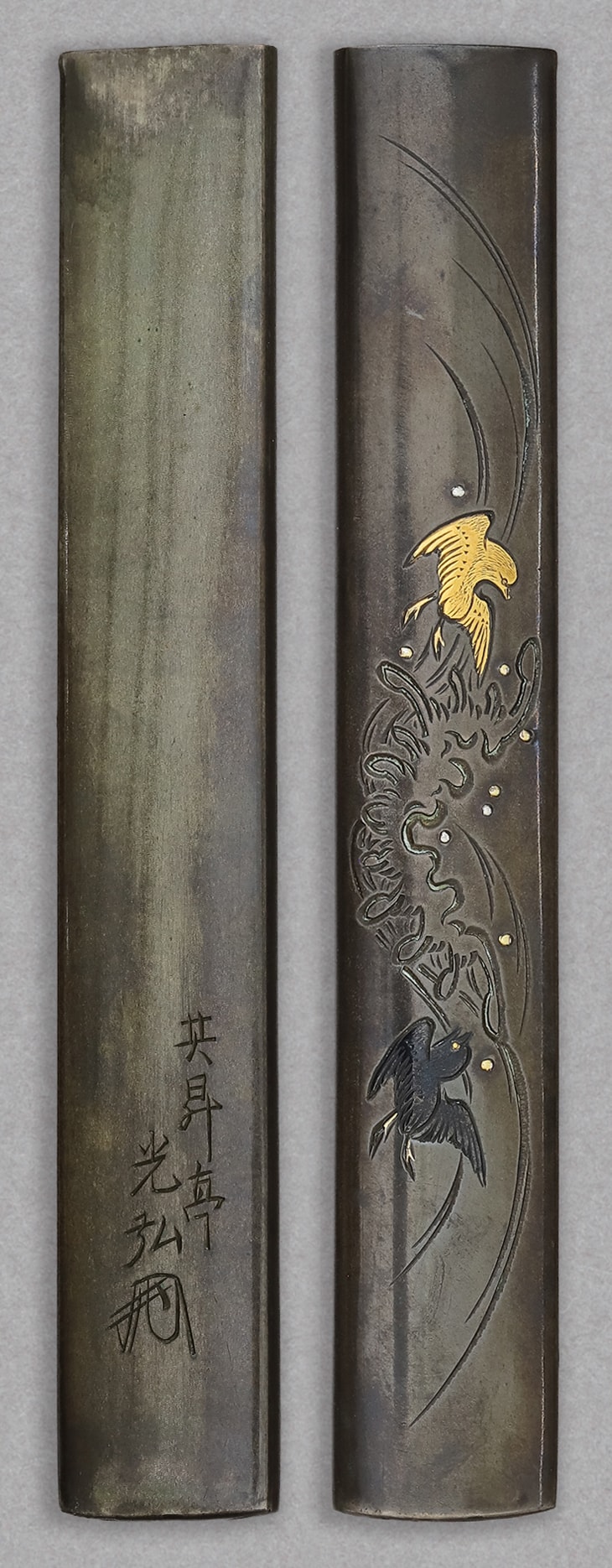
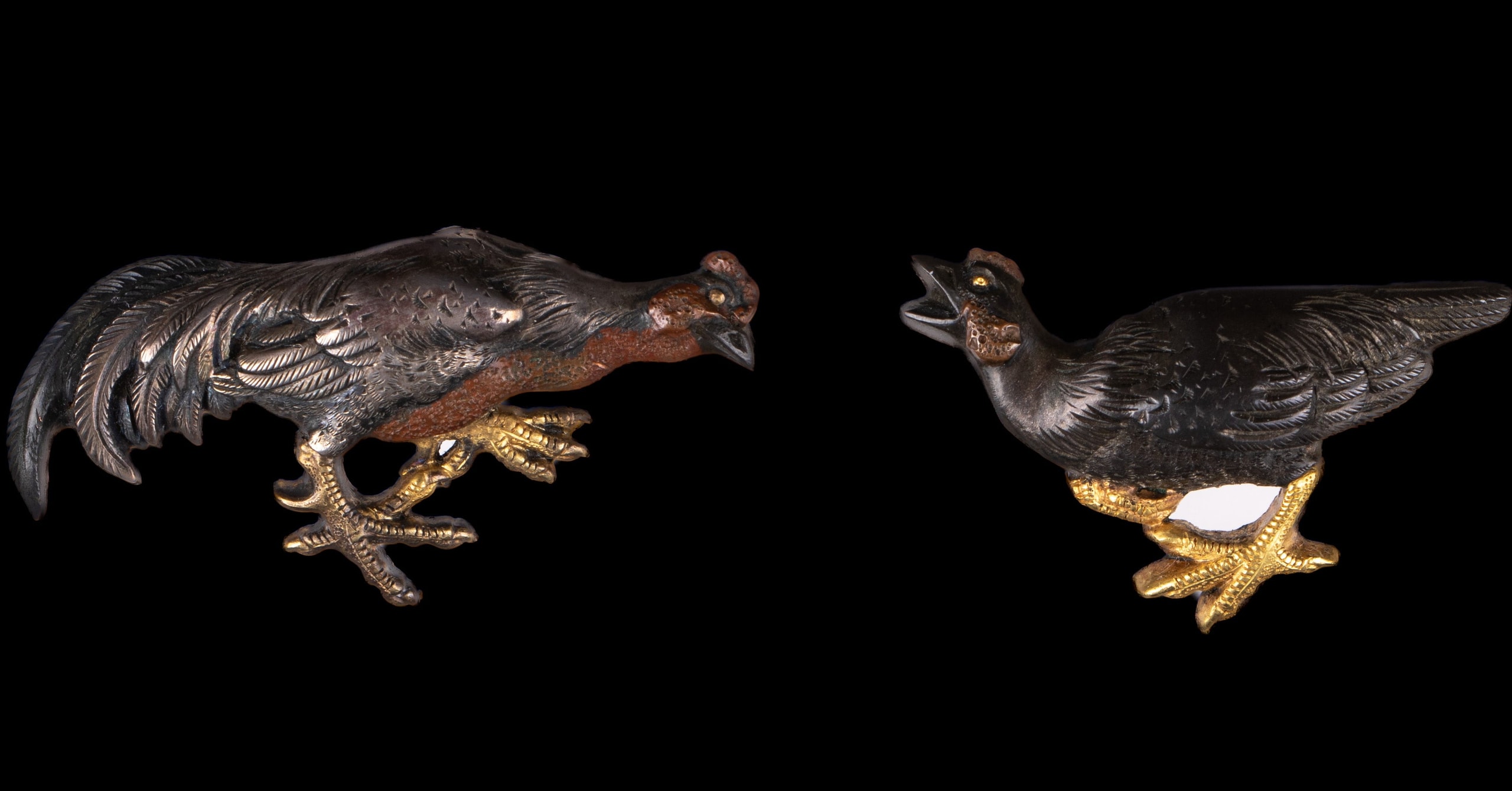
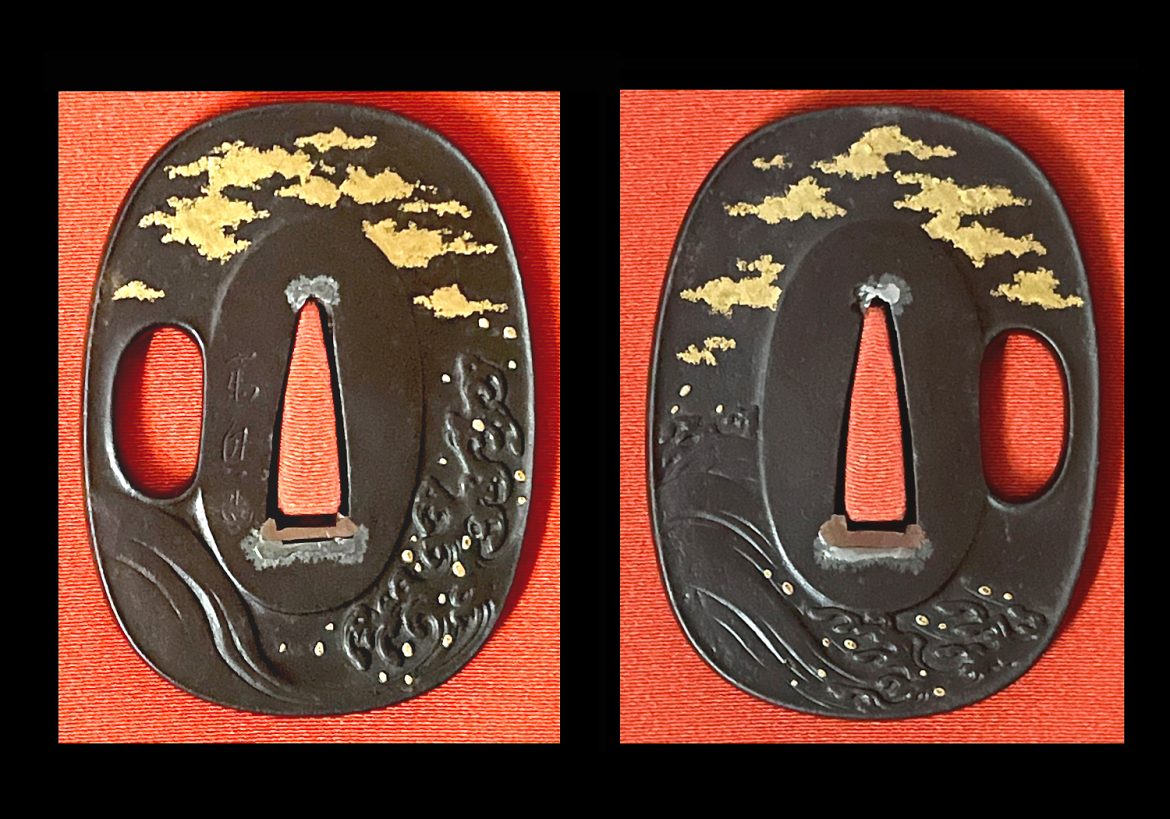
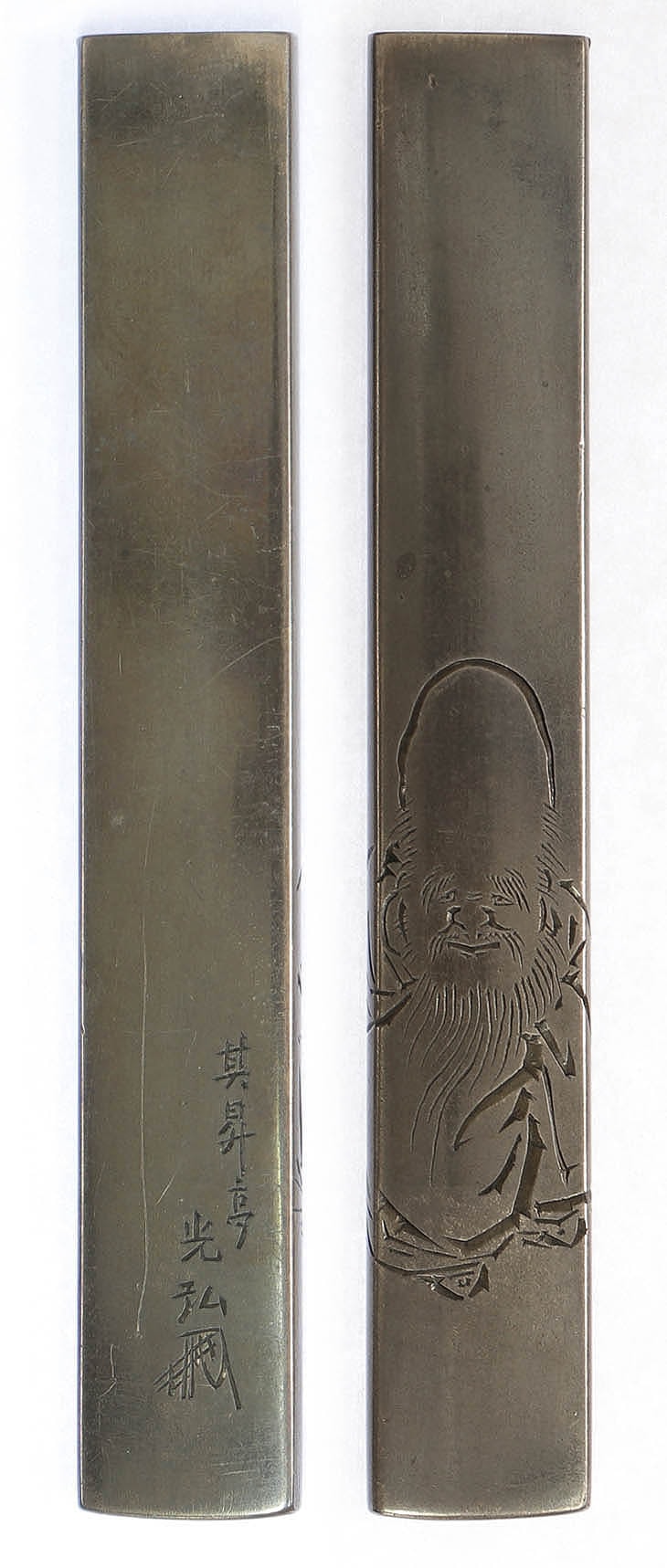
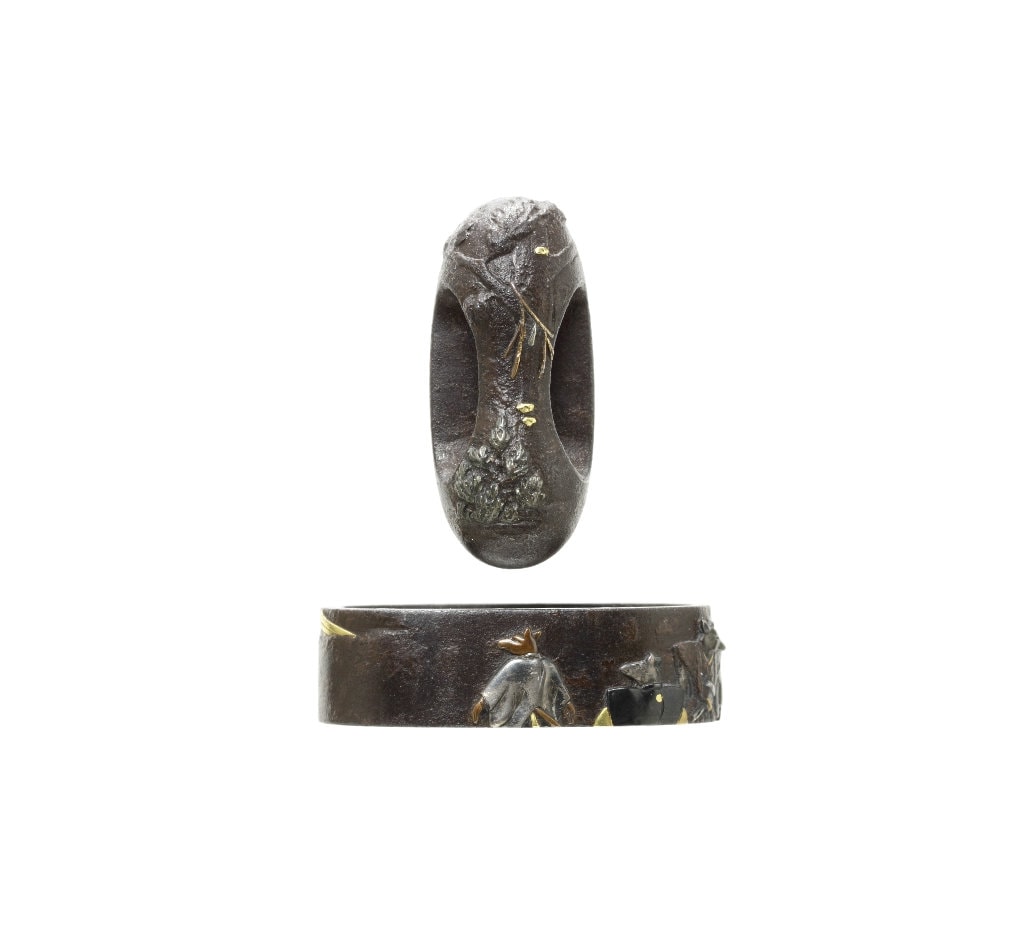
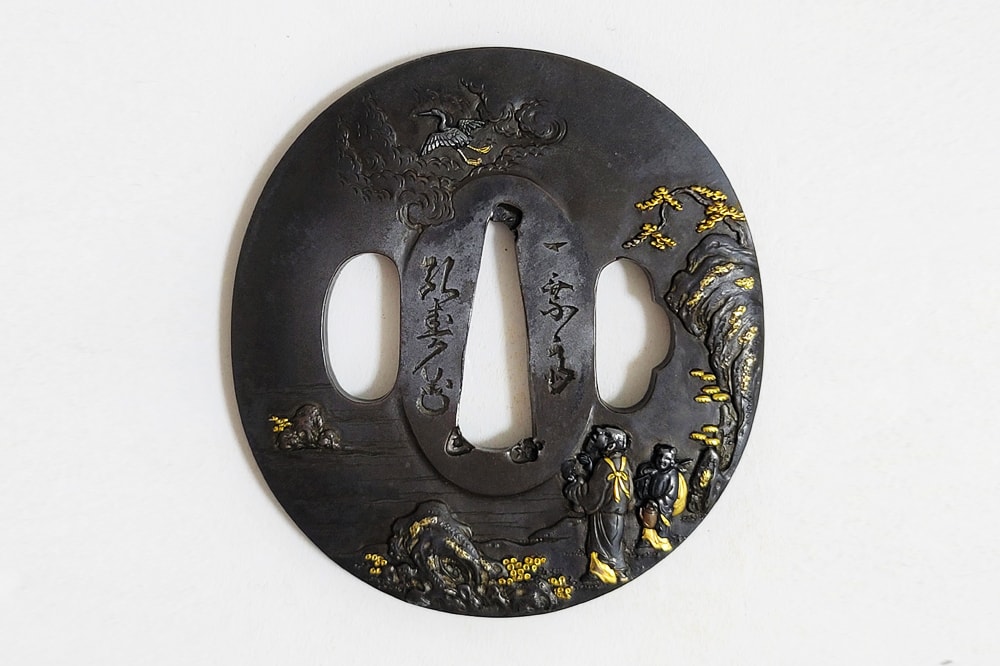
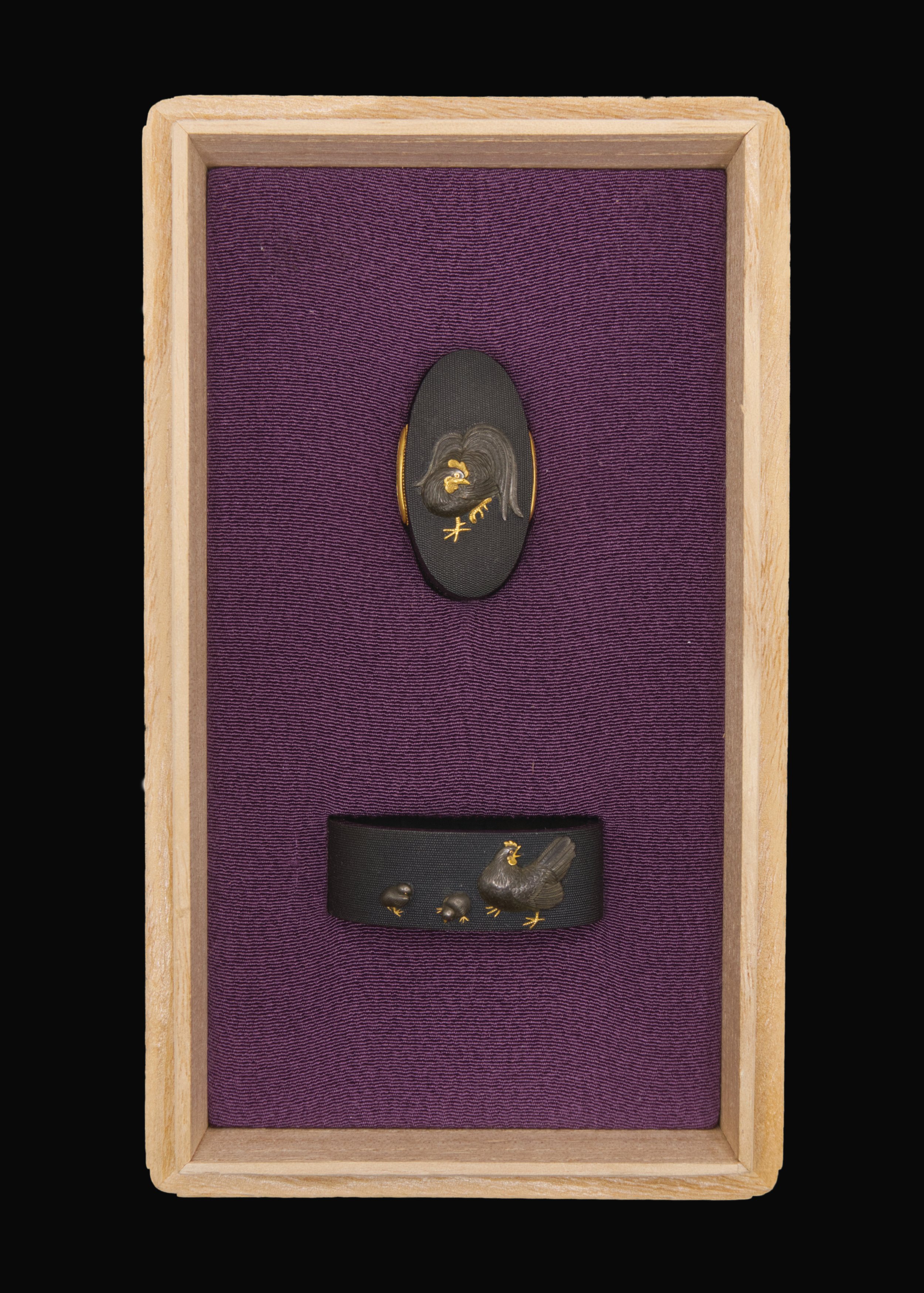
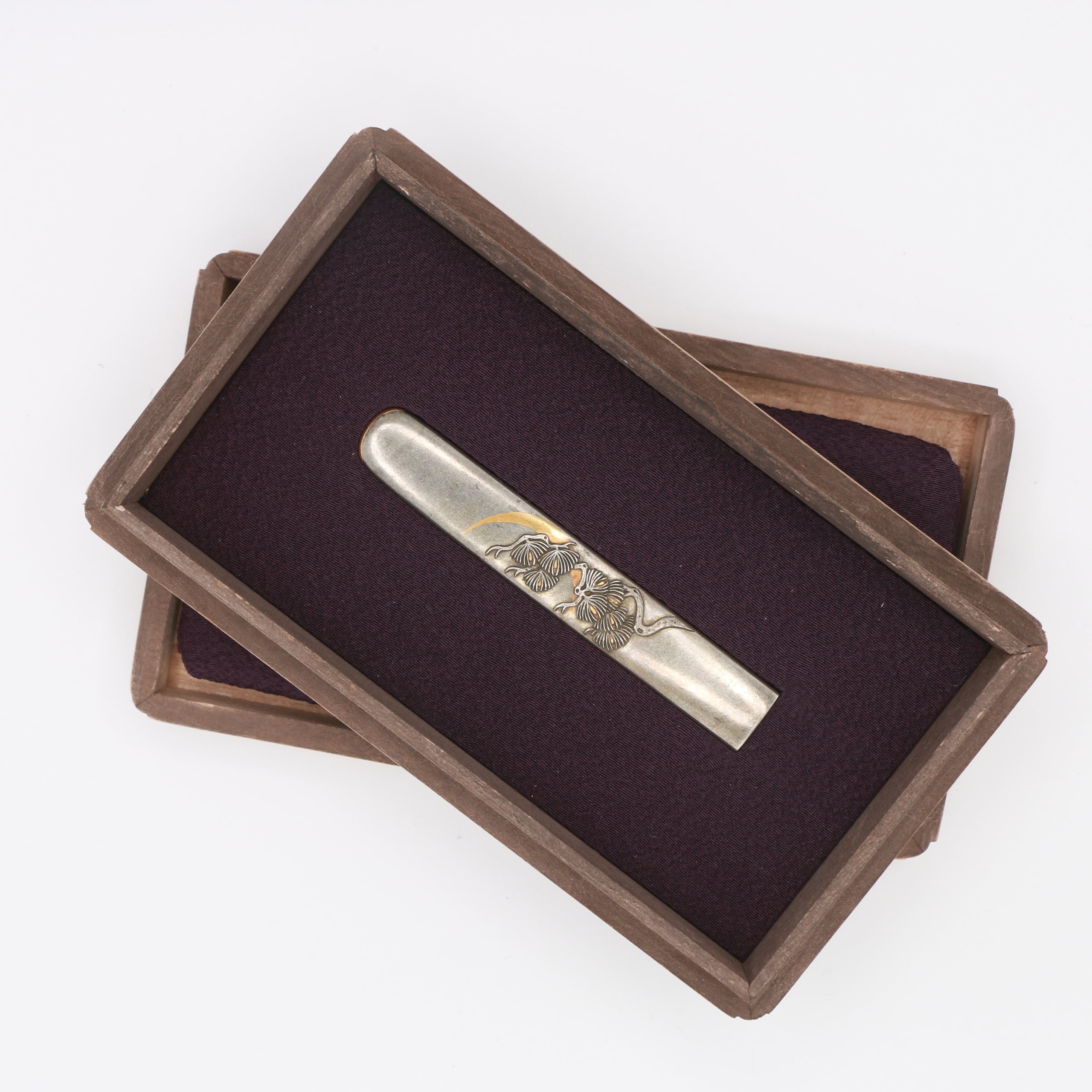
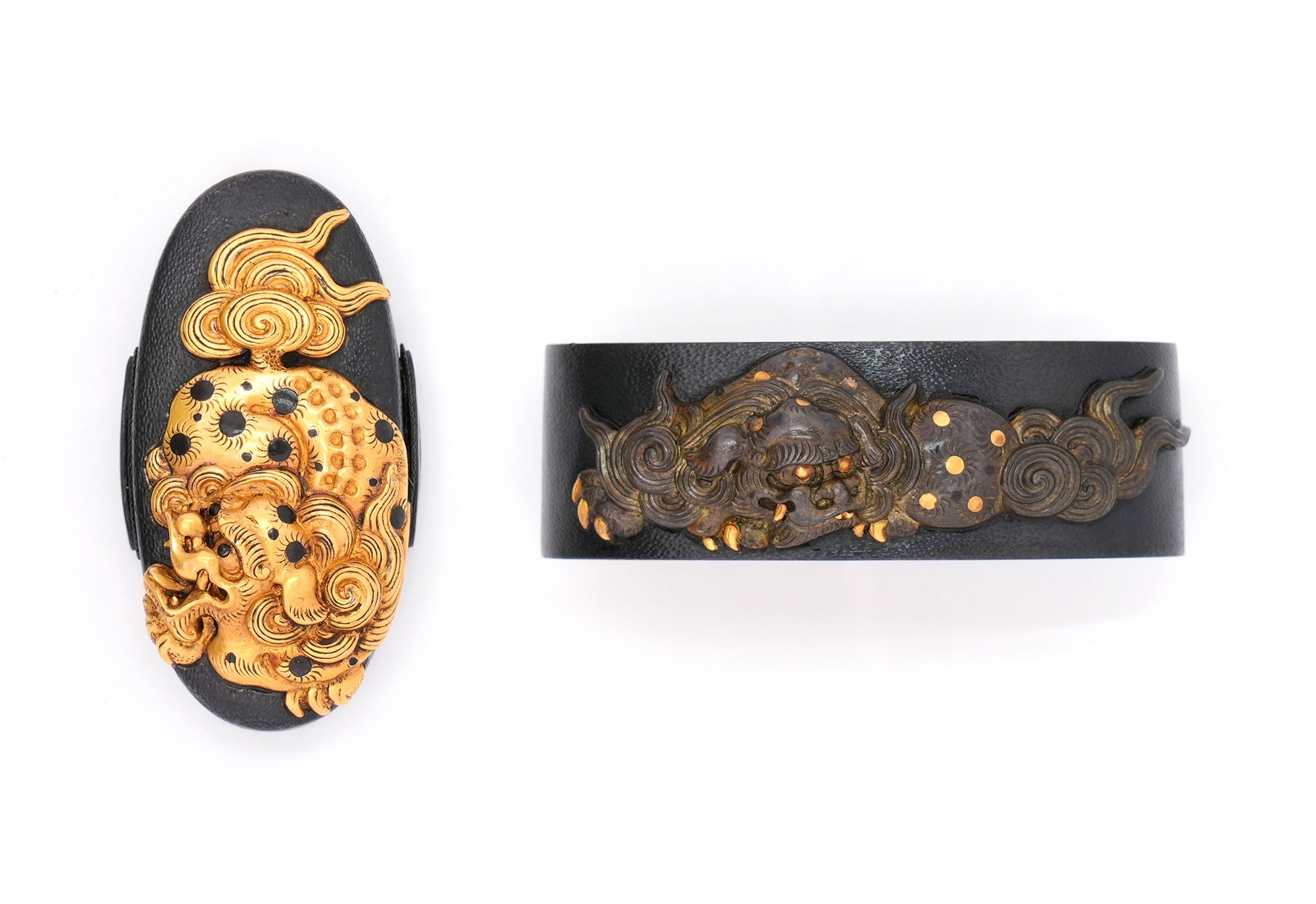
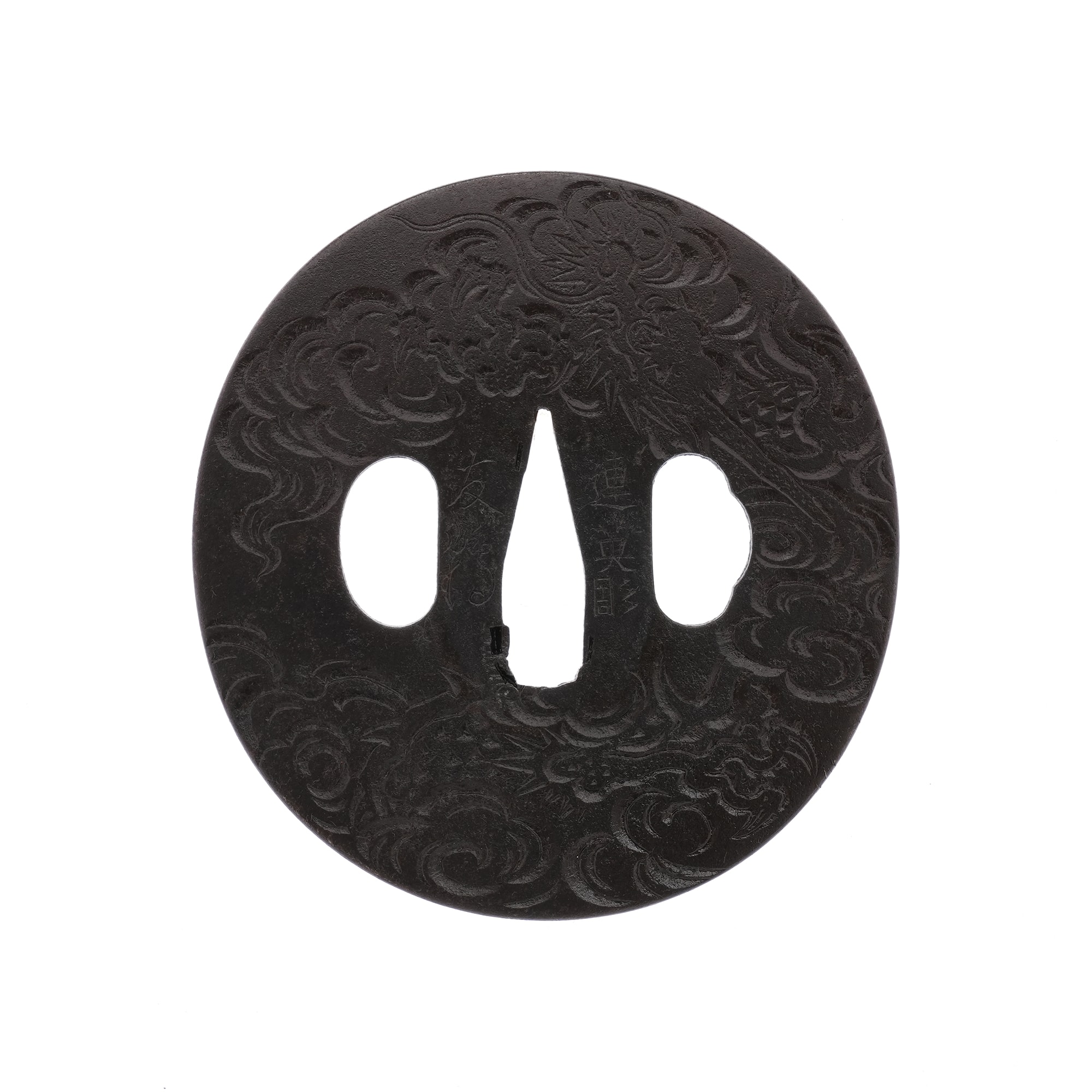
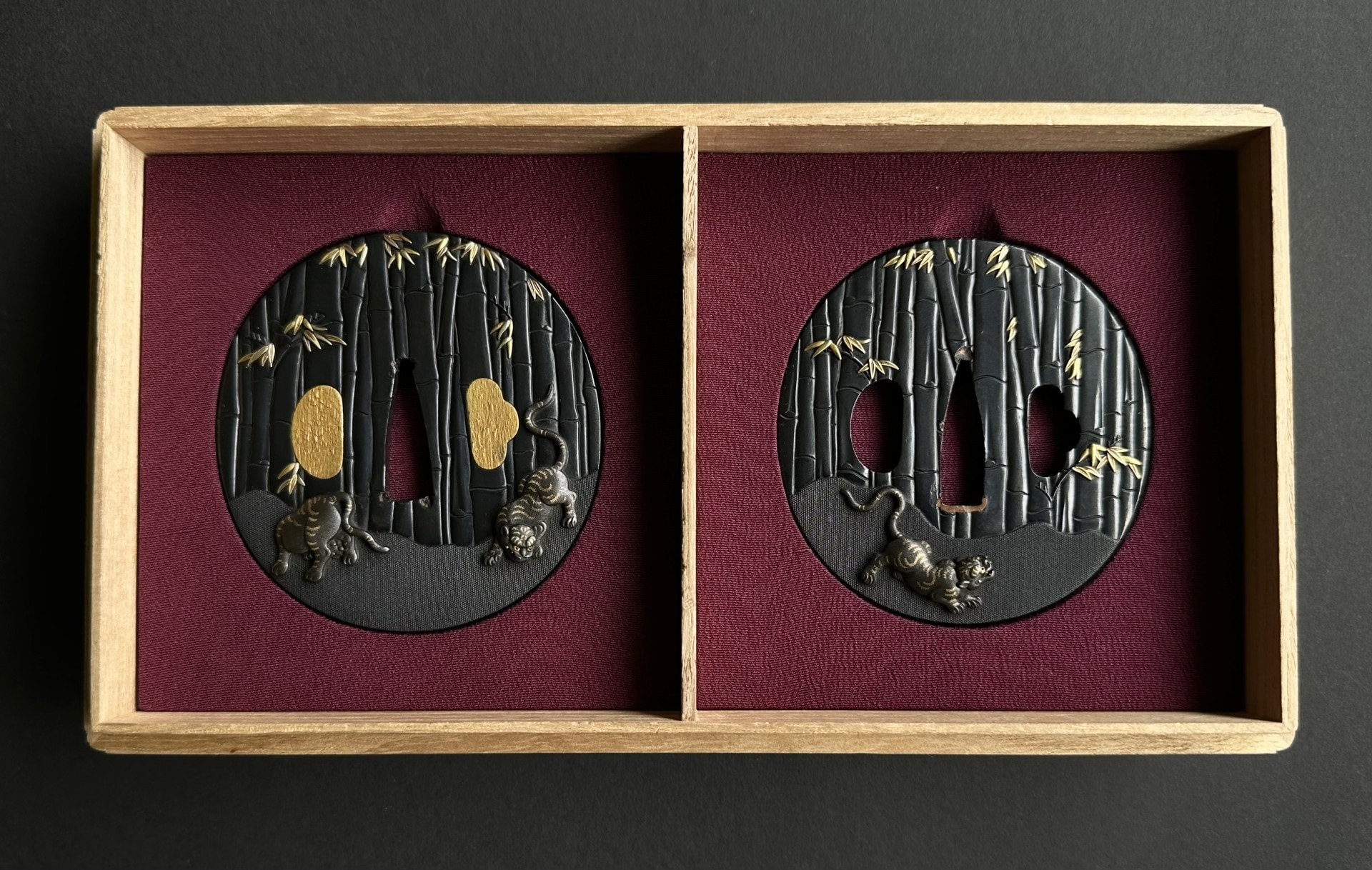
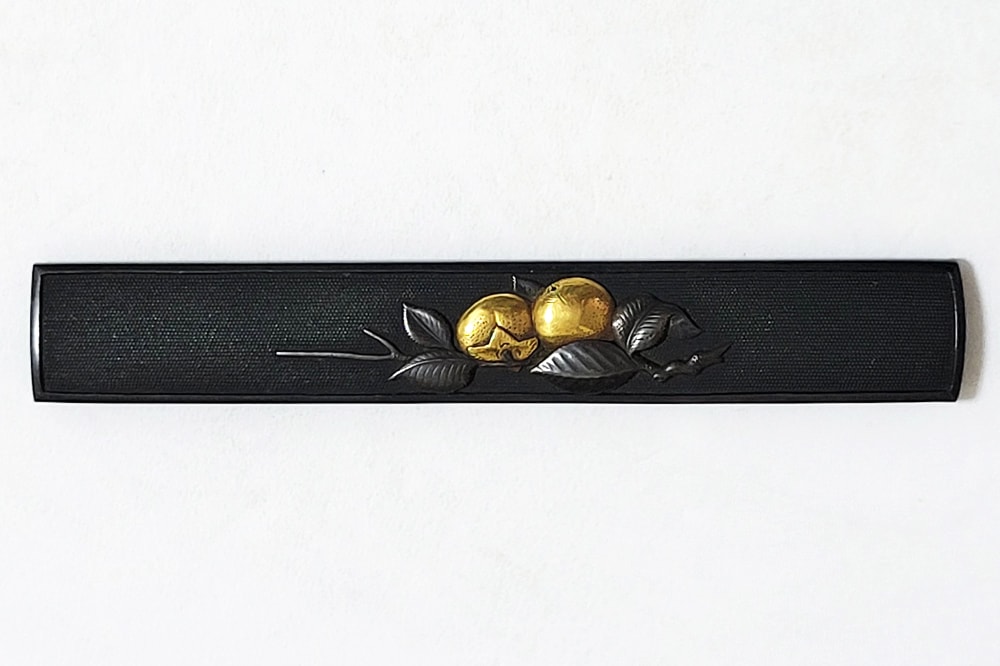
Kawarabayashi Hidekuni, former family name Nakagawa, common name Daizo, was born in Bunsei 8 (1825) in Yonago, Hoki Province. At the age of eighteen he traveled to Kyoto and entered the school of Kawarabayashi Hideoki, the foremost disciple of Otsuki Mitsuoki. He later married Hideoki's second daughter and succeeded the house as its second-generation head. He used the art names Tenkodo and Kinryusai. The consistently identifies him as the metalworker who brought the Otsuki school to its culmination --- "the last notable metalsmith of the Otsuki line" and "the final distinguished master metalworker of the Otsuki line" --- a figure who stood at the terminus of a long and celebrated Kyoto tradition.
Hidekuni particularly excelled in (high-relief carving) executed with skillful deployment of various alloys, and he was also highly proficient in (fine line engraving) and (single-bevel line carving). His subjects range from animals and plants rendered with a strong devotion to direct observation to figures and landscapes, all conveyed with the tasteful charm characteristic of the Otsuki manner. His technical command is evident in unified suites where he freely varies depth and shallowness in smooth high relief across iron, polished , and solid gold grounds, deploying , , and in gold, silver, , and to achieve meticulous polychrome effects --- from the venerable faces of arhats down to each plant, animal, and implement.
The observes that his later works exhibit "an airy and unconventional spirit" emblematic of Mitsuoki's own late production, suggesting an artistic maturation beyond mere technical mastery. His naturalistic rendering of animal subjects is singled out for particular praise: the untamed character captured in the expressions of the eyes and the accomplished fine line-carving of body hair attest to a commitment to sketching from life. Whether composing a Thunder God whose carving conveys "a vivid immediacy that could be called unprecedented" or an elegantly lyrical moonlit shore, Hidekuni's works are recognized as masterpieces in which his technical abilities are fully displayed --- fitting culminations of the Otsuki school's artistic legacy.
Kantei
3 descriptive axes: material (the full soft-metal ground palette of shakudo, shibuichi, suaka, solid gold, silver, gold and ishime grounds, alongside the iron ground his tsuba favour) x technique (high relief and sukidashi relief carried in colour inlay and fully-modelled katachibori, supplemented by katakiri-bori, applied suemon and kebori) x themes (the pictorial Otsuki-manner design, naturalist plants and animals drawn from life with figures and landscapes besides). With a thin corpus of nine pieces his discriminators are scope-tight and register-level, not a personal hand foreign to his school: the records say all his work transmits the Otsuki manner, so the genuine separator from the formal Goto field is the school's naturalist shasei strain, while his own contribution is faithful continuation rather than innovation.
Tenkodo Hidekuni, real name Kawarabayashi Hidekuni (old surname Nakagawa, common name Daizo), was a late- Kyoto metalwork artist whom the records repeatedly call the one who crowns the close (toxbi) of the Otsuki school. He was born in Bunsei 8 (1825) in Yonago in Hoki Province, went up to Kyoto at eighteen and entered the workshop of Kawarabayashi Hideoki, the high pupil of Otsuki Mitsuoki; he later married Hideoki's second daughter and succeeded as the second generation of the Kawarabayashi house. He took the studio-go Tenkodo and Kinryusai. The records say he was skilled above all at high relief worked in a range of colour-metals, and accomplished too in and katakiri-bori; his subjects are naturalist plants and animals drawn from life, with figures and landscapes besides, all of which they say transmit the Otsuki manner (Otsuki-ryu) well, and they note among them the light, witty pieces in the manner of the late Mitsuoki. The records present him as a faithful and excellent continuator of the house style, not the founder of a new one. One record ties him to two leading painters of the modern Kyoto world, Mori Kansai of the Maruyama school and Kono Bairei of the Shijo school, and reads their lush peonies into his peony fittings. Several pieces in this group are co-signed ensemble mountings in which Hidekuni made only part of the set; the foreign names in them are co-makers, not his.
Diagnostic discriminators
drawing-from-life naturalism in plants and animals, which the records make the keynote of his subject matter (his biography says his subjects are naturalist plants and animals worked thoroughly from life), named in seven of the nine records. The Otsuki school inherits the shasei strain of Kyoto kinko, absent (rate 0) from the formal house repertoire of Goto, so it separates the school's work from the formal field; within the Otsuki school it is the house register rather than a tell personal to him, since the records say all his work transmits the Otsuki manner well
Material (grounds)
He works across the full soft-metal palette and iron alike. His are most often worked on a polished iron ground, while his matched sets and fittings use the soft metals: , polished ground, , silver and gold grounds, and solid gold () for the most lavish ; one set of fittings uses a ishime ground. The records single out solid gold and silver grounds on one as an unusually lavish field for so bold a design.
Technique
The records call him skilled above all at high relief worked in a range of colour-metals, and accomplished too in and katakiri-bori. His core hand is high relief and relief finished in colour inlay, with fully-modelled and applied ; he adds katakiri-bori, inlay and fine where the design calls for it, and on the monkey works the fur in fine hair-line carving with colour at the faces and rumps. On iron he carries the relief up in gold and colour inlay.
Themes (pictorial)
His subjects are the pictorial designs of the Otsuki manner, which the records say he transmits well: naturalist plants and animals drawn from life (peony, a fierce tiger on a storm-swept crag, plovers over a drying-net under the moon, geese over waves, a spiny lobster), figures (the arhats described one by one across a matched set), and auspicious devices ( seaweed, scrolling vine, a lion). The records praise his command of subject and the lyrical, painting-like composition he carries onto the small field of the fitting, and note the lighter, witty pieces in the manner of the late Mitsuoki.
Pictorial Otsuki-manner design
Plants, animals, figures and landscapes laid out across the fitting like a painting and worked in high relief with colour inlay, which the records make the Otsuki-school manner he transmits well; on the drying-net-and-plover they call it a lyrical painterly world set onto the sword fitting.
Naturalist shasei (drawing from life)
Plants and animals caught with a naturalist eye, which the records repeatedly tie to the shasei manner: his biography says his subjects are naturalist plants and animals worked thoroughly from life, and the monkeys of the monkey are described carved from life, their wildness caught in the eyes. The Otsuki school inherits the shasei strain of Kyoto kinko, absent from the formal house repertoire of Goto.
Full iconography
Signature chronology
Placement
Recorded signatures
Documentary note
His signature chronology dates and authenticates the work, but in this group it carries little spread: he signs his art name Hidekuni under two studio-go, Tenkodo and Kinryusai, the Tenkodo Hidekuni signature by far the commoner (eight of the nine pieces), often Tenkodo Hidekuni or, on a copied毛抜形 mounting, Tenkodo Hidekuni utsusu-kore with a Bunkyu 3 (1863) date; the Kinryusai Hidekuni signature appears once, on the dragon of one . The bare two characters Hidekuni are split across paired (Hide-) and cut alone on a . The records name him in their prose as Kawarabayashi Hidekuni or Kawarabayashi Kinryusai Hidekuni, family-name forms that do not appear as transcribed signatures. Several pieces here are co-operative or ensemble mountings in which Hidekuni made only part of the set: on one he made the (signed Kinryusai Hidekuni) while Sasayama Ikkosai Tokuoki made the body fittings and Goto Koran the solid-gold ; on one he made the body fittings (signed Tenkodo Hidekuni) while the is signed Kyoryumon, a maker the record itself says is unidentified. A foreign name in the mounting is therefore a co-maker's mark, not Hidekuni's.
Scholarship
One record says he is traditionally said to have associated with Mori Kansai of the Maruyama school and Kono Bairei of the Shijo school, two leading painters of the modern Kyoto world, and reads the lush peonies of those schools into his peony fittings; a hedged reading named in a single record only.
Designations
Kokuhō—
Jūyō Bunkazai—
Jūyō Bijutsuhin—
Gyobutsu—
Tokubetsu Jūyō—
Jūyō Tōken9
Elite Standing
0.07 across 9 designated works
Top 19% among makers
Provenance
1 documented provenance across certified works by Hidekuni
Provenance Standing
0 works held in elite collections across 1 documented provenances