Perry’s arrival in 1853 unraveled the Tokugawa peace and created the first mass demand for working swords in two centuries. Kiyomaro, called the Masamune of Yotsuya, died on its eve; Munetsugu and Yukihide carried the boom to the end.
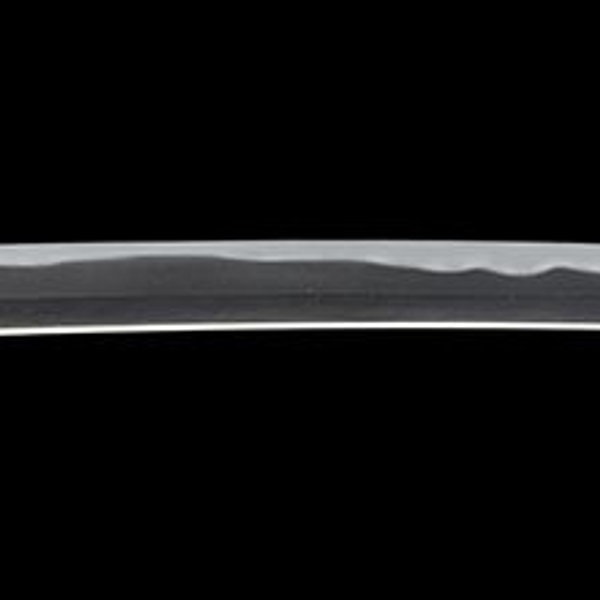
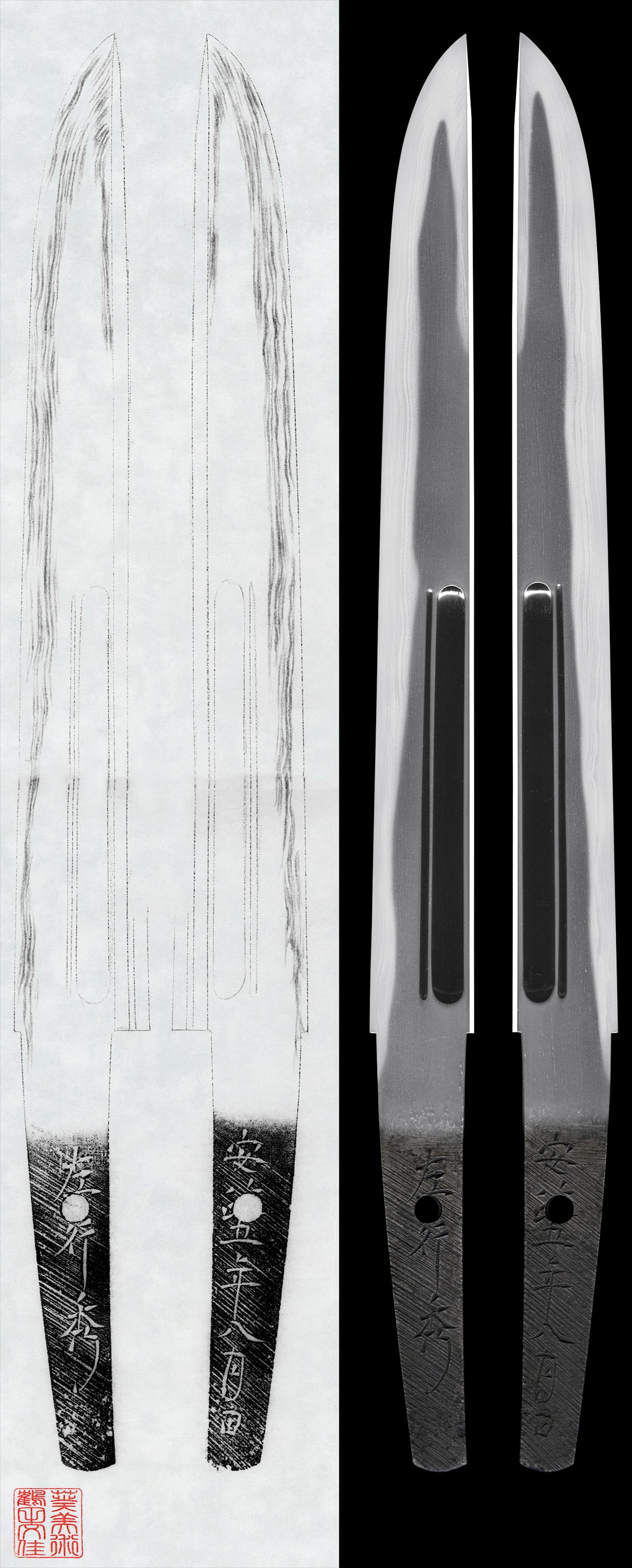
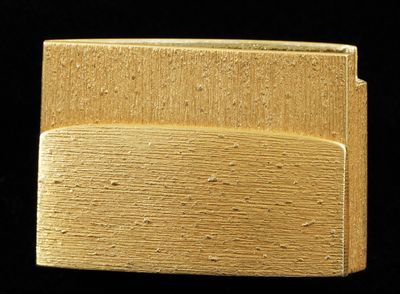
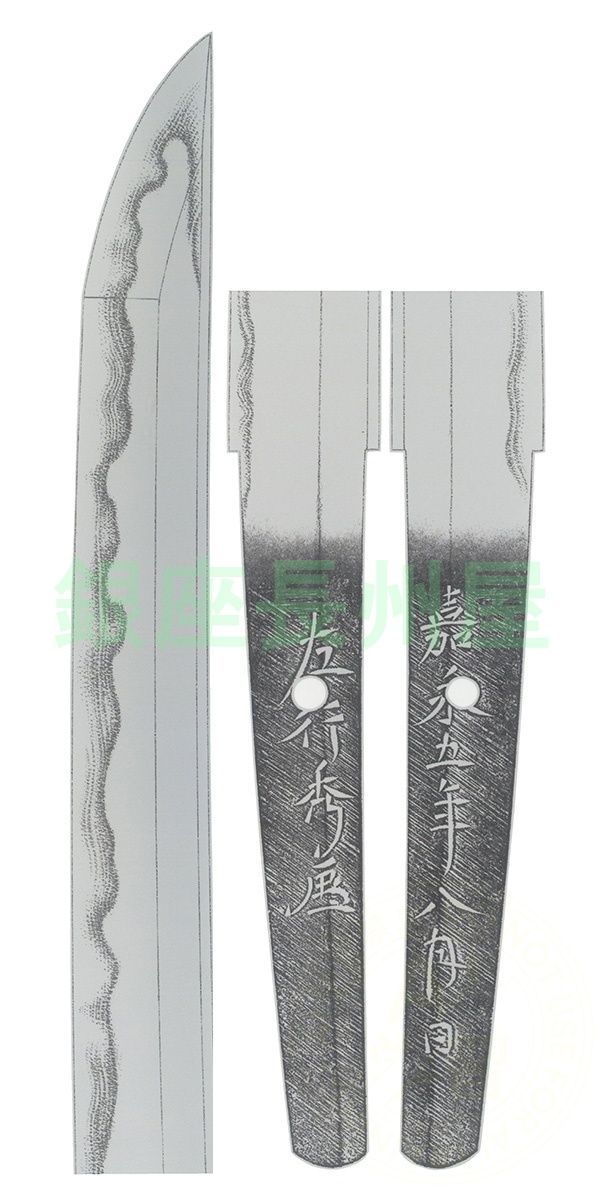
This wakizashi is signed by Sa no Yukihide with a kao, dated Kaei 5 nen (1852), and made in Tosa province when he was 40 years old. It features a powerful construction with a wide body and large kissaki, characteristic of Yukihide's prime period. The jitetsu is well-forged with flowing itame and thick ji-nie, while the hamon is a shallow notare mixed with gunome, becoming more active towards the tip with abundant nie and kinsuji. It comes with a gold-foiled double habaki and shirasaya, and is accompanied by an NBTHK Tokubetsu Hozon certificate.
 NihontoWatch
mei · Bunka–Meiji (1813-1887) · nagasa 47.72cm · sori 0.76cm








Shinshinto · Chikuzen
3 pieces on the market now
Sa Yukihide (左行秀) was born in Bunka 10 (1813) in the Hoshimaru area of Asakura, Kamiza District, Chikuzen Province, the legitimate son of Itō Matabei Morishige. The setsumei record that he styled himself the thirty-ninth-generation successor to the Chikuzen Sa (Samonji) line, and that he carved this claim into the inscriptions of certain blades, which is the source of the Sa name borne by his work. In the early Tenpō era he went up to Edo and studied forging under Shimizu Hisayoshi, a disciple of Hosokawa Masayoshi. In Kōka 3 (1846), at the age of thirty-four, he went down to Tosa on the recommendation of Sekita Shinpei Katsuhiro, a swordsmith in the service of the Tosa domain, and in the tenth month of Ansei 2 (1855) he became an official Tosa domain smith. From the close of Man'en 1 (1860) into the early part of Bunkyū 2 (1862) he again went up to Edo, establishing a residence and forging at the Tosa domain estate at Sunamura in Fukagawa. " His swordmaking concluded in Meiji 3 (1870), and he spent his later years in Yokohama with his heir Ikuma until his death in Meiji 20 (1887), placing the school's production squarely in the mid-nineteenth century shinshintō revival of the Sōshū-den. Across the register, the shared vocabulary is consistent enough to function as a recognition key. The sugata is bold and weighty: a wide mihaba with little taper, thick kasane, frequent funbari, and an ō-kissaki (a slightly more slender, sun-nobi form with an extended chū-kissaki appears in the Tosa and Edo-residence pieces). The kitae is a densely forged ko-itame that often flows toward masame, sometimes predominantly masame, carrying thick fine ji-nie and abundant chikei over notably clear steel. His favored hamon, named repeatedly as the manner he most excelled in, is a chū-suguha or suguha-chō base bearing a shallow notare tendency intermixed with gunome and ko-gunome, with ashi and yō; the nioiguchi is conspicuously deep, nie adheres thickly with occasional coarse grains, and kinsuji, nie-suji, and sunagashi run through a bright, clear edge.
The bōshi is midare-komi or sugu turning back in ko-maru with hakikake. A vigorous gunome-midare in Sōshū-den coloration, understood as aiming toward the manner of Gō Yoshihiro, appears in a daishō katana and in a rare hira-zukuri wakizashi. The nakago is ubu with sujikai kesho-yasuri and bold, deeply cut signatures, frequently raising the place characters "Chikushū" or "Doshū" and recording the forging site or iron used. Beyond the school itself, no pupils are named in these blades; the carver Isogai Yoshitatsu, a disciple of Masayoshi, executed the horimono on the daishō, a fact noted on its tang by Myōchin Ki Muneteru. For kantei, the deep nioiguchi with thick, brilliantly bursting nie over a clear masame-tending ground is the firmest discriminator, with localized tightening of the nioiguchi noted as an appealing departure from his usual breadth. The setsumei single out documentary inscriptions: the place-name "Ōshima-sanroku" recording the forging locale, and his repeated use of Nambu mochi-tetsu iron from the Kamaishi area, a material also employed by Unju Korekazu, Tairyūsai Munenobu, Iwai Masatoshi, and Gassan Sadakazu. The Meiji 3 katana carries the latest confirmed date and shows the shorter, period-marked form of his closing years, distinct from the grand Ka'ei and Ansei works. A fully matched daishō is recorded as exceptionally uncommon. Jūyō-Bijutsuhin pieces in the register were published in Meitō Shūbi, Edo Shintō Meisakushū, Nihontō Taikan, and Kanzan Tōwa. The NBTHK setsumei present Yukihide as a leading hand of the Bakumatsu Sōshū revival, his strongest blades carrying the school's claim to the medieval Sa name into a forceful late-Edo idiom. Learn more →
| Smith | Era | Designated |
|---|---|---|
| Yukihide行秀 | 1813-1887 | 64 |
| Toko東虎 | 1868-1912 | 1 |
Bakumatsu: the last war market
Perry’s arrival in 1853 unraveled the Tokugawa peace and created the first mass demand for working swords in two centuries. Kiyomaro, called the Masamune of Yotsuya, died on its eve; Munetsugu and Yukihide carried the boom to the end.
A Hozon-certified blade judged to show notably superior workmanship and a better state of preservation. The bar is higher: re-tempered blades and most unsigned Muromachi/Edo works are excluded.
The NBTHK (Nihon Bijutsu Tōken Hozon Kyōkai, the Society for the Preservation of Japanese Art Swords) is a public-interest incorporated foundation founded in 1948 and supervised by Japan’s Agency for Cultural Affairs (Bunkachō); it is based at the Japanese Sword Museum in Tokyo. Its expert panels physically examine each submitted work (shinsa) and issue a certificate (kanteishō) ranking it by artistic and historical merit. NBTHK papers are the most widely recognized standard of authentication for Japanese swords and fittings.
NBTHK official siteIf, due to our fault, the item differs significantly from its proper condition, the item may be returned. Cooling-off is within one week of the item's arrival.
¥1,800,000
This wakizashi is signed by Sa no Yukihide with a kao, dated Kaei 5 nen (1852), and made in Tosa province when he was 40 years old. It features a powerful construction with a wide body and large kissaki, characteristic of Yukihide's prime period. The jitetsu is well-forged with flowing itame and thick ji-nie, while the hamon is a shallow notare mixed with gunome, becoming more active towards the tip with abundant nie and kinsuji. It comes with a gold-foiled double habaki and shirasaya, and is accompanied by an NBTHK Tokubetsu Hozon certificate.
NihontoWatchmei · Bunka–Meiji (1813-1887) · nagasa 47.72cm · sori 0.76cm
Shinshinto · Chikuzen
3 pieces on the market now
Sa Yukihide (左行秀) was born in Bunka 10 (1813) in the Hoshimaru area of Asakura, Kamiza District, Chikuzen Province, the legitimate son of Itō Matabei Morishige. The setsumei record that he styled himself the thirty-ninth-generation successor to the Chikuzen Sa (Samonji) line, and that he carved this claim into the inscriptions of certain blades, which is the source of the Sa name borne by his work. In the early Tenpō era he went up to Edo and studied forging under Shimizu Hisayoshi, a disciple of Hosokawa Masayoshi. In Kōka 3 (1846), at the age of thirty-four, he went down to Tosa on the recommendation of Sekita Shinpei Katsuhiro, a swordsmith in the service of the Tosa domain, and in the tenth month of Ansei 2 (1855) he became an official Tosa domain smith. From the close of Man'en 1 (1860) into the early part of Bunkyū 2 (1862) he again went up to Edo, establishing a residence and forging at the Tosa domain estate at Sunamura in Fukagawa. " His swordmaking concluded in Meiji 3 (1870), and he spent his later years in Yokohama with his heir Ikuma until his death in Meiji 20 (1887), placing the school's production squarely in the mid-nineteenth century shinshintō revival of the Sōshū-den. Across the register, the shared vocabulary is consistent enough to function as a recognition key. The sugata is bold and weighty: a wide mihaba with little taper, thick kasane, frequent funbari, and an ō-kissaki (a slightly more slender, sun-nobi form with an extended chū-kissaki appears in the Tosa and Edo-residence pieces). The kitae is a densely forged ko-itame that often flows toward masame, sometimes predominantly masame, carrying thick fine ji-nie and abundant chikei over notably clear steel. His favored hamon, named repeatedly as the manner he most excelled in, is a chū-suguha or suguha-chō base bearing a shallow notare tendency intermixed with gunome and ko-gunome, with ashi and yō; the nioiguchi is conspicuously deep, nie adheres thickly with occasional coarse grains, and kinsuji, nie-suji, and sunagashi run through a bright, clear edge.
The bōshi is midare-komi or sugu turning back in ko-maru with hakikake. A vigorous gunome-midare in Sōshū-den coloration, understood as aiming toward the manner of Gō Yoshihiro, appears in a daishō katana and in a rare hira-zukuri wakizashi. The nakago is ubu with sujikai kesho-yasuri and bold, deeply cut signatures, frequently raising the place characters "Chikushū" or "Doshū" and recording the forging site or iron used. Beyond the school itself, no pupils are named in these blades; the carver Isogai Yoshitatsu, a disciple of Masayoshi, executed the horimono on the daishō, a fact noted on its tang by Myōchin Ki Muneteru. For kantei, the deep nioiguchi with thick, brilliantly bursting nie over a clear masame-tending ground is the firmest discriminator, with localized tightening of the nioiguchi noted as an appealing departure from his usual breadth. The setsumei single out documentary inscriptions: the place-name "Ōshima-sanroku" recording the forging locale, and his repeated use of Nambu mochi-tetsu iron from the Kamaishi area, a material also employed by Unju Korekazu, Tairyūsai Munenobu, Iwai Masatoshi, and Gassan Sadakazu. The Meiji 3 katana carries the latest confirmed date and shows the shorter, period-marked form of his closing years, distinct from the grand Ka'ei and Ansei works. A fully matched daishō is recorded as exceptionally uncommon. Jūyō-Bijutsuhin pieces in the register were published in Meitō Shūbi, Edo Shintō Meisakushū, Nihontō Taikan, and Kanzan Tōwa. The NBTHK setsumei present Yukihide as a leading hand of the Bakumatsu Sōshū revival, his strongest blades carrying the school's claim to the medieval Sa name into a forceful late-Edo idiom. Learn more →
| Smith | Era | Designated |
|---|---|---|
| Yukihide行秀 | 1813-1887 | 64 |
| Toko東虎 | 1868-1912 | 1 |
Bakumatsu: the last war market
Perry’s arrival in 1853 unraveled the Tokugawa peace and created the first mass demand for working swords in two centuries. Kiyomaro, called the Masamune of Yotsuya, died on its eve; Munetsugu and Yukihide carried the boom to the end.
A Hozon-certified blade judged to show notably superior workmanship and a better state of preservation. The bar is higher: re-tempered blades and most unsigned Muromachi/Edo works are excluded.
The NBTHK (Nihon Bijutsu Tōken Hozon Kyōkai, the Society for the Preservation of Japanese Art Swords) is a public-interest incorporated foundation founded in 1948 and supervised by Japan’s Agency for Cultural Affairs (Bunkachō); it is based at the Japanese Sword Museum in Tokyo. Its expert panels physically examine each submitted work (shinsa) and issue a certificate (kanteishō) ranking it by artistic and historical merit. NBTHK papers are the most widely recognized standard of authentication for Japanese swords and fittings.
NBTHK official siteIf, due to our fault, the item differs significantly from its proper condition, the item may be returned. Cooling-off is within one week of the item's arrival.
¥1,800,000