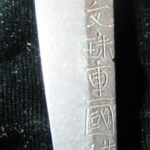
無銘 文珠重国(伝大和志津包友) Monju Shigekuni
¥750,000
Tracked across 81 dealers worldwide · price history · sold archive
Kenmu (1334-1338) ND
Specifications
68 cm
1.1 cm
2.7 cm
1.97 cm
About the school
Monju School文珠派
The setsumei of the **Monju** (文珠) line all gather around a single figure: Shigekuni (重国), the smith better known by the appellation Nanki Shigekuni (南紀重国). The records describe him as originally of Yamato Province and a late offshoot of the Tegai group (*Tegai-ha*), whose common name was Kurōsaburō. During the Keichō era (1596 to 1615) he entered the service of Tokugawa Ieyasu and forged at Sunpu, in present-day Shizuoka; then in Genna 5 (1619), when Ieyasu's tenth son Tokugawa Yorinobu was transferred to Kii Wakayama, Shigekuni accompanied him and settled at the foot of Mt. Meikō (also read Myōkō). The *mei* themselves carry the school name: one *wakizashi* is signed "Kishū Meikōzan Monju Kurōsaburō Shigekuni," fixing the Monju appellation to this Kii workshop. The corpus belongs almost wholly to the Momoyama and early Edo (*shintō*) period, with dated works ranging across Genna 7 and 8 (1621 to 1622). One Gyōbutsu entry raises the question of a smith named Kunimune, a close relative who remained at Sunpu, and a later setsumei speaks of a "second generation onward," so the records permit a Monju succession without resolving its members. A shared technical vocabulary runs through every blade, and the setsumei consistently divide Shigekuni's hand into two modes. The forging is a flowing *itame-hada*, mixed with *mokume* and inclined to *masame* and *nagare*, tending to stand (*hada-dachi*), with thick *ji-nie* and frequent *chikei* over a bright, clear steel. In the *Sōshū-den* mode the temper is a *midareba* of *ko-notare* mixed with *gunome*, angular and *yahazu*-like elements, deep *nioi*, strong *nie* that breaks down into *nie-kuzure*, and conspicuous *kinsuji* and *sunagashi*; the records read this manner as a private study of the high Sagami masters, naming Gō Yoshihiro above all, with Masamune and Sadamune also invoked. In the *Yamato-den* mode the temper is a *suguha*, at times shallow *notare*, carrying *hotsure*, *kuichigai-ba*, and *nijūba* along the *habuchi*, which the setsumei tie directly to the Tegai inheritance and the manner of Kanenaga. The *bōshi* across both modes turns *yakizume* or *ko-maru* with vigorous *hakikake*; *hira-zukuri* and *shōbu-zukuri* *wakizashi* show pronounced *sakizori*, often carved with *bonji*, *suken*, and *naginata-hi*. The records present these as two facets of one hand rather than competing lineages. For kantei, the setsumei name several recurring markers: the bright, clear quality of both *ji* and *ha* held up as Shigekuni's hallmark, the pronounced *sakizori* of his *hira-* and *shōbu-zukuri* *wakizashi*, *kinsuji* that coil into a whirlpool configuration within the temper, and the large original *mekugi-ana* met among Kii-domain works. One Sōshū-den *katana* is judged close in character to Batetsu (馬徹) and treated as a likely model for that smith, raising its documentary weight; another work's "Monju-style" *midare* is said to anticipate the *hadori* tendencies of the second generation. The blades carry firm provenance: a *wakizashi* made to the command of Matsudaira Shima no Kami Shigenari, a piece commissioned by the domain elder Kageyama Tosa-no-kami Munenobu, and a sword inscribed for Yorinobu's retainer Tsuzuki Tōichi, alongside a *katana* held in the Imperial collection. The setsumei note that nearly all of Shigekuni's Sōshū-den blades survive *suriage*, so the *ubu* examples gathered here are repeatedly singled out as research material. Across the records the Monju name stands as the Kii continuation of a Yamato root, carried into the *shintō* age in the service of the Kii Tokugawa house.
![刀 陸奥守包保 保存刀剣鑑定書 脇指 陸奥守包保 特別保存刀剣鑑定書 Katana(Mutsuno-kami Kaneyasu)] Wakizashi(Mutsuno-kami Kaneyasu)](/_next/image?url=https%3A%2F%2Fitbhfhyptogxcjbjfzwx.supabase.co%2Fstorage%2Fv1%2Fobject%2Fpublic%2Flisting-images%2Ftoyuukai%2FL399015%2F00.jpg&w=2560&q=90)
![陸奥守包保 特別保存刀剣鑑定書 Wakizashi(Mutsuno-kami Kaneyasu)[NBTHK:Tokubetsu Hozon] 品番:WA015](/_next/image?url=https%3A%2F%2Fitbhfhyptogxcjbjfzwx.supabase.co%2Fstorage%2Fv1%2Fobject%2Fpublic%2Flisting-images%2Ftoyuukai%2FL398976%2F00.webp&w=2560&q=90)
![脇指 於南紀重国造之 最上作 特別保存刀剣鑑定書 Wakizashi(oite Nanki Shigekuni tsukuri-kore) [NBTHK:Tokubetsu Hozon]品番:WA022](/_next/image?url=https%3A%2F%2Fitbhfhyptogxcjbjfzwx.supabase.co%2Fstorage%2Fv1%2Fobject%2Fpublic%2Flisting-images%2Ftoyuukai%2FL398901%2F00.jpg&w=2560&q=90)