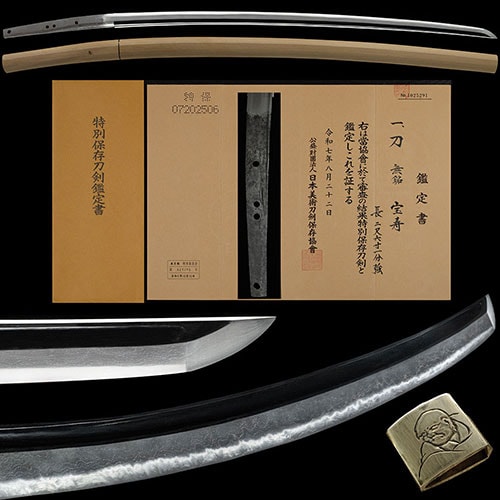
無銘 宝寿(後代)(南北朝) Hoju
SOLD
Tracked across 81 dealers worldwide · price history · sold archive
Heian
Specifications
66 cm
1.3 cm
2.77 cm
1.42 cm
About the school
Hoju School宝寿派
Among the swordsmiths said by old transmitted records to have worked in *Ōshū* (Mutsu and the wider northeast) from the Nara and Heian periods through the Kamakura age, the setsumei repeatedly observe that, of works actually surviving today, almost the only name that can be confirmed is **Hōju** (宝寿). The line is set within the *Maikusa* (Mokusa) sphere of Ōshū smiths, a group transmitted from the early Kamakura period onward; one tachi is described as a branch of the Maikusa smiths of Mutsu, and a Nanbokuchō entry pairs Hōju with Maikusa and, after Nanbokuchō, the Gassan group. The name itself was carried across a long span, from Kamakura through Nanbokuchō and into the Muromachi *Ōei* era, so that "Hōju" denotes a lineage rather than a single hand. A complicating thread runs through the corpus: one blade dated **Enkyō** 4 (1311) is signed *Yamato-kuni-jū Tōmoto Hōju*, raising the question of movement between Ōshū and Yamato, with the setsumei suggesting exchange of smiths through *Shugendō* mountain practice. Dated survivors anchor the chronology firmly, with inscriptions of **Shōchū** 2 (1325), **Eiwa** 2 (1376), **Eitoku** 2 (1382), and a run of *Ōei* years (5, 6, 12, 14, 22, 25). The shared hand the setsumei describe is an archaic northern one. The forging is *itame* mixed with *mokume* and *nagare-hada*, frequently with *ō-itame*, the grain standing up (*hada-dachi*) and at times an *ayasugi*-like or, near the edge, *masame* tendency; thick *ji-nie* gathers and bold *chikei* enter, the steel inclining to a blackish tone with a whitish cast, and *shirake-utsuri* rising in the ground. The temper is built on *suguha* and *suguha-chō* passing into *ko-midare*, or a shallow *notare* joined with *ko-gunome* and *ko-notare*; the *habuchi* shows frequent *hotsure*, *kinsuji* and *sunagashi* run vigorously, and a *yaki-otoshi* often drops the hardened edge at the *machi*. The *nioiguchi* tends to *shizumi* and *urumi*, subdued and moist rather than bright, though certain pieces run brighter. The *bōshi* enters *midare-komi* or *yakizume* with *hakikake*, and the carvings, *bonji* over a *sankō-tsuka-ken*, are rustic yet carry an elegant taste. To recognize the hand, read the standing large-grained *hada*, the dark steel with whitish *utsuri*, and the quiet *nioiguchi*, set against the heroic *koshizori* tachi form. For kantei, the diagnostic cluster is the combination of standing *ō-itame* with bold *chikei*, blackish steel under whitish *utsuri*, *yaki-otoshi* at the base, and the subdued *nioiguchi* with *hotsure*, *kinsuji*, and *sunagashi*, the whole carrying a frankly provincial character that the setsumei treat as the lineage's signature. Signature study is itself a kantei tool: the two-character *Hōju* mei of the Eitoku-era Imperial Household tachi is read against an *orikaeshi-mei* example dated Eitoku, certified an Important Art Object, to date later works by the same chisel. Named survivors map the standing: two signed tachi in the Imperial collection, the *kinzōgan-mei* katana carrying a Hon'ami Kōchū *origami* of Kyōhō 7 (1722), the Shōchū 2 tachi held by Mitake Shrine, and an *ubu mumei* ōdachi transmitted as a hereditary treasure of the Murakami, the maritime warriors of the Seto Inland Sea. *Ubu*, signed, and dated Hōju, especially those not descending past early Nanbokuchō, the setsumei prize as reference material for an Ōshū tradition otherwise known largely through this one enduring name.