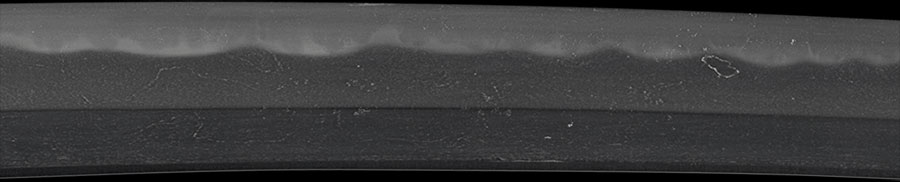
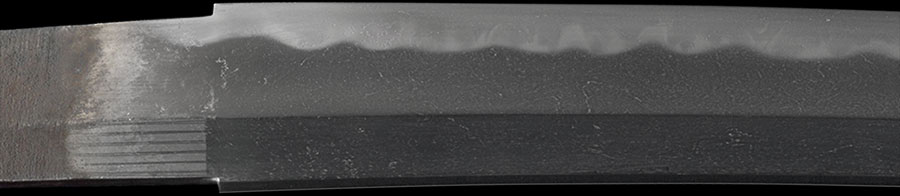
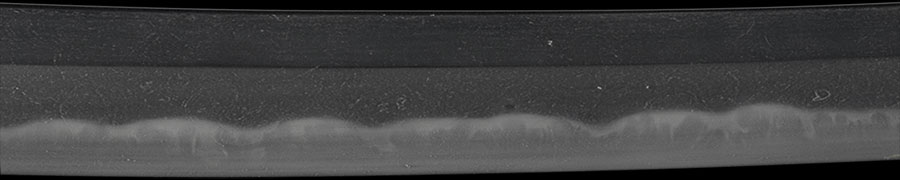
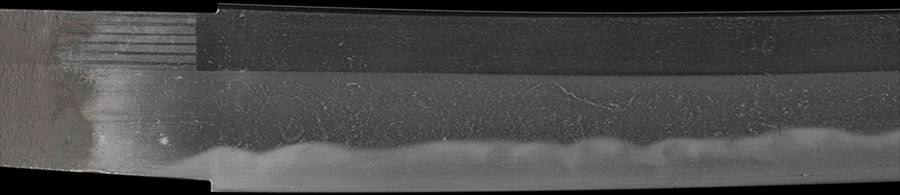
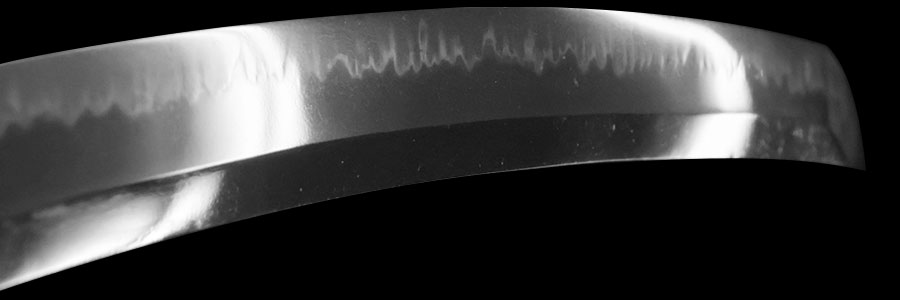
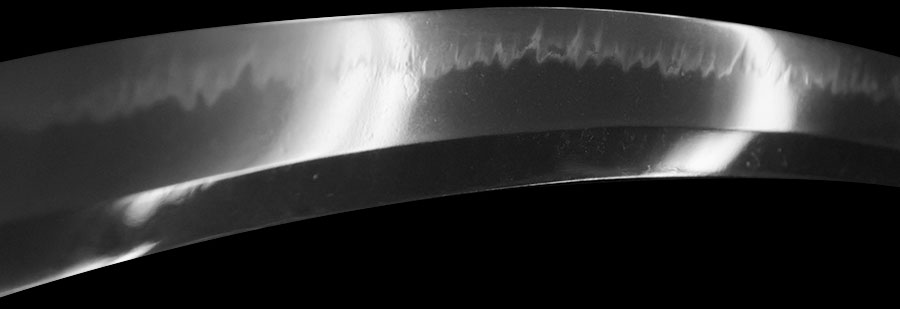
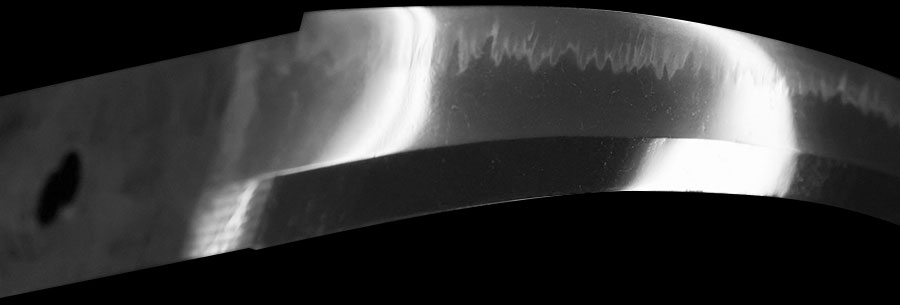
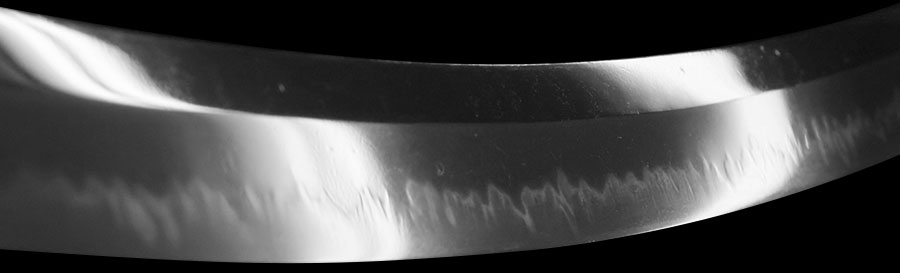
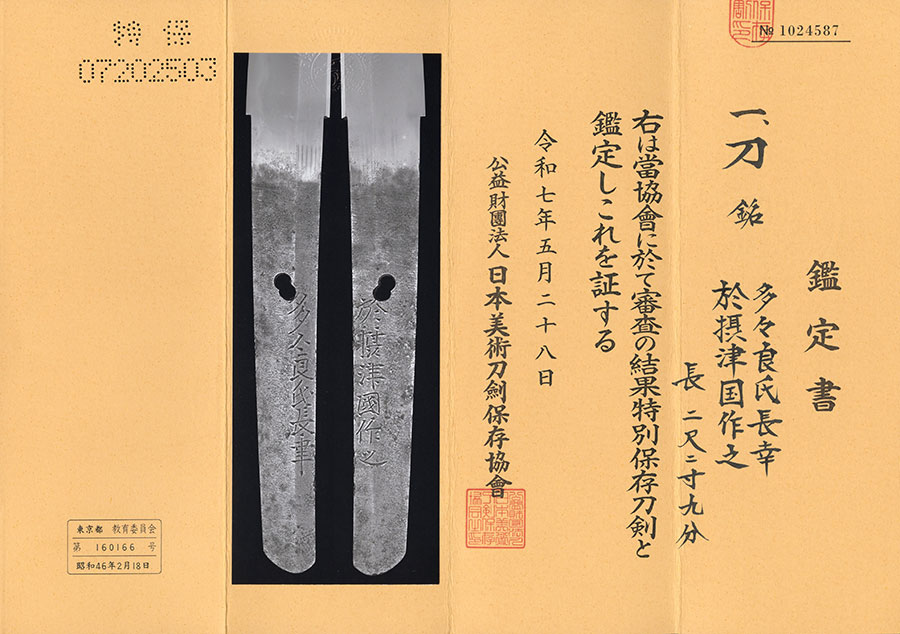
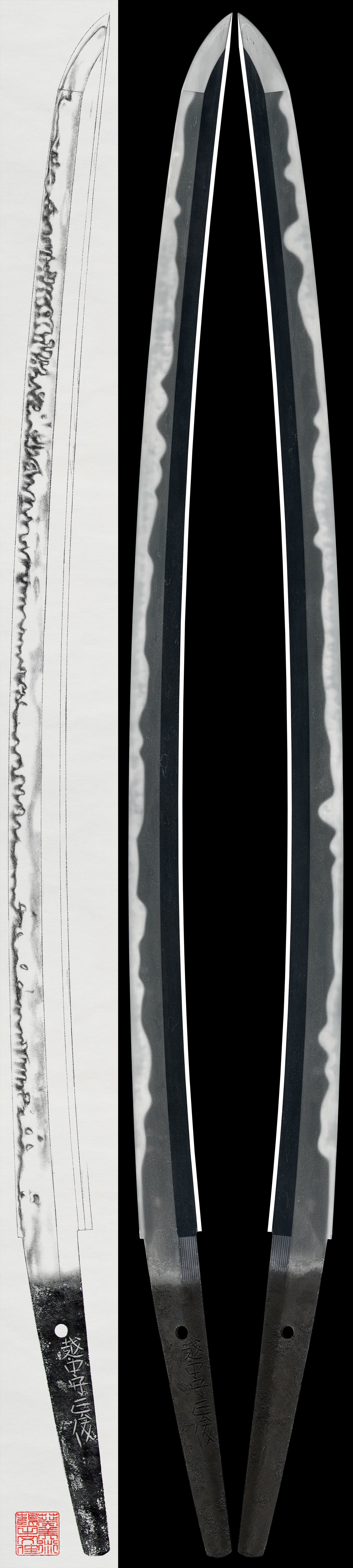
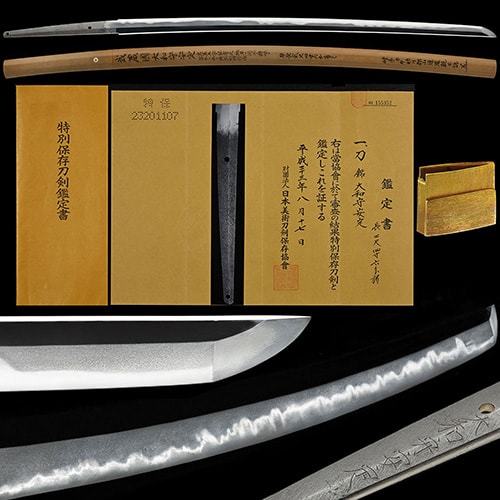
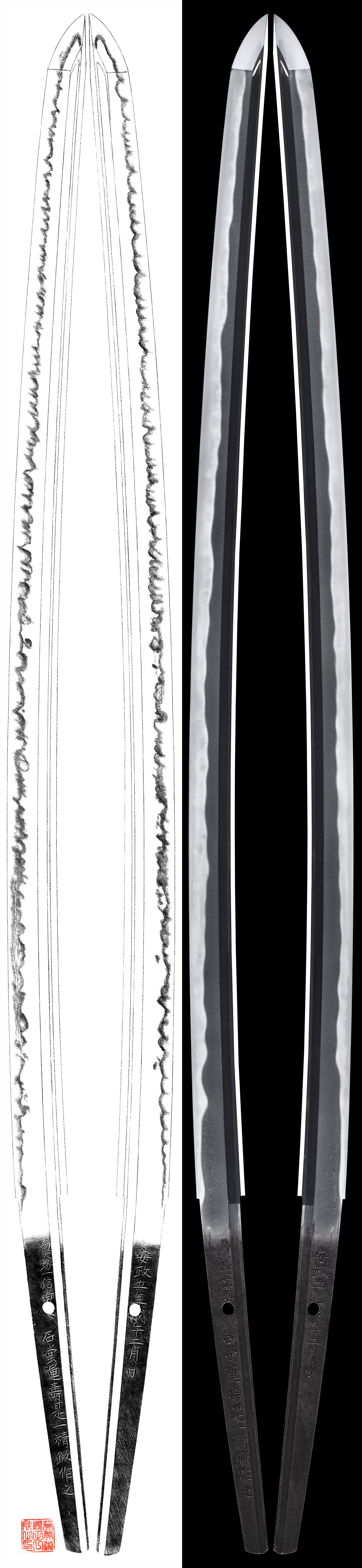
A katana signed in full Tatara Nagayuki and dated Jōkyō 4 (1687), inscribed on the reverse that it was forged with nanban-tetsu, is the kind of blade by which this Osaka master is known: a wide, robust body, a fine ko-itame jigane over which a clear midare-utsuri stands, and a chōji temper that revives the old Bizen Ichimonji in the Shintō age. The published sources record Nagayuki as a native of Kishū who styled himself Shirōbei, became a disciple of Kawachi no Kami Yasunaga of the Kishū Ishidō line, and moved with that vein to Osaka, where he took the name Osaka Ishidō and was active in the Tenna and Jōkyō years of the late seventeenth century. They describe him as a craftsman 「師に優る技量の持主」[[c:1]], one whose skill surpassed that of his teacher, and rank him the foremost maker of the Bizen tradition among Shintō smiths, 「新刀の備前伝中の第一人者」[[c:2]]. Dated work by him is exceedingly rare, only Tenna and Jōkyō years surviving, so a dated piece is treated as precious documentary material for the study of his career.
The hand for which Nagayuki is named is the Ichimonji-aim, which the published sources call the Ishidō school's hereditary art, 「石堂派本来の御家芸ともいうべき一文字」[[c:3]]. On a wide, lofty katana he tempers a flamboyant chōji-midare in which ō-chōji is mixed with ko-chōji and pointed togariba, with ashi and yō entering vigorously and juka-chōji-style double clusters appearing in places. The nioiguchi is tight and bright, with ko-nie added and small tobiyaki interspersed, and on the longest blades the chōji is fired tall and grand without being overwhelmed by the imposing form. The opposite pole of his work takes Sue-Bizen as its model: a koshi-no-hiraita gunome carried as the principal theme, into which a compound fukushiki manner is woven, what the older commentary names 「いわゆる蟹爪風の複式互の目」[[c:4]], the so-called crab-claw compound gunome. The published sources read this vein as taken chiefly from Yosozaemon Sukesada, and note that one chōji-led example may instead have looked to Katsumitsu, the Sue-Bizen smith in whom clove stands out most conspicuously.
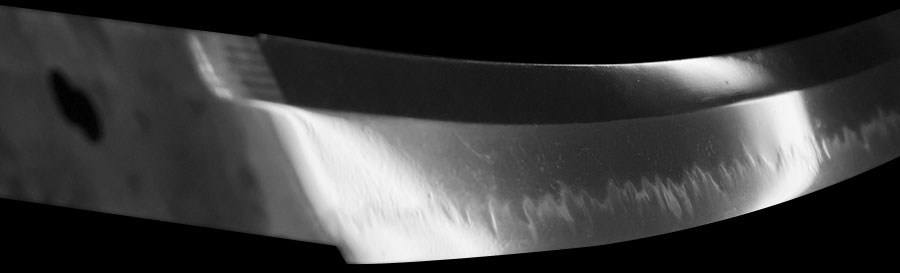
The jigane beneath both manners is the foundation of his standing. Nagayuki forges a fine ko-itame, at times mixing mokume or a flowing nagare-hada near the shinogi, with dust-fine ji-nie adhering thickly and fine chikei entering, and over it a clear midare-utsuri stands. This Bizen-revival reflection is rare among the Osaka smiths and is the feature the published sources warn makes his work 「時代を古く見あやまり易い」[[c:5]], easy to mistake for an older Bizen date, the masame in the shinogi-ji and a comparatively unpolished bōshi being the points by which the Shintō hand is told. Within the temper run ashi and yō, ko-nie and fine sunagashi, with small kinsuji and stray yubashiri in places, the nioiguchi tightening and clearing. The bōshi closes in midare-komi, the tip turning pointed and returning deeply or long, a feature the published sources name as consistent through his work and the personal mark that separates his revival from the Ichimonji and Sue-Bizen models he copies.
The two manners are not periods but choices the same hand makes, and the published sources draw them as a single 二様, two types under one craftsman. On the Sue-Bizen side his copying reaches beyond the temper to the bearing of the model, the short, somewhat stubby length with sakizori, so that the sugata too follows Sue-Bizen, and one wide ō-kissaki katana with a gold-inlaid cutting-test inscription is read as a faithful Yosozaemon Sukesada copy even in its silhouette. On the Ichimonji side the chōji is read as a personal devotion to Bizen Ichimonji, the shisuku of an ideal rather than a school inheritance worn lightly. His surviving production is concentrated in robust, wide katana, signed in long-mei, several carrying added inscriptions that the steel was nanban-tetsu or chigusa-tetsu, the latter a Harima iron the published sources explain he obtained through the Osaka iron wholesalers, a detail that opens a window onto the iron trade of his day. A matched daishō, both blades dated Jōkyō 3 and inscribed as forged with chigusa-tetsu, survives as well, exceptionally rare among his dated work and thought to have been a special commission.
What sets Nagayuki apart within the Ishidō family, spread across Kishū, Osaka, Edo and Fukuoka, is the completeness of his Bizen revival, the published sources singling him out as 「新刀中備前伝作家の第一人者」[[c:6]]. The Ishidō schools carried the Bizen Ichimonji tradition transplanted into Shintō centers, and the clove temper was their house art, but Nagayuki is the hand that reproduced jigane, temper and form together, the midare-utsuri standing as convincingly as the chōji is florid. His finest Ichimonji-aim katana are called works in which 「長幸の本領が遺憾なく発揮された一作」[[c:7]], his true strengths fully manifested, and the best of his Sukesada copies are read as faithful down to the silhouette. The pointed, deep-returning bōshi and the tight, bright nioiguchi remain his own throughout, the steady undertone beneath whichever Bizen model he sets out to recover.
For the collector Nagayuki is graded Jō-jō saku by Fujishiro, and his work has no National Treasures or Important Cultural Properties; the designated record runs instead through two Tokubetsu Jūyō katana and a body of Jūyō blades, ten in the Tokubetsu Jūyō and Jūyō tiers among the pieces here. Provenance is thin but real, the recorded name being General Tani Tateki, the Meiji military figure and noted sword enthusiast whose collection held more than one of his katana, recorded in red lacquer and as a former holding. Most designated blades by him are held rather than traded, and a robust dated example carries enough scholarly weight that it is treated as study material first, so one reaching the market is uncommon, a landmark for a private collector when it does. The published sources call his masterworks 「同工屈指の名品」, among the finest of his production, the high point of the Shintō Bizen revival set down by a Kishū smith who carried the Ichimonji and Sukesada into the swords of early-Edo Osaka.