NihontoWatch MonNihontoWatch
Market
Encyclopedia
Kantei
NihontoWatch MonNihontoWatch
Market
Encyclopedia
Kantei

Description

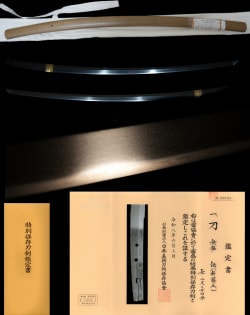
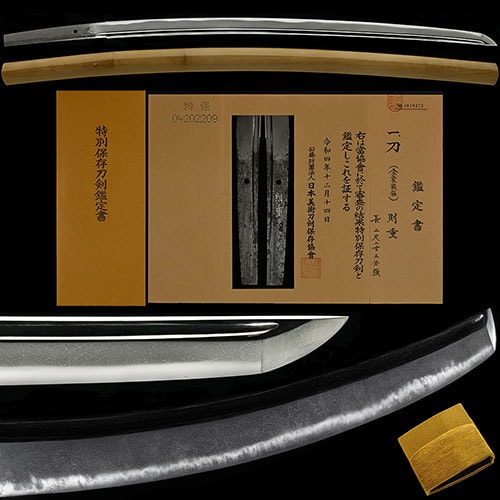
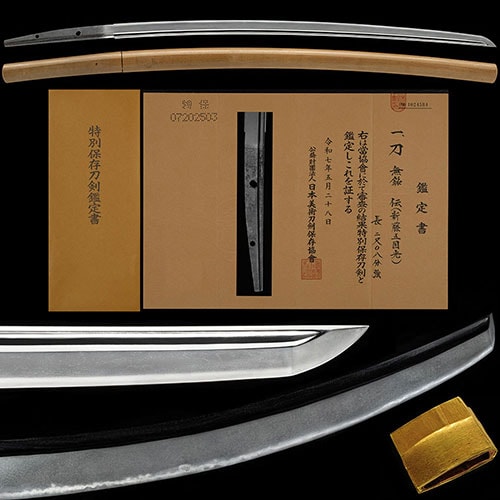
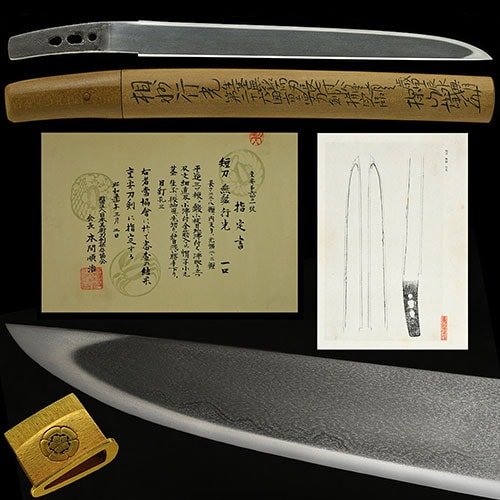
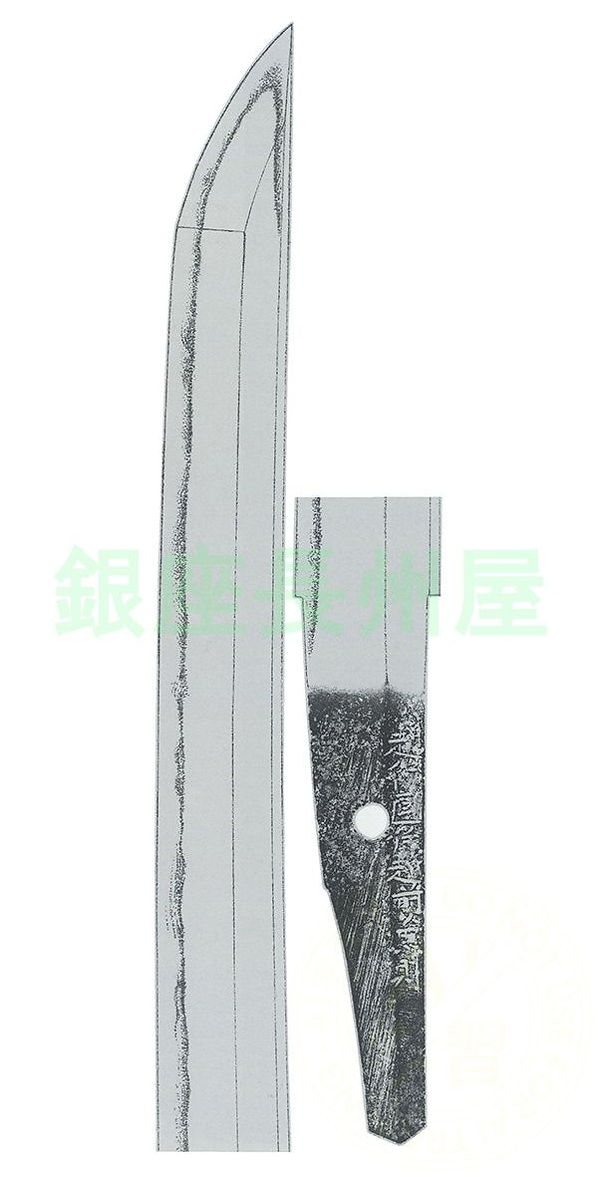
This wakizashi is signed by Kanenori, a smith from Echigo province active during the Momoyama period (around Tensho era). Kanenori belonged to the San-ami school of Mino province, known for forging exceptionally sharp blades. This particular smith moved to Kasugayama Castle town at the request of Uesugi Kenshin, later relocating his forge to Shibata in Echigo, with his lineage spreading to Echizen, Kaga, Noto, and Etchu.

NihontoWatch MonNihontoWatch
MarketEncyclopediaKantei
Swords›Sōshū-den›Momokawa›Kanenori›Wakizashi: Echigo Kuni Ju Echizen Kanenori (Wazamono)
wakizashi
Momokawa Kanenori

Wakizashi: Echigo Kuni Ju Echizen Kanenori (Wazamono)

mei · Seki · Momoyama

SOLD
Momokawa Kanenori (兼則) · Seki · MomoyamaView artist page →
Wakizashi
Could you name the smith from the blade alone? Today’s kantei →
Momokawa Kanenori — 1 of 2
Momokawa Kanenori — 2 of 2
1 / 2
1 / 2
Momokawa Kanenori — 1 of 2Momokawa Kanenori — 2 of 2
Momokawa Kanenori (兼則) · Seki · MomoyamaView artist page →
Wakizashi
Could you name the smith from the blade alone? Today’s kantei →
Measurements & details
Smith
Momokawa Kanenori
Type
Wakizashi
School
Momokawa
Period
Around 1573–1592(Tensho)
Province
Echigo
Signature
Signed
Description

This wakizashi is signed by Kanenori, a smith from Echigo province active during the Momoyama period (around Tensho era). Kanenori belonged to the San-ami school of Mino province, known for forging exceptionally sharp blades. This particular smith moved to Kasugayama Castle town at the request of Uesugi Kenshin, later relocating his forge to Shibata in Echigo, with his lineage spreading to Echizen, Kaga, Noto, and Etchu.

About the maker

Kanenori

兼則

Soshu-den · Echigo · around 1573-1592

›
Kanenori — full profileSoshu-den school

Study this maker →

About the school

Momokawa

百川

Soshu-den · Echigo

2 pieces on the market now

›

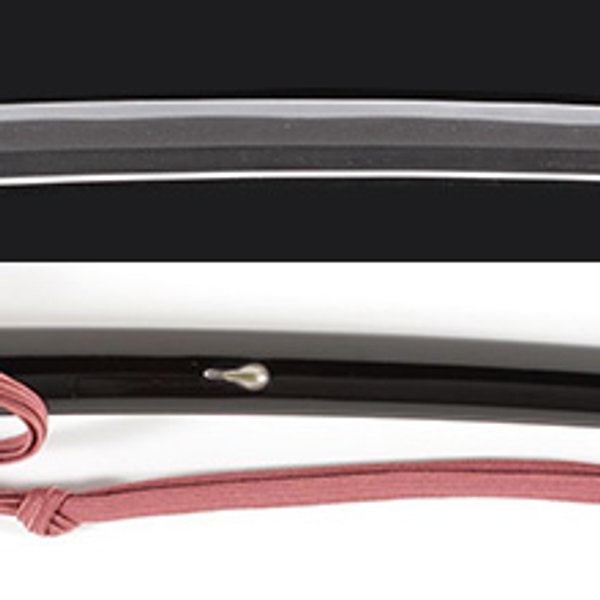
The Momokawa school takes its name from the locality of Momokawa in Echigo Province, where a small group of swordsmiths worked from the Nanbokucho period into the Muromachi era. Kanro Toshinaga, the figure most closely associated with the school's origins, is traditionally transmitted as a disciple of Takagi Sadamune of Goshu (Omi Province), though the NBTHK has consistently questioned this lineage, observing that Toshinaga's extant signed works -- exceedingly rare tachi and tanto -- bear little technical resemblance to Sadamune's manner. Rather, the examiners conclude that Toshinaga was a nearly contemporaneous smith whose aesthetic belongs entirely to the Yamato tradition. Momokawa Nagayoshi, recorded as Toshinaga's student, similarly shows minimal stylistic debt to his supposed teacher; his jiba is thoroughly Yamato in character, reflecting a distinct regional idiom that appears to have developed semi-independently in Echigo. Together with Heianjo Nagayoshi, who descends from the lineage of Heianjo Mitsunaga and represents a late Muromachi continuation in Yamashiro, these smiths form a loose constellation united less by direct master-pupil transmission than by a shared allegiance to Yamato-derived forging and tempering methods transplanted into provincial settings. The collective technical identity of the Momokawa group is defined by a pronounced nie-dominant aesthetic rooted in the Yamato tradition. Across the school's principal smiths, the forging consistently presents itame-hada mixed with mokume or nagare-hada, with a marked tendency toward masame -- standing grain that the NBTHK identifies as a defining characteristic of Toshinaga's hand and that recurs in Momokawa Nagayoshi's tightly executed, slightly whitish steel. Thick ji-nie and abundant chikei are universal hallmarks, producing surfaces of considerable depth and complexity. In tempering, the school favors nie-laden patterns built on ko-notare, shallow notare, or fundamentally suguha-based modes mixed with ko-gunome, uniformly enriched by vigorous hotsure, sunagashi, and kinsuji that run through the tempered zone with conspicuous energy.

Tobiyaki and yubashiri extend into the ji in Toshinaga's works, while Momokawa Nagayoshi's tempering is distinguished by persistent hotsure and a bright, clear nioiguchi. The boshi across the group consistently shows hakikake -- a feature the NBTHK singles out as diagnostic of Toshinaga and that echoes through Nagayoshi's midare-komi with pointed turnback. Heianjo Nagayoshi's late Muromachi production, while introducing gunome with angular turns and a tightened nioiguchi that inclines toward nioi, nonetheless retains the ji-nie, chikei, and Yamato-inflected grain structure that bind the group together. His occasional departures into hitatsura-like Soshu-flavored work remain distinguishable from true Soshu-den by the characteristically tight nioiguchi that marks the school's identity. The Momokawa school occupies a distinctive position within the broader history of Japanese swordmaking: a provincial tradition whose documented origins lie in Omi and Echigo rather than in the Yamato heartland, yet whose aesthetic -- described consistently by the NBTHK as exhibiting a "distinctly Yamato temperament" -- places it firmly within that lineage of restrained, nie-dominant craftsmanship. Signed works by all members are described as exceedingly rare, and each surviving blade carries exceptional documentary value for the study of medieval swordsmithing outside the major production centers. Toshinaga's works are praised as "truly brimming with haki (martial spirit)," while Momokawa Nagayoshi's few surviving pieces constitute irreplaceable records of Echigo-province traditions that left only the slightest trace in the historical canon. The school's legacy resides not in prolific output or stylistic innovation but in the faithful transmission of Yamato principles into provincial workshops, demonstrating that the tradition's characteristic austerity and nie-driven vigor could flourish far from its geographic origins. Learn more →

3 recorded smiths13 designated works
Leading smiths
SmithEraDesignated
Toshinaga俊長1338-13429
Nagayoshi長吉1345-13503
Kuniyoshi國吉1394-14280
Nagayoshi長吉1394-14280
Tsuguyoshi續吉1441-14440
Explore the Momokawa school →

Historical context

The Momoyama period (1573 to 1615)

›

Three unifiers ended the century of war, and the sword became an instrument of the new order: the 1588 sword hunt made it the warrior’s badge, famous blades passed between houses like treaties, and appraisal ever after divides the craft here, kotō from shintō.

The Momoyama period (1573 to 1615) →

Warning — certificate not found

We could not find an authenticity certificate on the seller’s listing. Japanese swords and fittings are normally papered by the NBTHK (or the NTHK). Without one, the attribution is the seller’s own assessment and has not been independently verified — treat it with caution and ask the dealer about certification before buying.

Seller
C
Choshuya
🇯🇵Ships from Japan
›
✓Verified dealerwww.choshuya.co.jp
✓Ships worldwide✓English support
Return policy

If, due to our fault, the item differs significantly from its proper condition, the item may be returned. Cooling-off is within one week of the item's arrival.

View all of Choshuya’s listings→View this item on the dealer’s site→

More from the Momokawa school

View all →
Goushuya
Jūyō
Katana - Jūyō - by Momokawa Toshinaga - Juyo Token: Mumei, attributed to Kanro ToshinagaKatana - Jūyō - by Momokawa Toshinaga - Juyo Token: Mumei, attributed to Kanro Toshinaga

Katana

ByMomokawa Toshinaga
Ask
Nihontocraft
Tanto - by Momokawa Nagayoshi - Momokawa NagayoshiTanto - by Momokawa Nagayoshi - Momokawa Nagayoshi

Tantō

ByMomokawa Nagayoshi
¥10,000

More from the Sōshū tradition

View all →
Kusanagi
Tokuho
Katana - Tokuho - by Soshu School - Soshu Masamune and Yukimitsu's master "Shintogo Kunimitsu," founder of Soshu-den who brought Awataguchi traditions to their peak; peerless health, masterpiece quality, Tokubetsu Hozon.Katana - Tokuho - by Soshu School - Soshu Masamune and Yukimitsu's master "Shintogo Kunimitsu," founder of Soshu-den who brought Awataguchi traditions to their peak; peerless health, masterpiece quality, Tokubetsu Hozon.

Katana

BySoshu School
¥6,800,000
Aoi Art
Tokuho
Katana - Tokuho - by Gō Yoshihiro - Mumei (Unsigned) Den Go YoshihiroKatana - Tokuho - by Gō Yoshihiro - Mumei (Unsigned) Den Go Yoshihiro

Katana

ByGō Yoshihiro
¥35,000,000
Choshuya
Jūyō
Tanto - Jūyō - by Soshu Norishige - Unsigned (Ubu-nakago) NorishigeTanto - Jūyō - by Soshu Norishige - Unsigned (Ubu-nakago) Norishige

Tantō

BySoshu Norishige
¥6,500,000
Samurai Nippon
Jūyō
Tanto - Jūyō - by Soshu Yukimitsu - Soshu Yukimitsu (Ubu Mumei)Tanto - Jūyō - by Soshu Yukimitsu - Soshu Yukimitsu (Ubu Mumei)

Tantō

BySoshu Yukimitsu
¥6,700,000
Tsuruginoya
Tokujū
Katana - Tokuju - by Soshu Yukimitsu - Soshu YukimitsuKatana - Tokuju - by Soshu Yukimitsu - Soshu Yukimitsu

Katana

BySoshu Yukimitsu
Ask
Eirakudo
Tokuho
Katana - Tokuho - by Soshu Norishige - Norishige - Tokubetsu Hozon TokenKatana - Tokuho - by Soshu Norishige - Norishige - Tokubetsu Hozon Token

Katana

BySoshu Norishige
¥6,500,000
Eirakudo
Tokuho
Katana - Tokuho - by Shintogo Kunimitsu - Shintogo Kunimitsu - Tokubetsu Hozon TokenKatana - Tokuho - by Shintogo Kunimitsu - Shintogo Kunimitsu - Tokubetsu Hozon Token

Katana

ByShintogo Kunimitsu
¥7,500,000
Eirakudo
Jūyō
Tanto - Jūyō - by Soshu Yukimitsu - Sosyu Yukimitsu Tanto Juyo TokenTanto - Jūyō - by Soshu Yukimitsu - Sosyu Yukimitsu Tanto Juyo Token

Tantō

BySoshu Yukimitsu
Ask

Swords

  • Katana
  • Wakizashi
  • Tantō
  • Tachi
  • Naginata
  • Yari
  • Japanese Swords
  • Samurai Swords

Fittings

  • Tsuba
  • Fuchi-Kashira
  • Kozuka
  • Menuki
  • Sword Guards (Tsuba)

Armor

  • Kabuto
  • Samurai Armor
  • All Samurai Armor

By Certification

  • Tokujū
  • Jūyō
  • Tokuho
  • Hozon

Resources

  • Dealer Directory
  • Artist Directory
  • The Daily Kantei
  • Glossary
  • Browse All
Nihontowatch© 2026
TermsPrivacyCookiesAbout
Sold

Description

This wakizashi is signed by Kanenori, a smith from Echigo province active during the Momoyama period (around Tensho era). Kanenori belonged to the San-ami school of Mino province, known for forging exceptionally sharp blades. This particular smith moved to Kasugayama Castle town at the request of Uesugi Kenshin, later relocating his forge to Shibata in Echigo, with his lineage spreading to Echizen, Kaga, Noto, and Etchu.

NihontoWatch MonNihontoWatch
MarketEncyclopediaKantei
Swords›Sōshū-den›Momokawa›Kanenori›Wakizashi: Echigo Kuni Ju Echizen Kanenori (Wazamono)
wakizashi
Momokawa Kanenori

Wakizashi: Echigo Kuni Ju Echizen Kanenori (Wazamono)

mei · Seki · Momoyama

SOLD
Momokawa Kanenori (兼則) · Seki · MomoyamaView artist page →
Wakizashi
Could you name the smith from the blade alone? Today’s kantei →
Momokawa Kanenori — 1 of 2
Momokawa Kanenori — 2 of 2
1 / 2
1 / 2
Momokawa Kanenori — 1 of 2Momokawa Kanenori — 2 of 2
Momokawa Kanenori (兼則) · Seki · MomoyamaView artist page →
Wakizashi
Could you name the smith from the blade alone? Today’s kantei →
Measurements & details
Smith
Momokawa Kanenori
Type
Wakizashi
School
Momokawa
Period
Around 1573–1592(Tensho)
Province
Echigo
Signature
Signed
Description

This wakizashi is signed by Kanenori, a smith from Echigo province active during the Momoyama period (around Tensho era). Kanenori belonged to the San-ami school of Mino province, known for forging exceptionally sharp blades. This particular smith moved to Kasugayama Castle town at the request of Uesugi Kenshin, later relocating his forge to Shibata in Echigo, with his lineage spreading to Echizen, Kaga, Noto, and Etchu.

About the maker

Kanenori

兼則

Soshu-den · Echigo · around 1573-1592

›
Kanenori — full profileSoshu-den school

Study this maker →

About the school

Momokawa

百川

Soshu-den · Echigo

2 pieces on the market now

›

The Momokawa school takes its name from the locality of Momokawa in Echigo Province, where a small group of swordsmiths worked from the Nanbokucho period into the Muromachi era. Kanro Toshinaga, the figure most closely associated with the school's origins, is traditionally transmitted as a disciple of Takagi Sadamune of Goshu (Omi Province), though the NBTHK has consistently questioned this lineage, observing that Toshinaga's extant signed works -- exceedingly rare tachi and tanto -- bear little technical resemblance to Sadamune's manner. Rather, the examiners conclude that Toshinaga was a nearly contemporaneous smith whose aesthetic belongs entirely to the Yamato tradition. Momokawa Nagayoshi, recorded as Toshinaga's student, similarly shows minimal stylistic debt to his supposed teacher; his jiba is thoroughly Yamato in character, reflecting a distinct regional idiom that appears to have developed semi-independently in Echigo. Together with Heianjo Nagayoshi, who descends from the lineage of Heianjo Mitsunaga and represents a late Muromachi continuation in Yamashiro, these smiths form a loose constellation united less by direct master-pupil transmission than by a shared allegiance to Yamato-derived forging and tempering methods transplanted into provincial settings. The collective technical identity of the Momokawa group is defined by a pronounced nie-dominant aesthetic rooted in the Yamato tradition. Across the school's principal smiths, the forging consistently presents itame-hada mixed with mokume or nagare-hada, with a marked tendency toward masame -- standing grain that the NBTHK identifies as a defining characteristic of Toshinaga's hand and that recurs in Momokawa Nagayoshi's tightly executed, slightly whitish steel. Thick ji-nie and abundant chikei are universal hallmarks, producing surfaces of considerable depth and complexity. In tempering, the school favors nie-laden patterns built on ko-notare, shallow notare, or fundamentally suguha-based modes mixed with ko-gunome, uniformly enriched by vigorous hotsure, sunagashi, and kinsuji that run through the tempered zone with conspicuous energy.

Tobiyaki and yubashiri extend into the ji in Toshinaga's works, while Momokawa Nagayoshi's tempering is distinguished by persistent hotsure and a bright, clear nioiguchi. The boshi across the group consistently shows hakikake -- a feature the NBTHK singles out as diagnostic of Toshinaga and that echoes through Nagayoshi's midare-komi with pointed turnback. Heianjo Nagayoshi's late Muromachi production, while introducing gunome with angular turns and a tightened nioiguchi that inclines toward nioi, nonetheless retains the ji-nie, chikei, and Yamato-inflected grain structure that bind the group together. His occasional departures into hitatsura-like Soshu-flavored work remain distinguishable from true Soshu-den by the characteristically tight nioiguchi that marks the school's identity. The Momokawa school occupies a distinctive position within the broader history of Japanese swordmaking: a provincial tradition whose documented origins lie in Omi and Echigo rather than in the Yamato heartland, yet whose aesthetic -- described consistently by the NBTHK as exhibiting a "distinctly Yamato temperament" -- places it firmly within that lineage of restrained, nie-dominant craftsmanship. Signed works by all members are described as exceedingly rare, and each surviving blade carries exceptional documentary value for the study of medieval swordsmithing outside the major production centers. Toshinaga's works are praised as "truly brimming with haki (martial spirit)," while Momokawa Nagayoshi's few surviving pieces constitute irreplaceable records of Echigo-province traditions that left only the slightest trace in the historical canon. The school's legacy resides not in prolific output or stylistic innovation but in the faithful transmission of Yamato principles into provincial workshops, demonstrating that the tradition's characteristic austerity and nie-driven vigor could flourish far from its geographic origins. Learn more →
3 recorded smiths13 designated works
Leading smiths
SmithEraDesignated
Toshinaga俊長1338-13429
Nagayoshi長吉1345-13503
Kuniyoshi國吉1394-14280
Nagayoshi長吉1394-14280
Tsuguyoshi續吉1441-14440
Explore the Momokawa school →

Historical context

The Momoyama period (1573 to 1615)

›

Three unifiers ended the century of war, and the sword became an instrument of the new order: the 1588 sword hunt made it the warrior’s badge, famous blades passed between houses like treaties, and appraisal ever after divides the craft here, kotō from shintō.

The Momoyama period (1573 to 1615) →

Warning — certificate not found

We could not find an authenticity certificate on the seller’s listing. Japanese swords and fittings are normally papered by the NBTHK (or the NTHK). Without one, the attribution is the seller’s own assessment and has not been independently verified — treat it with caution and ask the dealer about certification before buying.

Seller
C
Choshuya
🇯🇵Ships from Japan
›
✓Verified dealerwww.choshuya.co.jp
✓Ships worldwide✓English support
Return policy

If, due to our fault, the item differs significantly from its proper condition, the item may be returned. Cooling-off is within one week of the item's arrival.

View all of Choshuya’s listings→View this item on the dealer’s site→

More from the Momokawa school

View all →
Goushuya
Jūyō
Katana - Jūyō - by Momokawa Toshinaga - Juyo Token: Mumei, attributed to Kanro ToshinagaKatana - Jūyō - by Momokawa Toshinaga - Juyo Token: Mumei, attributed to Kanro Toshinaga

Katana

ByMomokawa Toshinaga
Ask
Nihontocraft
Tanto - by Momokawa Nagayoshi - Momokawa NagayoshiTanto - by Momokawa Nagayoshi - Momokawa Nagayoshi

Tantō

ByMomokawa Nagayoshi
¥10,000

More from the Sōshū tradition

View all →
Kusanagi
Tokuho
Katana - Tokuho - by Soshu School - Soshu Masamune and Yukimitsu's master "Shintogo Kunimitsu," founder of Soshu-den who brought Awataguchi traditions to their peak; peerless health, masterpiece quality, Tokubetsu Hozon.Katana - Tokuho - by Soshu School - Soshu Masamune and Yukimitsu's master "Shintogo Kunimitsu," founder of Soshu-den who brought Awataguchi traditions to their peak; peerless health, masterpiece quality, Tokubetsu Hozon.

Katana

BySoshu School
¥6,800,000
Aoi Art
Tokuho
Katana - Tokuho - by Gō Yoshihiro - Mumei (Unsigned) Den Go YoshihiroKatana - Tokuho - by Gō Yoshihiro - Mumei (Unsigned) Den Go Yoshihiro

Katana

ByGō Yoshihiro
¥35,000,000
Choshuya
Jūyō
Tanto - Jūyō - by Soshu Norishige - Unsigned (Ubu-nakago) NorishigeTanto - Jūyō - by Soshu Norishige - Unsigned (Ubu-nakago) Norishige

Tantō

BySoshu Norishige
¥6,500,000
Samurai Nippon
Jūyō
Tanto - Jūyō - by Soshu Yukimitsu - Soshu Yukimitsu (Ubu Mumei)Tanto - Jūyō - by Soshu Yukimitsu - Soshu Yukimitsu (Ubu Mumei)

Tantō

BySoshu Yukimitsu
¥6,700,000
Tsuruginoya
Tokujū
Katana - Tokuju - by Soshu Yukimitsu - Soshu YukimitsuKatana - Tokuju - by Soshu Yukimitsu - Soshu Yukimitsu

Katana

BySoshu Yukimitsu
Ask
Eirakudo
Tokuho
Katana - Tokuho - by Soshu Norishige - Norishige - Tokubetsu Hozon TokenKatana - Tokuho - by Soshu Norishige - Norishige - Tokubetsu Hozon Token

Katana

BySoshu Norishige
¥6,500,000
Eirakudo
Tokuho
Katana - Tokuho - by Shintogo Kunimitsu - Shintogo Kunimitsu - Tokubetsu Hozon TokenKatana - Tokuho - by Shintogo Kunimitsu - Shintogo Kunimitsu - Tokubetsu Hozon Token

Katana

ByShintogo Kunimitsu
¥7,500,000
Eirakudo
Jūyō
Tanto - Jūyō - by Soshu Yukimitsu - Sosyu Yukimitsu Tanto Juyo TokenTanto - Jūyō - by Soshu Yukimitsu - Sosyu Yukimitsu Tanto Juyo Token

Tantō

BySoshu Yukimitsu
Ask

Swords

  • Katana
  • Wakizashi
  • Tantō
  • Tachi
  • Naginata
  • Yari
  • Japanese Swords
  • Samurai Swords

Fittings

  • Tsuba
  • Fuchi-Kashira
  • Kozuka
  • Menuki
  • Sword Guards (Tsuba)

Armor

  • Kabuto
  • Samurai Armor
  • All Samurai Armor

By Certification

  • Tokujū
  • Jūyō
  • Tokuho
  • Hozon

Resources

  • Dealer Directory
  • Artist Directory
  • The Daily Kantei
  • Glossary
  • Browse All
Nihontowatch© 2026
TermsPrivacyCookiesAbout
Sold
NihontoWatch MonNihontoWatch
Market
Encyclopedia
Kantei
NihontoWatch MonNihontoWatch
Market
Encyclopedia
Kantei