The divided-courts war impoverished the court society that had sustained Kyōto’s most refined work. With the last Rai masters the classic line effectively closed, while Hasebe and Nobukuni carried the new Sōshū manner into the capital.
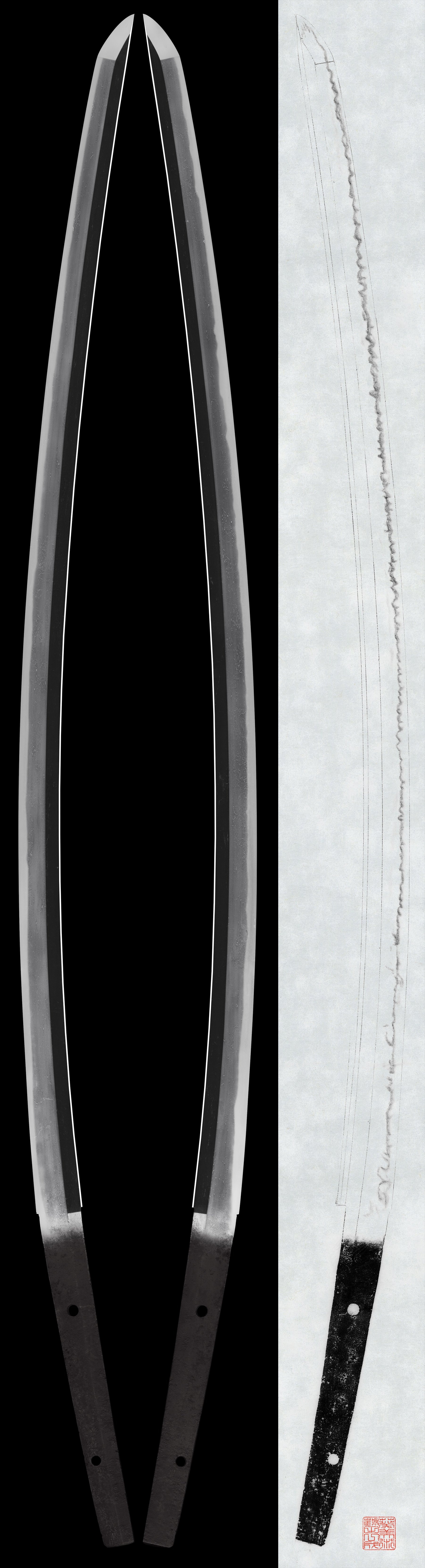
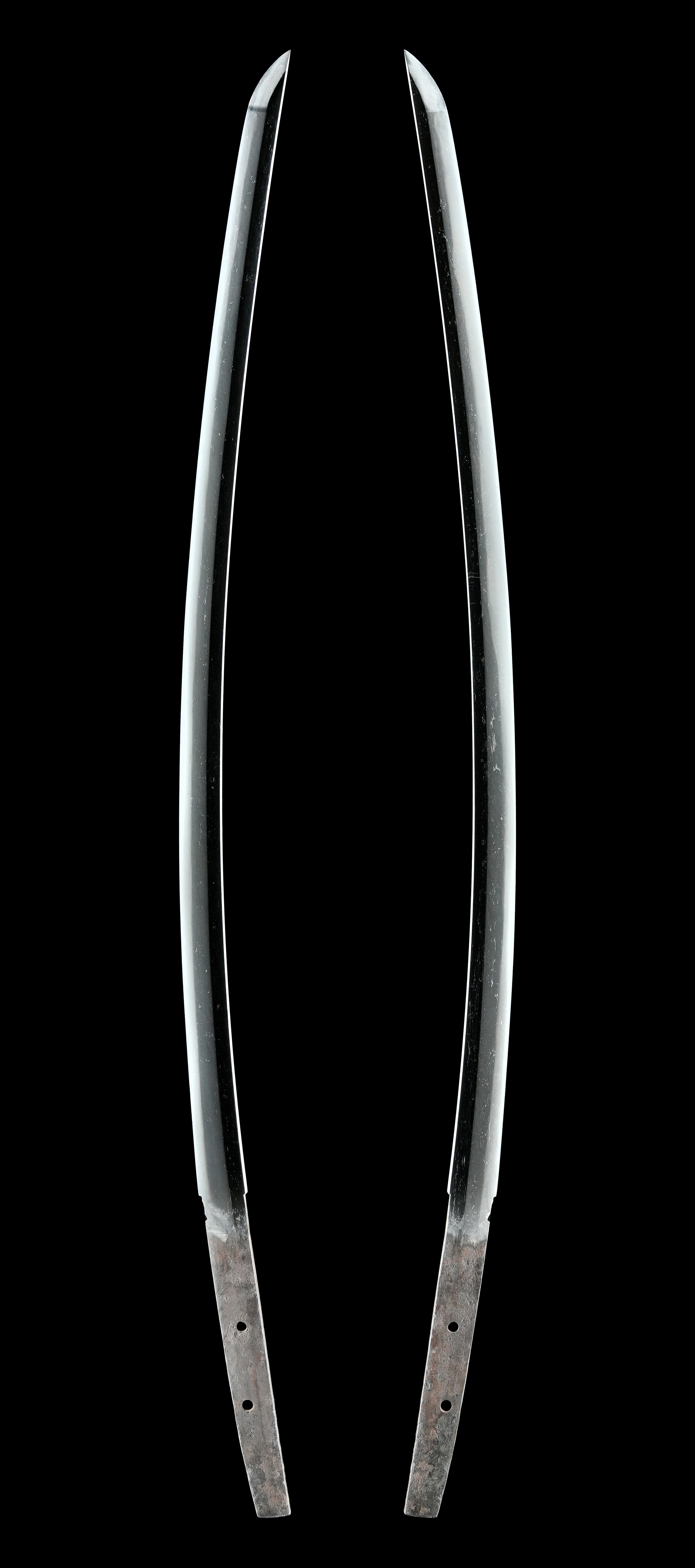
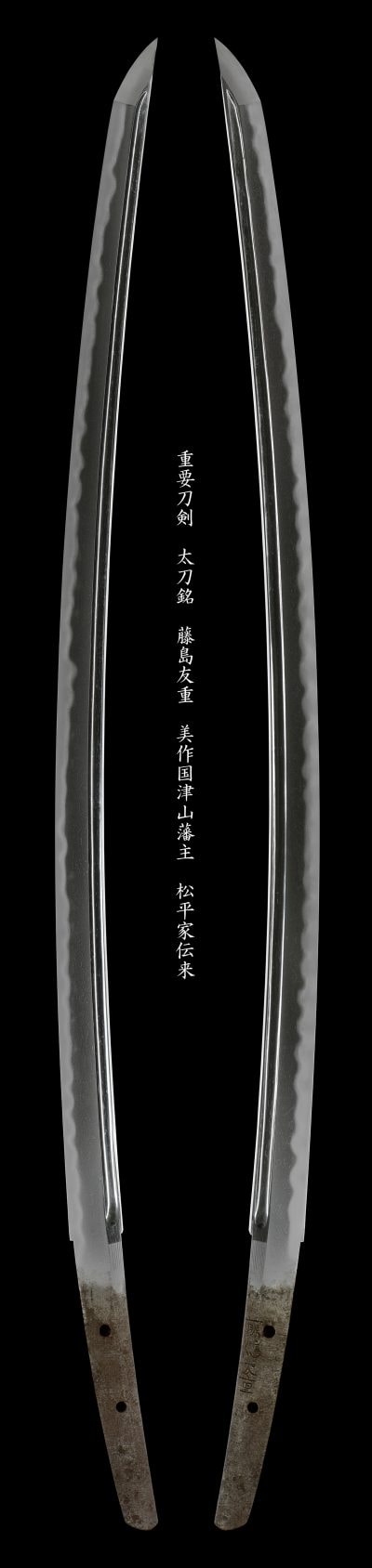
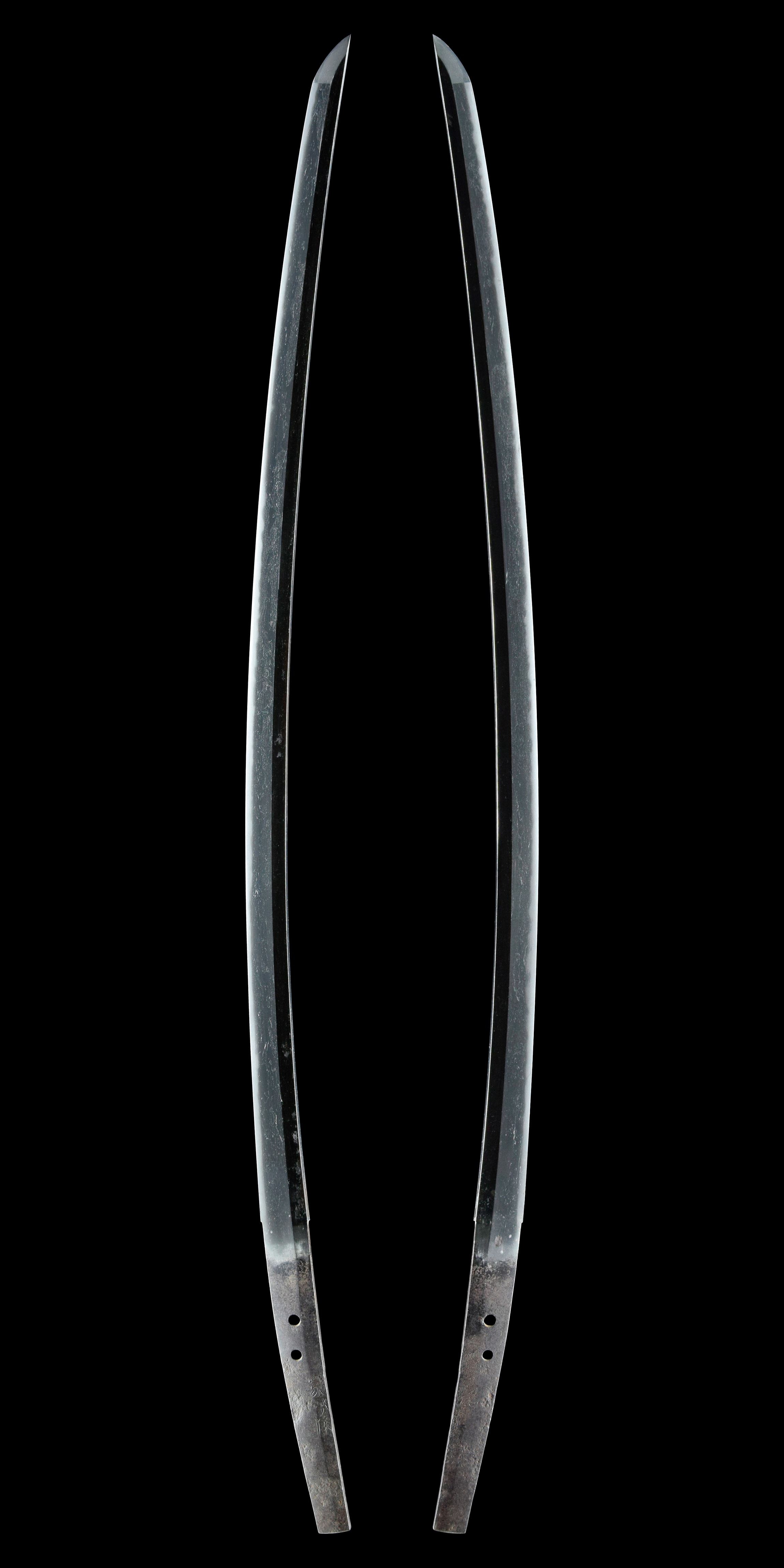
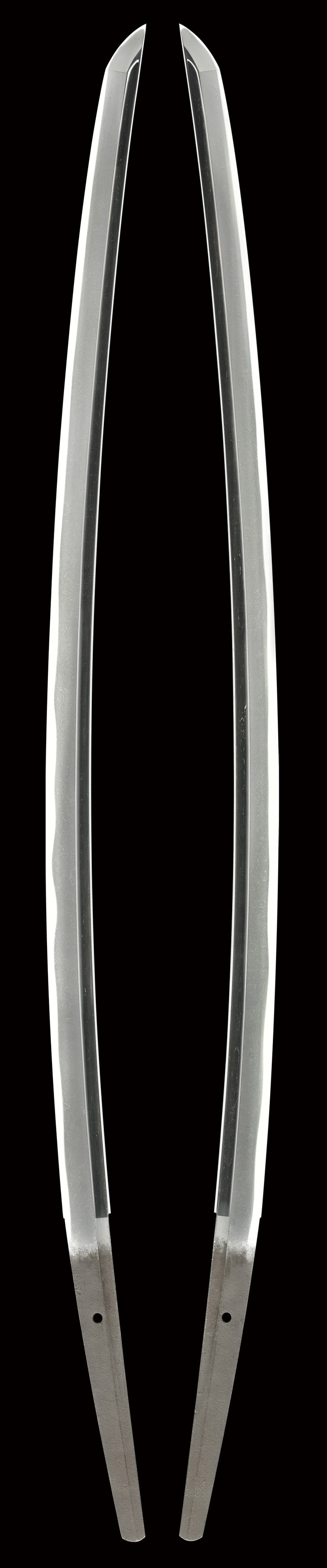
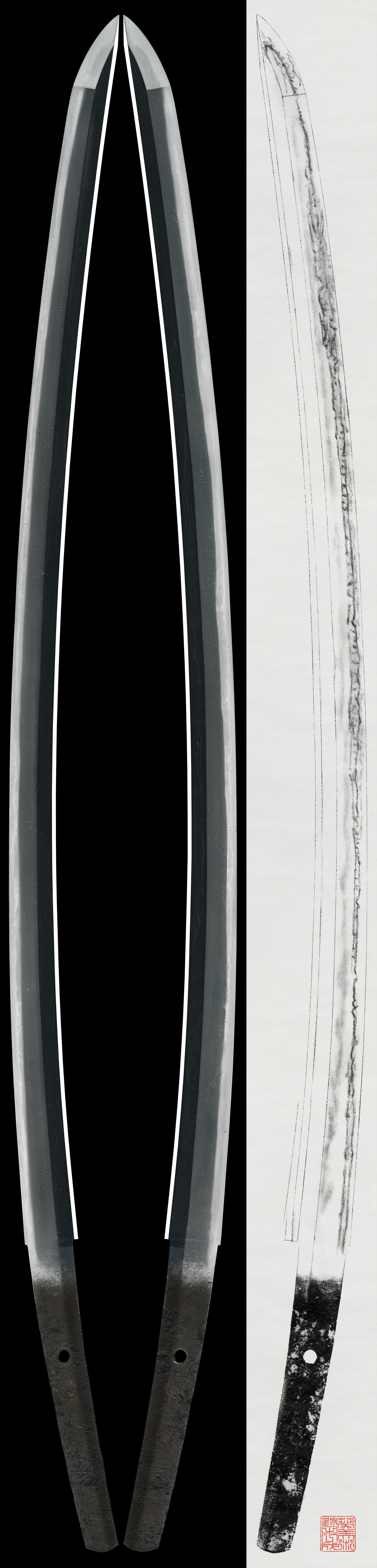
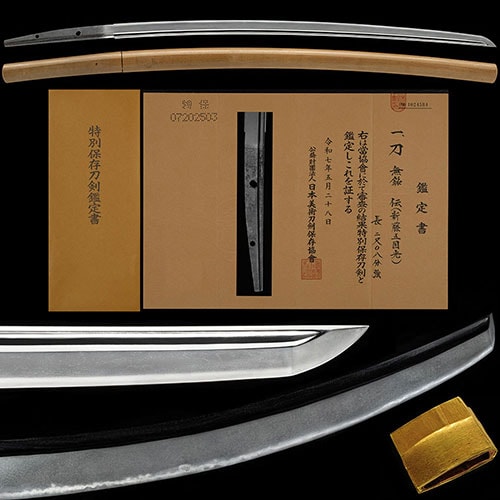
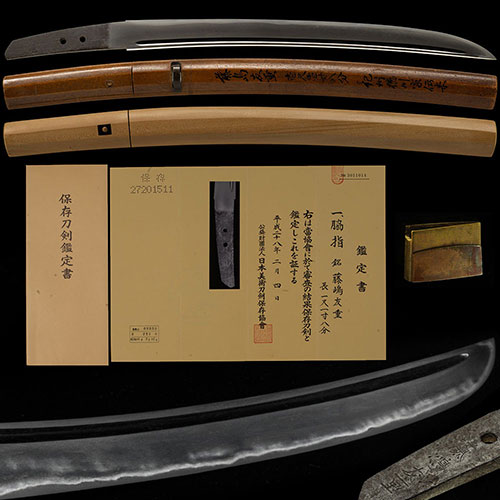
This is a sunnobi tanto by Fujishima Tomoshige, believed to be from the Nanbokucho to early Muromachi period. It features a wide mihaba, shallow sori, and a beautiful jitetsu with utsuri. The blade is accompanied by an NBTHK Hozon Token certificate and has provenance from the Kishu Tokugawa family.
 NihontoWatch
mei · Fujishima · Nanbokucho · nagasa 35.7cm · sori 0.8cm
Yamashiro-den · Echizen · around 1324-1326
Fujishiro Chu-jo saku · Tōken Taikan top 14%
1 piece on the market now
Fujishima Tomoshige is the founding smith of the Fujishima school, a lineage of swordsmiths resident at Fujishima in Kaga Province (Kashū). Documentary tradition holds that the first-generation Tomoshige was a disciple of Rai Kunitoshi, though no extant work can be appraised as dating to the Kamakura period, and the NBTHK has observed that "there is no material that can be accepted as confirming this tradition." Alternative sources variously connect him to Kashū Sanekage or Rai Toshimune, but these claims likewise "appear to leave room for further examination." Rather, judging from the workmanship and the manner of tang construction, the NBTHK has concluded that he may be considered to have drawn upon a Yamato-derived lineage. Among dated works, the earliest known inscription is Ōei 2 (1395); however, undated pieces exist whose style "appears to go somewhat earlier," with the oldest works appraised as beginning in the Nanbokuchō period. A single ken bearing only the two-character signature "Tomoshige" is thought to be the earliest surviving work, not descending later than the end of the Kamakura period. The Tomoshige name continued through the Muromachi period and into the Shintō era, flourishing over a long span.
A key point of appreciation in the workmanship of this school is the character of the jigane: it tends toward a slightly standing grain — hada-dachi — and takes on a darkened, blackish tone described as kan'a-iro, presenting a distinctive quality of northern-province workmanship known as hokkoku-hada. Faint shirake-utsuri frequently stands out against this dark ground. The hamon commonly forms a mixed midare in which gunome, hako-ba, and togariba appear together, producing what the NBTHK characterizes as "an impression in which Bizen-like characteristics and Mino-like tendencies coexist." In many works the ashi enter somewhat long and the temper is nie-laden, with vigorous sunagashi and kinsuji running through the hardened edge; small tobiyaki and muneyaki are also encountered. The bōshi frequently shows hakikake and tends toward yakizume. Conversely, among tantō one also encounters works in a fine hoso-suguha with ko-nie[[c:1]] — a mode in which the NBTHK has noted points of resemblance to Naoe Shizu and Sekishū Naotsuna, or an Aoe-like manner. The presence of angular and pointed elements within the hardened edge, together with conspicuous sunagashi, are consistently singled out as "points to be appreciated" and essential features of this smith.
Tomoshige is repeatedly designated "a representative smith of the Kaga Fujishima school," and his works are valued both as superior examples of craftsmanship and as reliable source material for understanding the scope of his oeuvre. The NBTHK consistently notes that his finest pieces exhibit ji and ha that are kenzen — sound and well-preserved — and praises blades that "clearly demonstrate the distinctive features of this school and smith." Rare forms such as naginata and large-bodied spears are singled out for exceptional praise; one yari is described as "not only a masterpiece among Fujishima-made spears, but one of the renowned spears representative of its age." Dated Ōei-era works are regarded as "particularly noteworthy" and "exceedingly precious" for establishing his chronology, while pieces appraised as pre-Ōei are valued for pushing the documented range of his career into the late Nanbokuchō period. Through his coexistence of Bizen temperament, Mino inflection, and Yamato structural sensibility — all cast upon the dark, characteristically northern-province ground steel — Tomoshige occupies a singular position among provincial smiths of the transitional Nanbokuchō-to-Muromachi era.
Where Tomoshige stands among comparable artisans: across all of nihontō, and within tradition, era, and period. The tiers (Foremost · Leading · Major · Notable) weigh official designations from the NBTHK and Japan's Agency for Cultural Affairs, together with historical honors of lasting repute such as the Sansaku and Meibutsu-chō.
Select a lens to see how it's measured.
Yamashiro-den · Kaga
21 pieces on the market now
Among the provincial lineages of the Hokurikudo, the Fujishima school took its name and its base from the village of Fujishima in Kaga province, where Tomoshige stands as founder and the name he set down passed through several generations from the close of the Nanbokucho period across the Muromachi and on into the early-modern Shinto era. The members place the chronological anchor with care: the earliest firmly dated work is a tanto of Oei 2 (1395), and the NBTHK finds nothing among the surviving blades that goes back earlier than Nanbokucho. Old documentary tradition reads the first generation as a pupil of Rai Kunitoshi of Yamashiro, alternatively of Kashu Sanekage or Rai Toshimune, but the published sources doubt each reading in turn, finding no stylistic tie to Rai Kunitoshi and a chronological impossibility with Sanekage; judging from the make and the nakago finish, they settle by elimination toward the Yamato tradition, close to the Yamato Shikkake hand. A tachi held at Atsuta Shrine and a two-character ken read as the oldest surviving piece bracket the early end of the line. The recognition of the school lives in its jigane. The members agree on a board-grained itame that mixes in mokume and runs to nagare, standing somewhat open (hada-dachi), the surface gathering ji-nie and chikei, the steel carrying a distinct blackish cast named kan'a-iro and tied directly to the northern provinces as hokkoku-hada; a faint whitish shirake-utsuri rises quietly against this dark ground rather than a bright Bizen reflection. Over that ji the school tempers a gunome-midare into which box-shaped (hako-ba), pointed and angular (togariba) teeth enter together with notare and ko-notare, the ashi running rather long, the ha nie-laden with sunagashi sweeping it and kinsuji entering, small tobiyaki and muneyaki scattered here and there.
The NBTHK reads the feel of it as a make in which Bizen temperament and Mino flavor coexist, the boshi running straight or midare-komi into a ko-maru, often swept with hakikake or running to yakizume. The members also mark the short blades apart: on the tanto the hand can quiet to a ko-itame and a narrow hoso-suguha or low ko-gunome with ko-nie, the nioiguchi sometimes clouding to urumi, the boshi turning jizo-like or returning deep, this the simplest face of the Yamato base while the dark steel keeps its northern mark. To kantei a Fujishima blade the eye works the conjunction rather than any single trait: the standing dark ji read together with the box-and-pointed midare and the constant sunagashi names the school where a clean Bizen choji or a true Yamashiro ko-itame would not. The members note works read variously toward an Aoe air, toward Naoe Shizu and Sekishu Naotsuna, the Mino and northern lines the school sits between, kin in feel to the Etchu and Echizen smiths of the same region. Among the membership Tomoshige carries the name and the standing; Fujishiro rates the founder Chu-jo saku and places others among the middle ranks of the koto smiths, and the most highly regarded work falls in the Oei generation while the Muromachi work survives most often. The single finest piece is a great spear (o-mi-yari) signed Fujishima Tomoshige and carved with a sanko-ken and the deity-name Myoken Daibosatsu, which the published sources judge not merely the best spear of the school but one of the representative famous spears of its age; surviving naginata by the line are noted as rare, their ubu-nakago valued as dating evidence. Provenance gathers around named houses recorded in the blades themselves, an Oei katana descended in the Inaba daimyo house and a tanto held in the Imperial collection, heritage pieces in long-standing hands; yet the line is not among the unattainable names, and a Juyo Tomoshige remains a realistic if uncommon encounter for the patient collector, valued for the way a single dark-steeled blade carries the whole northern school in its ji. Learn more →
| Smith | Era | Designated |
|---|---|---|
| Tomoshige友重 | 1394-1428 | 15 |
| Tomoshige友重 | 1346-1370 | 5 |
| Tomoshige友重 | 1324-1326 | 5 |
| Fujishima藤島 | 1394-1428 | 4 |
| Kiyomitsu清光 | 1573-1592 | 0 |
Yamashiro in the Nanbokuchō period
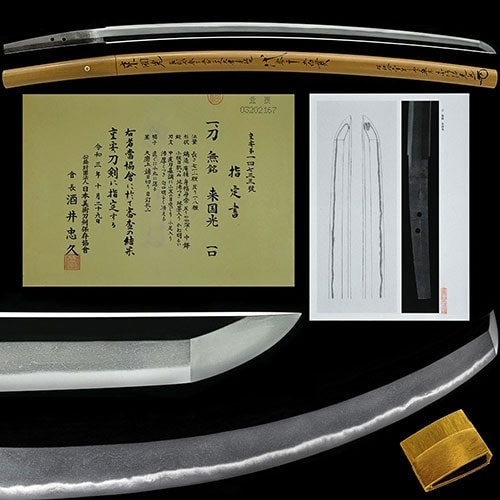
The divided-courts war impoverished the court society that had sustained Kyōto’s most refined work. With the last Rai masters the classic line effectively closed, while Hasebe and Nobukuni carried the new Sōshū manner into the capital.
Certifies a genuine blade worth preserving: a signature confirmed correct, or, if unsigned, an era, province, and school that the NBTHK can reliably identify.
The NBTHK (Nihon Bijutsu Tōken Hozon Kyōkai, the Society for the Preservation of Japanese Art Swords) is a public-interest incorporated foundation founded in 1948 and supervised by Japan’s Agency for Cultural Affairs (Bunkachō); it is based at the Japanese Sword Museum in Tokyo. Its expert panels physically examine each submitted work (shinsa) and issue a certificate (kanteishō) ranking it by artistic and historical merit. NBTHK papers are the most widely recognized standard of authentication for Japanese swords and fittings.
NBTHK official siteReturns/exchanges/cancellations not accepted after shipment except for significant defects; if defective, return/exchange possible within 3 days of arrival (return shipping paid by customer).
This is a sunnobi tanto by Fujishima Tomoshige, believed to be from the Nanbokucho to early Muromachi period. It features a wide mihaba, shallow sori, and a beautiful jitetsu with utsuri. The blade is accompanied by an NBTHK Hozon Token certificate and has provenance from the Kishu Tokugawa family.
NihontoWatchmei · Fujishima · Nanbokucho · nagasa 35.7cm · sori 0.8cm
Yamashiro-den · Echizen · around 1324-1326
Fujishiro Chu-jo saku · Tōken Taikan top 14%
1 piece on the market now
Fujishima Tomoshige is the founding smith of the Fujishima school, a lineage of swordsmiths resident at Fujishima in Kaga Province (Kashū). Documentary tradition holds that the first-generation Tomoshige was a disciple of Rai Kunitoshi, though no extant work can be appraised as dating to the Kamakura period, and the NBTHK has observed that "there is no material that can be accepted as confirming this tradition." Alternative sources variously connect him to Kashū Sanekage or Rai Toshimune, but these claims likewise "appear to leave room for further examination." Rather, judging from the workmanship and the manner of tang construction, the NBTHK has concluded that he may be considered to have drawn upon a Yamato-derived lineage. Among dated works, the earliest known inscription is Ōei 2 (1395); however, undated pieces exist whose style "appears to go somewhat earlier," with the oldest works appraised as beginning in the Nanbokuchō period. A single ken bearing only the two-character signature "Tomoshige" is thought to be the earliest surviving work, not descending later than the end of the Kamakura period. The Tomoshige name continued through the Muromachi period and into the Shintō era, flourishing over a long span.
A key point of appreciation in the workmanship of this school is the character of the jigane: it tends toward a slightly standing grain — hada-dachi — and takes on a darkened, blackish tone described as kan'a-iro, presenting a distinctive quality of northern-province workmanship known as hokkoku-hada. Faint shirake-utsuri frequently stands out against this dark ground. The hamon commonly forms a mixed midare in which gunome, hako-ba, and togariba appear together, producing what the NBTHK characterizes as "an impression in which Bizen-like characteristics and Mino-like tendencies coexist." In many works the ashi enter somewhat long and the temper is nie-laden, with vigorous sunagashi and kinsuji running through the hardened edge; small tobiyaki and muneyaki are also encountered. The bōshi frequently shows hakikake and tends toward yakizume. Conversely, among tantō one also encounters works in a fine hoso-suguha with ko-nie[[c:1]] — a mode in which the NBTHK has noted points of resemblance to Naoe Shizu and Sekishū Naotsuna, or an Aoe-like manner. The presence of angular and pointed elements within the hardened edge, together with conspicuous sunagashi, are consistently singled out as "points to be appreciated" and essential features of this smith.
Tomoshige is repeatedly designated "a representative smith of the Kaga Fujishima school," and his works are valued both as superior examples of craftsmanship and as reliable source material for understanding the scope of his oeuvre. The NBTHK consistently notes that his finest pieces exhibit ji and ha that are kenzen — sound and well-preserved — and praises blades that "clearly demonstrate the distinctive features of this school and smith." Rare forms such as naginata and large-bodied spears are singled out for exceptional praise; one yari is described as "not only a masterpiece among Fujishima-made spears, but one of the renowned spears representative of its age." Dated Ōei-era works are regarded as "particularly noteworthy" and "exceedingly precious" for establishing his chronology, while pieces appraised as pre-Ōei are valued for pushing the documented range of his career into the late Nanbokuchō period. Through his coexistence of Bizen temperament, Mino inflection, and Yamato structural sensibility — all cast upon the dark, characteristically northern-province ground steel — Tomoshige occupies a singular position among provincial smiths of the transitional Nanbokuchō-to-Muromachi era.
Where Tomoshige stands among comparable artisans: across all of nihontō, and within tradition, era, and period. The tiers (Foremost · Leading · Major · Notable) weigh official designations from the NBTHK and Japan's Agency for Cultural Affairs, together with historical honors of lasting repute such as the Sansaku and Meibutsu-chō.
Select a lens to see how it's measured.
Yamashiro-den · Kaga
21 pieces on the market now
Among the provincial lineages of the Hokurikudo, the Fujishima school took its name and its base from the village of Fujishima in Kaga province, where Tomoshige stands as founder and the name he set down passed through several generations from the close of the Nanbokucho period across the Muromachi and on into the early-modern Shinto era. The members place the chronological anchor with care: the earliest firmly dated work is a tanto of Oei 2 (1395), and the NBTHK finds nothing among the surviving blades that goes back earlier than Nanbokucho. Old documentary tradition reads the first generation as a pupil of Rai Kunitoshi of Yamashiro, alternatively of Kashu Sanekage or Rai Toshimune, but the published sources doubt each reading in turn, finding no stylistic tie to Rai Kunitoshi and a chronological impossibility with Sanekage; judging from the make and the nakago finish, they settle by elimination toward the Yamato tradition, close to the Yamato Shikkake hand. A tachi held at Atsuta Shrine and a two-character ken read as the oldest surviving piece bracket the early end of the line. The recognition of the school lives in its jigane. The members agree on a board-grained itame that mixes in mokume and runs to nagare, standing somewhat open (hada-dachi), the surface gathering ji-nie and chikei, the steel carrying a distinct blackish cast named kan'a-iro and tied directly to the northern provinces as hokkoku-hada; a faint whitish shirake-utsuri rises quietly against this dark ground rather than a bright Bizen reflection. Over that ji the school tempers a gunome-midare into which box-shaped (hako-ba), pointed and angular (togariba) teeth enter together with notare and ko-notare, the ashi running rather long, the ha nie-laden with sunagashi sweeping it and kinsuji entering, small tobiyaki and muneyaki scattered here and there.
The NBTHK reads the feel of it as a make in which Bizen temperament and Mino flavor coexist, the boshi running straight or midare-komi into a ko-maru, often swept with hakikake or running to yakizume. The members also mark the short blades apart: on the tanto the hand can quiet to a ko-itame and a narrow hoso-suguha or low ko-gunome with ko-nie, the nioiguchi sometimes clouding to urumi, the boshi turning jizo-like or returning deep, this the simplest face of the Yamato base while the dark steel keeps its northern mark. To kantei a Fujishima blade the eye works the conjunction rather than any single trait: the standing dark ji read together with the box-and-pointed midare and the constant sunagashi names the school where a clean Bizen choji or a true Yamashiro ko-itame would not. The members note works read variously toward an Aoe air, toward Naoe Shizu and Sekishu Naotsuna, the Mino and northern lines the school sits between, kin in feel to the Etchu and Echizen smiths of the same region. Among the membership Tomoshige carries the name and the standing; Fujishiro rates the founder Chu-jo saku and places others among the middle ranks of the koto smiths, and the most highly regarded work falls in the Oei generation while the Muromachi work survives most often. The single finest piece is a great spear (o-mi-yari) signed Fujishima Tomoshige and carved with a sanko-ken and the deity-name Myoken Daibosatsu, which the published sources judge not merely the best spear of the school but one of the representative famous spears of its age; surviving naginata by the line are noted as rare, their ubu-nakago valued as dating evidence. Provenance gathers around named houses recorded in the blades themselves, an Oei katana descended in the Inaba daimyo house and a tanto held in the Imperial collection, heritage pieces in long-standing hands; yet the line is not among the unattainable names, and a Juyo Tomoshige remains a realistic if uncommon encounter for the patient collector, valued for the way a single dark-steeled blade carries the whole northern school in its ji. Learn more →
| Smith | Era | Designated |
|---|---|---|
| Tomoshige友重 | 1394-1428 | 15 |
| Tomoshige友重 | 1346-1370 | 5 |
| Tomoshige友重 | 1324-1326 | 5 |
| Fujishima藤島 | 1394-1428 | 4 |
| Kiyomitsu清光 | 1573-1592 | 0 |
Yamashiro in the Nanbokuchō period
The divided-courts war impoverished the court society that had sustained Kyōto’s most refined work. With the last Rai masters the classic line effectively closed, while Hasebe and Nobukuni carried the new Sōshū manner into the capital.
Certifies a genuine blade worth preserving: a signature confirmed correct, or, if unsigned, an era, province, and school that the NBTHK can reliably identify.
The NBTHK (Nihon Bijutsu Tōken Hozon Kyōkai, the Society for the Preservation of Japanese Art Swords) is a public-interest incorporated foundation founded in 1948 and supervised by Japan’s Agency for Cultural Affairs (Bunkachō); it is based at the Japanese Sword Museum in Tokyo. Its expert panels physically examine each submitted work (shinsa) and issue a certificate (kanteishō) ranking it by artistic and historical merit. NBTHK papers are the most widely recognized standard of authentication for Japanese swords and fittings.
NBTHK official siteReturns/exchanges/cancellations not accepted after shipment except for significant defects; if defective, return/exchange possible within 3 days of arrival (return shipping paid by customer).