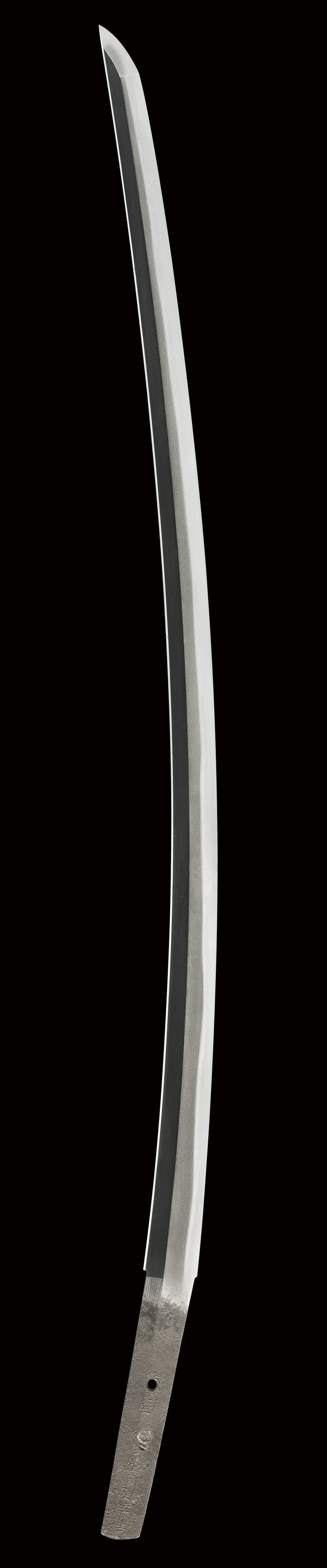
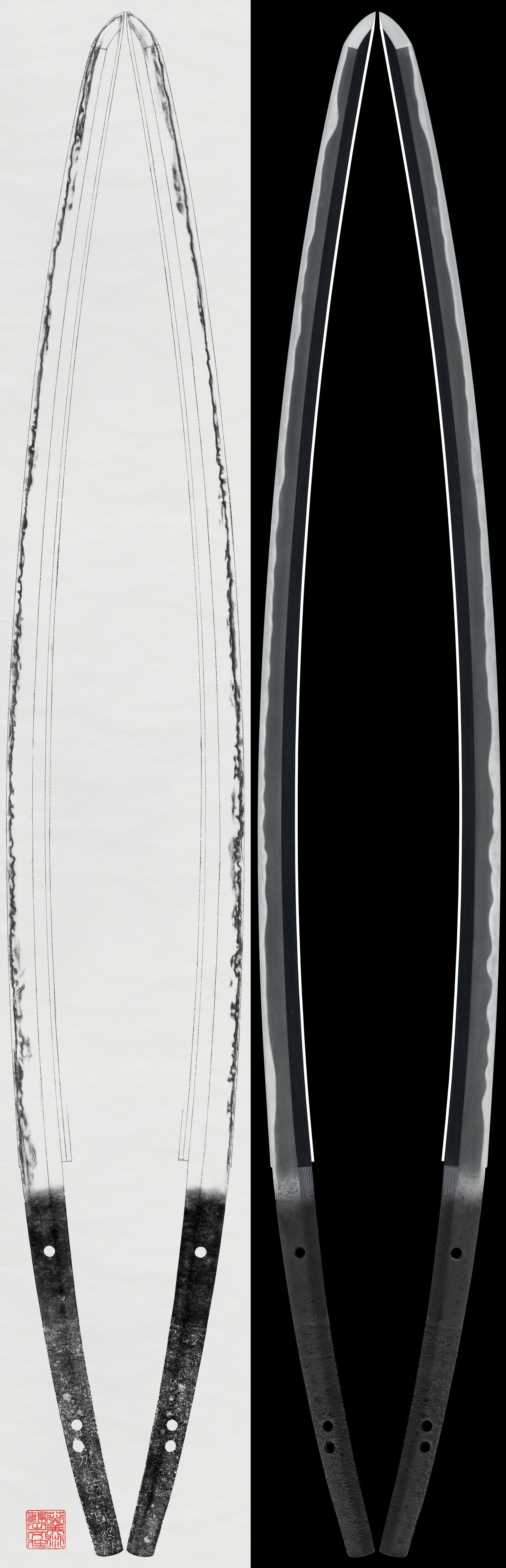
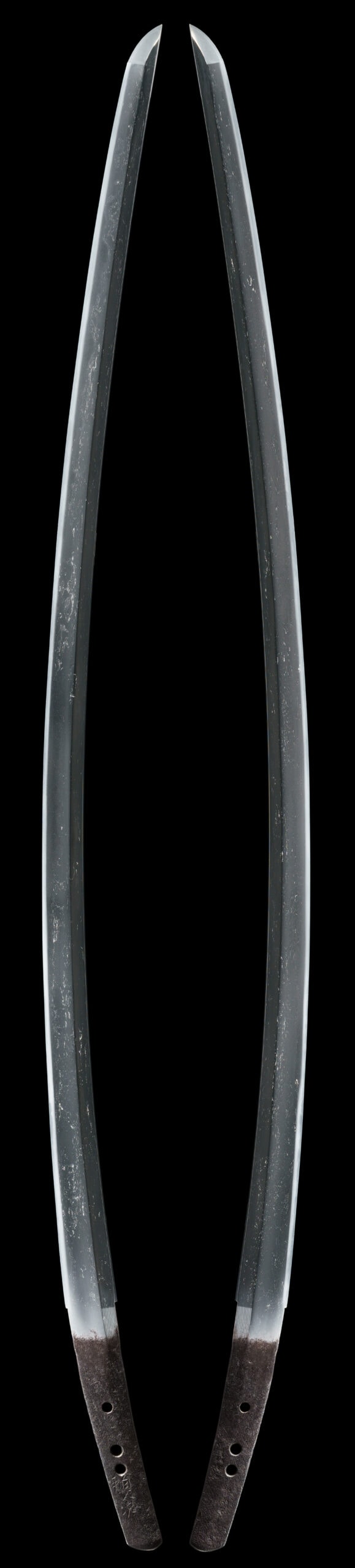
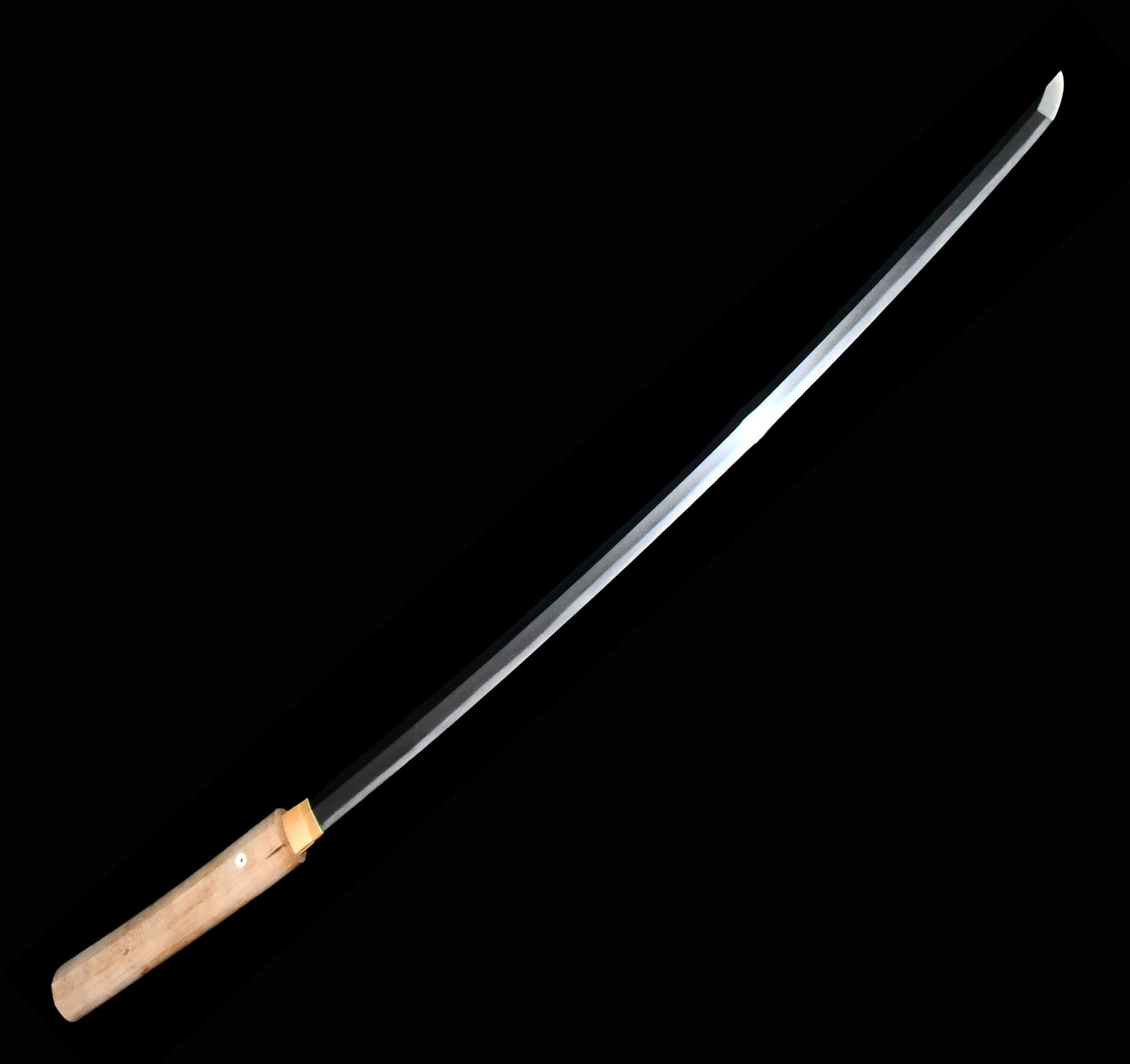
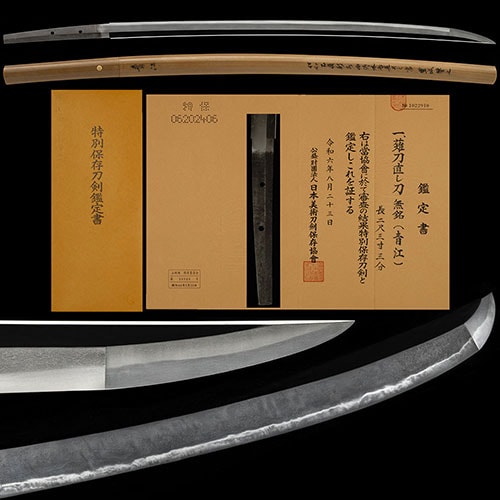
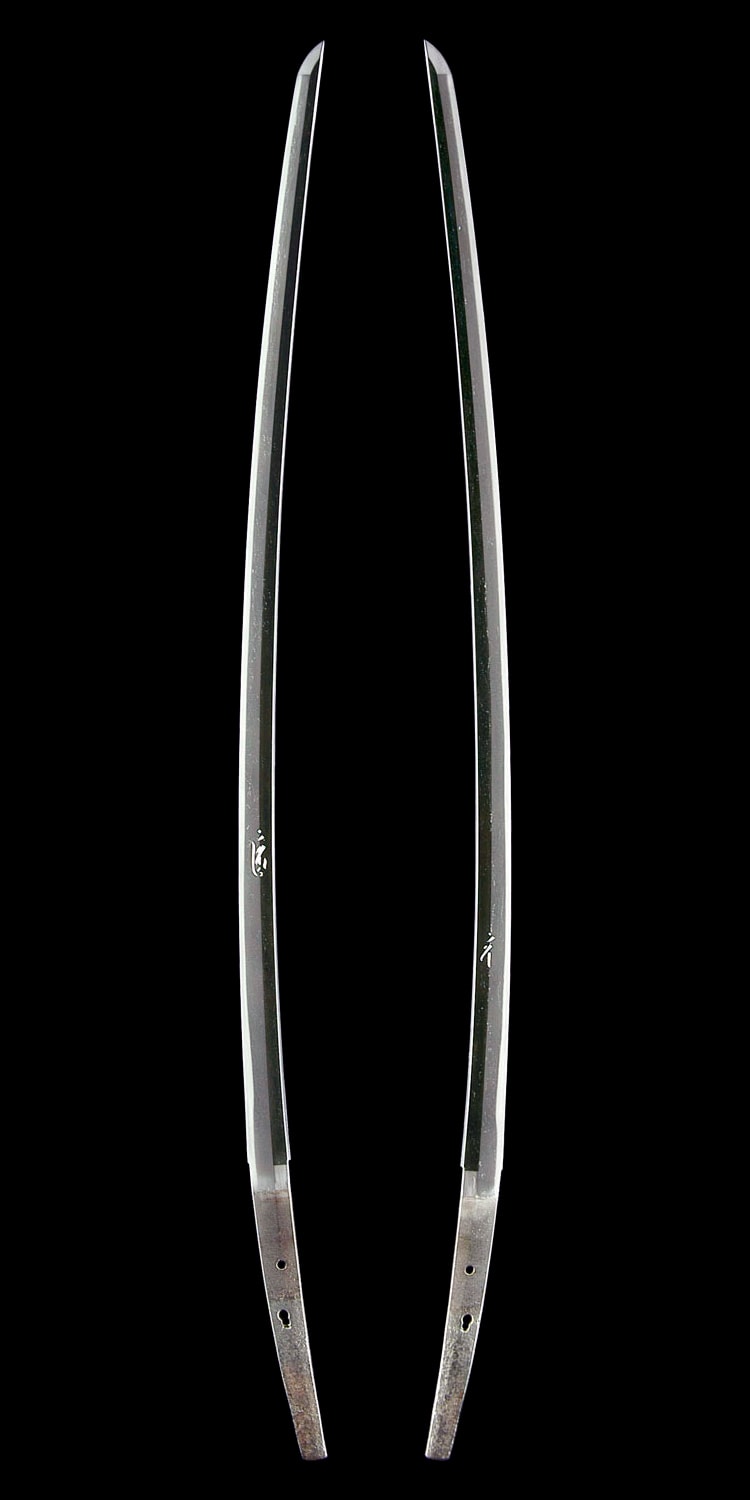
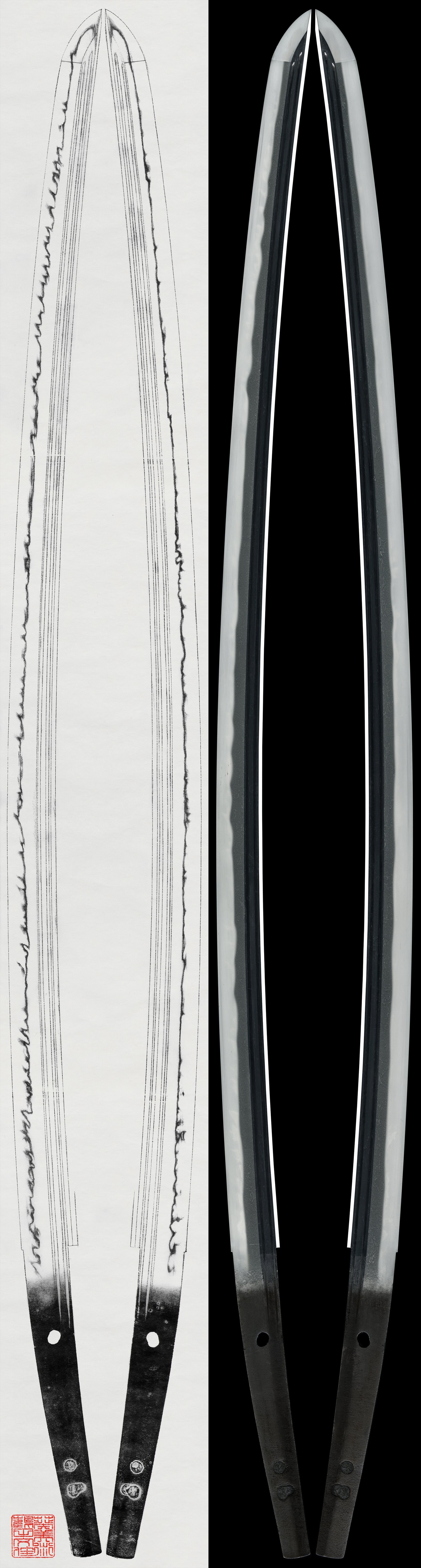
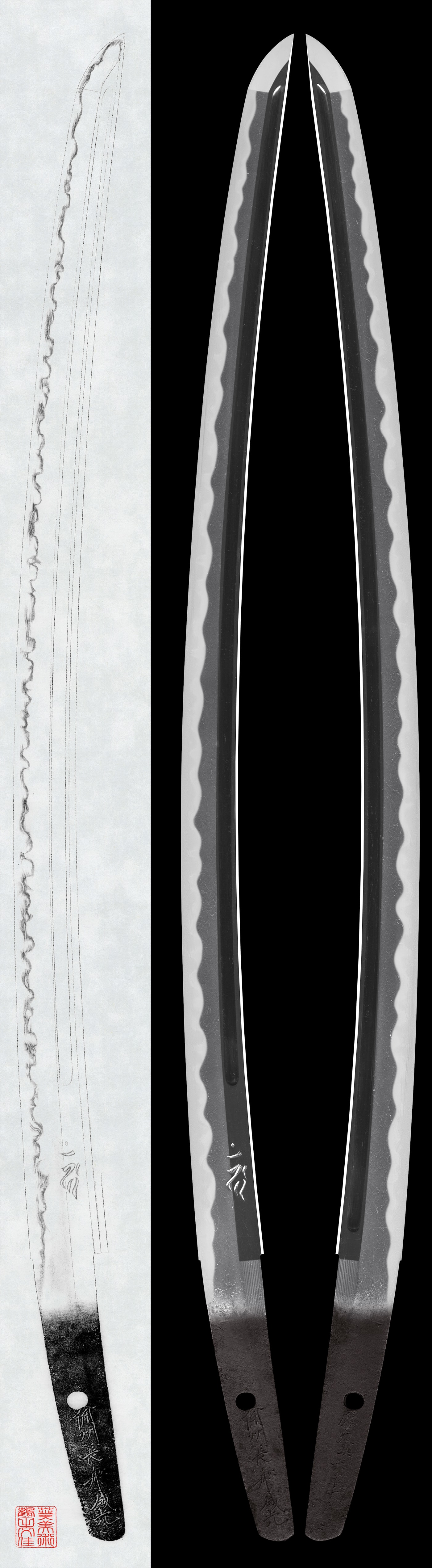
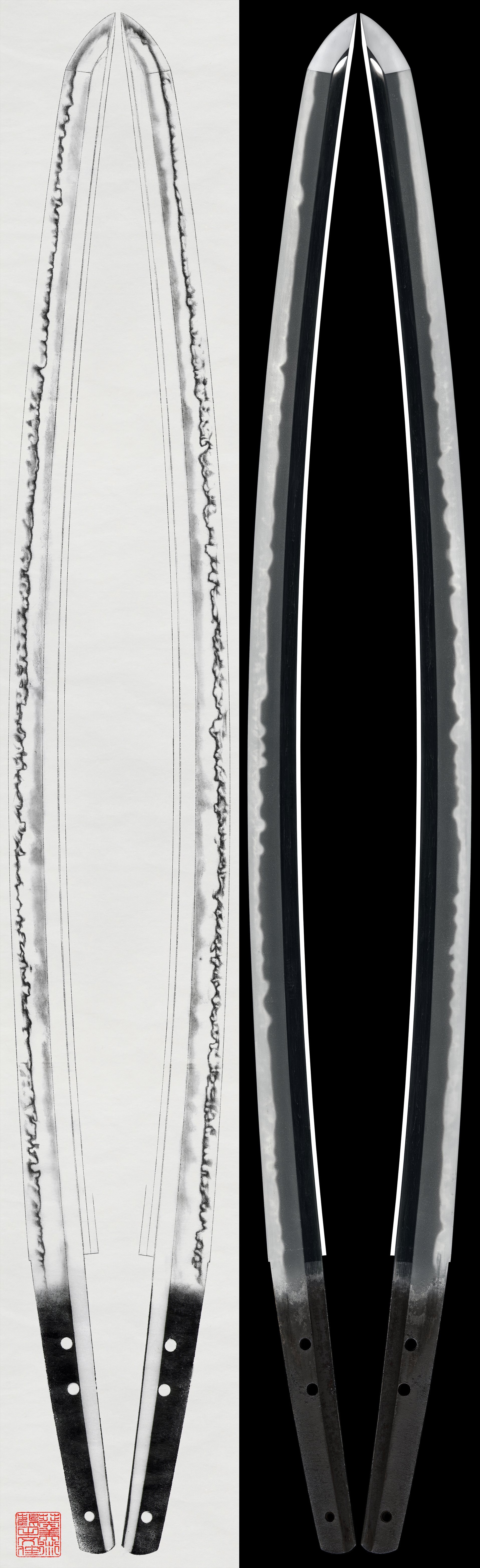
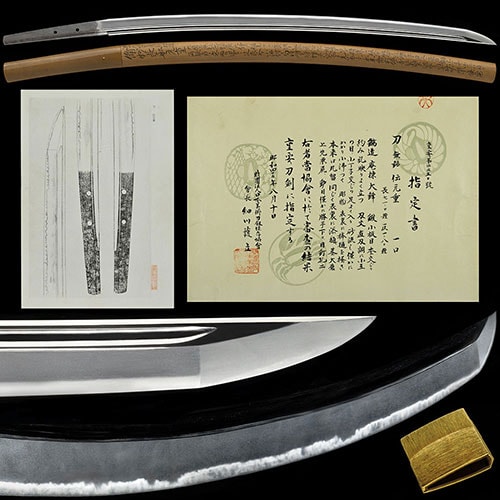
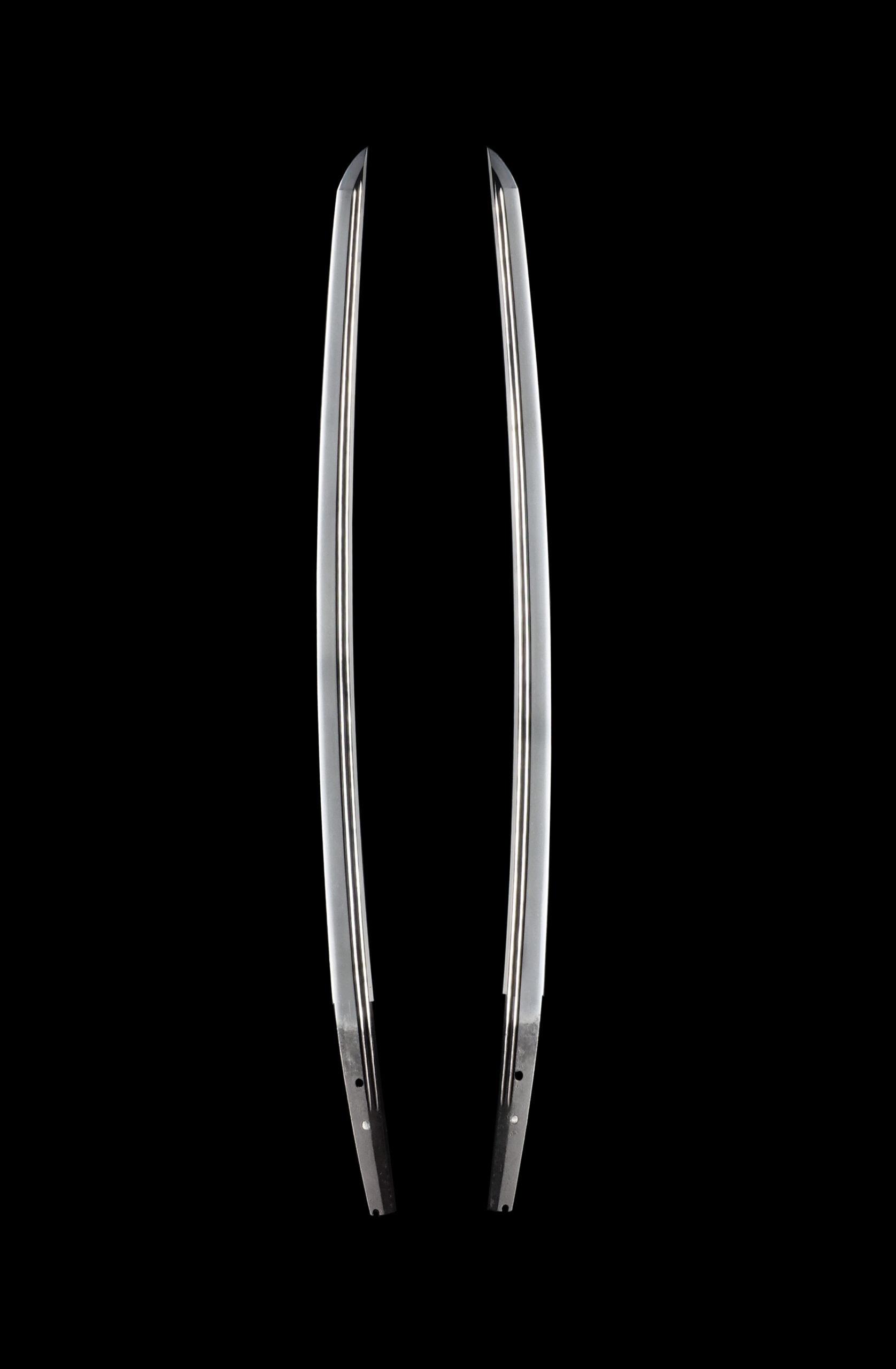
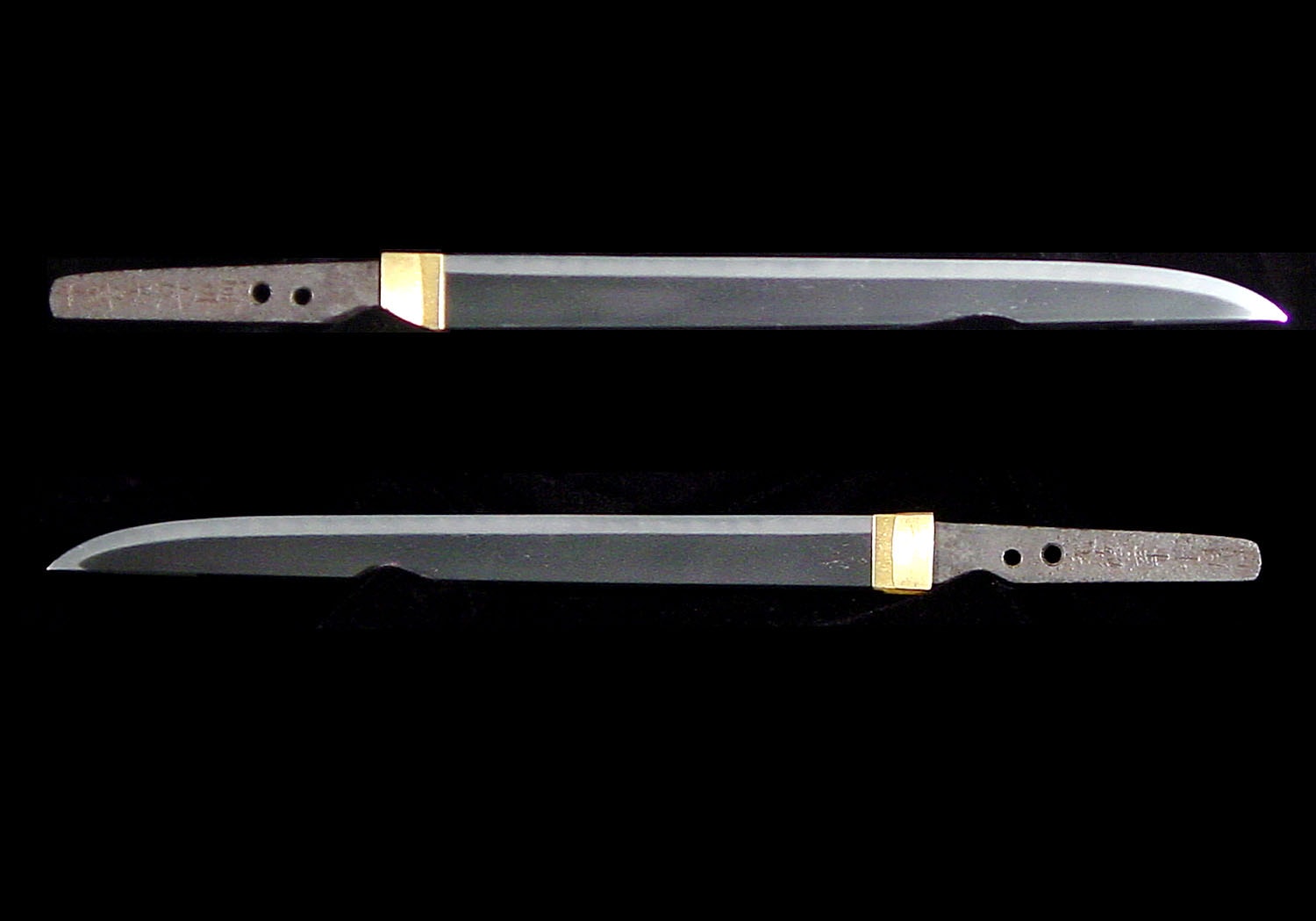
In Gentoku 1 (1329), in the twelfth month, Naotsugu (直次) of signed a small "-shū jū Sahyōe-no-jō Naotsugu" with the date cut on the reverse, and the calls it a fine piece that demonstrates the smith's high technique. He belongs to the school of , which forged along the lower reaches of the Takahashi river. The published sources divide its production in two: work to about the middle of is called , and what follows, on into , simply . The places Naotsugu's activity around the Karyaku era (1326-29); he styled himself Saemon-no-jō and Sahyōe-no-jō, and together with Yoshitsugu he is counted among the representative smiths of the school in the passage from the very end of into the opening of . His base, as the published record says of the smiths of this time, is , with many of his blades built fundamentally upon it.
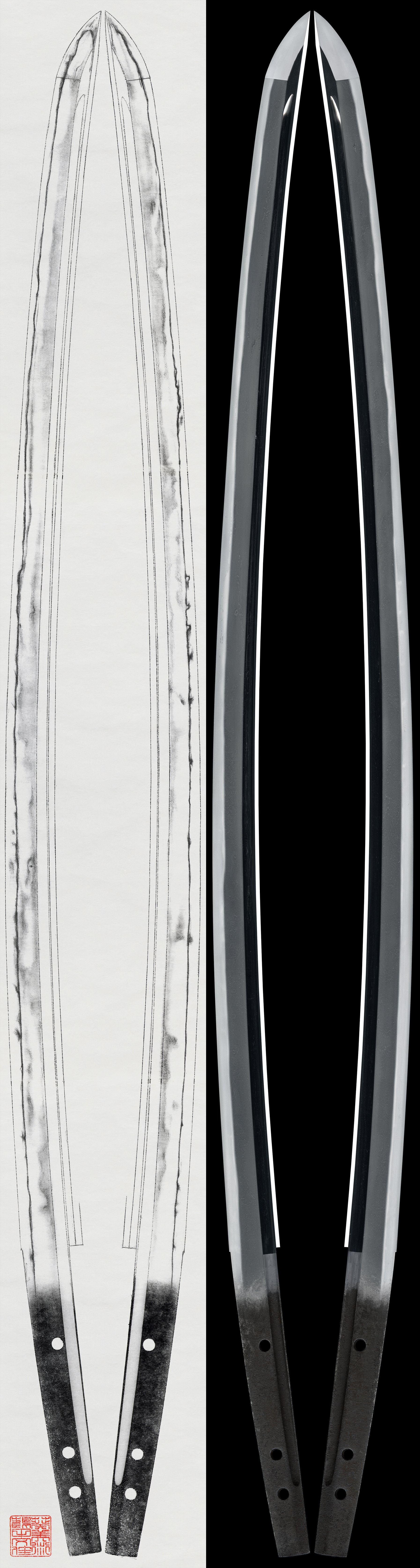
What distinguishes the hand is a controlled rather than the flamboyant of an earlier . The tightens and brightens, and small angular enter the temper, and faint run toward the base with the reverse slant the school is known for, the that the published sources read as the mark of so-called . On the widest of his the edge is a with a tight , , and , and the is bright and clear; the rises a little before its return, a slight that ends in a pointed turn. He keeps the quiet and lets the and the slant carry the work, and on the Kitaguchi the judges find in all of these points the characteristic features of this craftsman and his school.
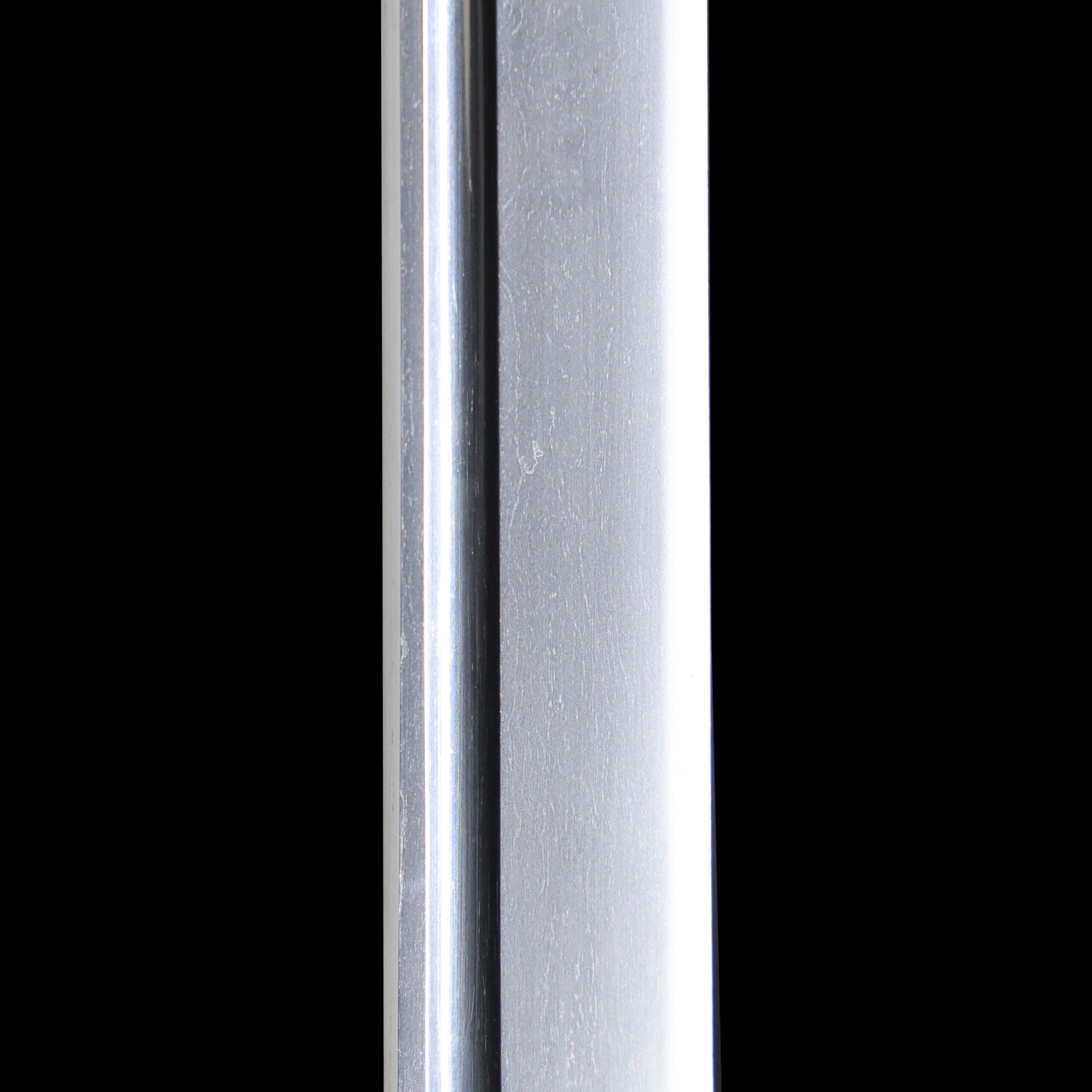
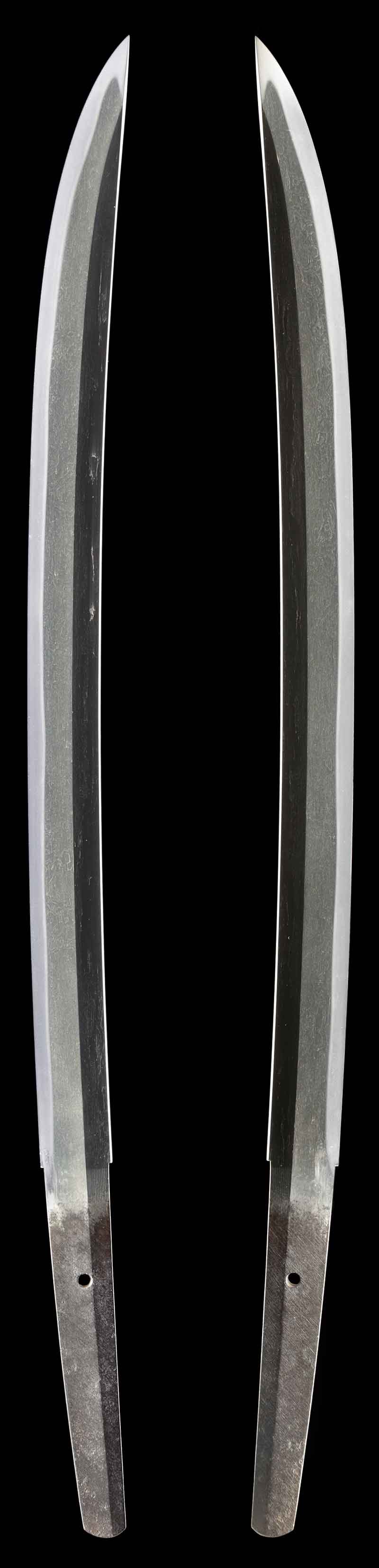
The shows the steel at full strength. A mixed with tightens into the so-called , the crêpe-like surface texture of the school, and through it run the patchy and the clear patches that are among 's surest tells. On the the forging packs down finely, thick gathers, and a faint rises across it; on the unsigned the grain stands more openly, with mixed in and a rather coarse on the edge. The temper on the Gentoku is carried down into the , a the judges single out, and the bright, clear sharpness of its is what they note above all, the hardened edge keeping its line tight and luminous. The runs straight or with a shallow and turns back in a or, more characteristically, with the tip drawn to a point.
His surviving work falls into two registers by form. The signed and dated pieces are the documentary core: the Gentoku 1 headed by the Sahyōe-no-jō title, with the long cut by a slender chisel and the date on the reverse, and the wide-bodied signed " no jūnin Naotsugu ," their long signatures preserved through shortening by being folded back into an . The published sources note that among his works the signatures including the Sahyōe-no-jō title are rare, the surviving examples of that type carrying dates of Gentoku, Shōkei and Kenmu, so the office title and the year together fix both the man and the moment. The second register is the shortened attributed to him by sight, and or with only a fragment of the province inscription left at the tang tip; here the faint, reverse-slanting on a standard are read as the well-expressed mark of , the attribution and the period alike judged secure. The reads a first and a second generation under the name, the second dated Ryakuō into Enbun, a two-generation theory the judges cite without forcing a division of the surviving blades.
What sets him apart within the school is stated in his own work rather than borrowed from a comparison. The published sources call one a clear expression of the characteristics of the late- school, Naotsugu in particular, and another the very type of the late- blade, the and the steep filing named as the school's own viewing points. His with its quiet reverse slant stands just before the school's peak, where the turns to and the characteristic saka-chōji-midare appears; his manner is the standard work that the peak would carry further. On the unsigned attributed to him the judges find the good and the workmanship good, allowing only that the shows a slight cloudiness, and they note that the former silhouette and the workmanship make both the period assessment and the attribution untroubled. The bare two-character and the file marks of the Niigata are called typical, the signature characters and the filing alike following the established conventions of the school.
The record that survives him is small and almost wholly in the designated tiers. Five of his blades carry an official designation, two of them and three , and Fujishiro rates him Jō-; the published sources praise the quality of execution repeatedly, the Kitaguchi judged thoroughly healthy in both and and the a piece that clearly expresses the style of the school of this period, of particularly excellent workmanship. No National Treasure or Important Cultural Property stands among them, and his blades carry no recorded provenance in the houses, so what a collector may realistically encounter is one of the or pieces: a signed and dated in which the late- manner is set down whole, or a shortened whose folded-back signature still names the smith. They come to light only from time to time, and a signed and dated example, and clear in both its characters and its file marks, is the kind of thing the published sources themselves treat as material of high documentary value.