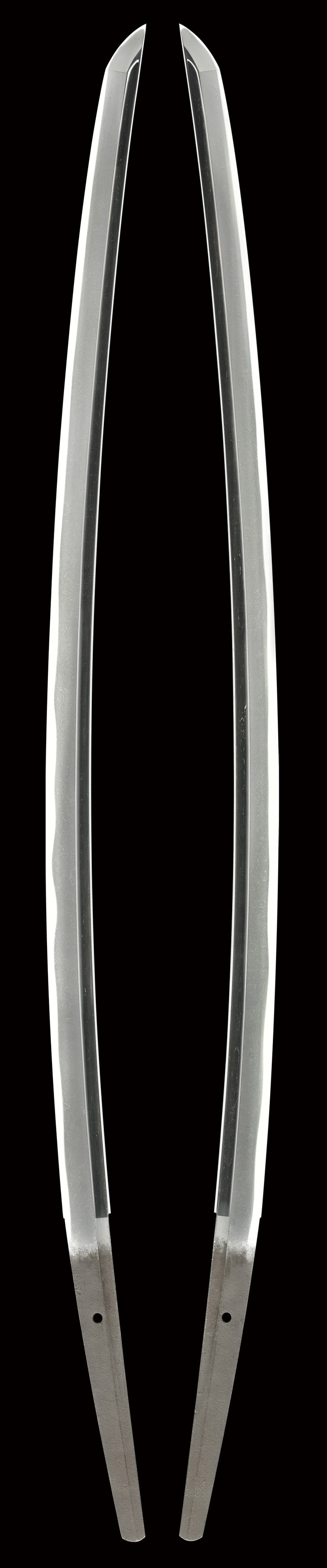
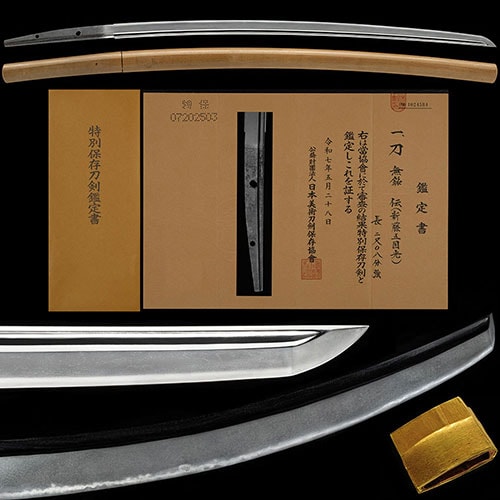
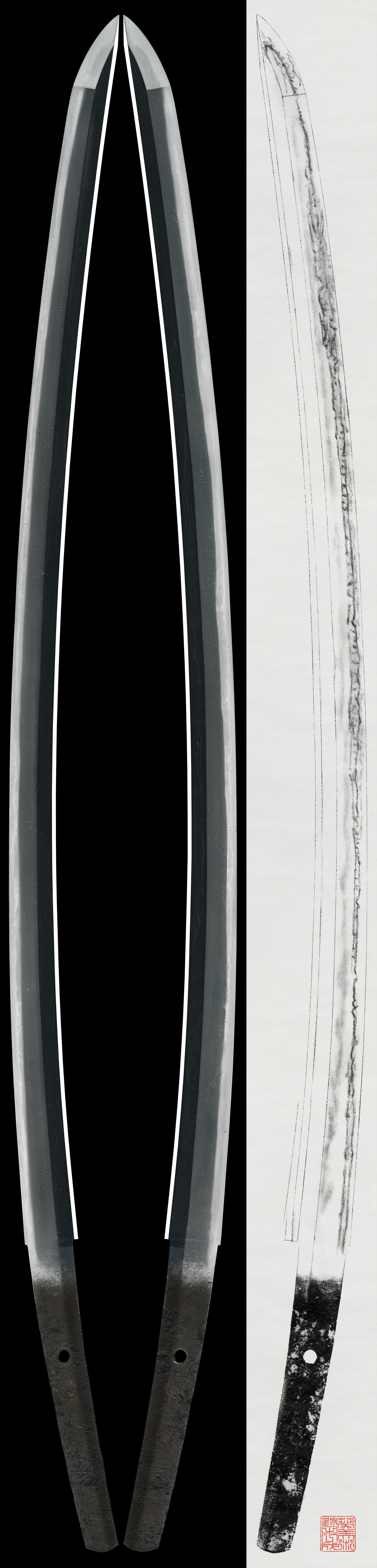
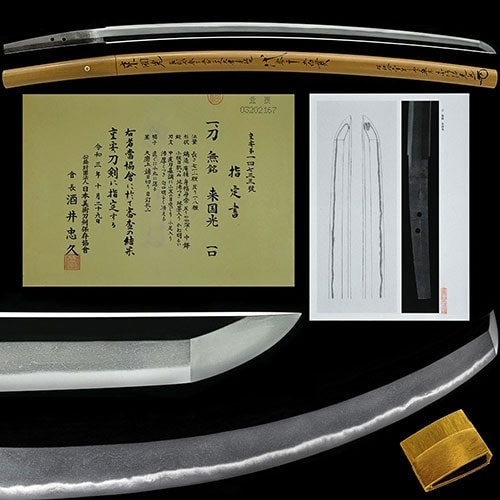
Kunimitsu, who styled himself Saemon no Jo, is traditionally held to have been the younger brother of Kuniyoshi, working within the illustrious school of Yamashiro Province during the late period. Another tradition identifies him as a son of Norikuni. Extant signed works are exceedingly rare; among the few known signed examples, the of Yoroji in Gifu Prefecture and the of the Kurokawa Institute of Ancient Cultures, both designated Important Cultural Properties, stand as representative pieces. He typically inscribed a two-character signature reading simply "Kunimitsu."
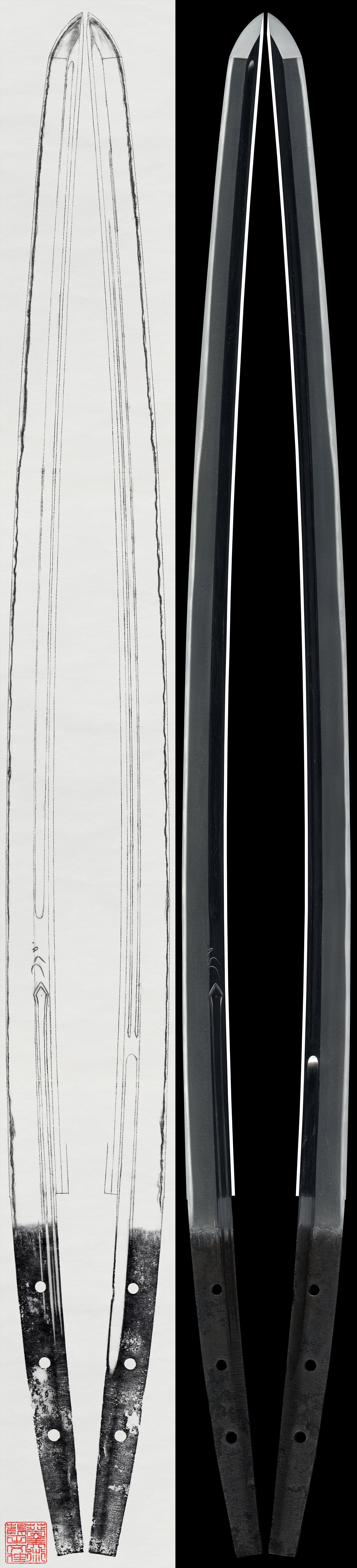
Kunimitsu's workmanship is defined by a mastery of refined steel and restrained tempering. His is characteristically a tightly forged in which ultra-fine adheres like minute particles, producing a steel surface of exceptional clarity. Abundant thread through the ground, and faint frequently appears. The is a calm or into which enter; adheres well along the temper line, with and running through and a that is consistently bright and clear. The turns in , typically straight, sometimes exhibiting . Several designated works preserve carved kaki-nagashi or , and one example retains an -style and near the base, a feature observed among other members of the group.
Kunimitsu's work embodies the highest virtues of the school: a well-refined of excellent quality united with a bright and orderly to produce blades of dignified tone and restrained elegance. Though most surviving examples are and unsigned, the consistency of his forging and tempering characteristics allows confident attribution. His blades convey a somewhat slender, gentle overall impression that, combined with the luminous , yields works of quiet authority representative of the finest Yamashiro tradition in the late period.