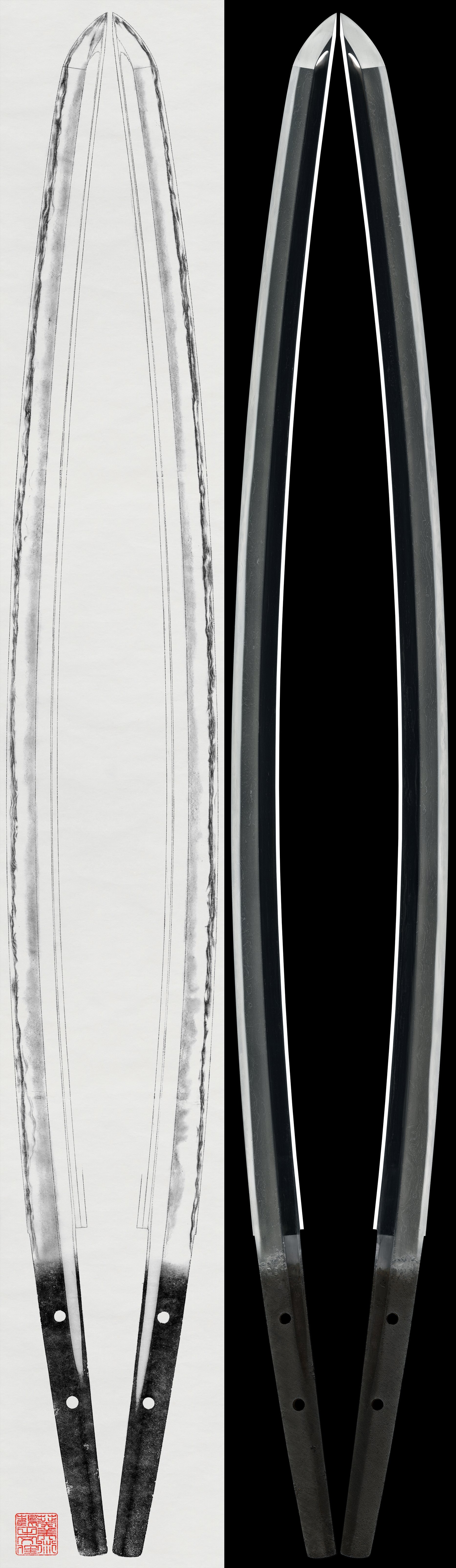
Sadakiyo worked in Takaichi District of Yamato as one of the able hands of the Hosho group, the line that the published sources single out as the most strongly individual of the five Yamato traditions. The reference works place him around the Genko era of the late period and record him as a son of Sadamune, ranking him with Sadayoshi, Sadaoki and Sadamitsu among the smiths who share the character as the common element of their names. He is the textbook Hosho hand. A of his is praised in its commentary as a piece that displays not only this smith but the whole school, "leaving nothing unexpressed" of the Hosho character, and the preservation of both and exceptionally good. He is, before anything else, a forger of .
The steel is where he is read. Every blade on record, signed and shortened alike, is forged in an all-over , at times shallowly undulating and running through to the tip and out onto the , with thickly applied and entering. Over that grain he tempers a quiet , on the a narrow , deep in with well adhered and the clear. The temper does not stand apart from the but intertwines with it, fraying repeatedly into along the , where , and uchi-noke gather with and running through. The published commentary names the school's habit exactly: from around the upward the hardened width broadens and "the attaches one step more strongly than below". The follows the Yamato manner, running straight and vigorously to a sweep with no turnback.
The repays a close look. On his more tightly forged a stands faintly over the , and on one small a -like effect rises from the , the sort of confirming detail the Hosho refinement throws up. The carving, when it appears, is sober and devotional: one carries at the and a with a companion . The tang itself is part of the signature of the school, finished with file marks and cut off bluntly, and the published sources treat that tang and abrupt as points of appreciation in their own right.
His surviving record falls into two manners of one hand. The first is the signed , of standard to slender width and thick , slightly elongated in proportion and showing the classic , on which the quiet narrow and frayed are seen at their most characteristic. The second is the attributed to him, several bearing a later that the blade was shortened by Sadakiyo. These run slightly narrow with a comparatively wide, somewhat high and a deep , the flowing strongly and the steel showing , a moist quality; over it the temper takes a shallow , low at the and broadening above the middle, with small and mixed in, and the animated vigorously by uchi-noke, , , and even sanjuba. The commentary on these calls the result "bold, and filled with commanding spirit", the Hosho idiom carried at full width. Signed works are extremely few and, tellingly for a connoisseur, no dated example by him is known; pieces are met with either a two-character signature or a four-character Fujiwara Sadakiyo, while a Hosho Sadakiyo signature and any long signature remain unobserved.
What distinguishes him is, paradoxically, how little he insists on his own person. The Hosho line is read as a school more than a roster of individuals, and the published sources are candid that among its smiths "no sharply differentiated individuality can be found", so that a is affirmed as Hosho from era and manner rather than from a personal tell. What individuality the eye can hold is in the brush of the chisel: the commentary notes his signature characters run linear with conspicuous reverse-chisel strokes, calling this "a mannerism common to the smiths of this school". Against his neighbours he is placed between Sadaoki, whose pieces tend to the smaller scale, and the coarser, strong- of Sadayoshi, his own and reading a degree calmer and more refined, in the slightly later Hosho temper.
For the collector he is a rare late- name held almost entirely in private and institutional keeping. He has no National Treasure and no Important Cultural Property on record; his standing rests instead on a thin but high spine of designated work, two pieces at and six more at , with one prewar Bijutsuhin that passed through the Okajima collection of Aichi, and two of the published in the Tsuchiya . The is the one the judges hold up as fully expressing the school, "displaying the characteristics of not only this smith but the lineage as a whole". Because signed Sadakiyo blades are so few and undated, an in- example reaches the market only seldom, a notable thing when it does; the shortened Hosho that carry his attribution come to light somewhat more often, and offer a private collector the more realistic encounter with this hand. Either way the meeting is with the purest in Yamato, a school that made its grain its signature.