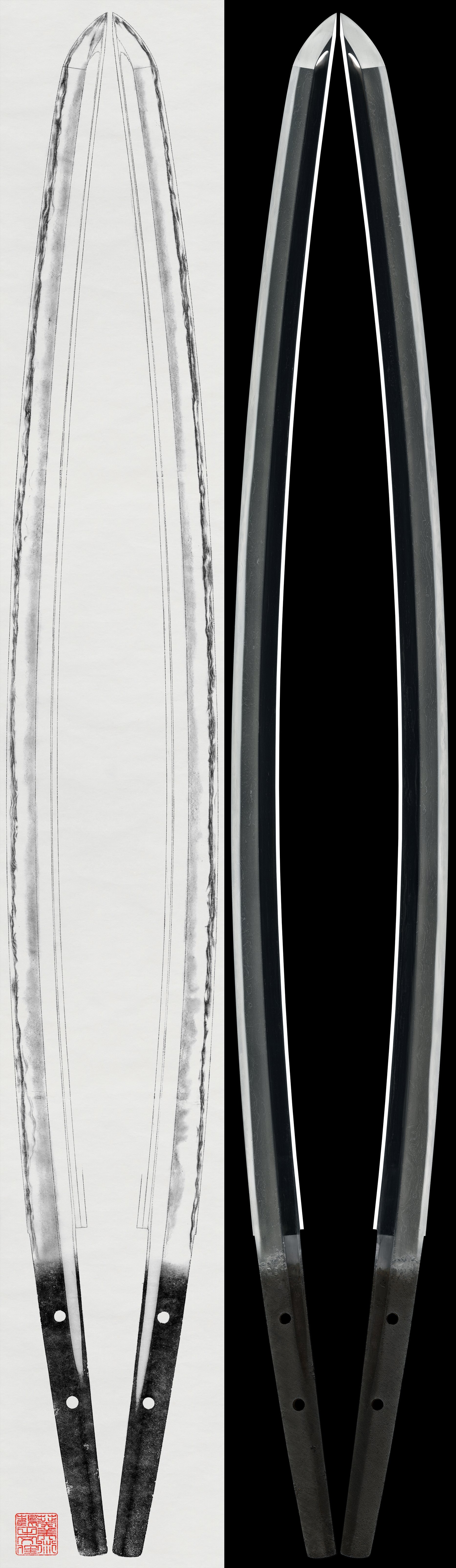
Sadaoki is a smith of the Yamato Hosho group, resident in Takaichi District of Yamato and working at the close of the period. The swordbooks place him around the Gentoku era and record him variously as a son of Sadamune in the line of Sadayoshi or as a son of Sadakiyo; with Sadayoshi, Sadakiyo and Sadamitsu he shares the character as the group's common name element. The Hosho stood apart from the rest of Yamato by the openness of its individuality, and the published sources name it so: among the five Yamato traditions its workmanship is "the most markedly distinctive". What they distinguish is a school built whole on an orderly forging, a -laden that frays as it goes, a that finishes bluntly, and a tang filed . Sadaoki is one of the hands through whom that manner is read in full.
His is, first, the . Across every blade the published record describes a , well ordered and tightly forged, at times taking on a flowing tendency, with fine adhering and entering; on the closer-grained a stands toward the . The grain is the constant and the tell, the orderly that the sources hold up as the Hosho hallmark. Over it the temper stays comparatively quiet, a deep in with well adhered and the clear. The line is not left plain. It intertwines with the grain and frequently breaks into , gathering uchi-noke, and along the , with and running through and the temper carried down into the . This is activity belonging to the rather than to the clove clusters of a edge.
The completes the signature. On every recorded blade it runs straight, vigorously , and finishes in a sweep, on some turning back in a small on the before it ends. The published sources, citing the Koji-kiron on the Hosho Goro manner, put the whole hand in a single line: "the forging is made to stand out conspicuously, the is bluntly finished in , and nothing is concealed". The school's customary animation is also noted, that from the upward "the grows broader and the adheres with greater strength"; Sadaoki's surviving tend toward the calmer end of that range.
His record divides between two forms. The body of it is the signed , small in stature and slender to standard in width with a notably thick and the inward of old Yamato work, the tang and filed , signed in two characters, in the four-character Fujiwara Sadaoki, or in a full long signature. Against these stands the rare attributed to him, slender and shortened, the well ordered, the temper a tone mixed with and broken by , , and . The published sources stress how few such survive: of Sadaoki "examples in the form of are extremely rare". No extant work of his bears a date, and the sources revise the conventional placement, observing that the swordbooks' dating to the Joji era, judged from the surviving work, "feels somewhat too late".
What sets Sadaoki within his own school is read by build and by the calm of his hand rather than by any single personal tell, the group's smiths showing no sharply differentiated individuality. The published commentary draws the line carefully: Sadayoshi's runs coarser with stronger , while the slightly later Hosho hands grow gentler and cleaner in both and . It is on exactly this basis that one is given to him, the judges reasoning that "from its small-scale construction, an attribution to Sadaoki is considered appropriate". His small, refined, thick- are the standard against which the comparison is drawn, the quiet and clean end of the Hosho line.
For the collector Sadaoki is a scarce late- name whose record runs through a small number of pieces rather than through the top designations. He has no National Treasures and no Important Cultural Properties; his standing rests on a handful of works in the and tiers, seven of them on record here, three carried to the rank. The finest is the signed whose and , in the words of the published sources, leave nothing to be desired in showing the whole Hosho group, sound and exceptionally well preserved, the more valued for being and signed. A signed survives with its gold chrysanthemum-and-paulownia mounting, and two of the are published in the Kozan . None of these blades carries a recorded current holder, and provenance for the group is thin, so a Sadaoki is encountered seldom; a signed example, and a above all, is a rare thing for a private collector to meet, and a clear document of the Hosho manner when it does appear.