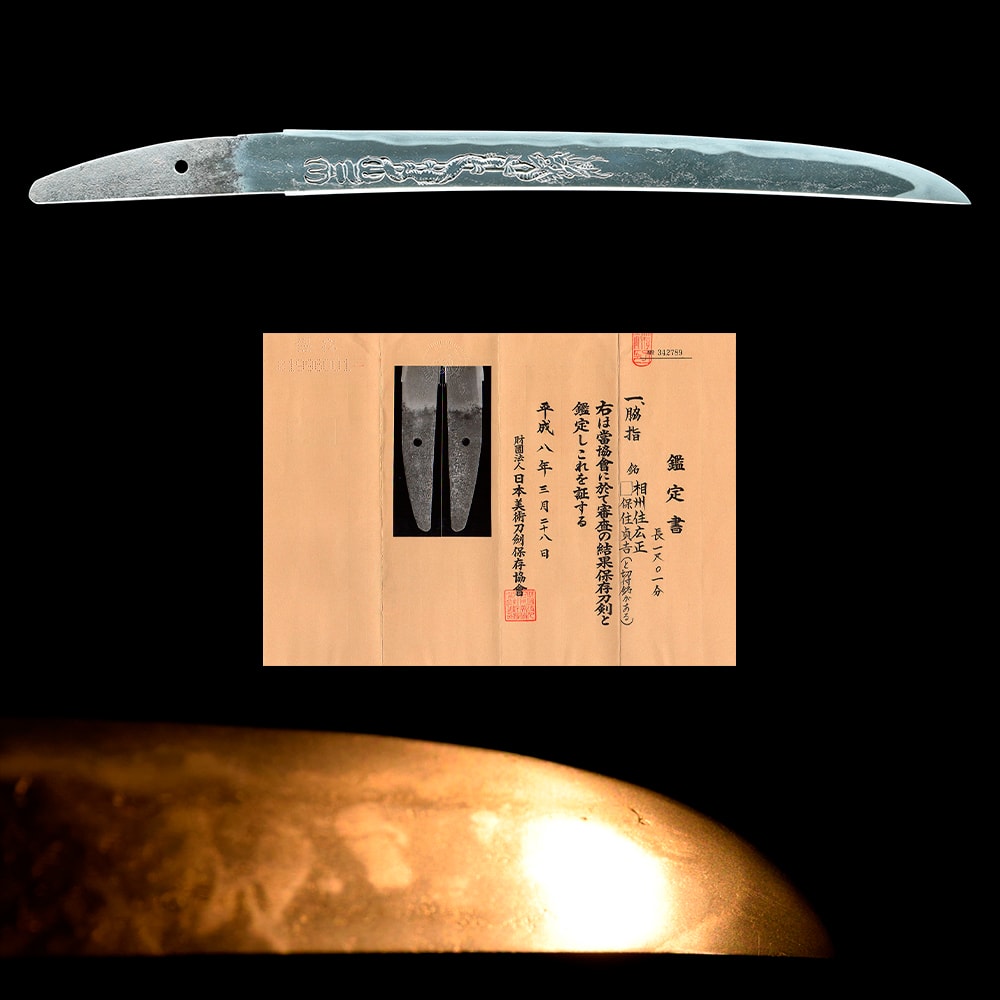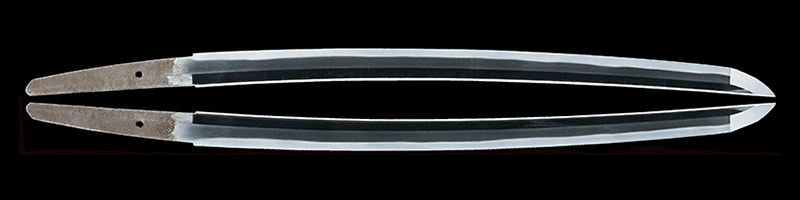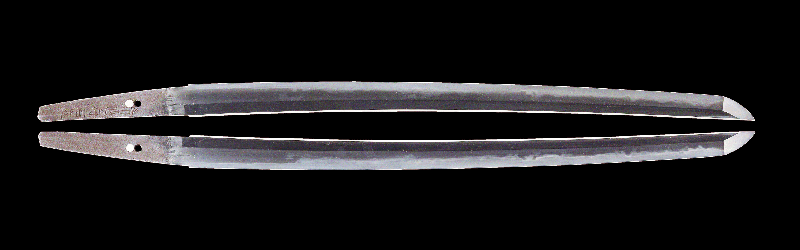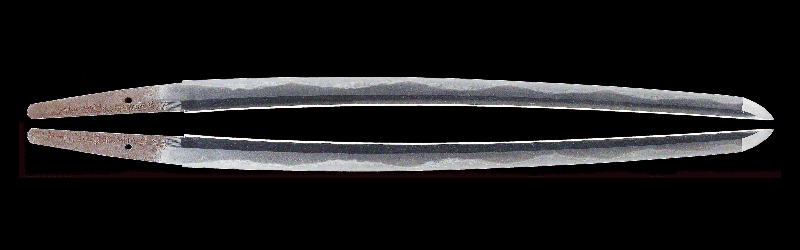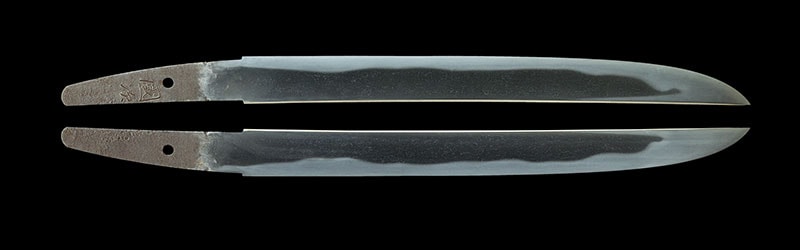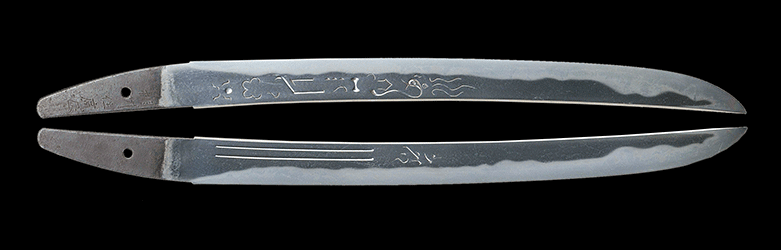
古刀 相州住広正 特別保存刀剣
SOLD
Tracked across 81 dealers worldwide · price history · sold archive
Specifications
36.3 cm
About the maker
Sue-Soshu Hiromasa廣正
Hiromasa is the mid-Muromachi Sagami smith whose few signed and dated blades fix one of the most divided names in late Soshu work. Three of his four designated swords carry a date, the tachi of Hotoku 2 in 1450 and Kosho 2 in 1456 and the wakizashi of Bunan 5 in 1448, all cut Soshu-ju Hiromasa on an unshortened tang, and it is on these dated pieces that the whole line turns. The published sources are explicit about the difficulty, observing that the Hiromasa name was borne by several generations active continuously from the Nanbokucho period through the Muromachi, each a capable hand, yet that signed examples bearing a date are exceedingly few. Their own words on one of the dated tachi run 「広正は同名が何代かあって、南北朝期から室町時代に及んで活躍しており、それぞれに上手であるが、現存する有銘且つ年紀のあるものは極めて少い」, a name worked by several hands across two centuries of which the dated survivors are the rarest. This maker is transmitted as the third-generation Hiromasa of Sagami, and he belongs to Sue-Soshu, the late Sagami line that carried the Soshu-den of Masamune and his successors Hiromitsu and Akihiro down through the Muromachi period. His characteristic hand is the gunome-midare that builds into hitatsura. Over the temper he scatters tobiyaki above the habuchi, and on three of the four blades these detached spots gather with yubashiri and muneyaki until the tempering spreads across the whole blade as the all-over hitatsura that the late Sagami school made its own. The nioiguchi stays tight and ko-nie adhere well, ashi and yo enter the temper, and sunagashi runs through it repeatedly, with kinsuji and a choji-like temper mixed with ko-gunome on the latest katana. This is the Soshu-den read in its Muromachi register, where the restrained suguha and ko-midare of the Kamakura founders has given way to a more demonstrative all-over manner. On the quietest of the four, the Bunan wakizashi, the tobiyaki gathers only near the monouchi rather than flooding the blade, so the same hand can be watched stepping back from full hitatsura toward a small midare with gunome. The jigane is the standing Sagami steel from which that temper rises. He forges sometimes a tight ko-itame and sometimes an itame that stands and opens into hadadachi, at one point mixing ohada, and ji-nie adheres across it. The construction is the middle Muromachi bearing of Sagami, a shinogi-zukuri tachi or katana of standard width with sakizori and a chu-kissaki, at times grown suntsumari and deep in sori, while the wakizashi is a broad hira-zukuri grown sun-nobi with high sakizori. The boshi answers the disturbed temper, turning in midare-komi on most of the blades, standing ichimai with a long turnback on others, and on the Kosho tachi brushed in hakikake to a pointed return. Across both faces he cuts conspicuous horimono, bonji and a grass-style kurikara, and within a koshi-hi or bo-hi he sets a sanko-ken or paired gomabashi rods in raised relief, the carving fine and the relief well-raised. The published sources count this carving among the distinctive merits of every one of these blades; of the Hotoku tachi they write 「地刃に時代の様相と相州物の伝統的な作風を見せ、彫物もまた特色あるもので見事である」. Because the generations cannot be told apart with certainty, the dated and ubu-signed pieces do double duty as workmanship and as documents. The undated katana of the 25th session is judged to date to around the Hotoku era on the evidence of the others, the published sources stating plainly of the name 「年紀作は稀であり、各代の区別は明確にし難い」, that dated works are rare and the several generations difficult to separate. So the record proceeds by anchoring the rest of the line to the few inscriptions that survive, and the Bunan wakizashi adds an instructive accident: its date inscription was reduced to a soko-mei on the tang reverse when a bo-hi was carved in later, legible but, in the words of the published commentary, regrettable, a detail that itself records the carving habit of the line. The hand is read as one Sagami manner across these four, not as separate styles, the variation between full hitatsura and a quieter monouchi temper being the range of a single workmanship rather than the mark of distinct masters. Within the Sagami succession Hiromasa stands at a working centre rather than at a founding edge, the school whose technical identity is bold hitatsura over a standing itame with accomplished carving. His own midare-utsuri-free, nie-laden jiba and his pointed, disturbed boshi set him within that idiom rather than against any rival, and the published sources read each of his blades as the period itself made visible, calling the Kosho tachi 「この時代の相州物の典型的且つ代表作の一口」, a typical and representative example of Sagami work of its time. The line he carries is bound forward into the principal Odawara-Soshu succession, for the school commentary transmits that the first-generation Tsunahiro, active in the Tenbun era, was a descendant of Hiromasa, summoned by Hojo Ujitsuna to Odawara and granted the character tsuna to change his name, a lineage reaching into the shinshinto period. His mid-Muromachi hand, with its hitatsura and its devotional carving, stands among the foundational manners that the later Odawara smiths, Tsunahiro and Tsunaie among them, carried to the end of the feudal age. Hiromasa is known through a small and uniformly signed designated record of four Juyo blades, the wakizashi of the 17th session, two tachi of the 18th, and the katana of the 25th, every one ubu and cut Soshu-ju Hiromasa, three of them dated. His skill is rated Jo saku in the Fujishiro ranking, and the published commentary calls his work splendid, the workmanship of the dated tachi excellent and the carvings distinctive. There are no National Treasures and no Important Cultural Properties among his blades, and no provenance is recorded for any of them, so the honest measure of his standing is the rarity itself, the few ubu and dated survivors of a name that several generations worked across two centuries. For a private collector his swords are encountered only seldom, all four at the Juyo level, none locked away as national patrimony but none coming to market with any frequency either; a signed and dated Hiromasa, of the kind the published sources hold up as the documentary anchor of the whole divided name, is among the less common things a student of late Soshu work is likely to meet, and a quiet reward when one does, for in it the Muromachi register of the Soshu-den can be read whole.