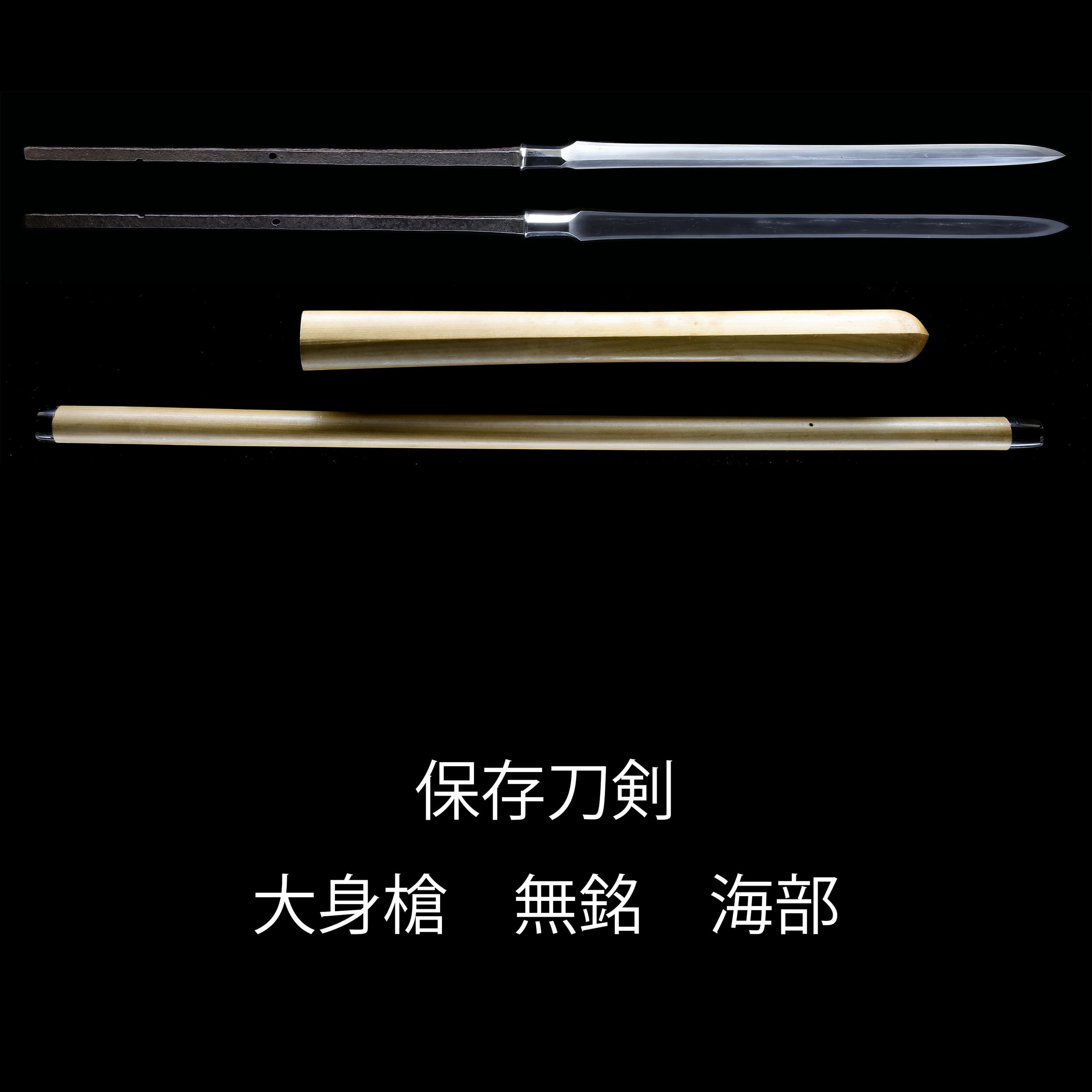
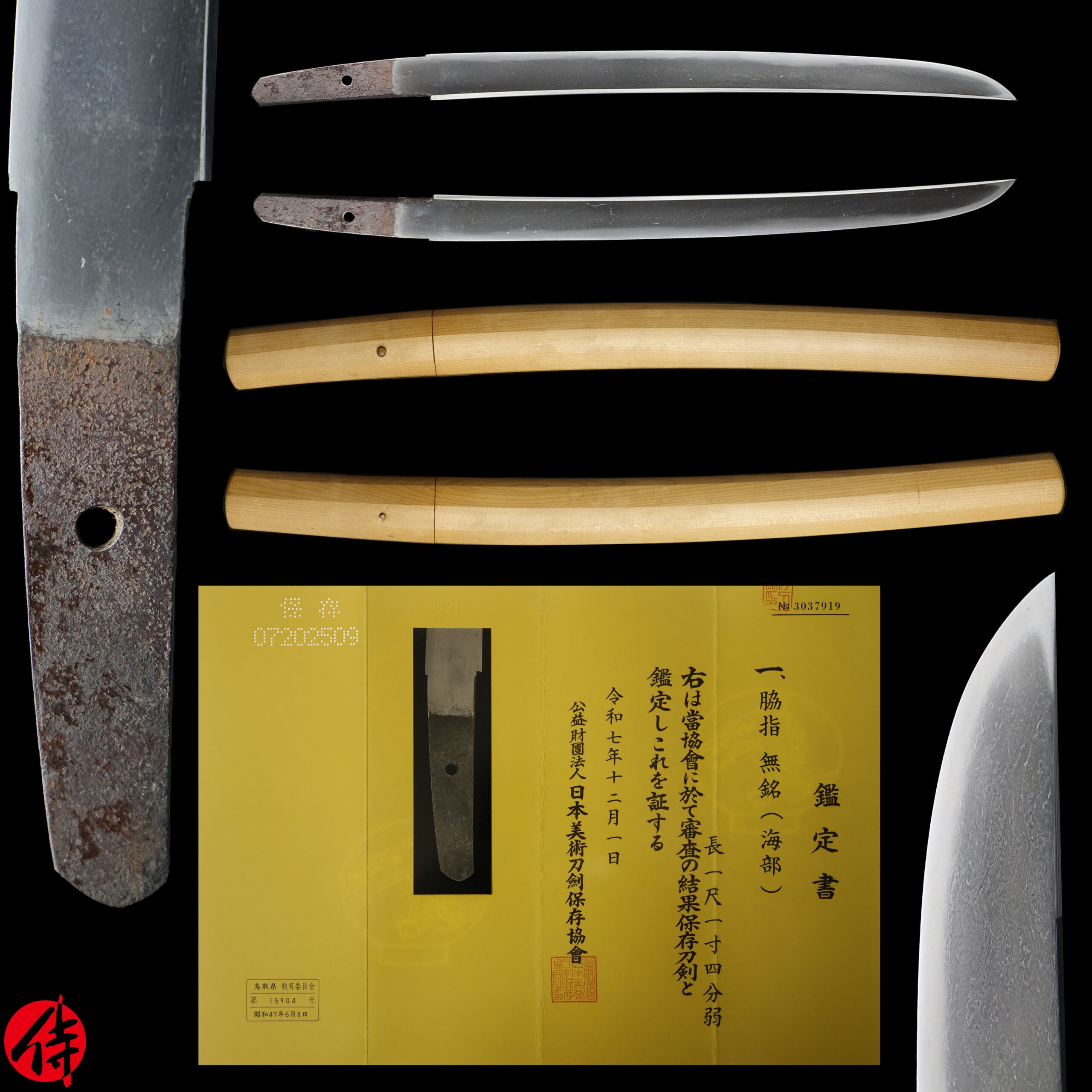
保存刀剣 無銘(新々刀海部)
SOLD
Tracked across 81 dealers worldwide · price history · sold archive
Specifications
76 cm
0.8 cm
3.46 cm
2.55 cm
About the school
Kaifu School海部派
The Kaifu group (*Kaifu-ha*, 海部) takes its name from the Kaifu district of Awa Province on Shikoku, in the region of present-day Tokushima. The *Kotō Meizukushi* and the *Kokon Meizukushi* place the founder as Kaifu Tarō Ujiyoshi (海部太郎氏吉), set around the Kōryaku era (1379-1381), and record a second strand said to descend from a pupil of Naminohira around the Ōan era (1368-1375) who signed with the single character Fuji (藤). No blade securely traces back to those origins, and the setsumei are consistent that the group's documented activity belongs to the Muromachi period, growing conspicuous from its latter half. The smiths who appear by name on the designated blades are Ujiyoshi (氏吉), Ujishige (氏重), Yasuyoshi (泰吉) with a Daiei 5 (1525) example, and Yasunaga (泰長), placed around the Daiei era; one tantō by Ujishige is read as the earliest of the line, end of Nanbokuchō into early Muromachi. A shintō continuation survives in Fujiwara Ujiyoshi of Kaifu in Ama district, working in the Kyōhō era (1716-1736), whose hand the setsumei describes as late *kotō* in appearance, his ancestors' manner carried forward without absorbing other provinces' shifts. Forging across the group runs to *ko-itame* or *itame* that often flows and inclines toward *masame* near the edge, with *ji-nie* and *chikei* that the setsumei repeatedly call subdued or lacking strong brilliance; *shirake-utsuri* and a faintly blackish *kanairo* recur. The temper is most often a *suguha* base, from a narrow line on the *tantō* to a broad *suguha* mixed with *ko-notare*, *gunome*, and *midare*, the *nioiguchi* frequently hazy and oceanic (*bōyō*) rather than tight, with *ko-nie*, *kinsuji*, and *sunagashi*; *bōshi* turn back in *ō-maru* with long *kaeri* or run *midare-komi* with a *togari* tendency. The signature Kaifu form is the *hira-zukuri* *tantō* of wide *mihaba* and slight *uchizori*, carrying a *bonji* with *suken* and *gomabashi* cut as deep *kaki-nagashi* grooves, the long *mei* boldly chiselled in thick strokes. The setsumei also note the *kiriba-zukuri* wakizashi known as Kaifu mountain swords (*Kaifu no yamatō*), and a high, thick build of utilitarian character; a flowing *masame*-tinged *jigane* with hazy temper and a coarse, *bōbō* nie reads as the group's ordinary signature, while finer pieces in the same idiom step above it. For kantei, a deeply tempered *suguha*-based blade whose *ko-itame* carries dense *ji-nie* can at a glance suggest Go Yoshihiro, and the group's drift toward a Naminohira manner and the old saying that Kaifu work "changed into E" mark the lines along which it is read. The standing of these smiths rests on cutting character: the *meibutsu* Iwakiri Kaifu, a katana by Ujiyoshi recorded in the Kyōhō *Meibutsu-chō*, takes its name from its sharpness, was held by the Miyoshi of Awa with whom Miyoshi Nagayoshi is said to have won martial exploits, and passed thereafter to the Kuroda of Fukuoka. The Ujishige *tantō* once in the collection of Itō Miyoji is published in the *Kōzan Oshigata*; a katana by the later Yamato Daijō Ujishige stands at Hiromine Shrine; and two wakizashi by Fujiwara Ujiyoshi were given to the Imperial Household Agency by volunteers from Tokushima. Signed Kaifu blades are few, which makes each named example reference material for the group as a whole.