
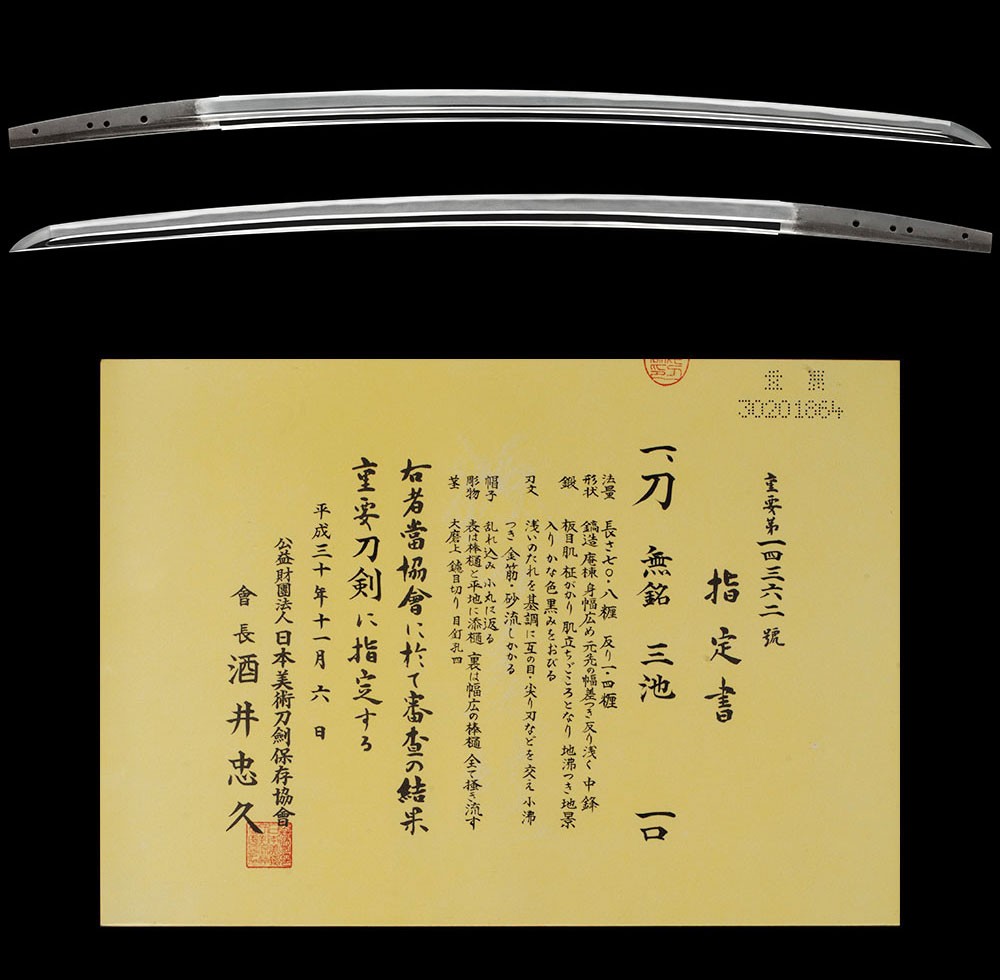
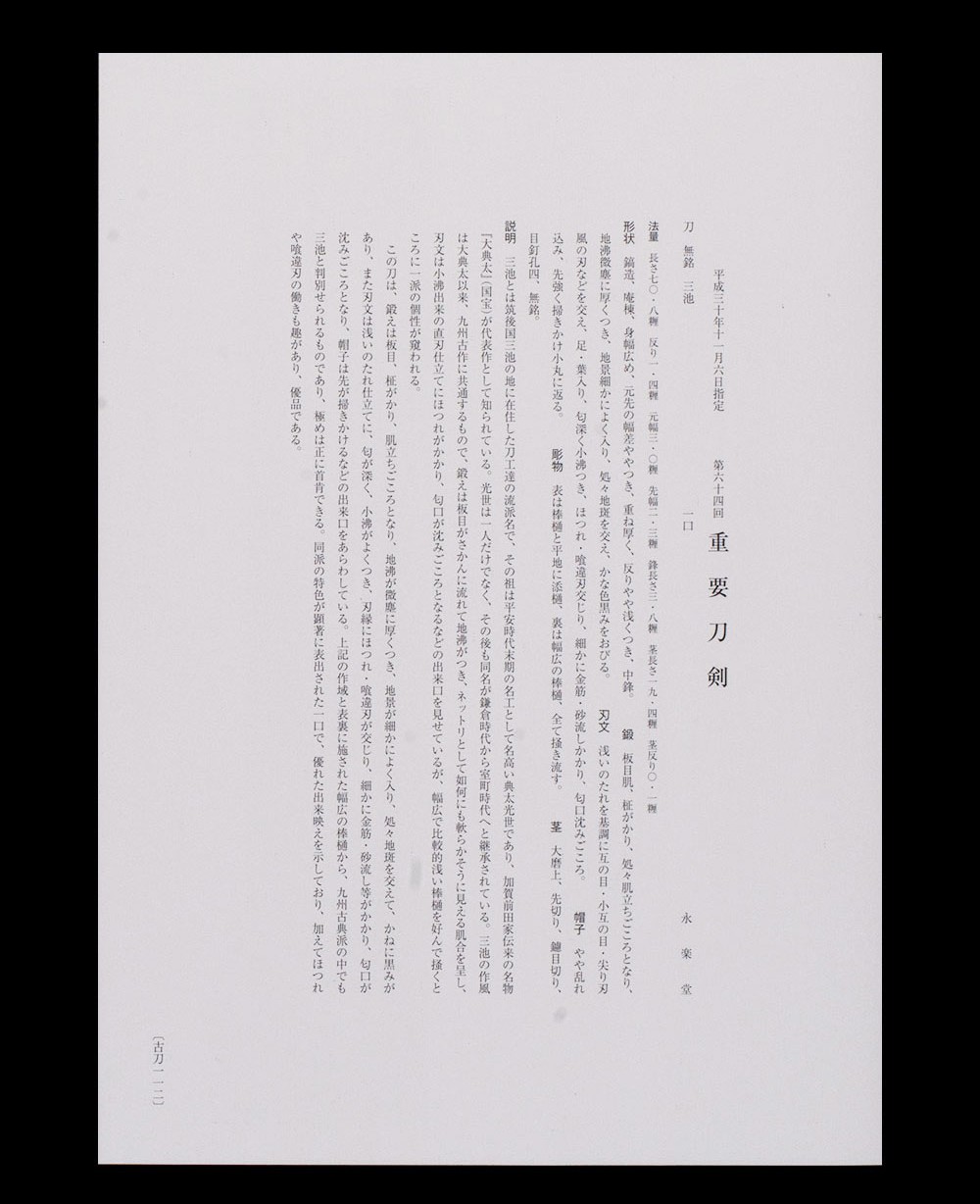

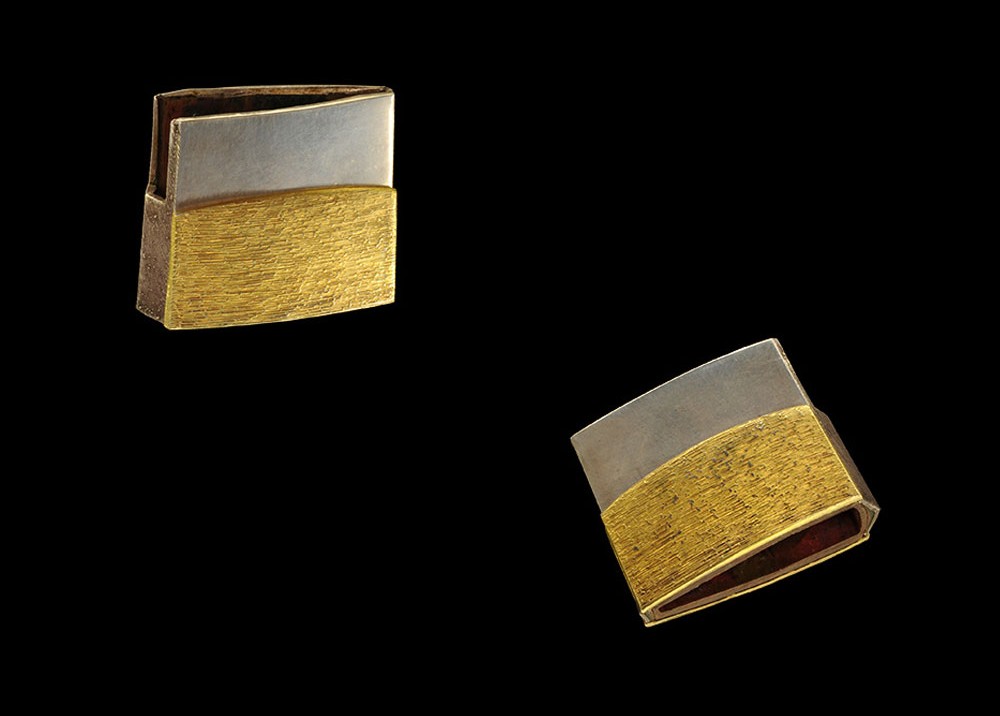
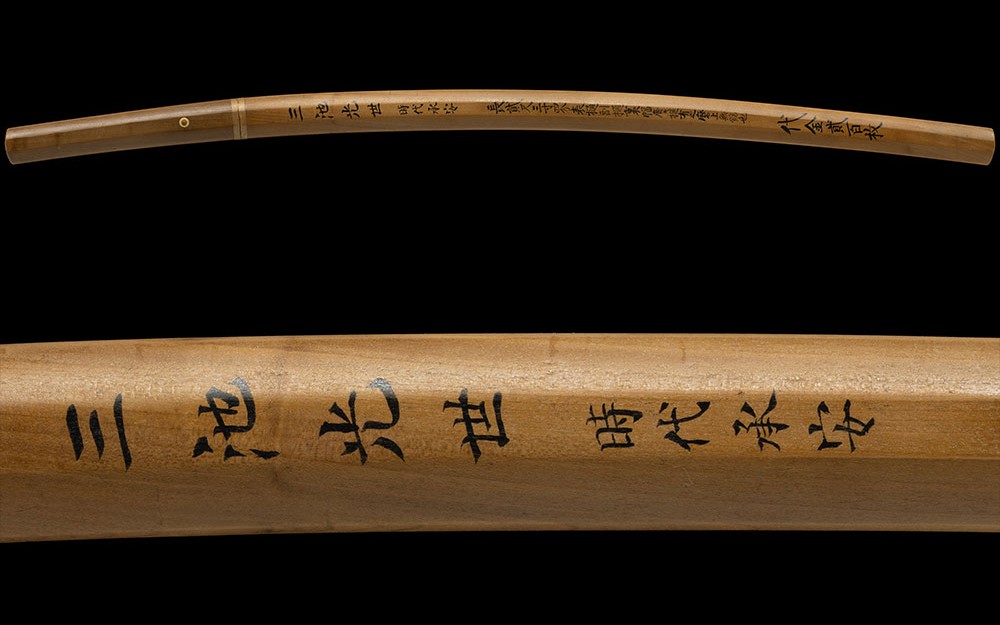
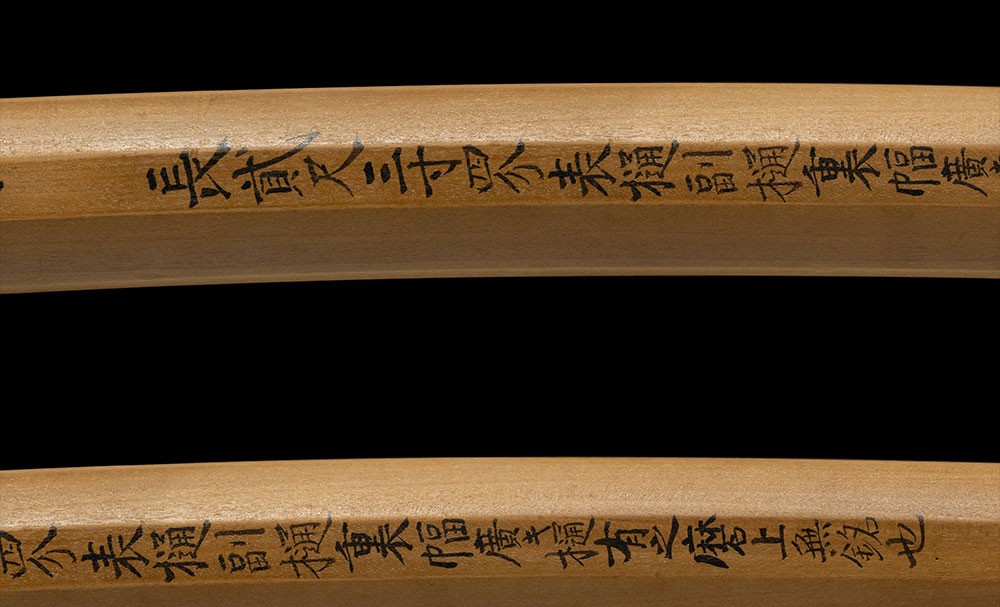
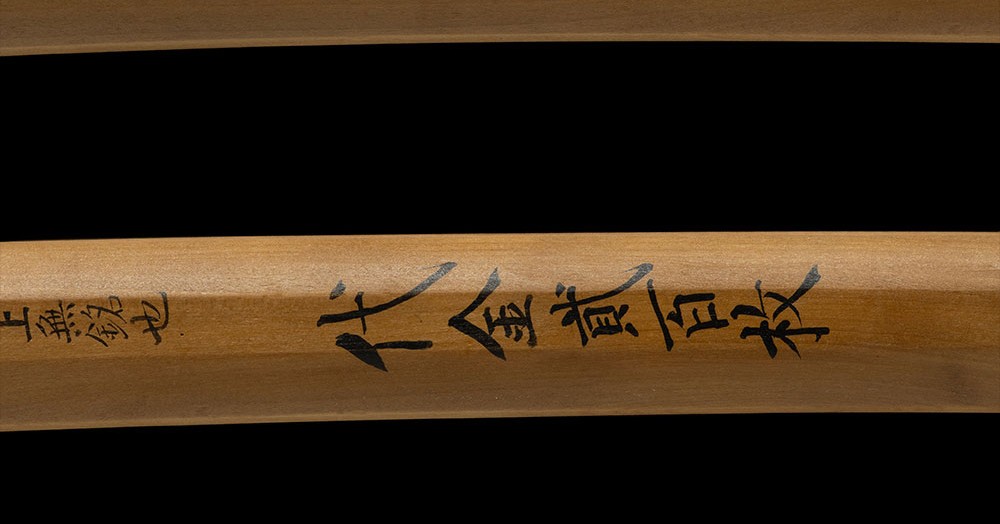
-, 64th Session — Designated November 6, 2018
, : Miike (三池)
Measurements 70.8 cm, 1.4 cm, 3.0 cm, 2.3 cm, 3.8 cm, 19.4 cm, 0.1 cm
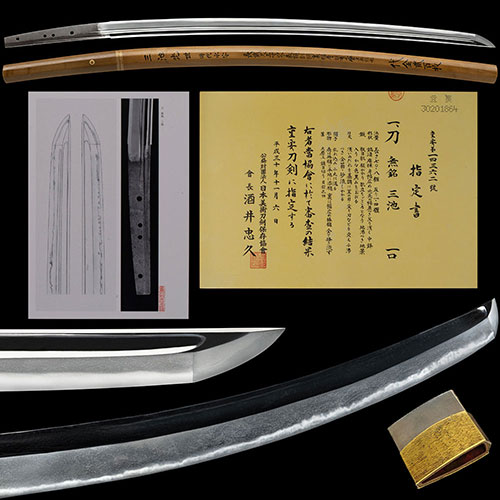
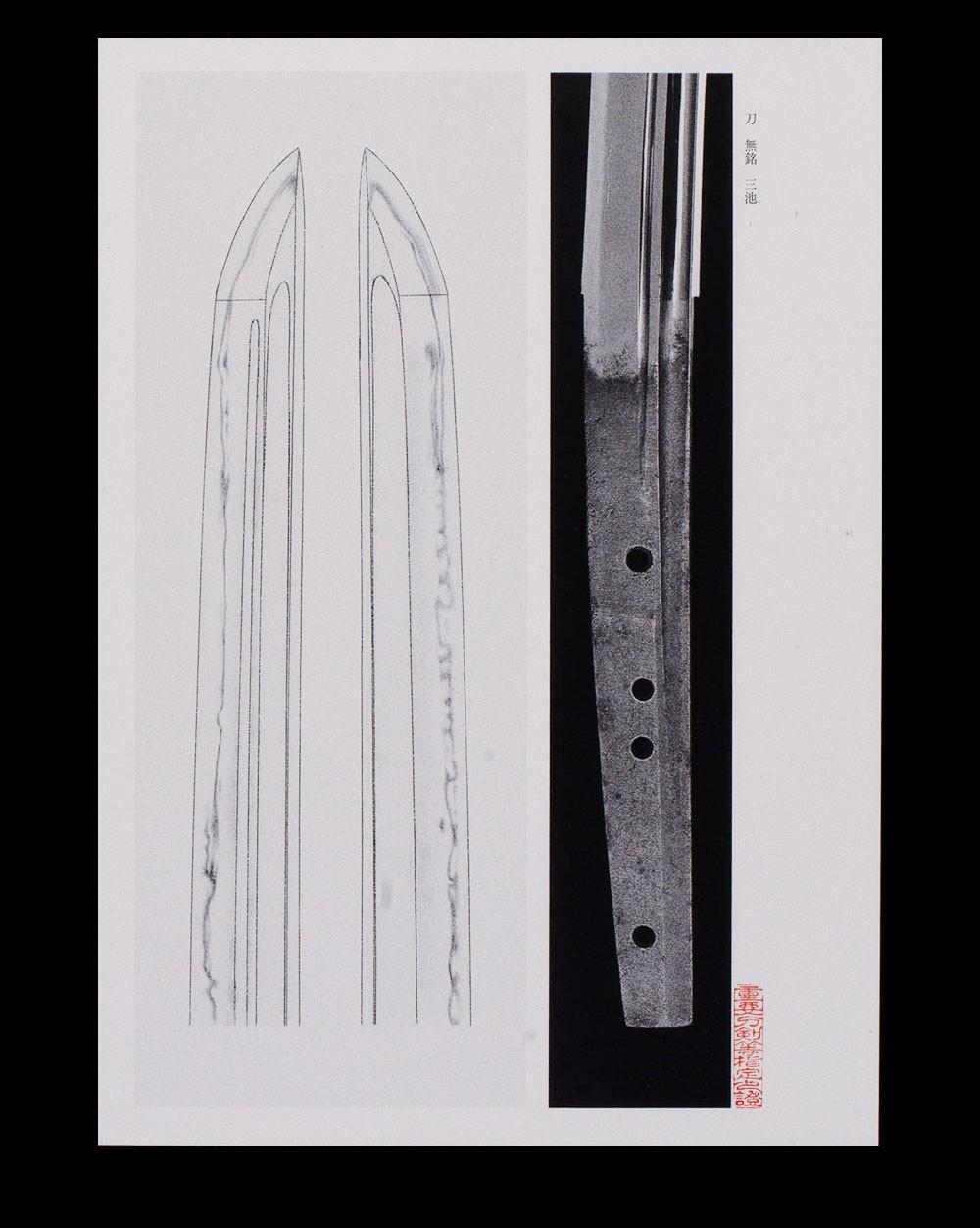
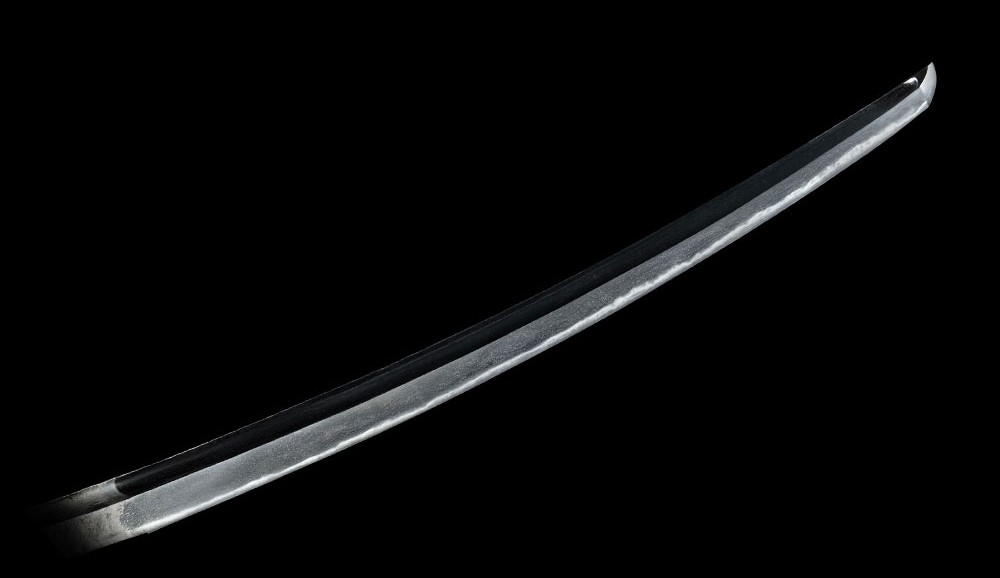
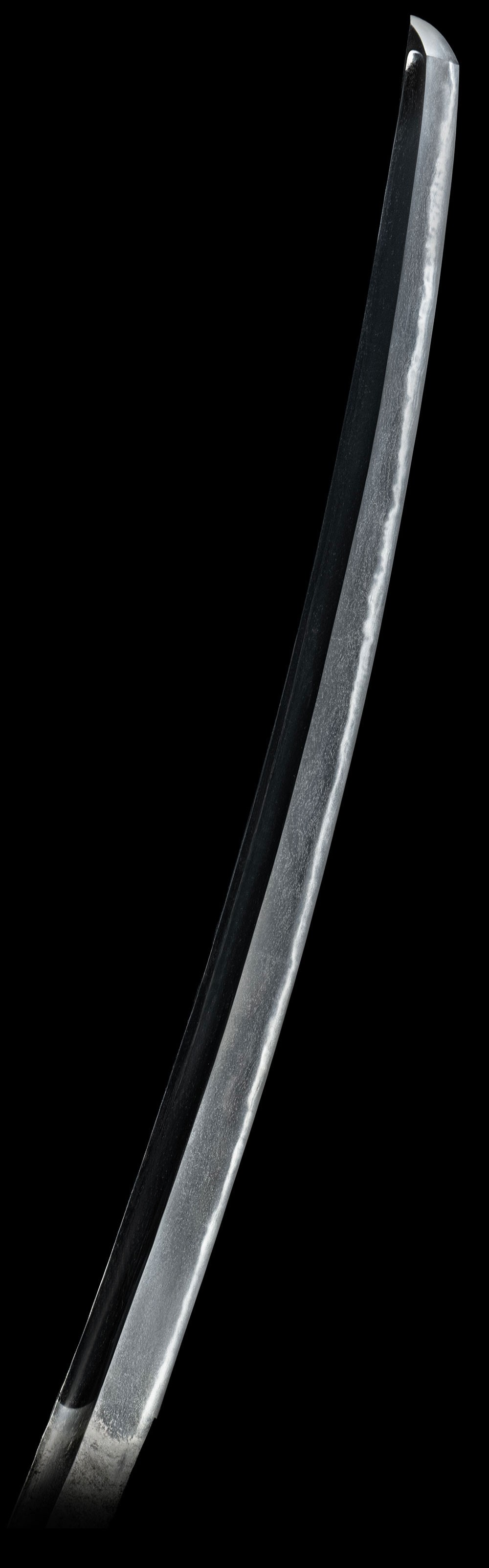
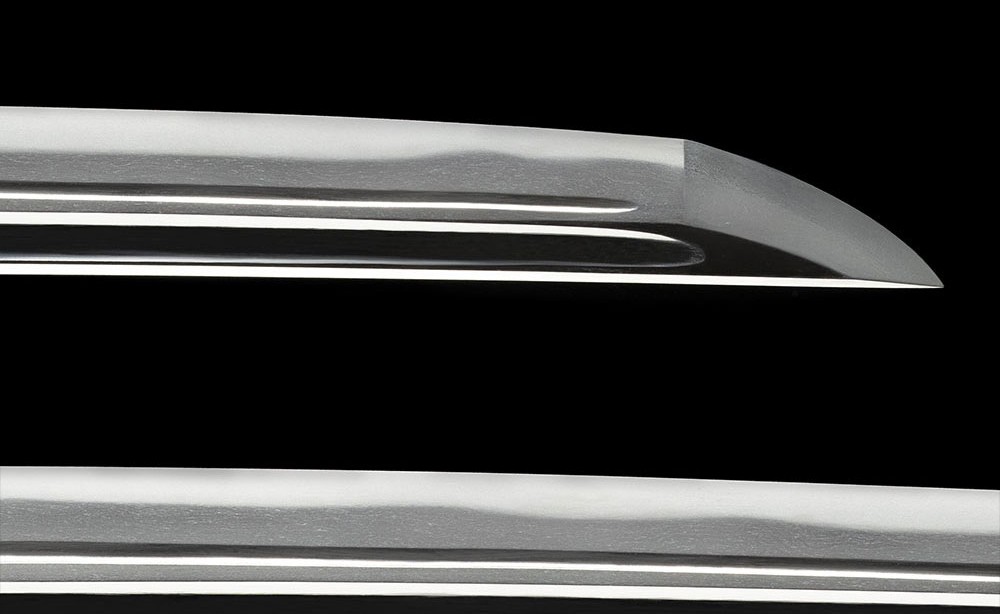
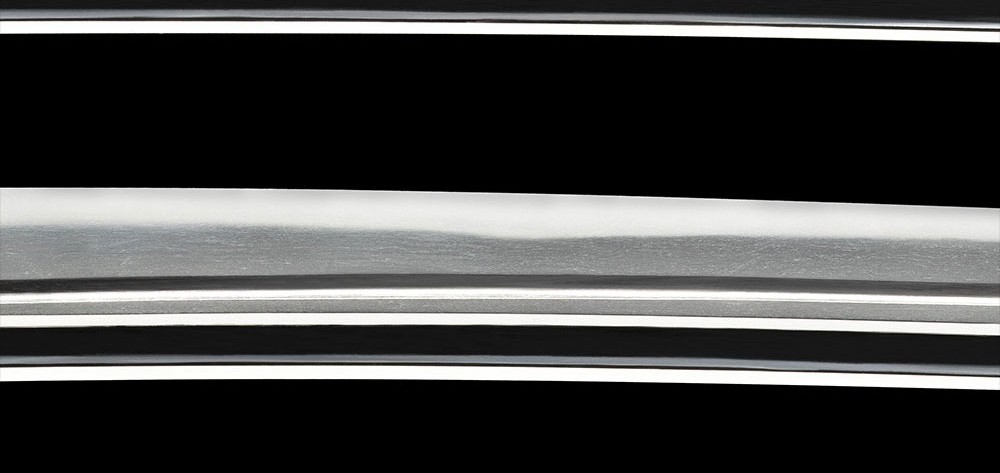
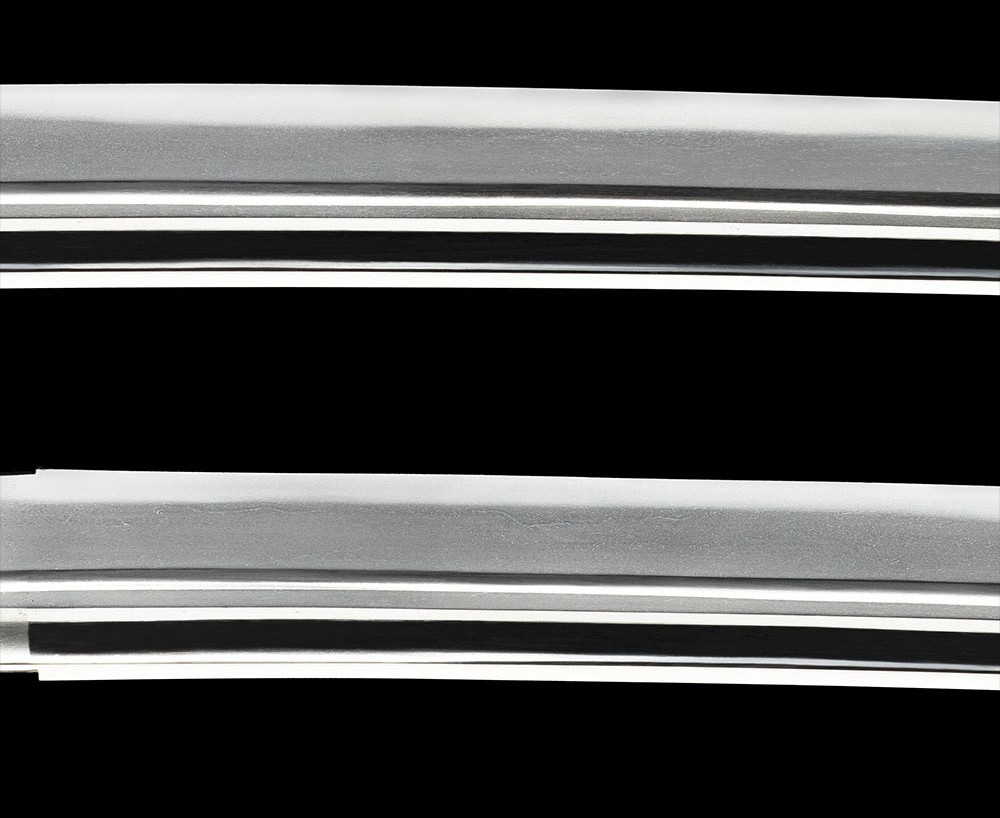
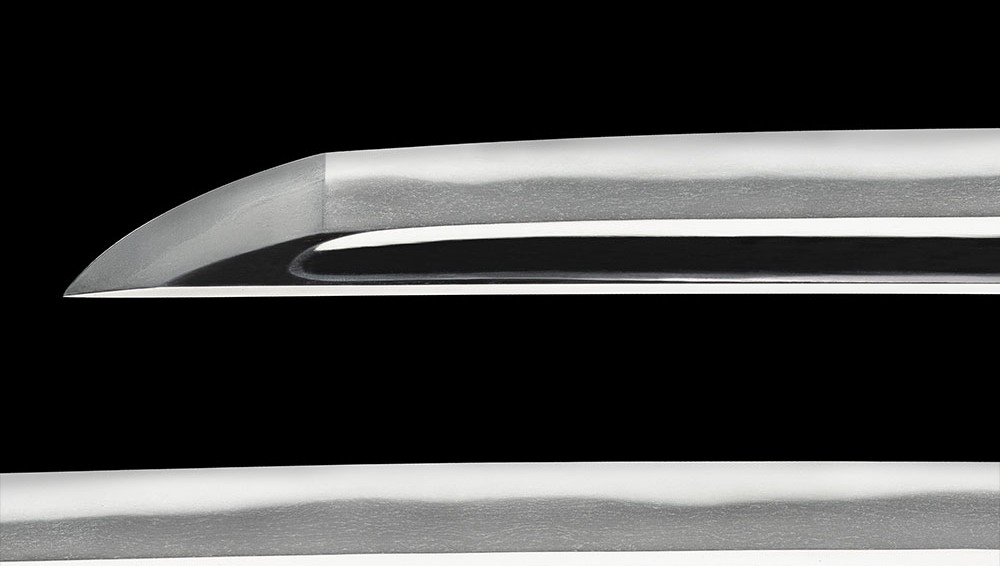
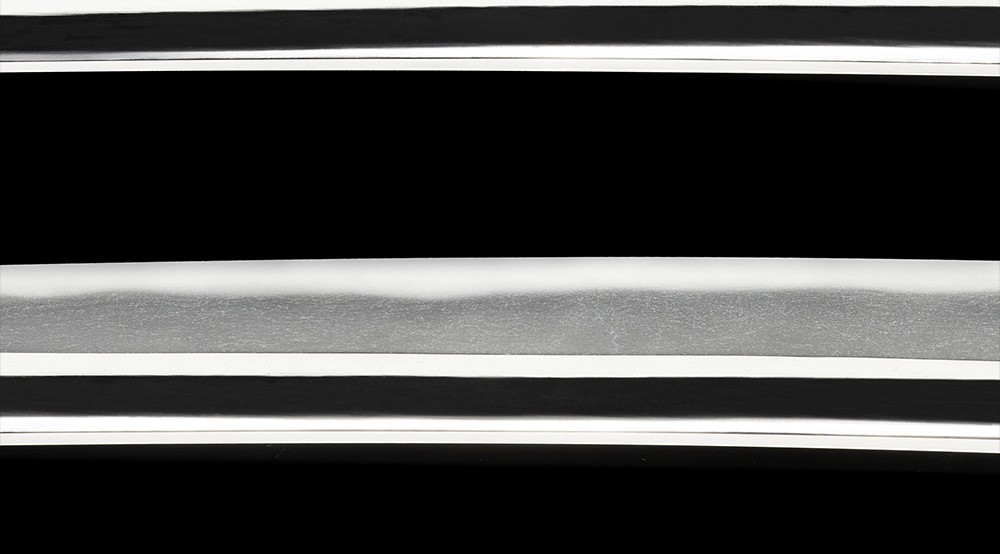
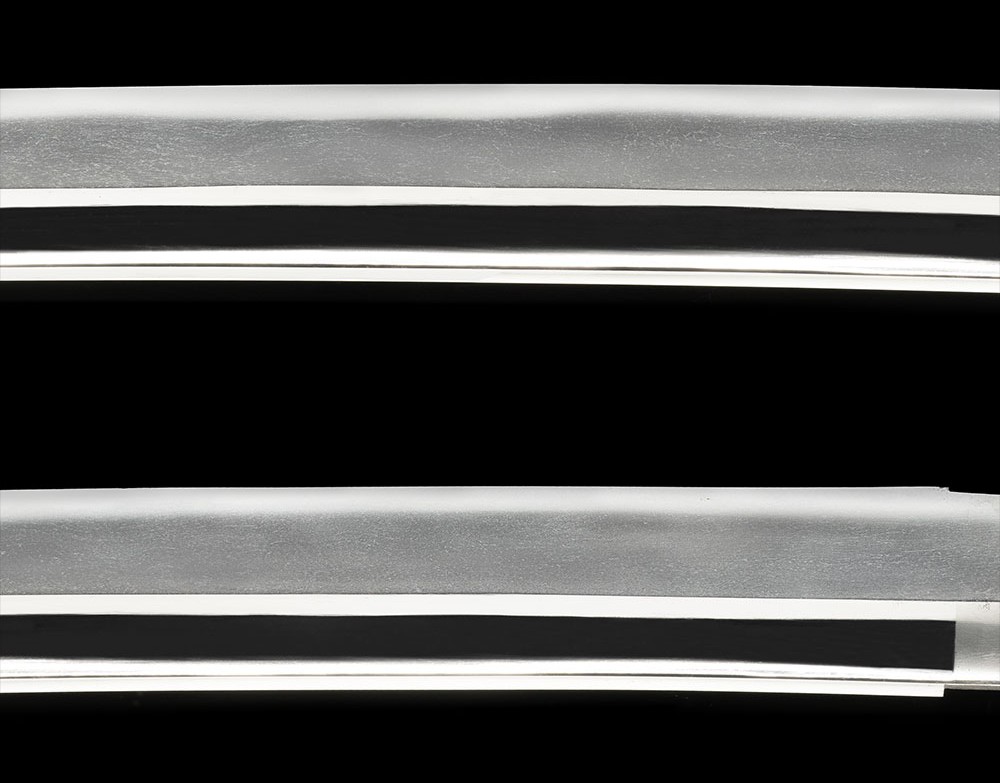
Description Keijō: , ; somewhat wide with a slightly evident difference between base and tip widths; thick ; somewhat shallow ; . : with a tendency toward ; in places showing a slightly standing-grain appearance; adheres finely and thickly; fine enter well; in places are mixed in; the steel shows a somewhat darkened tone. : Based on a shallow , mixing , , and -ba-like elements; with and ; the is deep and adheres; mixed with and ; fine and appear; the shows a (subdued) tendency. : Slightly ; toward the tip it becomes strongly , turning back in . : On the , a with an accompanying in the ; on the , a wide ; all are kaki-nagashi. : ; ; ; four ; .
Artisan Miike school (三池)
Era period
Explanation “Miike” denotes the name of a lineage of swordsmiths who resided in the Miike area of Chikugo Province. Its founder is the celebrated master Denta Mitsuyo, renowned as an outstanding smith of the late period; his representative work is the famed “Ōdenta” (National Treasure), transmitted in the Maeda family. Mitsuyo was not a single individual alone, for the name continued to be carried on thereafter from the period into the period.
Since the time of the Ōdenta, the style of Miike work has shared features common to early Kyūshū blades: the forging shows vigorously flowing with , presenting a (viscous) texture that appears characteristically soft; the temper is formed as a -based structure in with applied, and with the tending toward (subdued). Moreover, the school’s individuality can be perceived in its preference for carving relatively wide and comparatively shallow .
This displays an forging with a tendency and a somewhat standing-grain aspect; fine adheres thickly, fine enter well, and appear here and there, with a dark tone in the steel. The is a shallow composition with deep and well-adhering ; along the edge it includes and , while fine and , among other activities, appear, and the shows a subdued tendency; the also shows at the tip. From these workmanship features and the wide carved on both sides, this blade can be distinguished as Miike among the early Kyūshū classical schools, and the appraisal is fully convincing. It is a piece in which the school’s characteristics are conspicuously expressed, exhibiting excellent workmanship; in addition, the activities of and are particularly tasteful, making it a superior example.
