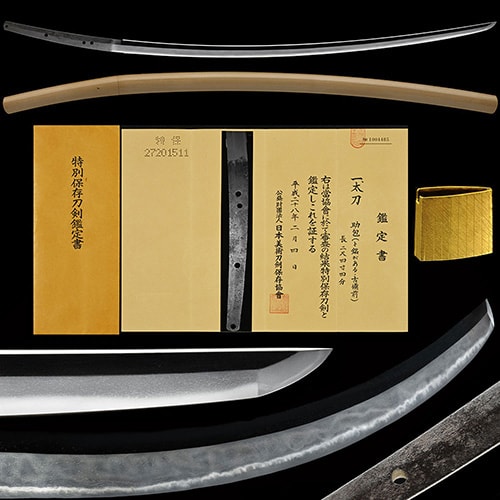
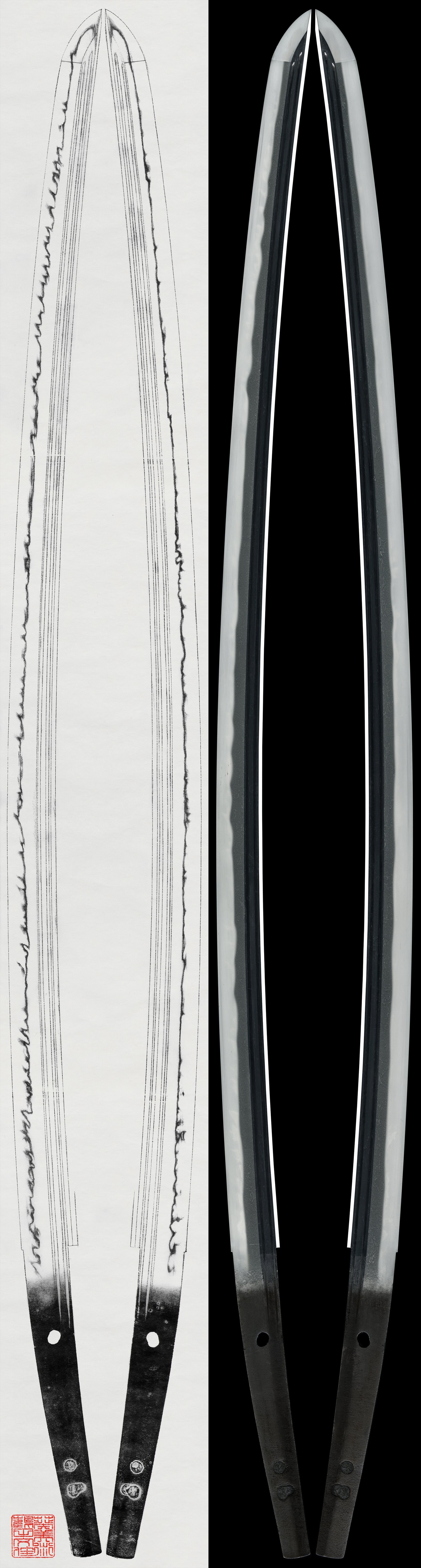
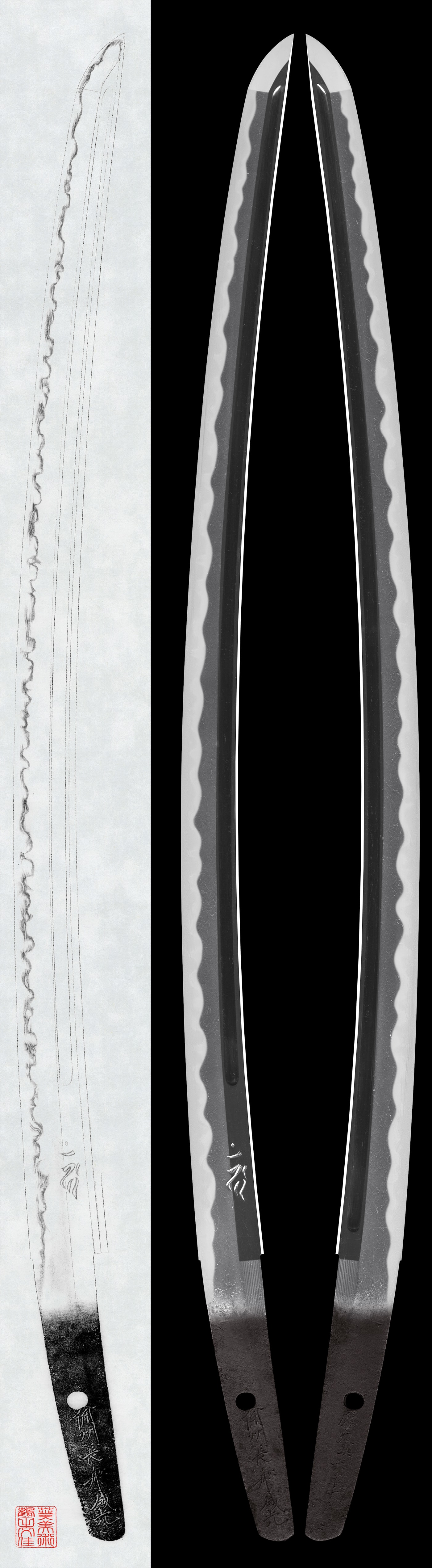
Among the works of the published sources place Tomonari as the smith whose manner is the most classically archaic and who at the time carries the highest dignity. Together with Masatsune he is counted one of the two pillars (双璧) of the school, and the descriptions return to a single comparison between the pair: that Tomonari is marked by the excellence of his while Masatsune is marked by the excellence of his . The published record traces the line back to a founding Tomonari placed around the Eien era of the late period, and notes that the name was carried through several generations down to about the mid- period; because surviving bear Katei-era dates of the early , the name cannot have belonged to a single man.
The published sources separate the two masters further by their . Where Masatsune shows that is clearly visible, Tomonari's tends to be faint, and the descriptions record works in which it scarcely appears at all. They add that his inclines slightly toward a blackish iron color, and that he favored carving , a feature comparatively uncommon in Masatsune; the notes remark that a Tomonari without is rare.
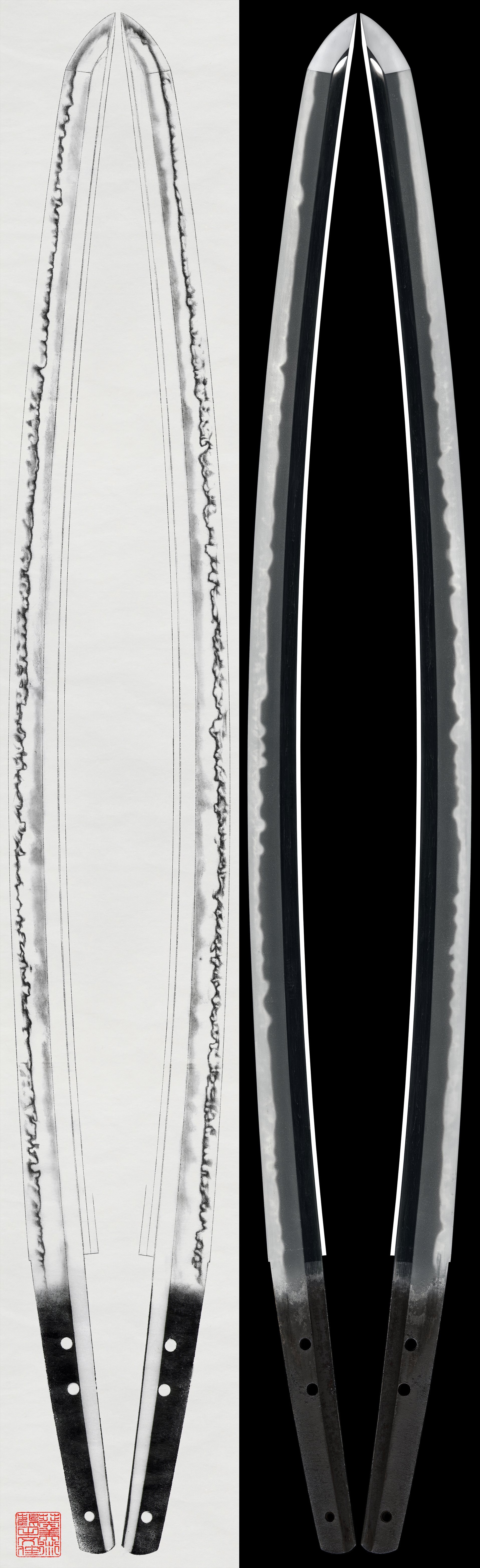
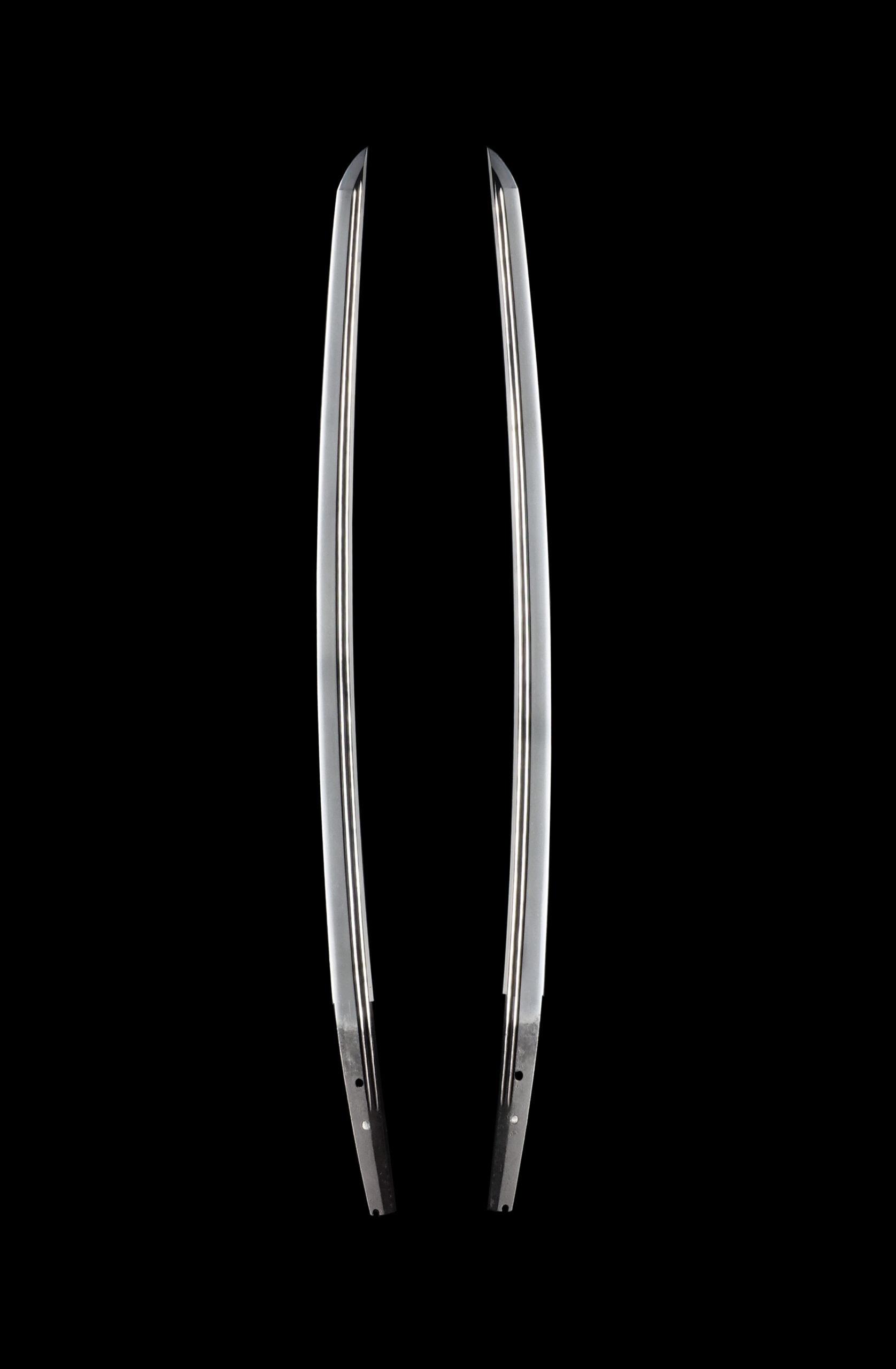
The the descriptions assign to him is the slender of the period: with , high with marked , the curvature settling slightly toward the tip, closed by a . The forging is mixed with , the grain standing a little in places (), applied and woven through; over this a faint rises, and in some blades the descriptions note a - or texture mixed into the . The temper is a -based pattern carrying as its main theme, into which and enter; the is deep, adheres thickly, and work within the , and and run through it. The is a quiet , at times tending to .
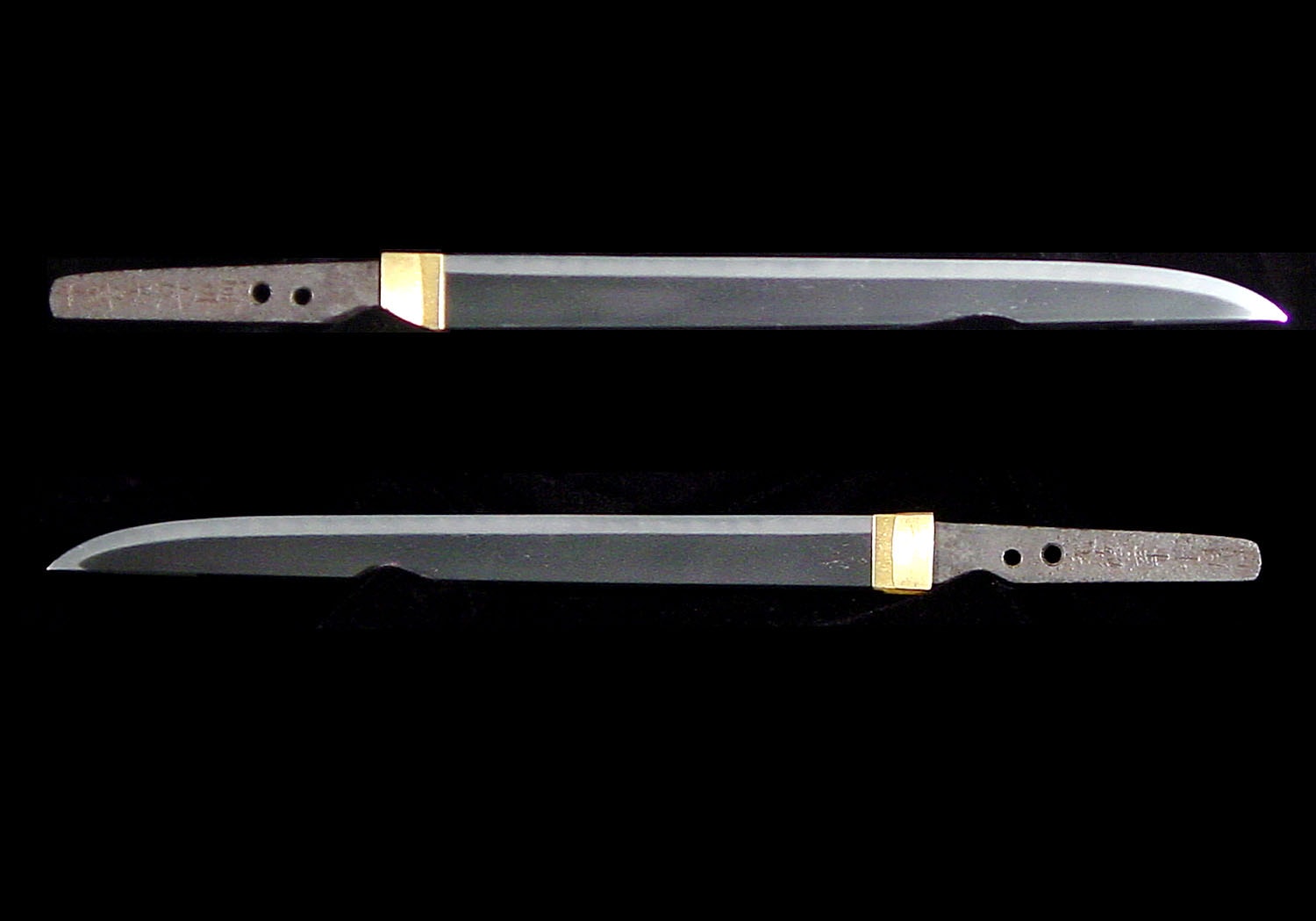
The published sources order his signed work by the length of the inscription. Compared with the long signatures such as no Tomonari and no Tomonari , the descriptions write, the longer forms more often accompany workmanship of a markedly archaic character, while blades signed simply Tomonari or Tomonari show and that are more orderly and are appraised as somewhat later in date. The notes record several forms of his signature: no Tomonari, no Tomonari , Tomonari , and Tomonari. They observe a particular complication of the corpus: that certain blades originally bore Katei-era dates which were later erased, the descriptions reason, to make the work appear that of an older Tomonari. Of the blades that survive, the published sources judge those whose and most effectively express the archaic, elegant taste of early to be the ones that most readily stand comparison with Tomonari himself, and one such they call the work that most fully expresses the archaic refinement of old .
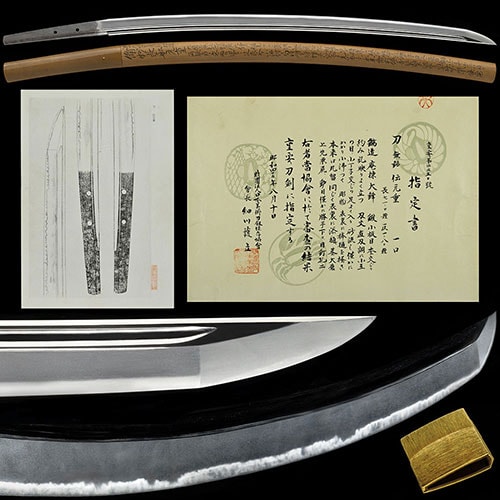
Tomonari is Sai-jo in Fujishiro's grading and stands at the head of the field by the weight of designation against his name. Three of his blades are National Treasures, with seven Important Cultural Properties above eight works in the and tiers. Of his recorded works most can never trade, eight held in the National Treasure and Important Cultural Property tiers and another eight in the Tokuju and tiers; the Maruguchi , a since the period, passed by way of Tanaka Mitsuaki to Emperor Meiji, and several of his remain in the Imperial Household. The institutions that hold him include Nikko Toshogu, Itsukushima Jinja, the Tokyo National Museum, the Okura Museum of Art, the Kyushu National Museum, Takateru Jinja, Seikado Bunko Art Museum, the Mouri Museum and Jingu. Eighteen of his blades carry a recorded provenance, among the holders the Imperial Family, Emperor Meiji, the Himeji Sakai Family, the Satake Family, Taira no Munemori, Ashikaga Takauji and the Mito Tokugawa Family. A Tomonari coming into open hands is among the rarest events in the field.