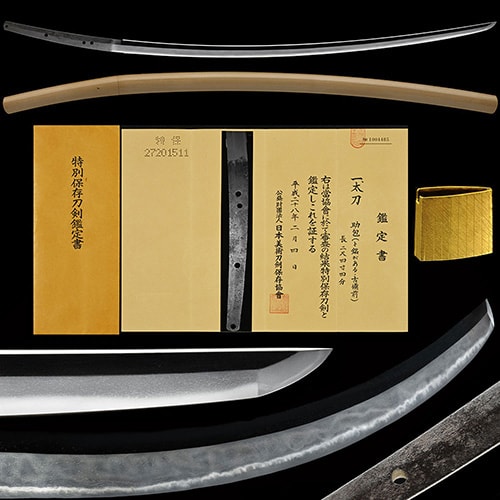
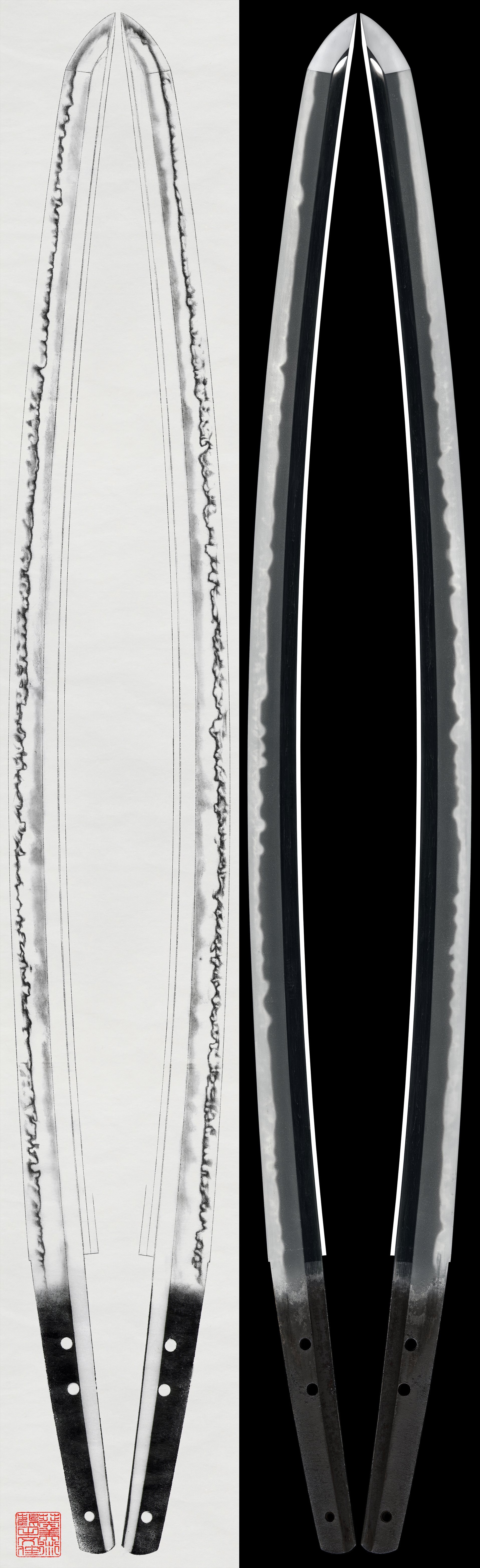
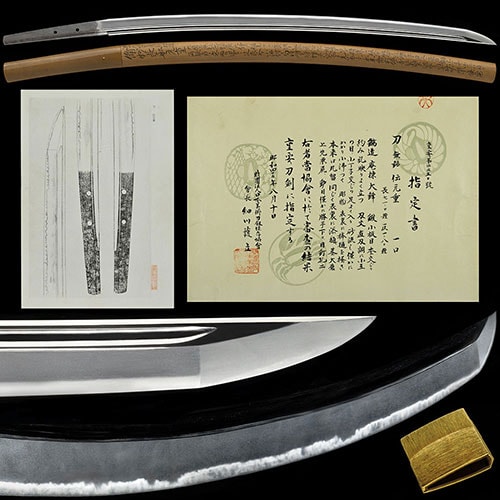
Kanehira is one of the masters of the late and early period. The published descriptions place him from of old, with Sukehira and Takahira, among the Sanpei (備前三平), the three of early , and the published descriptions return again and again to a single reason his name stands above the others: the existence of the Ō-Kanehira, the supreme long counted among the finest blades ever forged in Japan and now a National Treasure. By that one work, the writes, 'his name has become still more widely known to the world'. He is the rare early smith remembered for a single overwhelming masterpiece who is, at the time, recognizable by a consistent hand and reachable through a real body of signed work.
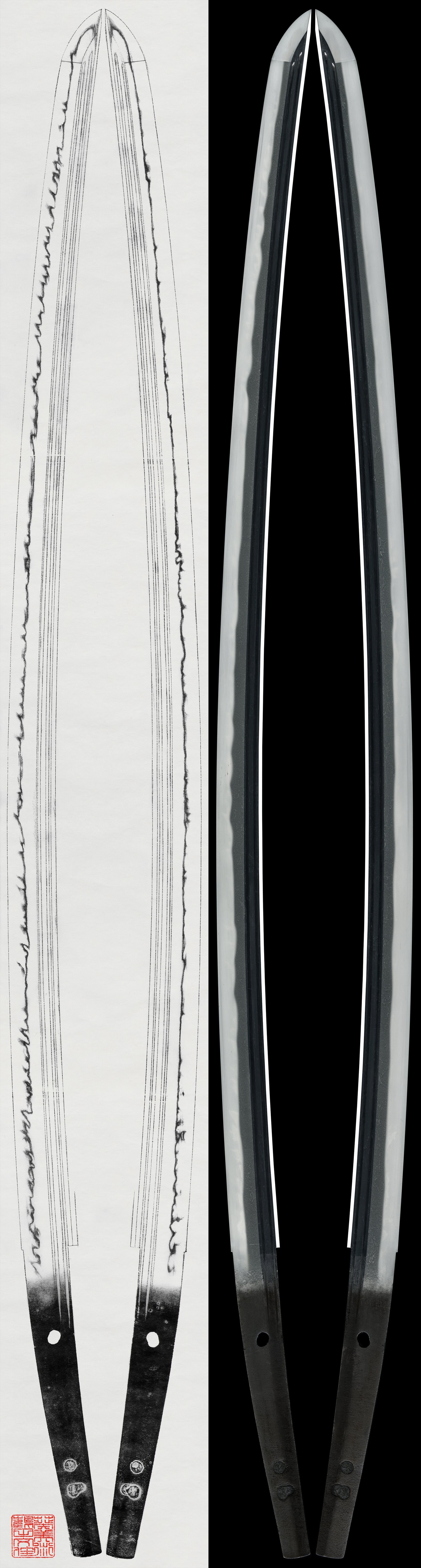
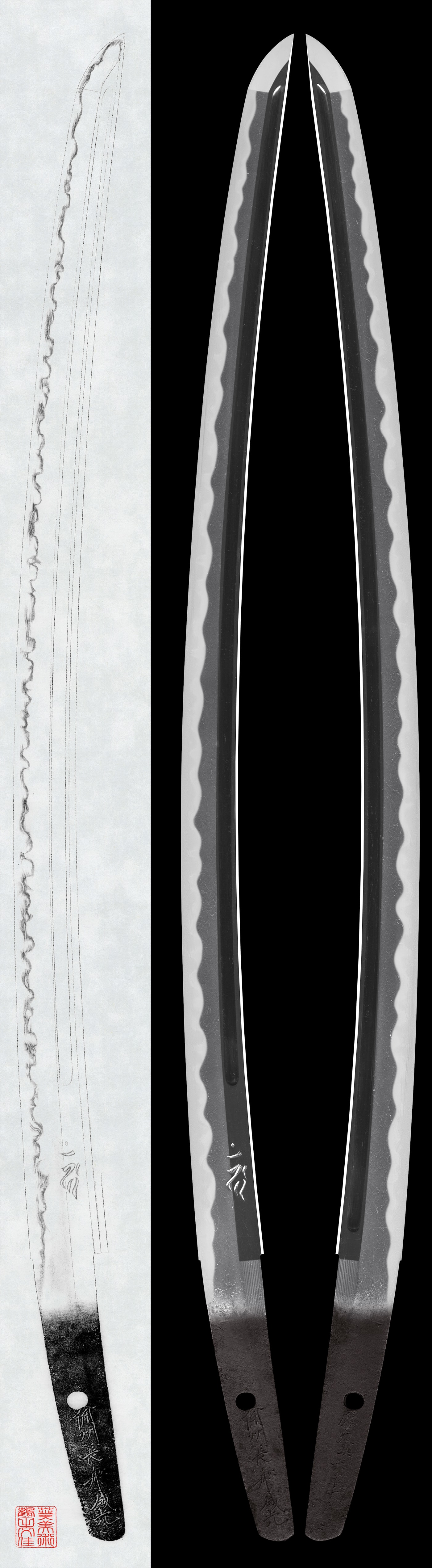
That hand is the refined manner held to a quiet register. Over a standing mixed with , adhering well and woven through, he tempers a -based pattern carrying as its theme, into which and enter; the and work freely, the attaches thickly, and and run within the , closed by a calm . The published sources read this as classical carrying 'an antique fragrance', a that is 'truly graceful' and 'shows the character of its age well'. Where the later schools turn to a flamboyant display, his is the vocabulary held in a steady hand. What sets him apart within the Three is not the temper, which he shares with his peers, but the scale he commands, for no is broader or more powerful than the Ō-Kanehira.
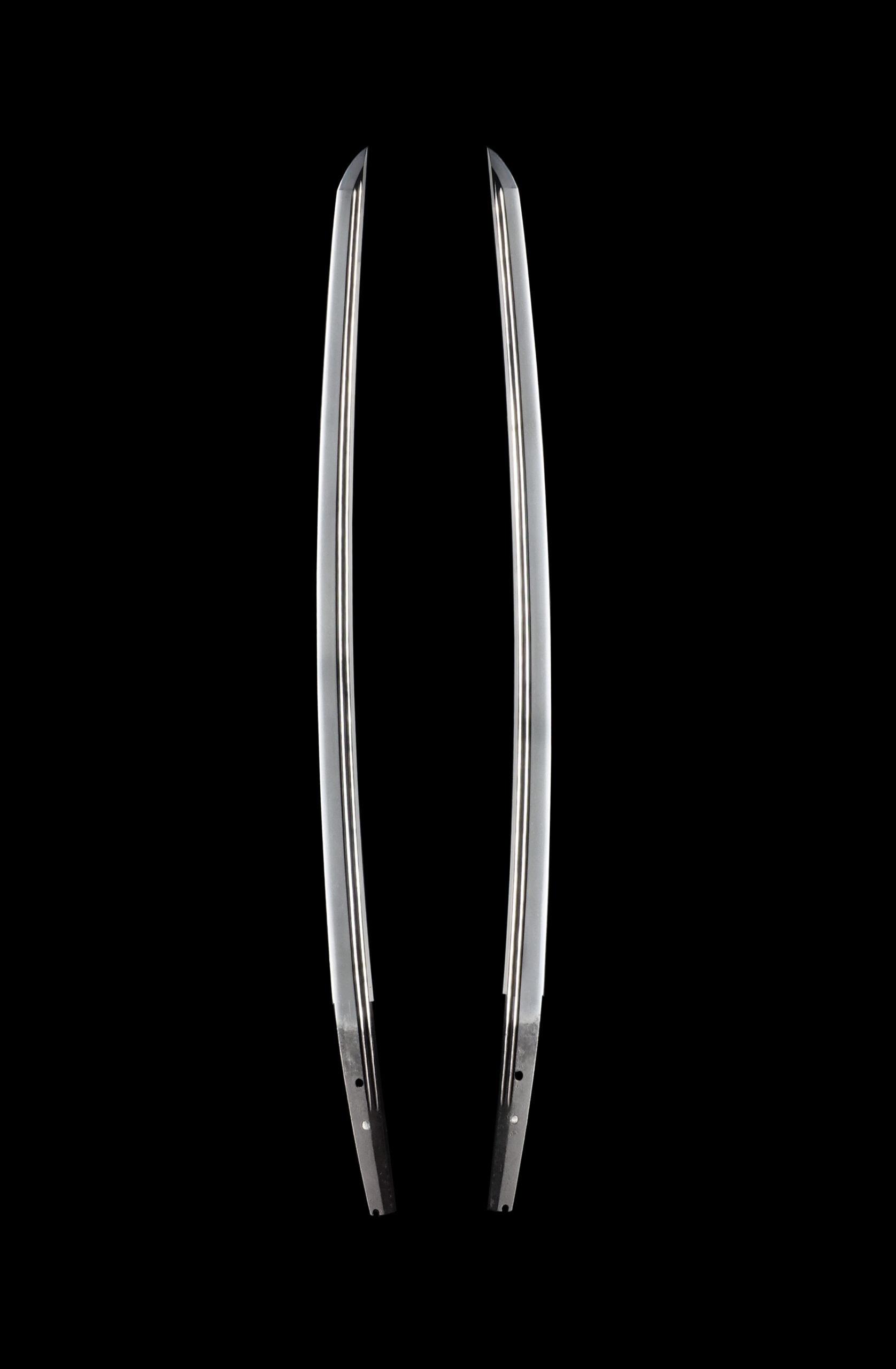
The the descriptions assign to him is the slender of the period: with , 'high , the curvature settling toward the tip', with marked and a , the figure they call typical of the late through early . Across the forging a faint rises, at times a , the speckled reflection the published record notes standing up clearly in the steel of old . The temper keeps its measured throughout, the bright; in a few blades the drops to a just above the , an archaic touch the sources mark as one sometimes met with in work.
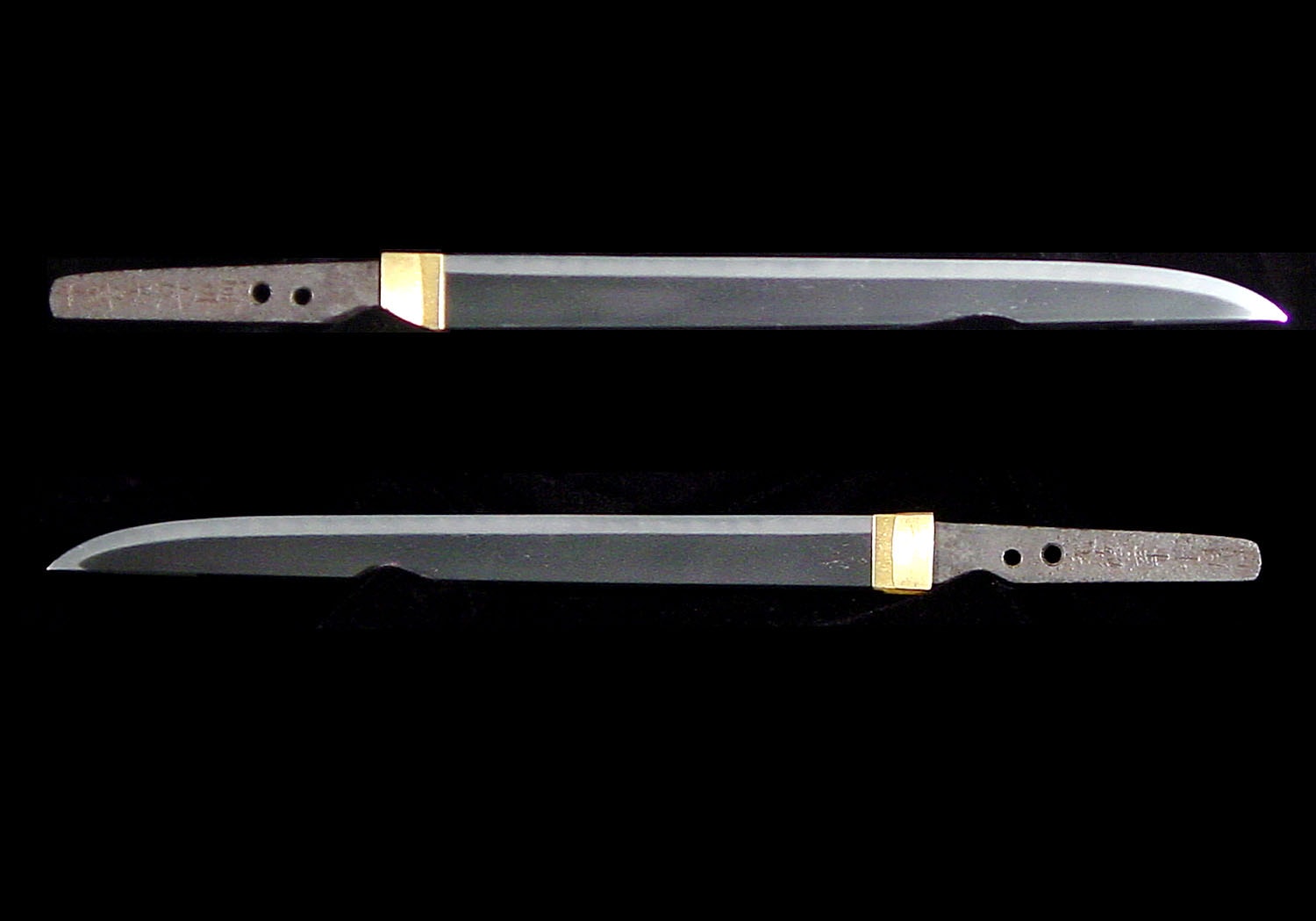
His signature carries a story the published descriptions dwell on. His habitual is the two-character 包平; of the long provincial form 備前国包平作 the record states that, apart from the Ō-Kanehira, 'there is virtually no other example', counting only one further long-signed blade, now in the tier. The descriptions also reason, more than once, that the two-character signatures fall into a small fine-chisel hand and a larger thick-chisel hand, so that either the name spans several periods of one career, or several smiths in late to early worked under it. For so early a smith an unusual number of his works come down , the original signed intact, where most of his contemporaries are now , and of the blades that survive the signed far outnumber the unsigned. How prized that signature was can be read in one Satake-house whose was deliberately shaved on one side, which the record explains, according to one account, as 'a measure to escape an order to present the blade to the Shogun's house'.
Within the Three the published sources draw the comparison by and by build, and they note where his work touches the other early hands: of one whose turns back straight and round, the writes that it 'reveals an atmosphere that in one vein also connects to Masatsune'. His manner is part of the root from which the whole tradition descends, and the Ō-Kanehira gathers all of it into one object. Long the supreme treasure of the Ikeda house, it is the grandest produced, and it is held today in the Tokyo National Museum.
For the collector the reckoning is plain. Kanehira is Sai-jo in Fujishiro's grading, and few names in the whole sword canon carry a heavier weight of designation. The Ō-Kanehira is a National Treasure and can never trade, kept as patrimony rather than offered; behind it stand some nineteen blades in the and tiers, of recorded whereabouts in the Tokyo National Museum, the Sano and Hayashibara museums, the Seikado Bunko, and the Kurokawa and Mori Shusui collections among others. Their recorded provenance runs through the first houses of the realm, the Ikeda, the Kuroda, the Satake, the Akimoto and the Tokugawa shogunal family, and through the Imperial collection. A signed Kanehira is not wholly beyond reach, but it comes to a serious collector only from time to time and with patience, a landmark when it does. He is the master known for one unrepeatable blade, recognized by the composure of his steel and, as the record keeps returning to, the rarity of his long signature.