NihontoWatch MonNihontoWatchBETA
MarketEncyclopedia
NihontoWatch Mon

NihontoWatchBETA

Market
Encyclopedia
Overview·Kantei·Designations·Blade Forms·Signatures·School
OverviewKanteiDesignationsBlade FormsSignaturesSchool
  1. Schools
  2. Seki
  3. Kaneyuki

Seki Kaneyuki

金行

Jūyō
Vol. 13, No. 51 · Katana

Seki Kaneyuki

金行

10 ranked works

ProvinceMinoEraKano (1350–1352)PeriodNanbokuchōSchoolSekiTraditionMino-denToko Taikan600(top 21%)TypeSwordsmithCodeKAN589
10Jūyō Tōken

Overview

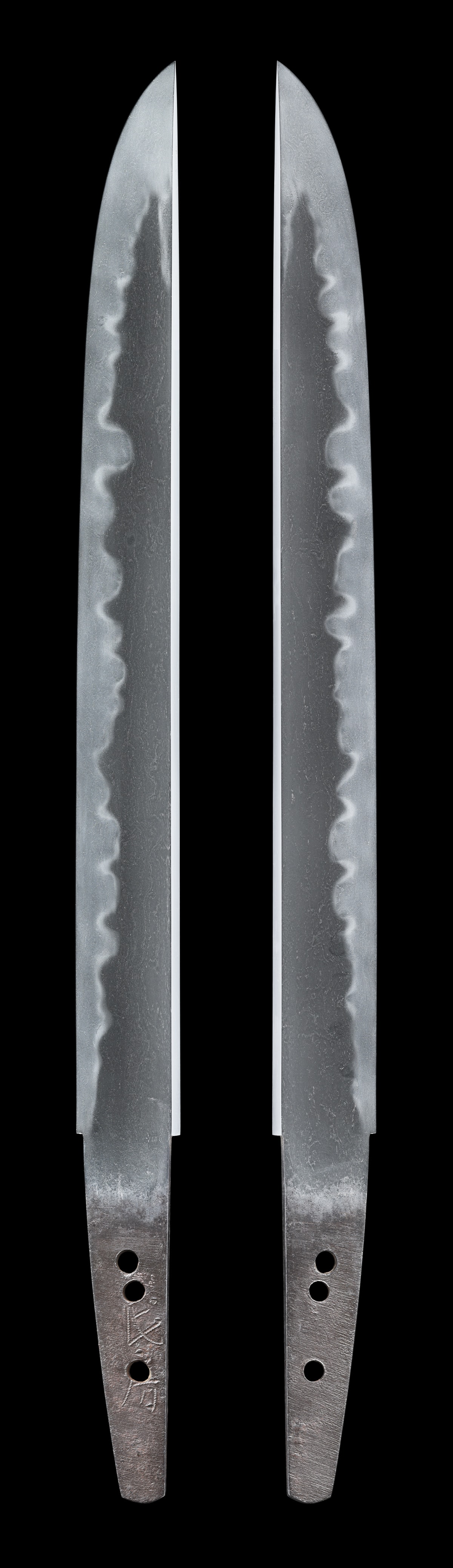
Kaneyuki of is known entirely through unsigned blades, nine of which have passed between 1963 and 2018, the earliest a greatly shortened once a of more than three , the most recent a wide, imposing of the shape. Not one of his works carries a date, and securely signed examples are so rare that the published sources treat them as all but absent; the smith is reached only through attribution. He was a disciple of the first-generation Kaneshige, named in the references as either Kaneshige's younger brother or his son, and the references place the two of them, with Kaneuji, at the head of swordmaking, calling Kaneshige one who "together with Kaneuji became a fountainhead of smithing." The sources, citing the Kokon Meizukushi, describe Kaneshige as a man of "the Buddhist name Dōa, a native and resident of Tsuruga in , an outstanding master who crossed into Seki and settled there," and from the Kōzan they recover two of his dated Jōji 2 (1363), the only fixed point for the group's active period. Kaneyuki belongs, then, to the founding generation of Seki, before the mainstream of the later smiths took shape.

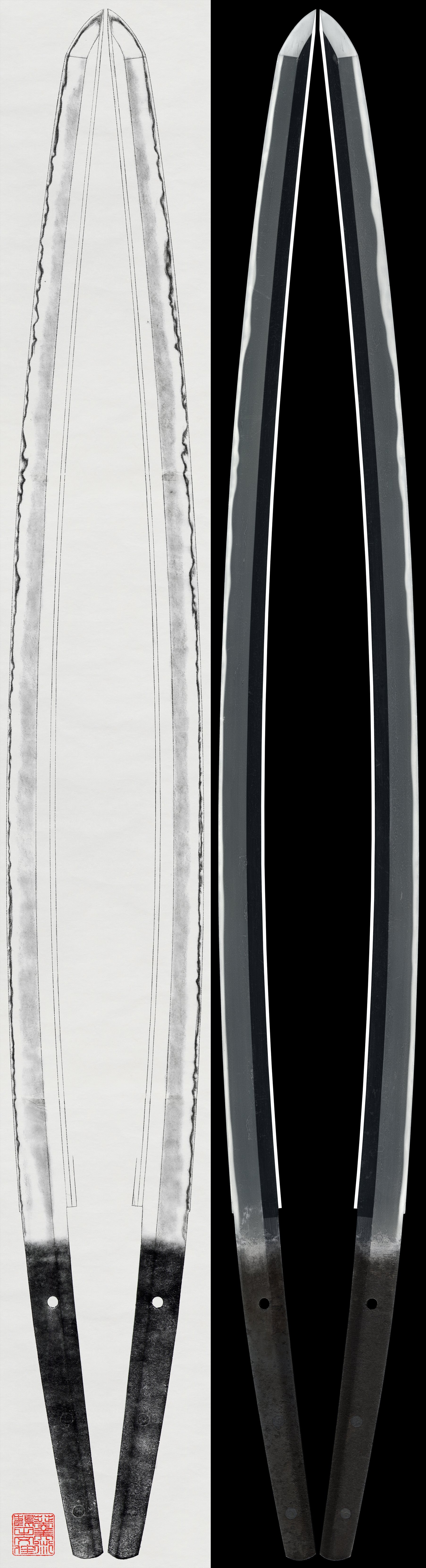
The hand that the references reconstruct for him is a - manner deliberately held apart from the line. Over an that flows and stands, and on several blades inclines openly to , he tempers round-headed and , mixed with and a low and linked in a comparatively calm sequence. The published sources name this directly: blades long appraised as Kaneshige or Kaneyuki "emphasize round-headed and as the main theme" and as a rule "show a comparatively gentle manner of tempering." Across the temper run , and fine , the clear, with entering and the fraying in places into . The answers the and , sweeping in to a small , here and there entering . It is a quiet, controlled by standards, and the references make that calm a positive trait of the group rather than a limitation.

The carries the rest of the recognition. The flowing, standing that inclines to is what the published sources hold up as the appreciation point shared across the Kaneshige group, and it is on this that an unsigned blade is sorted to Kaneyuki rather than to . adheres throughout, and where a reflection appears it is the dim of the -, not the bright of ; the two early show a faint whitish , while on the broad late the brightens to thick, fine with frequent and a faint plain , one showing a -like effect. Running through all of it is what the references call a "northern-provinces temperament" read in the forging, a slightly rustic flavor they attribute to Kaneshige's origin carried into steel, and a they judge frankly as of a rougher make than Kaneshige's, with a that does not reach his. The honesty of that judgment is part of the attribution: Kaneyuki is the calmer, plainer hand of the founding Seki generation.

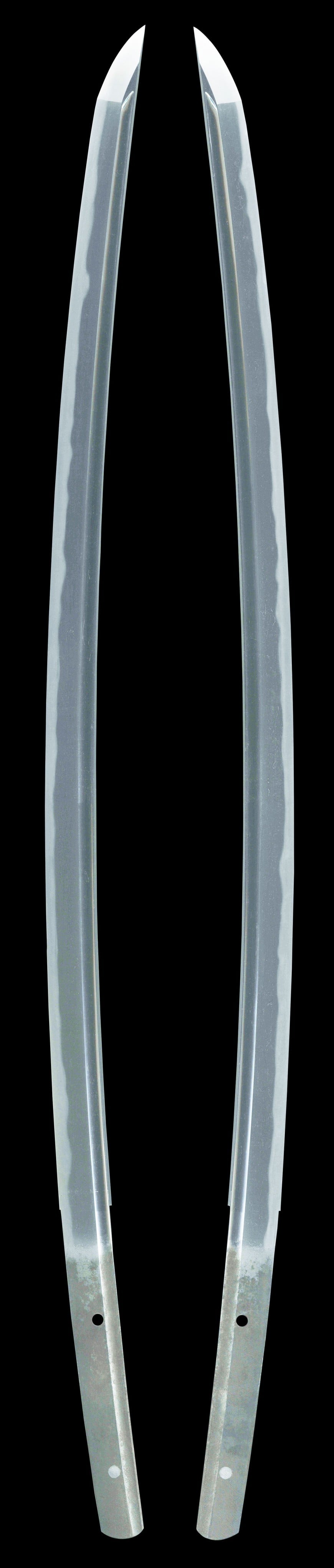
The designated work divides less by date than by form. The bulk of it is greatly shortened, unsigned and , originally and of wide , shallow and large , the silhouette in full; on these the calm round-headed and the -leaning read most plainly, and the late wide of the 48th and 64th sessions are the brightest and most tightly forged, the references calling them sound in and and superior examples of his appraised work. Apart from these stands the one piece that keeps its original tang, an , slightly elongated and thin in , on which the temper is a regular with run frequently, and which alone carries in the religious idiom the smiths favored, a sankō-hilted on one face and a with on the other. The published sources read this regular , beside the linked round-headed , as one of the two typical of blades attributed to Kaneyuki without signature.

What keeps Kaneyuki distinct is set entirely against the line he is most easily confused with. Both are - of the moment, and the references frame the appraisal as a contrast held steadily across his record: while connected to Kaneshige's manner, his blades "differ in character from the works of the group," the calmer round-headed and the standing, -leaning standing against the more restless . The references call one of his a clear instance of "Kaneyuki's typical workmanship," and another a on which "the appreciation points of the Kaneshige school are conspicuously shown," so that the school's character is read off his own blades rather than borrowed. His hand thereby became one of the recognized templates against which unsigned blades are sorted, a sub-current of the broad Seki and Naoe- stream that fed the later mainstream of the Kanesada and Kanemoto smiths.

Kaneyuki's record is modest in scale and entirely unsigned: nine designated works on record, all in the rank across a span of more than half a century, with no National Treasure, no Important Cultural Property and no among them, and a designation factor that places him in the long tail of the index rather than near its head. The published sources nonetheless judge the best of these blades sound in both and and call them superior examples of the appraisals of this smith, the praise measured rather than effusive, which suits a smith reached only by elimination. No provenance is recorded for his blades, and no institution holds one on the public record, so the honest picture is of a quiet name held in private collections and seen at designation, the swords passing between collectors rather than resting in museums. A Kaneyuki does come to market, since none of his work is held as patrimony, but rarely, and when it does it is the calm, -leaning - hand and the round-headed , not a signature, that identify it. For a collector who values the founding generation of Seki over the famous names that followed, an unsigned Kaneyuki of sound and , sorted from the line by exactly the traits the references name, is a quietly rewarding thing to encounter.


Kantei

one Mino-den Kaneshige-group manner held consistently across the designated mumei blades, read in two registers: the typical calm hand of round-headed gunome and ko-gunome on a masame-tending, faintly utsuri-bearing ji, set beside the broad Nanbokucho o-kissaki katana on which the ji brightens to thick ji-nie and frequent chikei and the temper carries more togariba, tobiyaki and muneyaki; the work-type axis is the form, the ubu hira-zukuri wakizashi alone carrying the regular ko-notare and the Fudo horimono of bonji and gomabashi

Kaneyuki is a -period smith of Seki, described by the published sources as a disciple of the first-generation Kaneshige, who is variously called Kaneshige's younger brother or his son. Kaneshige, by the account of the Kokon Meizukushi, was a smith of Tsuruga in who crossed over into Seki and settled there, so that Kaneyuki stands, with Kaneuji, at the source of swordmaking. As with his master, securely signed and dated works by Kaneyuki are exceedingly rare, and his entire designated record is of ozuriage , and one handed down as Kaneyuki. His recognized hand is a - manner that the sources hold deliberately apart from the line: over an that flows and inclines to , with the grain standing and present and a faint whitish , he tempers round-headed and mixed with and , comparatively calm in the temper, with , and fine running through, the sweeping in to a . What the sources name as the group's appreciation point is the -leaning and the -laden temper with , and what they name as its character is a Hokuriku temperament read in the forging, a rustic flavor and a judged not to reach the refinement of Kaneshige.

Diagnostic discriminators

67% of his works · 2.2× vs Shizu group itame (less standing, less masame)

67% of his works · 6.7× vs Bizen-den baseline (nioi-based, little sunagashi)

unique vs Shizu group (more pointed, restless gunome-midare)

Observation by phase

The typical Kaneshige-group manner (his recognized hand)

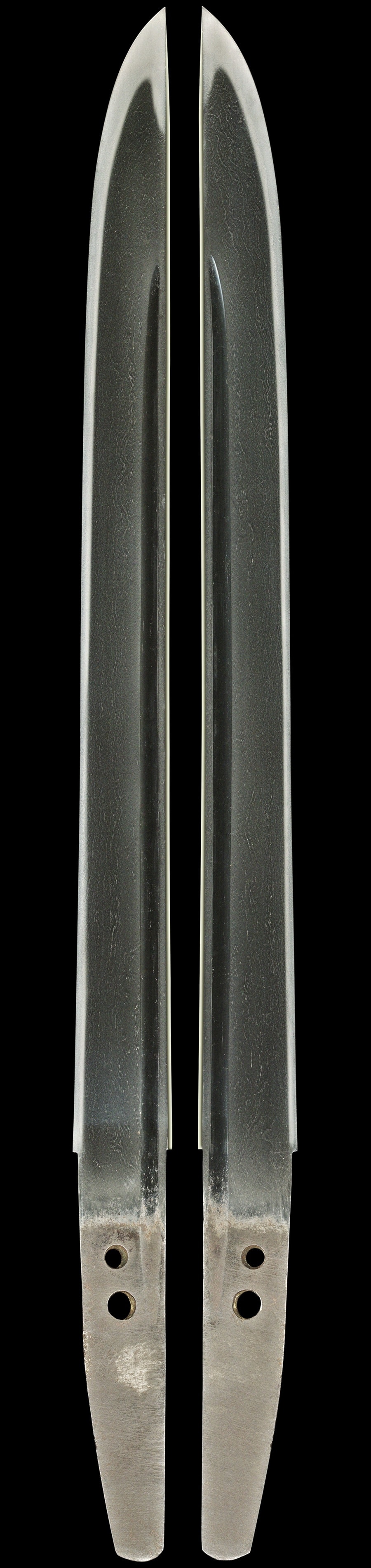
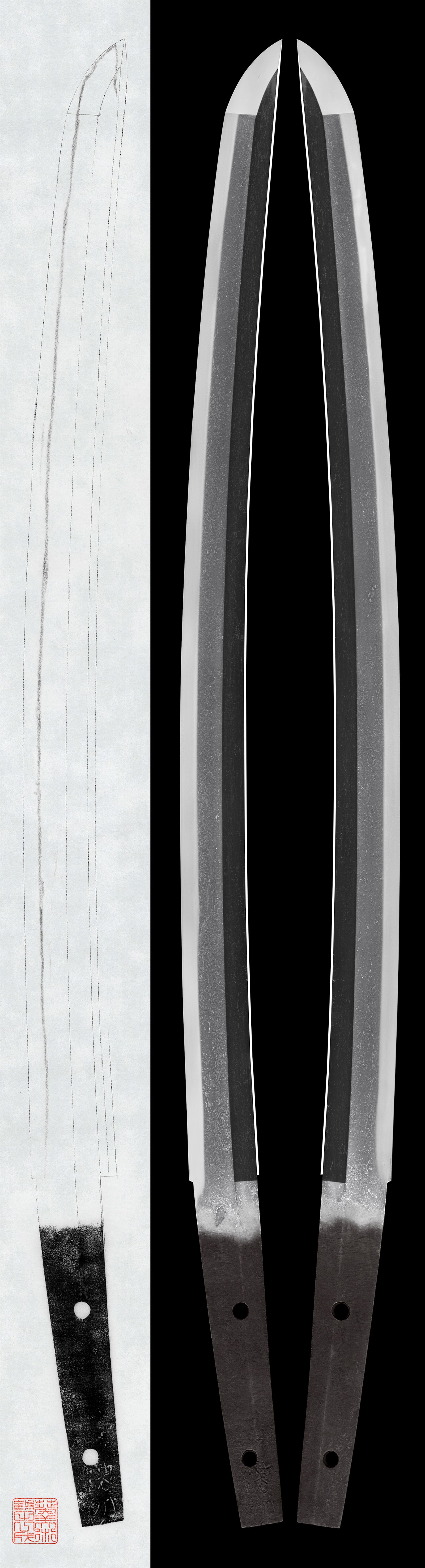
His most consistently described work is an ozuriage or , with , originally a of proportions with wide , shallow and a large . Over an that flows and tends toward , the grain stands () and adheres, and on a number of blades a faint whitish appears. The temper is round-headed and mixed with and , linked in a comparatively calm sequence; enter, adheres, and with fine run through, the clear. The sweeps in to a , here and there in . The published sources read the -leaning and the -laden temper in which runs as the appreciation points common to the Kaneshige group, and the round-headed on a calm temper as the typical form of unsigned blades attributed to Kaneyuki.

Sugata 姿
Jigane 地鉄
Hamon 刃文
Bōshi 帽子

The broad Nanbokucho o-kissaki katana, brighter in ji and ha

less firmly establishedthe brighter register is keyed to the broad o-kissaki katana of the 48th and 64th sessions, where the ji is tightly forged with thick ji-nie and frequent chikei and the togariba, tobiyaki and muneyaki are most pronounced

A second register of the hand runs broader and brighter. On the imposing wide-bodied of the late designations the becomes tightly forged mixed with , the thick and very fine, entering frequently, and a faint standing; on one the sources note a -like effect. The temper here mixes more into the linked , some of it heated high, with fine and running through and the bright; individual blades add or beneath the . These are the blades the published sources call sound in and and superior, well-forged examples of Kaneyuki's appraised work, the period character of wide , shallow and large displayed in full.

Jigane 地鉄
Hamon 刃文

The ubu hira-zukuri wakizashi with Fudo horimono

the Fudo horimono register is keyed to the single ubu hira-zukuri wakizashi, the only blade in the corpus carrying carvings and the only one with an original tang

Set apart by form is the one , unsigned , slightly with wide and thin . Here the temper is a regular , forming and frequently applied, the entering in and turning with on the , pointed on the . It alone carries the religious the smiths favored: on the a , on the a and . The published sources name this regular , together with the linked round-headed , as the two typical of blades attributed to Kaneyuki without signature.

Sugata 姿
Hamon 刃文
Scholarship

The published sources set Kaneyuki, with Kaneshige, at the source of the Mino tradition alongside Shizu Kaneuji, and hold his work deliberately apart from the Shizu line: while connected to Kaneshige's manner, blades appraised as Kaneyuki differ in character from the works of the Shizu group, tending to a rougher workmanship and a jigane that does not reach Kaneshige's, and it is on this distinction that an unsigned blade is judged to be Kaneyuki.

The same sources cite the Kokon Meizukushi for Kaneshige's Echizen origin and his move into Seki, and the Kozan Oshigata for two of his tanto dated Joji 2, so that although neither Kaneshige nor Kaneyuki has securely signed and dated work surviving, the period of the group can be fixed; from old times blades appraised as Kaneshige or Kaneyuki reveal a Hokuriku temperament and a rustic flavor, their hamon emphasizing round-headed gunome and ko-gunome in a comparatively calm tempering.

Designations

Kokuhō—
Jūyō Bunkazai—
Jūyō Bijutsuhin—
Gyobutsu—
Tokubetsu Jūyō—
Jūyō Tōken10

Elite Standing

0.07 across 10 designated works

Top 20% among smiths

Blade Forms

Distribution across 10 ranked works

Signatures

Signature types across 10 ranked works

Currently Available

Seki School

Other artisans of the Seki school

  1. 1.Kinju金重2 for sale45designated
  2. 2.Ujifusa氏房3 for sale16designated
  3. 3.Ujifusa氏房3 for sale9designated
  4. 4.Kanekore兼之7designated
  5. 5.Kanenori兼法1 for sale7designated
  6. 6.Nagasada永貞6 for sale5designated
  7. 7.Kaneyoshi兼吉4designated
  8. 8.Hanjo繁昌4designated
  9. 9.Kanenori兼伯3designated
  10. 10.Daido大道2 for sale3designated
  11. 11.Kanenobu兼延2 for sale3designated
  12. 12.Kanenobu兼宣1designated

Kaneyuki

Kaneyuki(金行) was a Japanese swordsmith of the Seki school in Mino province, active during the Kano (1350-1352) ND period.

The work follows the Mino-den tradition.

Designated works by Kaneyuki include 10 Jūyō.