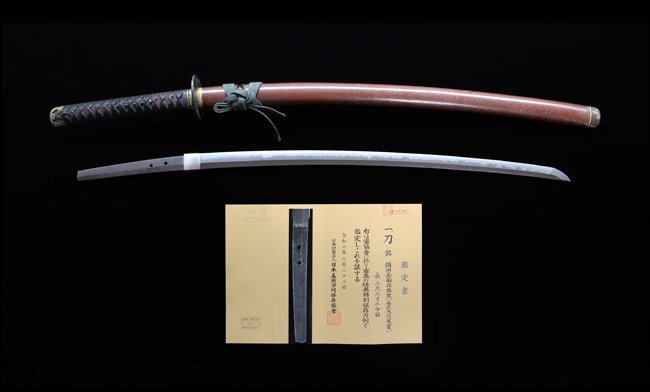
脇差 横山上野大掾藤原祐定 備前長船住人 拵入
Price on request
Tracked across 81 dealers worldwide · price history · sold archive
Specifications
Nagasa
46.4 cm
Sori
1.7 cm
【Product Description】 Blade Classification: Wakizashi Mei: Mumei (Den: Enju) Appraisal: NBTHK Tokubetsu Hozon Token Nagasa: 45.4 cm Sori: 1.0 cm Motohaba: 2.8 cm Sakihaba: 1.9 cm Motokasane: 0.6 cm Sakikasane: 0.4 cm Mekugi-ana: 2 Weight: 395g (blade only) [Sugata] Shinogi-zukuri, Iori-mune. The nagasa is standard, the sori is shallow, and the chu-kissaki is well-proportioned. [Jitetsu] Itame-hada mixed with mokume, becoming fine and dense. The jigane is clear with abundant jinie and shirake-utsuri appears. [Hamon] Chu-suguba based, mixed with ko-gunome and ko-ashiri. The nioiguchi is bright and clear with fine konie. The habuchi is soft and elegant. [Boshi] Straight (sugu) with a small, rounded return (ko-maru). [Koshirae] Black lacquered (kuro-roiro) saya. Fuchi-kashira: Shakudo-nanako ground, autumn insects and flowers design, takabori, iro-e. Menuki: Shakudo-nanako ground, autumn flowers design, takabori, iro-e. Tsuba: Iron ground, round shape, openwork (sukashi) design. [Explanation] The Enju school was founded by Taro Kunimura, the grandson of Rai Kunitoshi, who moved from Yamashiro to Higo province (Kumamoto Prefecture) during the late Kamakura period. They served as the exclusive swordsmiths for the Kikuchi clan. This work is mumei but has been attributed to Enju by the NBTHK. The jitetsu shows a refined texture with shirake-utsuri, and the hamon is a graceful suguba, characteristic of the school's style which closely follows the Rai tradition. It is a masterpiece that exudes the elegance of the Yamashiro style while maintaining the sturdy dignity of Higo koshirae.
 NihontoWatchBETA
Price on request
Tracked across 81 dealers worldwide · price history · sold archive
46.4 cm
1.7 cm
Price on request
【Product Description】 Blade Classification: Wakizashi Mei: Mumei (Den: Enju) Appraisal: NBTHK Tokubetsu Hozon Token Nagasa: 45.4 cm Sori: 1.0 cm Motohaba: 2.8 cm Sakihaba: 1.9 cm Motokasane: 0.6 cm Sakikasane: 0.4 cm Mekugi-ana: 2 Weight: 395g (blade only) [Sugata] Shinogi-zukuri, Iori-mune. The nagasa is standard, the sori is shallow, and the chu-kissaki is well-proportioned. [Jitetsu] Itame-hada mixed with mokume, becoming fine and dense. The jigane is clear with abundant jinie and shirake-utsuri appears. [Hamon] Chu-suguba based, mixed with ko-gunome and ko-ashiri. The nioiguchi is bright and clear with fine konie. The habuchi is soft and elegant. [Boshi] Straight (sugu) with a small, rounded return (ko-maru). [Koshirae] Black lacquered (kuro-roiro) saya. Fuchi-kashira: Shakudo-nanako ground, autumn insects and flowers design, takabori, iro-e. Menuki: Shakudo-nanako ground, autumn flowers design, takabori, iro-e. Tsuba: Iron ground, round shape, openwork (sukashi) design. [Explanation] The Enju school was founded by Taro Kunimura, the grandson of Rai Kunitoshi, who moved from Yamashiro to Higo province (Kumamoto Prefecture) during the late Kamakura period. They served as the exclusive swordsmiths for the Kikuchi clan. This work is mumei but has been attributed to Enju by the NBTHK. The jitetsu shows a refined texture with shirake-utsuri, and the hamon is a graceful suguba, characteristic of the school's style which closely follows the Rai tradition. It is a masterpiece that exudes the elegance of the Yamashiro style while maintaining the sturdy dignity of Higo koshirae.
NihontoWatchBETAPrice on request
Tracked across 81 dealers worldwide · price history · sold archive
46.4 cm
1.7 cm
Price on request