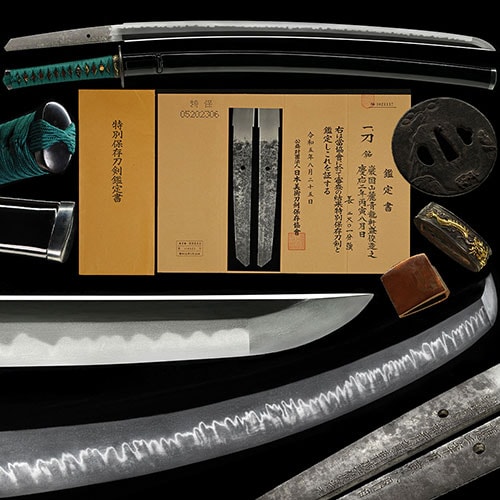
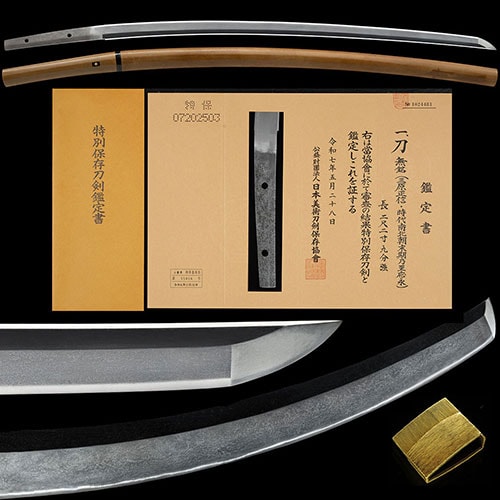
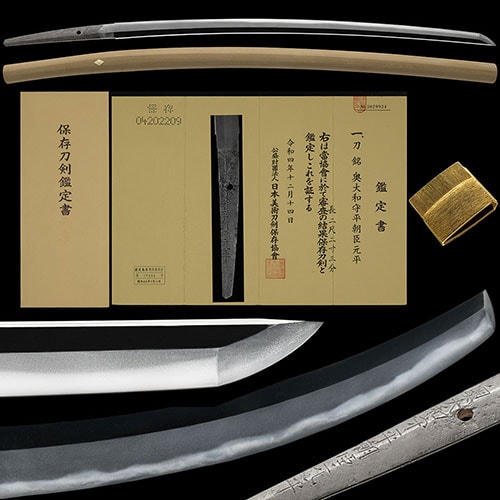
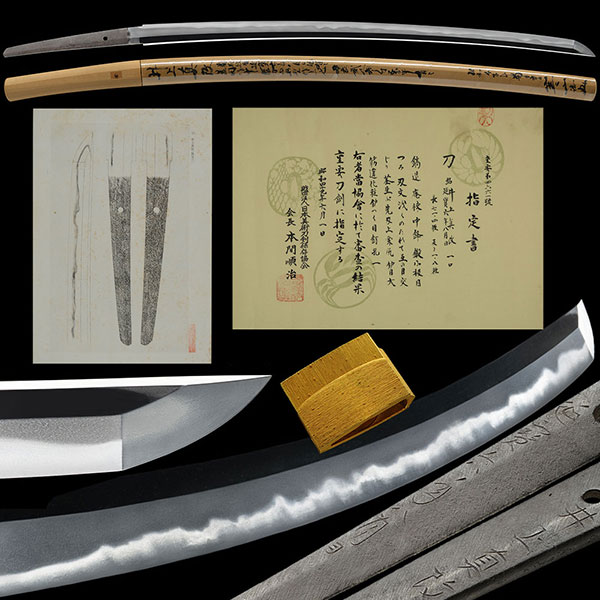
古三原正家 特別保存刀剣
SOLD
Tracked across 81 dealers worldwide · price history · sold archive
Specifications
68.9 cm
2.5 cm
3 cm
About the maker
Ko-Mihara Masaie正家
Masaie (正家) is traditionally regarded as the founder of the Mihara school of Bingo Province and one of the representative figures of the group known as Ko-Mihara, which flourished from the end of the Kamakura period into the Nanbokucho period. According to *meikan* and other reference works on smith lineages, Masaie was active around the Showa (1312--1317) or Shochu (1324--1326) eras, and his line continued down into the Muromachi period. Within the Ko-Mihara group, Masaie stands alongside Masahiro as the school's most distinguished name. Works of the Mihara school display pronounced Yamato character, belonging firmly to the *Yamato-den* tradition centered in Bingo Province. An Imperial Collection tachi bearing his signature has been described as representing the highest level of Ko-Mihara craftsmanship, with even Masahiro having scarcely any work of such caliber. The distinguishing traits of Masaie's work may be seen in several key technical features. The *jigane* typically shows *ko-itame-hada* tightly forged, with fine *ji-nie* adhering and a characteristic whitish *utsuri* appearing in the ground metal---a hallmark of Ko-Mihara production. The *hamon* favors *chu-suguha*, sometimes with a slight admixture of small *gunome*, tempered in a *nioi*-based manner with the *nioiguchi* tending toward tightness and *ko-nie* present along the border. Fine *kinsuji* and *sunagashi* frequently appear within the tempered zone. Whereas many works by Masahiro are of *chu-kissaki*, Masaie is often encountered in examples with a bold and imposing *o-kissaki*, lending his blades a particularly powerful *sugata*. Signed works by Masaie of early date are extremely rare, making authenticated examples of considerable scholarly value. His blades consistently demonstrate sound preservation, with both *ji* and *ha* described as notably *kenzen* in official evaluations. Among blades attributed to Ko-Mihara, his work is singled out as especially superior, and those examples bearing the large *kissaki* and characteristic *boshi* make the attribution to Masaie fully persuasive. His contribution to the founding of one of Bingo Province's most important sword-making traditions secures his place among the significant smiths of the late Kamakura period.