NihontoWatch MonNihontoWatchBETA
MarketEncyclopedia
NihontoWatch Mon

NihontoWatchBETA

Market
Encyclopedia
Overview·Kantei·Dated Works·Designations·Provenance·Blade Forms·Signatures·Lineage·School
OverviewKanteiDated WorksDesignationsProvenanceBlade FormsSignaturesLineageSchool
  1. Schools
  2. Osaka Shinto
  3. Tadatsuna

Shinto Tadatsuna

忠綱

Tokujū
Vol. 9, No. 29 · Katana

Shinto Tadatsuna

忠綱

53 ranked works

ProvinceSettsuEraKanbun (1661–1673)PeriodEdoSchoolOsaka ShintoTraditionShintoGeneration2ndTeacherTadatsunaFujishiroJo-jo sakuToko Taikan1,000(top 8%)TypeSwordsmithCodeTAD268
1Jūyō Bunkazai
3Tokubetsu Jūyō49Jūyō Tōken

Overview

Ikkanshi Tadatsuna is the second-generation Ōmi no Kami Tadatsuna, son of the Ōmi no Kami Tadatsuna and one of the representative Osaka smiths of the Genroku years. The published sources record his common name as Mantayū, that he succeeded his father as the second to bear the title Ōmi no Kami, that he claimed descent from Kunitsuna and so prefixed to his signature, and that around Genroku 2 he began to style himself by the gō Ikkanshi. They place him among the leading Osaka makers of his day, one who is, in their words, "renowned for the brilliance of his and and the decorative beauty of his carving" (地刃の華麗と彫刻の装飾美を以て名高い). His early manner follows his father closely, and the heart of his record is the broad, signed and dated that doubles as a field for the carving on which his fame chiefly rests.

His characteristic hand is read first in the temper. Over a tightly forged he opens a straight at the base and then runs two related manners. The earlier and more inherited of them is a with well-aligned and long , the very style in which the excelled, the long chōji-ashi entering and the and cutting across them. The published sources call him "a master who surpassed his father" (父に優る名手で), and they locate the difference precisely: where the first generation's is aligned and dignified, the nidai's is deeper in , brighter in and firmer in , talent they name shutsuran, the dye that outdoes the indigo.

His mature and most personal manner is the tōran-midare, the surging-wave temper collectors know as . The published sources tie it to the Tsuda Sukehiro circle and call it on one his "favoured Tsuda-style tōran temper" (得意の津田風の濤欄刃をやき). Over the tight , the applied thickly in minute particles and fine entering, he builds a shallow base mixed with and -like elements that swells into the wave, the long chōji-ashi still entering, the deep, thickly adhered, and running frequently, the bright and clear. The is a shallow to with . A quieter survives on a small number of blades, the calmest and rarest of his three faces, set over the bright .

That is the constant beneath all three manners. The forging is a tightly and finely packed, the gathering thickly and at its best falling in minute particles, with fine threading the surface, the steel bright and clear. It is the well-made Osaka rather than a rustic one, and it is the field his temper and his carving both sit upon. The reference texts list his oeuvre as the aligned after the , the tōran, and the occasional , all opened from the long straight that marks the Osaka start.

What sets him apart, more than any single feature of or , is the carving. The published sources treasure his tōshin horimono as Ikkanshi-bori, recording that he "earned a high reputation for surpassing his teacher, and his blade carvings in particular are admired and treasured as Ikkanshi carving" (出藍の誉高く); "his blade carving is skillful and is treasured by the world as Ikkanshi-bori" (殊に刀身彫刻は巧みで一竿子彫として賞玩されている). He cut a relief -no- within the groove, the -, jewel-chasing dragons, and the -no-takinobori, a carp ascending a waterfall that the sources believe he was the first to attempt and which they note has "not been encountered on any of his blades other than this one" (同作中でも本刀以外には未見である). He worked closely with the Osaka carving master Fujita Tsūi, and he cut the added inscription dōsaku to mark the carving as his own hand, a feature, the sources observe, not seen on the at all and one that established a model within .

For the collector Ikkanshi Tadatsuna is a leading Osaka name whose work can still be sought, though the very best is held rather than traded. Fujishiro grades him Jō-jō . He has no National Treasures; his record runs instead through the rank in number, with several pieces reaching and a long signed raised to Important Cultural Property. The published sources call one of his a representative work from the period when he was at the height of his powers, excellent in both and , its Ikkanshi-bori exceptionally splendid. About fifty-two of his blades stand in the and tiers, with a recorded example held by the Kyoto National Museum and a documented blade once in the keeping of the Asai house. Because his work is signed and dated and survives in fair number, a Tadatsuna comes to light more readily than most Osaka masters of his rank, yet a dated carrying his own Ikkanshi-bori is a landmark when it appears, and the finest, with the carp and the cut by the smith himself, are documents of the carving craft at its Osaka height.
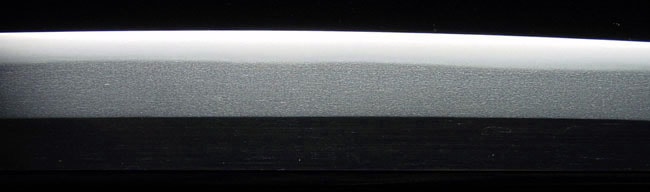
Kantei

one Ikkanshi Tadatsuna hand read across three registers over a constant bright ko-itame ground: the aligned long-legged chōji after the shodai; his mature surging tōran-midare, the Tsuda-style sudareba; and a rare quiet suguha, all carried on a katana that doubles as a field for his Ikkanshi-bori carving

Tadatsuna of Settsu is read in our corpus as the second generation, Ōmi no Kami Tadatsuna, known to collectors by his gō Ikkanshi, the son of the Ōmi no Kami Tadatsuna and one of the celebrated Osaka smiths of the Genroku years. The published sources record his common name as Mantayū, that he succeeded his father as the second to bear Ōmi no Kami, that he claimed descent from Kunitsuna and so prefixed to his signature, and that his skill was held to surpass his father, talent the swordbooks call shutsuran, the dye outdoing the indigo. His recognized prime is a broad, thick- with an extended , forged in a tightly packed with abundant and fine , over which he opens a straight and then runs two manners: an aligned, long-legged inherited from the , and the surging tōran-midare, the wave he took from the Tsuda Sukehiro circle, both deep in with well adhered, the bright and clear, and frequent, the to . A quiet survives on a few blades. Above all he is the carver: the published sources treasure his tōshin horimono as Ikkanshi-bori, the relief -no- within the groove, the -, the jewel-chasing dragon and the -no-takinobori, often with and goma-bashi, and he cut the added inscription dōsaku to declare the carving his own hand.

Diagnostic discriminators

unique vs his plain-carved blades (bo-hi only)

Observation by phase

The aligned, long-legged chōji after the shodai (his early prime)

His earlier prime follows the : a with well-aligned and long , the manner in which the first generation excelled, opened from a straight . The ground is a tightly packed with , sometimes mixed with , the deep and the bright, well adhered, appearing and running through, the to . What sets the nidai apart from the father, the published sources say, is precisely this brightness: the deeper , the clearer and the firmer , read as the talent that surpasses the teacher. The way the long chōji-ashi enter and the and cut across them is named as the highlight of his hand.

Sugata 姿
Jigane 地鉄
Hamon 刃文
Bōshi 帽子

The surging tōran-midare (his mature sudareba prime)

His mature and most personal manner is the tōran-midare, the surging-wave temper the published sources also call his favored Tsuda-style wave, after Tsuda no Kami Sukehiro. Over the tight , thick and fine entering, he opens a straight and then builds a notare base mixed with and -like elements that develops into the tōran, long chōji-ashi entering, the deep, thickly adhered, and running frequently, the bright and clear, the a shallow to with and a somewhat long or deep return. The published sources read the finest of these as the typical and outstanding expression of Ikkanshi Tadatsuna's tōran-midare, the long-entering cut across by and named as his conspicuous highlight.

Sugata 姿
Jigane 地鉄
Hamon 刃文
Bōshi 帽子

The quiet suguha register

less firmly established

Beside the two midare manners the published sources name a register, less often seen on his signed work. Here the temper settles into a or -leaning line over the tight with , the bright, the to . The swordbooks list together with tōran and aligned as the three faces of his oeuvre, the the calmest and rarest of them.

Jigane 地鉄
Hamon 刃文
Bōshi 帽子
Scholarship

The published sources record that Awataguchi Ōmi no Kami Tadatsuna, common name Mantayū, was the son of the shodai Ōmi no Kami Tadatsuna, succeeded as the second generation, received the Ōmi no Kami title and took the gō Ikkanshi; that his early manner followed the first generation's aligned, long-legged chōji while his later work turned to gunome-midare, the tōran wave and even suguha; and that he was particularly accomplished at tōshin horimono, which harmonize without impairing the blade.

On the carving the published sources record that he is thought to have been closely associated with the Osaka horimono specialist Fujita Tsūi, that the koi-no-takinobori (a carp ascending a waterfall) appears to have been first attempted by Ikkanshi Tadatsuna and is unseen on any blade of his other than one Tokubetsu Jūyō, and that he cut the added inscription horimono dōsaku to mark the carving as executed by his own hand.

Dated Works

Years he was demonstrably active, proven by signed-and-dated blades

Active period
1685–1708Editorial estimate: 1673–1717
31 of 51 designated works carry a date
16801710
  1. 1685
    貞享二年Juyo session 35, item 183
  2. c. 1688
    元禄十二二年Juyo session 31, item 191
    元禄十二二年Juyo session 9, item 79
    元禄二二年Juyo session 15, item 243
    元禄十二二年Juyo session 10, item 140
  3. 1690
    元禄三年Juyo session 22, item 293
    元禄三年Juyo session 48, item 164
  4. 1692
    元禄五年Juyo session 16, item 203
    元禄五年Juyo session 15, item 244
  5. 1693
    元禄六年Juyo session 31, item 190
  6. 1696
    元禄九年Juyo session 17, item 258
  7. 1697
    元禄十年Juyo session 26, item 317
    元禄十年Juyo session 41, item 153
  8. 1698
    元禄十一年Juyo session 34, item 107
  9. 1699
    元禄十二年Juyo session 14, item 316
    元禄十二年Tokubetsu Juyo session 9, item 29
    元禄十二年Juyo session 19, item 330
  10. 1700
    元禄十三年Juyo session 11, item 107
    元禄十三年Juyo session 56, item 49
    元禄十三年Juyo session 23, item 389
    元禄十三年Juyo session 19, item 331
    元禄十三年Juyo session 21, item 315
  11. 1702
    元禄十五年Juyo session 32, item 81
  12. 1703
    元禄十六年Juyo session 23, item 390
  13. c. 1704
    宝永二二年Juyo session 49, item 197
    宝永元年Juyo session 44, item 128
    宝永二二年Juyo session 49, item 198
  14. 1706
    宝永三年Juyo session 15, item 245
  15. 1708
    宝永五年Juyo session 22, item 294
    宝永五年Juyo session 64, item 123
    宝永五年Juyo session 63, item 124

Designations

Kokuhō—
Jūyō Bunkazai1
Jūyō Bijutsuhin—
Gyobutsu—
Tokubetsu Jūyō3
Jūyō Tōken49

Elite Standing

0.22 across 53 designated works

Top 11% among smiths

Provenance

1 documented provenance across certified works by Tadatsuna

Provenance Standing

0 works held in elite collections across 1 documented provenances

Top 48% among smiths

Raw score: 2.00 / 10

Blade Forms

Distribution across 53 ranked works

Signatures

Signature types across 53 ranked works

Currently Available

Lineage

TeacherTadatsuna
Tadatsuna
Students (6)
  1. 1.Tadatsuna忠綱2 for sale53designated
  2. 2.Naotsuna直綱
  3. 3.Tadamitsu忠光
  4. 4.Tadatsuna忠綱
  5. 5.Yoshitsuna吉綱
  6. 6.Tadatsuna忠綱

Osaka Shinto School

Other artisans of the Osaka Shinto school

  1. 1.Shinkai真改13 for sale79designated
  2. 2.Kanesada包貞9 for sale78designated
  3. 3.Kunisuke國助5 for sale10designated
  4. 4.Kanesada包貞4 for sale10designated
  5. 5.Kuniyasu國康1 for sale7designated
  6. 6.Kuniteru國輝4designated
  7. 7.Sadanori貞則3designated
  8. 8.Kanemichi兼道2designated
  9. 9.Kuniteru國輝1designated
  10. 10.Munetsuna宗綱1designated
  11. 11.Shinryo真了2 for sale1designated
  12. 12.Yoshimichi吉道1designated

Tadatsuna

Tadatsuna(忠綱) was a Japanese swordsmith of the Osaka Shinto school in Settsu province, active during the Kanbun (1661-1673) period.

The work follows the Shinto tradition.

Designated works by Tadatsuna include 1 Jūyō Bunkazai (Important Cultural Property), 3 Tokubetsu Jūyō, 49 Jūyō.

