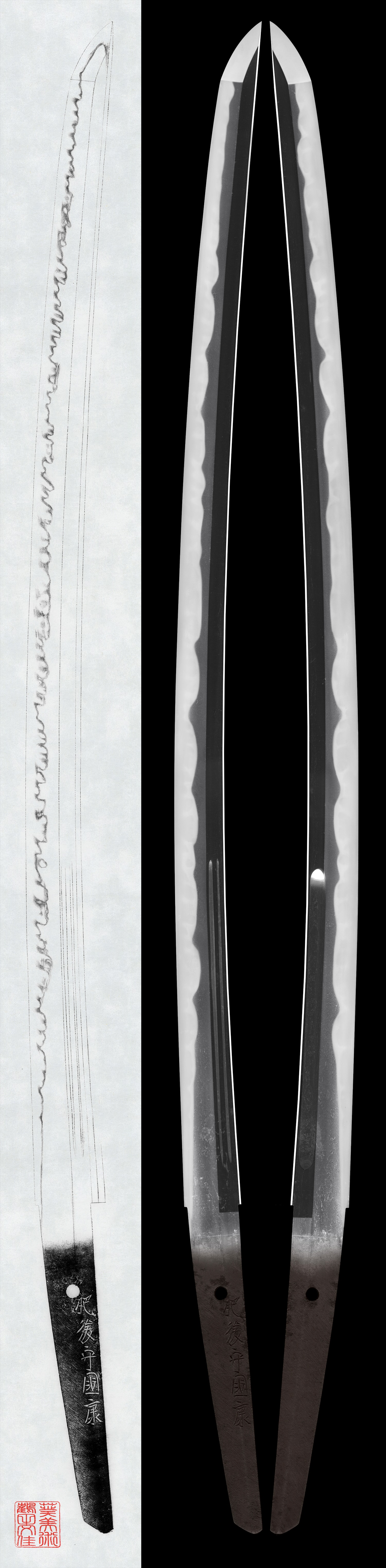
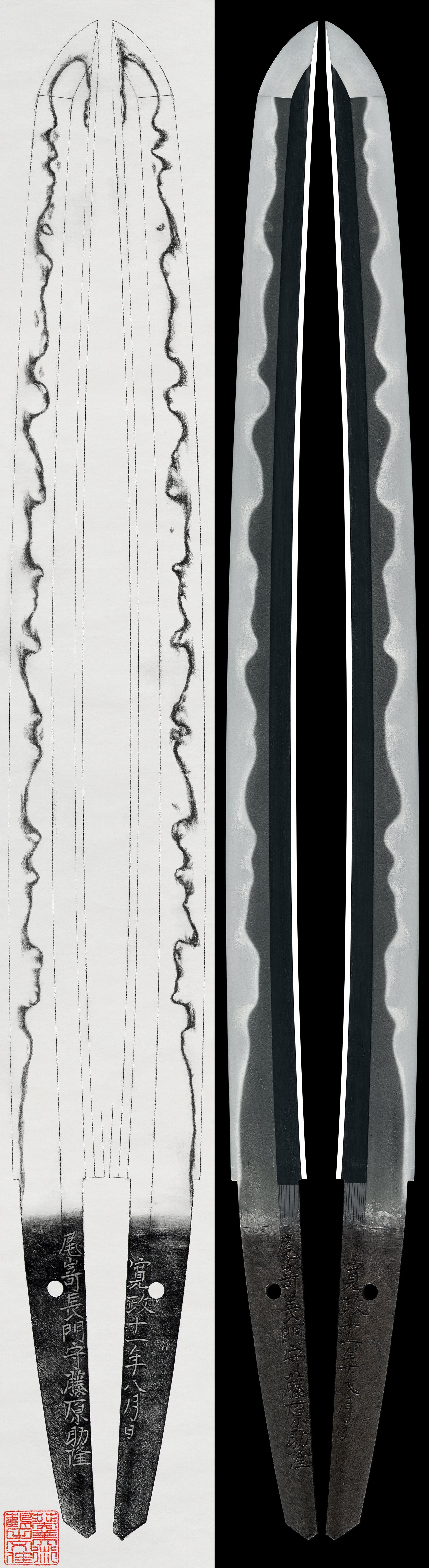
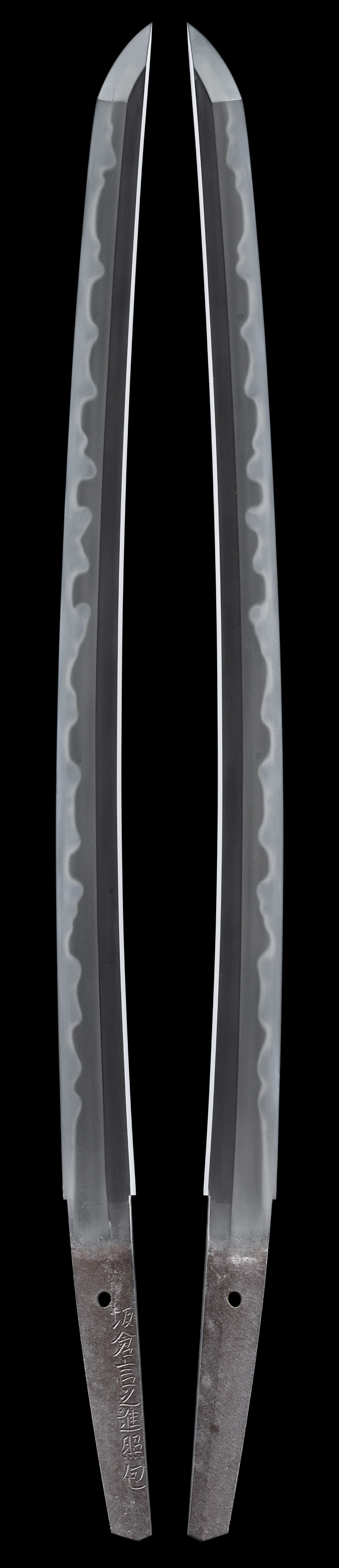
Inoue Shinkai was the second son of the first-generation Izumi no Kami Kunisada, the smith the published sources call the Oya-Kunisada, who carried the line down to Osaka and founded the school there. Commonly known as Hachirobei, the son served as his father's and in the old man's last years, and on succeeding to the house as the second generation he signed, like his father, Izumi no Kami Kunisada. Around Manji 4 (1661) the court granted him the right to cut the chrysanthemum crest on his tangs, and from the eighth month of 12 (1672) he changed his name to Shinkai; he died suddenly in the eleventh month of Tenna 2 (1682). The published commentary holds his forging to surpass his father's, and the name he is given is the Osaka Masamune. He is to be kept distinct from the first generation he succeeded: where the father cut the Fujiwara surname, the son prefixed Inoue and omitted Fujiwara, and the pre-rename pieces signed Izumi no Kami Kunisada the collectors gather as the work of Shinkai-Kunisada.
The hand the sources return to again and again is a one. Over a tightly packed he tempers a that takes on a shallow tendency, sometimes with a little mixed, the run especially deep, thick and well gathered, and through the temper enter vigorously and appears. The phrase the commentaries use for the result is that the is bright and clear, the and alike clear and bright. It is the depth of the and the brightness of the steel together that the judges single out: a of his, they write, displays the extremely tight and refined for which he was particularly renowned, in a of especially fine quality, with exceptionally deep and and within. The work the published record describes most often is precisely this restrained, deeply -laden straight temper rather than any flamboyant .
The is the foundation of that judgment. His forging is a dense in which the adheres thickly and minutely (), here and there coarser rising unevenly, and fine enter well, the steel notably clear; this is the celebrated Osaka , packed and lustrous. Over it the temper begins with a -dashi and develops its shallow , and entering, the deep, with occasional faint near the . The runs straight into a and sweeps in at the point. The published sources state plainly what this manner amounts to: of all his work, this kind, deep in and clear in steel, is the one that "most fully shows the beauty of his -forged work". He is, in their phrase, a master of .
The chronology of his work is read off the signature itself, so that the is a dating tell. The pre-rename signature moves in stages: he signed first the plain Izumi no Kami Kunisada, and then, after the court granted him the chrysanthemum crest around Manji 4 (1661), the name with the Inoue prefix added, Inoue Izumi no Kami Kunisada, so that these pre-rename blades already carry the and a date. The published sources record that he "signed both Izumi no Kami Kunisada and Inoue Izumi no Kami Kunisada at first". From the eighth month of 12 he changed the name to Shinkai and cut the four-character Inoue Shinkai large toward the on the , with the chrysanthemum crest and a cursive date on the . A of 10 (1670) still carries the long Inoue Izumi no Kami Kunisada signature, while the bulk of the corpus, signed Shinkai and dated through the Enpo years, belongs to his prime. Within that prime the published sources mark out a register apart: the Go-, a deliberate copy after Go Yoshihiro, the master he most prized. In these the of and run stronger than usual, the a stage deeper, the temper widening into a large that turns angular in places with , and the deepens to a single-sheet manner sweeping long in . The commentary names one such blade "the work he was most skilled at, the Go-", reading it against "a model, an Go , that Shinkai copied"; these are the pieces in which his shows to the full, the mastery of his own province. A separate problem of attribution sits at the edge of the corpus: the after the rename was long thought never to carry the Izumi no Kami title, so a signed Izumi no Kami Shinkai was held in reserve until research judged it a precious piece from just after the name change.
He is placed, in the published record, at the very head of the school beside one other man. Among the Osaka makers, the sources write, "the two great champions are Sukehiro and Shinkai", the former especially remarkable for , the latter, Shinkai, particularly outstanding for fine . His own model he took not from Masamune, despite the epithet, but from Go Yoshihiro, and the manner most fully his is the deep- and the Go-. The point that most clearly sets him apart from his great colleague is one of temper: where Tsuda Sukehiro founded the billowing toran-ba, Shinkai tempers none of it, and the commentaries, when they name the two together, pair them by contrast, his bright and shallow against Sukehiro's toran. His own deep- work, the sources add, together with Sukehiro's toran, exerted a great influence on the swordsmiths who came after.
He is Sai-jo among the makers of his age, and the designation behind his name is heavy: one of his blades is an Important Cultural Property, with four and sixty-seven , seventy-one works in the and tiers in all, and seventy-seven designated works on record. His record is signed throughout, a documented hand and not a mystery: seventy-seven of the official pieces carry his signature. The provenance recorded against them runs through known collectors of the modern era. His Enpo 3 once belonged to General Tani Tateki, remembered as a discerning sword-lover of the Meiji and Taisho years; other blades pass through the hands of Yosaburo, Sumiyoshi Asataro, Otomo Tsunetaro, Bun' of Hyogo and the Aoyama family, and one Go- the published commentary ranks as "next after the example designated an Important Cultural Property". A private collector may realistically encounter his and blades, of which a fair number survive of recorded whereabouts; but they come to market only rarely, and a signed, dated, Shinkai of the Enpo prime is a landmark when it does.