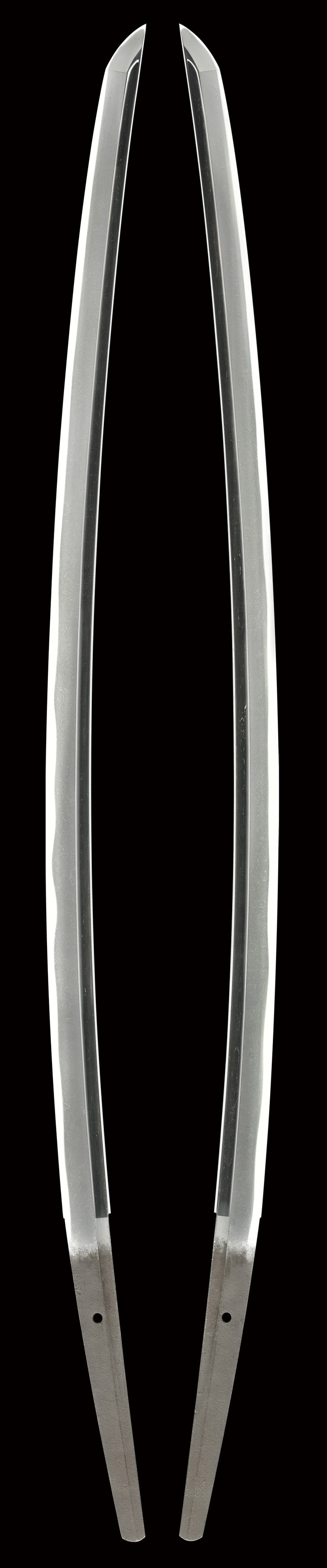
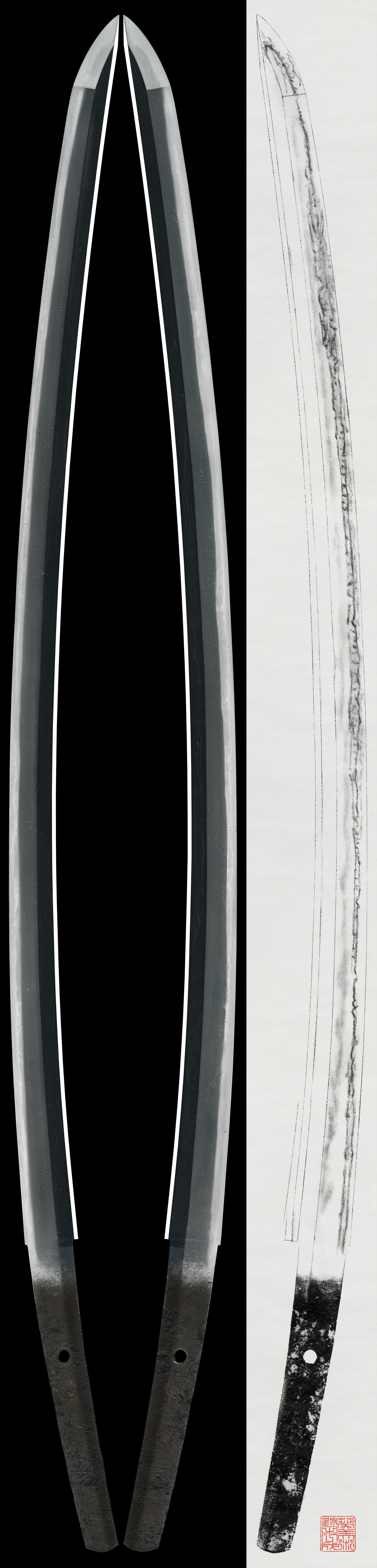
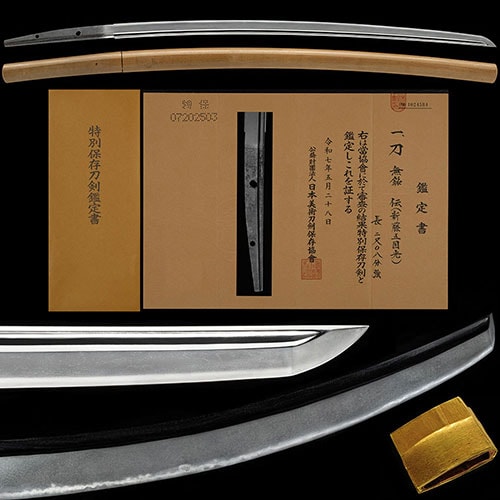
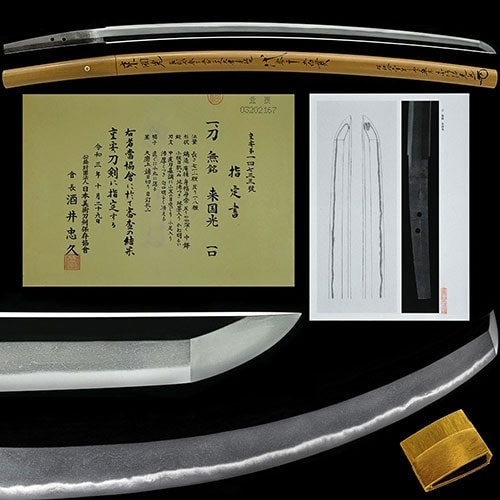
Kunisuke worked at Kumafu in Kikuchi District of Province, a leading hand of the school across the close of the period and into the . By tradition he was a son of the founder Taro Kunimura, who is recorded as a grandson through a daughter of Kuniyuki of Yamashiro, so that Kunisuke stands as the second generation of a lineage that carried the Yamashiro idiom south to the provinces. His activity is fixed by a dated Karyaku 2 (1327), one of the rare dated pieces of a school in which year-marked work is scarce. The published sources read the school as one broad manner with little individual variation, and within that uniformity they return repeatedly to a single judgment about Kunisuke: surveying the surviving works, the writes, one perceives that he was "a smith of considerable skill even within the lineage", ranked with Kunitoki and Kuniyasu among its strongest smiths. The name is recorded as continuing two or three generations into , the technique declining as it descends, and the treats the line under one head.
What distinguishes Kunisuke within an otherwise even school is the abundance of activity in his . Where the school's temper is a quiet chu- or with calmer internal work, his is the busiest hand of the line: a base that frequently takes and somewhat angular , with abundant , vigorous , and , the at times sinking and at times brightening. The published sources mark the difference as a matter of degree rather than kind. Of one the observes that its runs "more violently than usual", its pointed, and judges the result uncommon within the school. Above this busy temper sits the feature the judges name as his alone: on his wide, and , the is hardened deep and breaks into a violent flame, rising and pointing back, the taking a form. Of the the published record states plainly that this deeply tempered, fierce flaming is "without parallel even among this smith's own work and within the school".
The forging is a packed or that flows toward , mixed at times with , and on his wider pieces the grain stands a little, the tendency answering the liveliness of the . Across the lie dust-fine , applied thickly, and fine that enter well, over which the school's pale rises. The of his quieter blades closes into a or a large-radius with a shallow turnback, often with at the tip. Against the parent school the published sources fix the differences precisely: the -lean and the whitish steel, the tending toward , the calmer internal activity, and the larger, shallower-returning . These are the named recognition points of , and Kunisuke shows them all, the standing a degree more than his profiled siblings.
His surviving work falls into two registers. The first is the active manner of the phase: wide, and , read as from their broad bodies and stretched length, carrying the busy and the flaming described above. The second is a quieter register of slender with deep and small , and whose deep arc-like preserves a Kyoto air. Of one such , finely packed in with bright , the writes that its workmanship "closely recalls Kyo-mono", so that the attribution to the technically accomplished Kunisuke is fully persuasive. On certain of his the judges note an unusual thing for the line: the temper construction is the one usually seen on the school's . His signature is itself a point. Among all smiths he cuts the boldest two-character , set close and "with the thickest chisel within the school"; and where most of the line cuts the right element inside the enclosure in an ear-shaped manner, in Kunisuke that tendency is not conspicuous.
Kunisuke is read within the school less by a different kind of work than by degree, and the published sources place him by his proximity to . The states the point the whole school turns on: that the work "at a glance can resemble Kunimitsu and the like", which the judges take as corroboration of the tradition that the founder Kunimura was a pupil of Kunitoshi. His own preservation of that Kyoto air on the slender and the closes the lineage from the side, while the busy and the unique flaming mark the distance the school had travelled by his generation. A few of his blades carry the school's documentary curiosities: a signed on the , rare for the line, and another whose cut-off signed tang-tip was reset as a when the blade was shortened. Among the Enju hands the judges set him with Kunitoki and Kuniyasu at the head of the line, the standing , the busiest and the flaming of his wide pieces marking him out within a school that otherwise reads as one manner.
Fujishiro grades Kunisuke Jo-jo . Seventeen of his blades stand in the and tiers, one as a Bijutsuhin, and the survival of , signed examples is itself prized in the published descriptions, the more so where the dated anchors his chronology. The provenance against his name is unusually grand for a provincial smith: blades passing through Toyotomi Hideyoshi and Tokugawa Ieyasu, and held in the Hosokawa, Date, Uesugi and Tokugawa houses. The Tayasu Tokugawa carries a history written out by Count Tokugawa Satotaka in 1919: Hideyoshi bestowed it on Takenaka Uneme, it passed to Ieyasu, then to the Mito Tokugawa as an heirloom of Yorifusa, and finally to the Tayasu branch under Munetake. Of his designated works of recorded whereabouts, examples are held by the Sano Art Museum, the Seikado Bunko Art Museum, the Tokugawa Art Museum and Oyamazumi Jinja. For a private collector a Kunisuke is among the more attainable of the names, since most survive in the tradeable and tiers; even so the great majority are held, not traded, and a signed and dated example, or one of the flaming- pieces, comes to market only rarely.