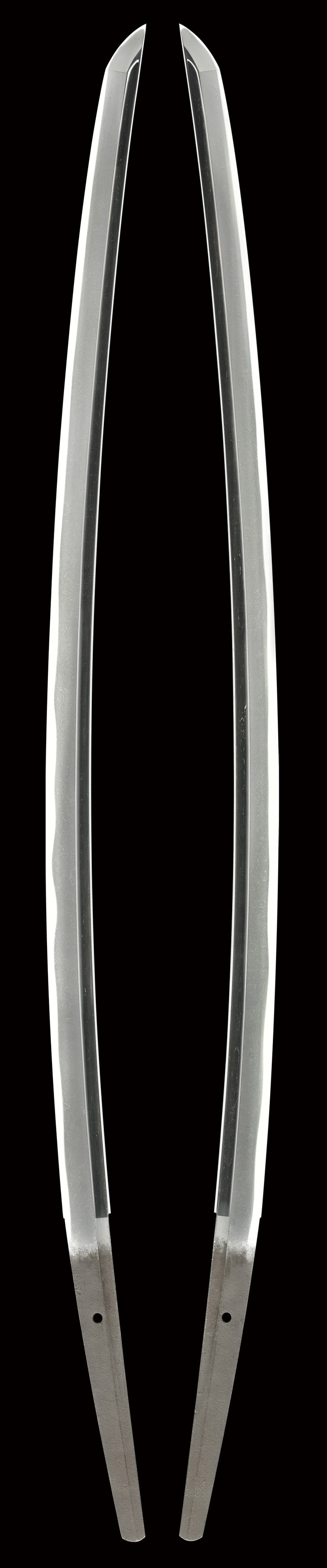
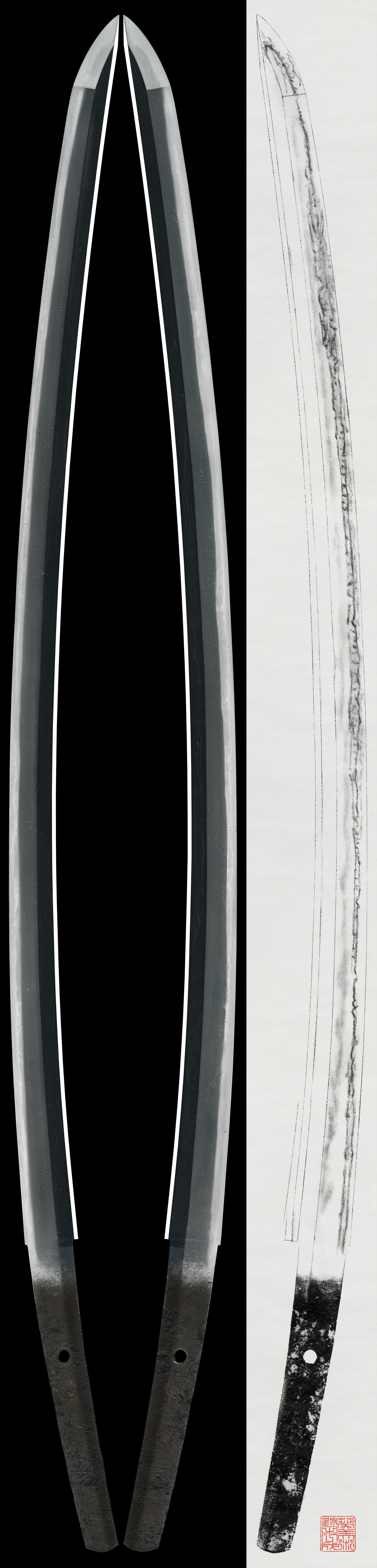
Kunimura is the founder of the school of province, and the published sources set him within the orbit of Yamashiro . According to the prevailing account he was the son of Hiromura of the Yamato Senjuin line, who married a daughter of Kuniyuki, so that Kunimura is transmitted as Kuniyuki's grandson through that daughter and a pupil in the workshop; the school name 延寿, , reads on the characters as the line itself. From him issued the smiths who carried the school, Kuniyoshi, Kunitoki, Kuniyasu, Kunitomo, Kunisuke, Kuninobu and Kunitsuna among them, and from the close of through the period the family flourished at Kumafu in Kikuchi District. His own dated standing falls in the late period, and one of his signed , the blade of 2012, still survives at 87.8 cm with a two-character signature cut in somewhat thick chisel strokes near the center of the tang.
The published descriptions characterize the Enjū hand as the Yamashiro look carried south to the provinces, and they say plainly that the school "in general resembles the school". What separates it is a set of provincial accents on that Kyoto manner. The forging shows "a noticeable -tinge together with conspicuous whitish ", the being the surest single tell, the cool reflection of a steel that is not quite the bright . The temper is , either or the narrower , with the drawn somewhat , sunken and quiet, frequently breaking into , the doubled line that recurs across his blades. The completes the signature: where turns back in a tight , the tip is rounded on a larger radius, an with a shallow, short turnback.
The is a well packed and close, mixed with and running into toward the edge, with laid on finely and delicate entering; in places the grain flows strongly and leans to , and over it stands the faint whitish the sources keep returning to. The is laid down in deep with adhering, and at times a small feeling entering, fine drawn through it; the activity within the edge is gentle rather than busy, and the in his better work is bright and clear even where it sinks. On the the published commentary reads this "inherited from the tradition" as producing "a profound, subdued and quiet flavor", the temper restrained, the calm, the whole understated rather than showy.
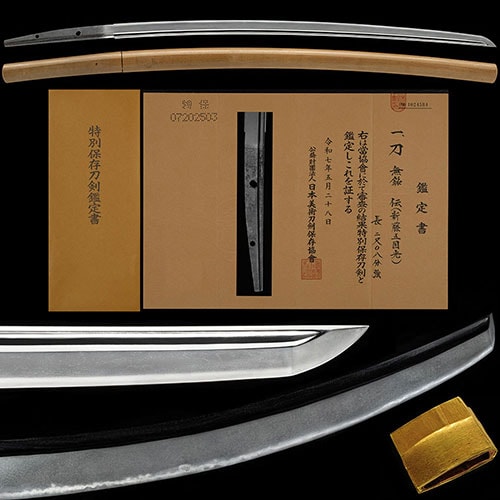
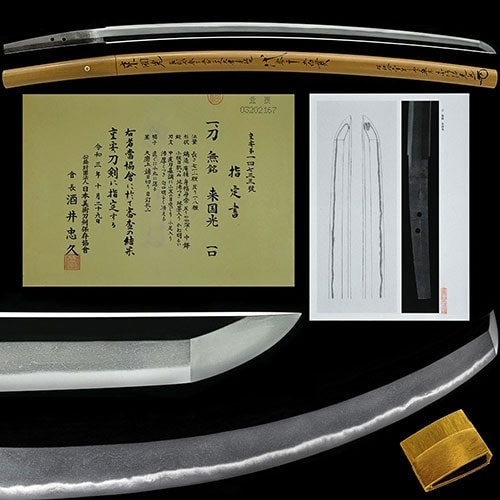
His work survives only as , the published record noting that "his production is confined to ", with no or other forms yet seen; the long blades come down either or into , and the surviving signed pieces are all . Two registers can be read in the corpus. The signed - are slender, long, with a marked taper from base to tip, deep with , and a small ; this 細身・幅差顕著・小鋒 form the sources call "distinctive to Kunimura even within the school", and it is precisely this that lets an appraiser narrow a blade down to Kunimura himself, as the 2019 and 2021 commentaries do explicitly. The form the second register, shortened from such and attributed by the reasoning. One even preserves the cut-off, signed tang-tip, inserted back into the shortened as a so the signature would not be lost.
The distinction the sources care about is against , and they draw it from Kunimura's own traits rather than from the blades. One feels "the air of Kyoto work, of the school in particular" in its wheel-like curvature, yet the depth and tightening of its place it with ; another, grounded in workmanship, is said to "reveal a Yamato temperament" in its flowing and . The Jūyō Bijutsuhin commentary by Honma puts the kinship and its limit in one phrase: work "resembles yet differs a little", carrying some whitishness and a -air, and its shows activity "more sparing than the of the school". That quieter, cooler register is the whole point of the school, and Kunimura is the smith who sets it.
In Fujishiro's grading Kunimura is Jō-jō , and the Tōkō Taikan values his work at one million yen, a high standing for a provincial founder. The designated record runs to one Important Cultural Property, two and eight , ten blades in the and tiers, divided about evenly between signed and pieces. The provenance behind them is considerable: the Important Cultural Property descends through the Kuroda family, one through Tokugawa Iesato and the Tokugawa family, others through Nanbu Toshihide, Harumasa and Yamada Fukunosuke; of recorded whereabouts, examples are held by the Hayashibara Museum of Art, the Idemitsu Art Museum and the Okayama Museum of Art. The Important Cultural Property is heritage held in trust and will not trade. The remainder, the and blades, come to market only from time to time and with patience; a signed by the founder of is among the rarer things a collector of work could hope to encounter, and most of what survives is the attribution rather than the signed blade.