NihontoWatch MonNihontoWatchBETA
MarketEncyclopedia
NihontoWatch Mon

NihontoWatchBETA

Market
Encyclopedia
Overview·Kantei·Designations·Work Types·Signatures·School
OverviewKanteiDesignationsWork TypesSignaturesSchool
  1. Schools
  2. Shoami
  3. Denbei

Shoami Denbei

傳兵衛

Jūyō
Vol. 54, No. 108 · Tsuba

Shoami Denbei

傳兵衛

12 ranked works

ProvinceDewaEraKeian-Kyoho (1651–1727)SchoolShoamiTraditionIron-tsubaTeacher正阿弥吉長 Shōami Yoshinaga (秋田正阿弥 / Akita Shōami)Specialtiestsuba, mokume-ganeTypeTosogu MakerCodeSHO_DEN1
12Jūyō Tōken

Overview

Shoami Denbei, born Suzuki Denbei in Keian 4 (1651) in Shonai, Dewa Province, is regarded as the founding master and foremost representative of the Akita Shoami lineage. At the age of eighteen, in 8 (1668), he traveled to and entered the school of Shoami Yoshinaga. In Enpo 1 (1673) he relocated to Akita in the company of Funao, a retainer of the Satake family, and in Enpo 3 (1675) he was taken into official service by the domain lord Satake Yoshizumi as a retained craftsman. The following year, in Enpo 4 (1676), he was granted permission to assume the Shoami lineage name and thereafter styled himself Shoami Denbei. He flourished as Akita's preeminent metalworker until his death in Kyoho 12 (1727) at the age of seventy-seven. The Akita Shoami themselves are understood to have relocated from to Akita in the Keicho era, accompanying the Satake ; Denbei consolidated this regional tradition into a distinctive artistic identity with national standing.

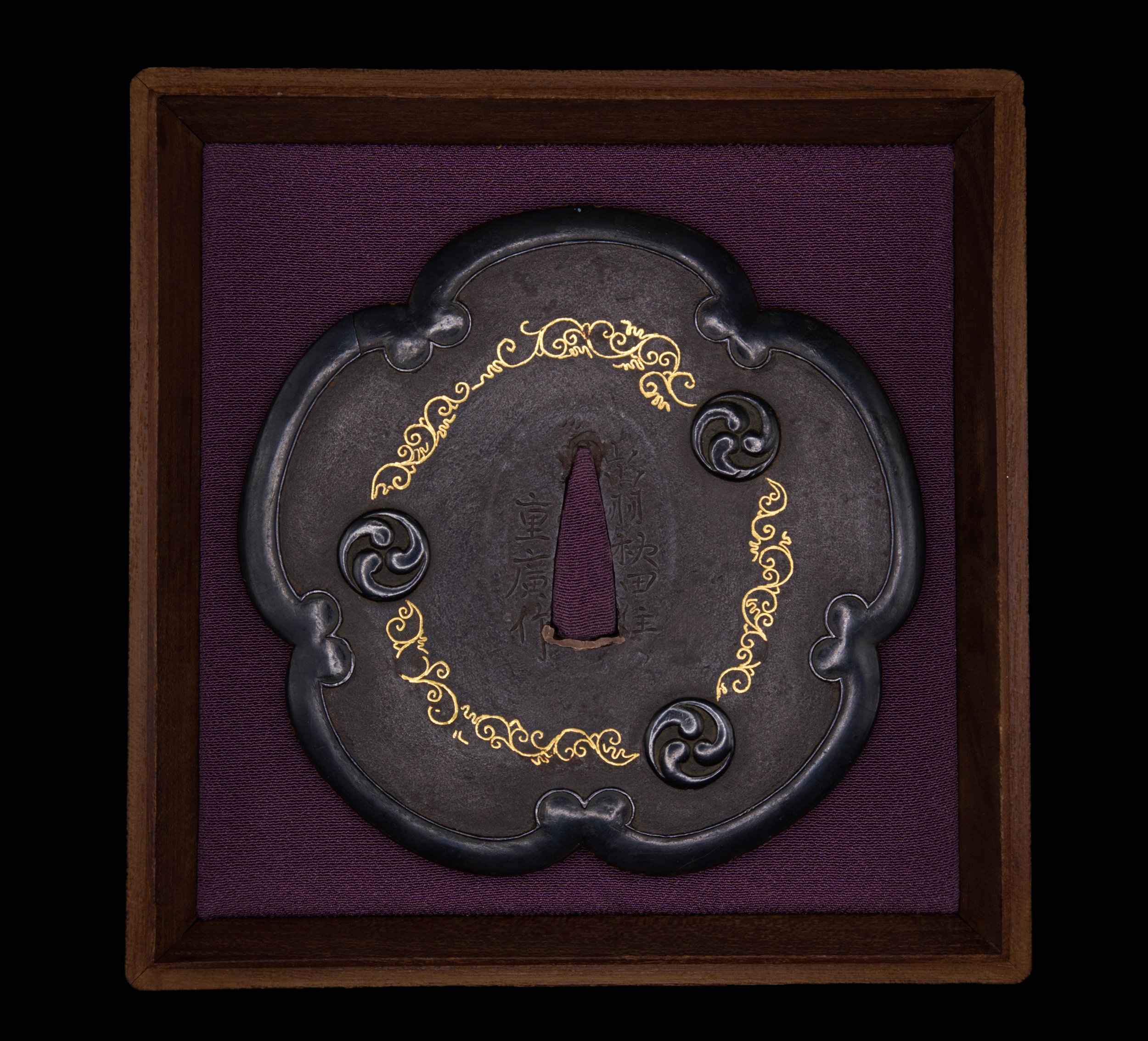
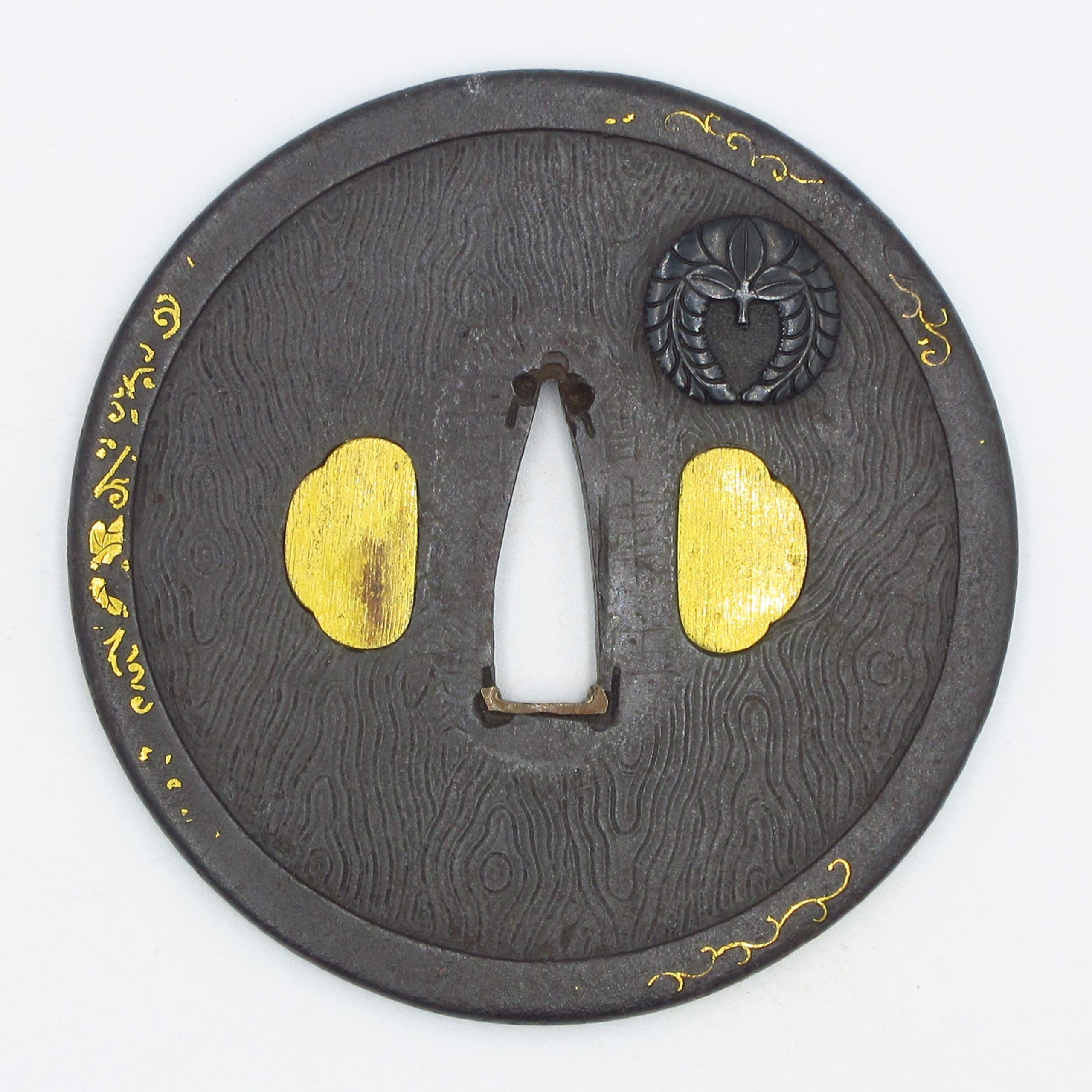
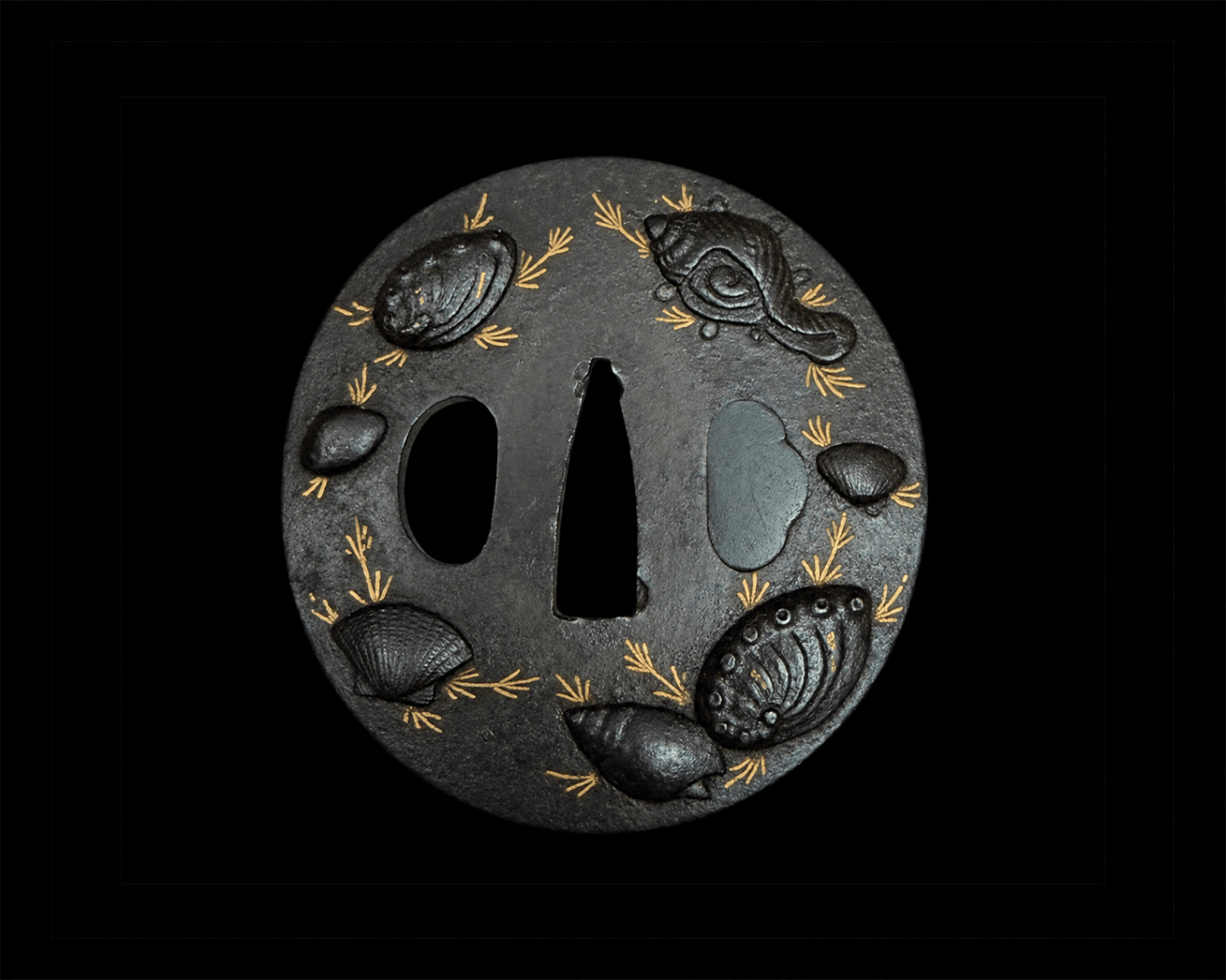
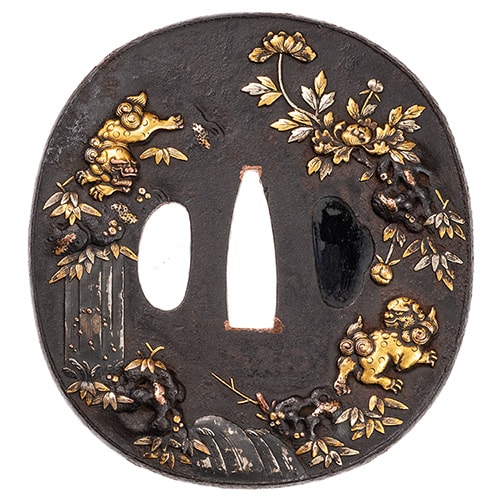
The range of Denbei's production is remarkably broad. His oeuvre encompasses pieces depicting subjects closely associated with Akita — most notably butterbur (fuki) motifs and cloud-and-dragon (unryu) themes — rendered through nikubori relief carving combined with openwork ground () and inlay. He also produced works employing guri-bori carving in laminated and copper that achieves effects reminiscent of lacquer tsuishu, a technique in which he particularly excelled. In every case, his compositions are innovative, and his advanced inlay methods — particularly sen- (line inlay) and (textile-pattern inlay) — are consistently striking. His gold ornament is highly individual, wholly different from the arabesques of , Kyoto, or Awa, and constitutes a distinctive Denbei idiom. The butterbur subject held special significance within the school, both for its association with Akita's celebrated giant fuki and for its auspicious homophony with fuki meaning "wealth and rank." Additionally, his shippo (gold cloisonne inlay) has been identified as entirely identical to the cloisonne methods of the main Hirata lineage, providing valuable evidence of technical exchange between the two houses.

Denbei's consistently project an assertive, powerfully individual artistic character regardless of subject or format. Whether working in otafuku forms with bold butterbur leaves, true-round iron plates with - and all-over gold , or hexagonal guards with bamboo openwork, his works convey both mastery and authority. His approach to spatial organization is distinctive: he combines realistic depiction with devised, original compositional ideas, and places importance on effects of coloration. Even with an intentionally simple motif, he projects a forceful, individual world and conveys the capacity of a master craftsman. Denbei's work reveals a sophisticated hand grounded in traditions inherited from the Shoami forebears, elevated by originality and technical virtuosity into a manner that is uniquely his own.
Kantei

3 descriptive axes: material (a varied palette of iron, shibuichi, oborogin and shakudo plates) x technique (ground-openwork sukashi finished with inlay, nunome and guri-bori) x themes (the Akita butterbur above all, with bamboo, dragon and scrolling arabesque). His load-bearing discriminators against ordinary Shoami openwork are the butterbur subject he made his own and the lacquer-derived guri-bori, with his distinctive nunome arabesque a third, single-source tell.

The first-generation Akita Shoami Denbei, personal name Suzuki Denbei, is named in the records the foremost metalwork artist of the Akita branch of the Shoami school. Born in Dewa-Shonai in 1651, he went up to at eighteen in 1668 and entered the school of Shoami Yoshinaga; he moved to Akita in 1673 and in 1675 was taken as a retained craftsman of the Satake lord Yoshisune, and was formally granted the Shoami line-name in 1676, signing Shoami Denbei thereafter. He died in 1727 at seventy-seven. His art is the (openwork) above all, the pierced plate worked in iron, , and grounds and finished with inlay, his compositions praised as fresh and inventive. His load-bearing subject is the giant Akita butterbur (fuki), which he made the emblem of the Akita Shoami, and his most characteristic technique the guri-bori he brought over from lacquerwork into laminated metal.

Diagnostic discriminators

the butterbur is named the subject that expresses the individual Akita-Shoami manner, the great Akita meibutsu fuki and a homophone for wealth-and-rank; it is genuinely depicted on roughly a third of his pieces (the fuki-leaf openwork guards), and recited as his signature subject in nearly every record

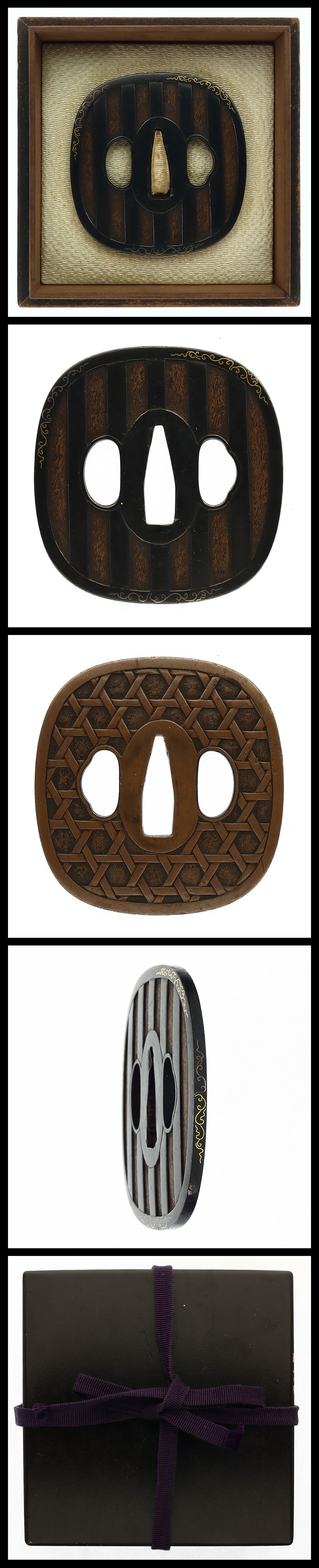
the records call guri-bori the technique he was most expert in and name a laminated shakudo-and-suaka guard his masterpiece in it; the manner translates the tsuishu layered-lacquer effect into metal, foreign to ordinary Shoami iron openwork, and is recited as his speciality across the corpus

unique vs the Higo, Kyo and Awa nunome arabesque

Material (the plates)

An unusually varied palette for a Shoami openwork hand: iron grounds polished or hammered, and the -grey , and , often worked in combination so that the front and back of a leaf read in two metals; silver is also used.

Technique

Ground-openwork () is his frame, the design pierced through the plate and the field cut away, finished with relief and a range of inlay: gold nunome arabesque, flat inlay and line inlay, with cloisonne enamel on one guard; over this he commands the lacquer-derived guri-bori, the layered scroll-section cut into laminated metal.

Themes (openwork subjects)

The giant Akita butterbur above all, its broad leaf and stalk pierced and inlaid; with bamboo and bamboo-grove, the dragon and cloud-dragon, the gourd and vine, and scrolling arabesque, the records praising the freshness of his composition and his command of space.

The Akita butterbur

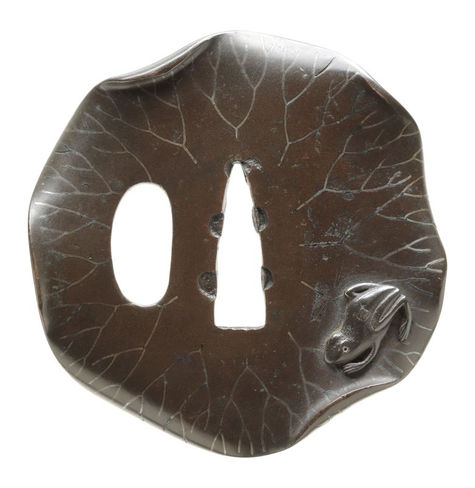
The Akita- butterbur, large enough to serve as a parasol, pierced and carried in two metals front and back with gold-inlaid veins, the subject the records say expresses the individual manner of the Akita Shoami.

Bamboo, dragon and vineless firmly established

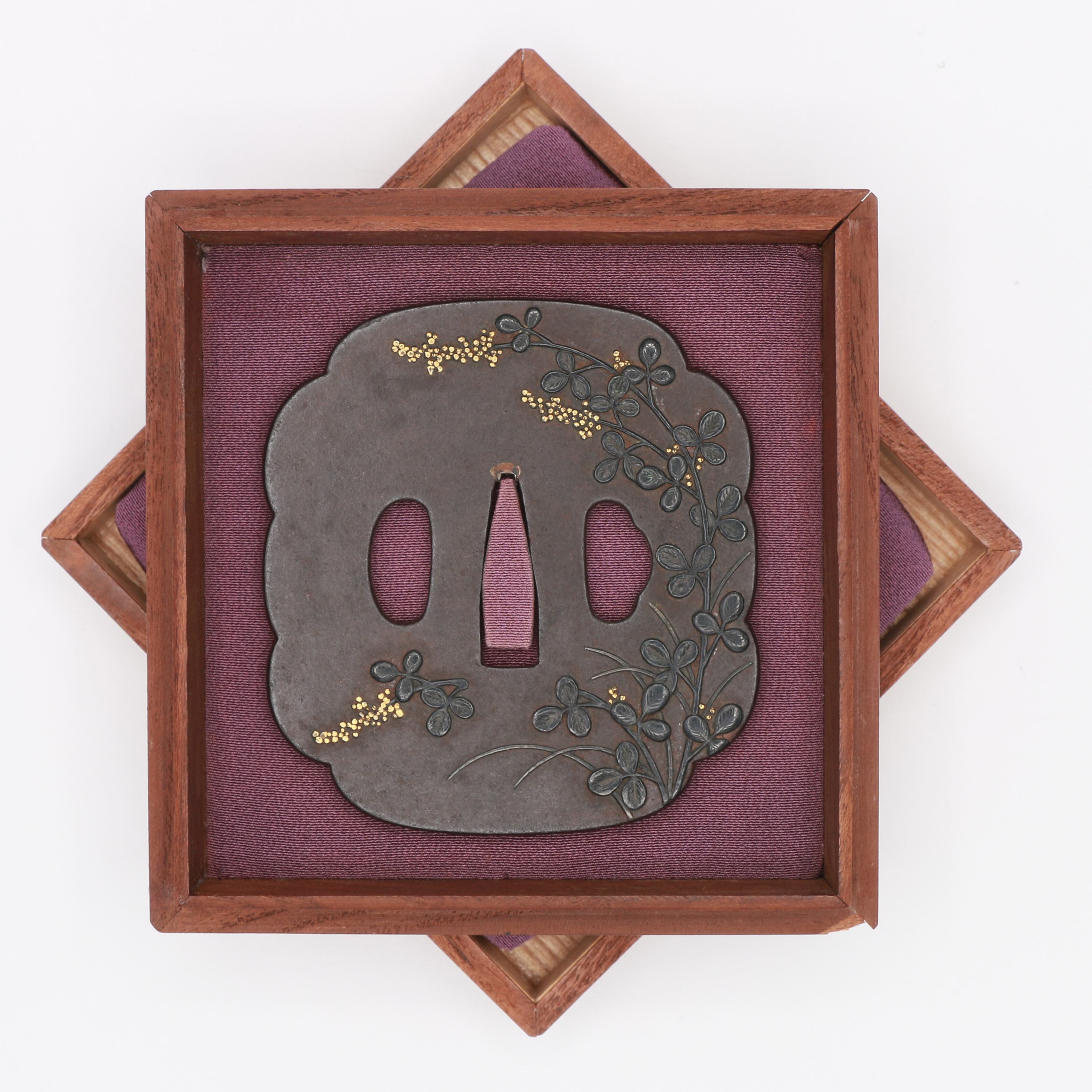
Bamboo and the bamboo grove, the dragon and cloud-dragon, gourd-and-vine and scrolling arabesque, all carried as pierced openwork with inlay.

Full iconography

Signature chronology

Recorded signatures

Documentary note

His signature is the school-name and personal name Shoami Denbei, cut without a and most often with the full Dewa-Akita-ju residence prefix (Dewa Akita-ju Shoami Denbei); the earlier records write the personal name with the new-form 伝, the later ones with the old-form 傳, and the corpus carries both. His real family name Suzuki is given only once in the biographies and is never chiseled. The Shoami line-name was formally granted him in 1676, after which he signed as Shoami Denbei; the name was carried on by later generations of the Akita branch, so the profile is scoped to the first generation by the consistent Dewa-Akita-ju full-address signature and the documented dates rather than by the bare Denbei name alone.

Scholarship

His distinctive manner is read as adding design to realism, a fresh and inventive composition with a command of space the records call his alone.

Designations

Kokuhō—
Jūyō Bunkazai—
Jūyō Bijutsuhin—
Gyobutsu—
Tokubetsu Jūyō—
Jūyō Tōken12

Elite Standing

0.09 across 12 designated works

Top 15% among makers

Work Types

Distribution across 12 ranked works

Tsuba
1192%
Other
18%

Signatures

Signature types across 12 ranked works

Currently Available

Shoami School

Other artisans of the Shoami school

  1. 1.Shoami Katsuyoshi正阿弥勝義7designated
  2. 2.Shigeteru重照1designated
  3. 3.Shoami Choemon正阿弥長右衛門1designated
  4. 4.Masanori政徳6 for sale1designated
  5. 5.Shoami正阿弥1 for sale1designated

Denbei

Denbei(傳兵衛) was a maker of Japanese sword fittings (tōsōgu) of the Shoami school in Dewa province, active during the Keian-Kyoho (1651-1727) period.

The work follows the Iron-tsuba tradition.

Designated works by Denbei include 12 Jūyō.