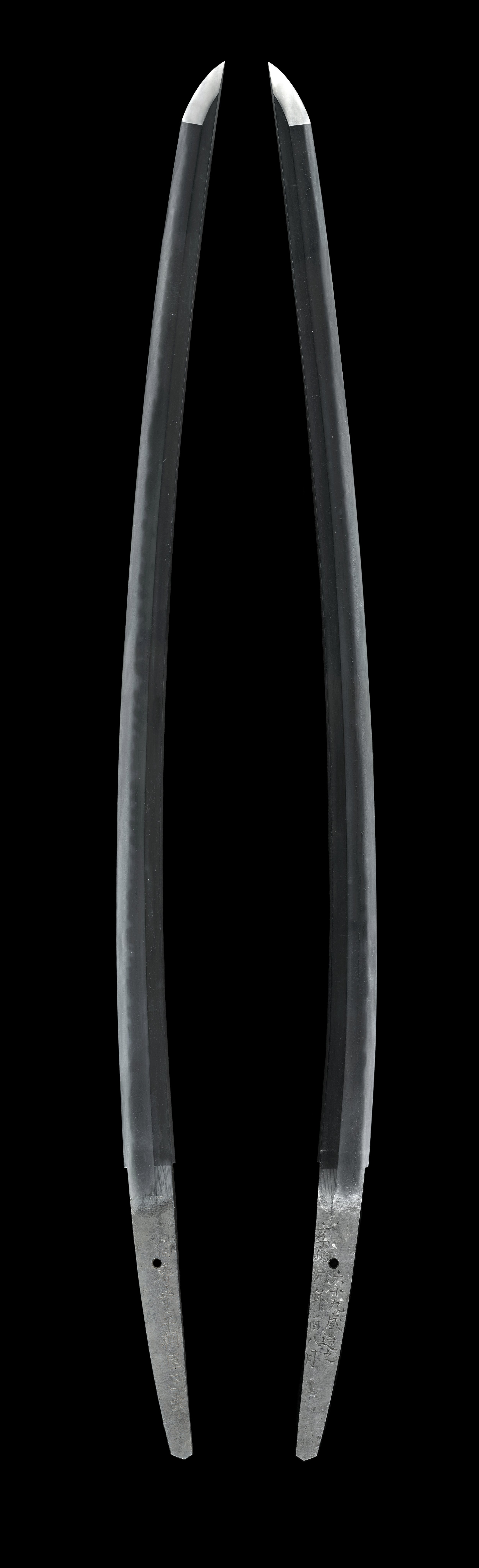
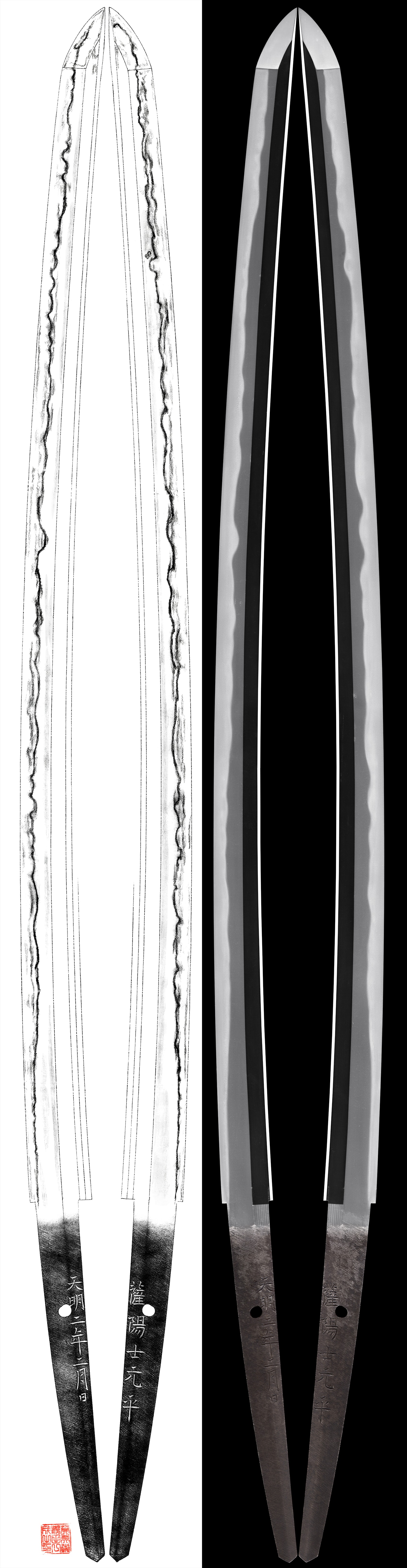
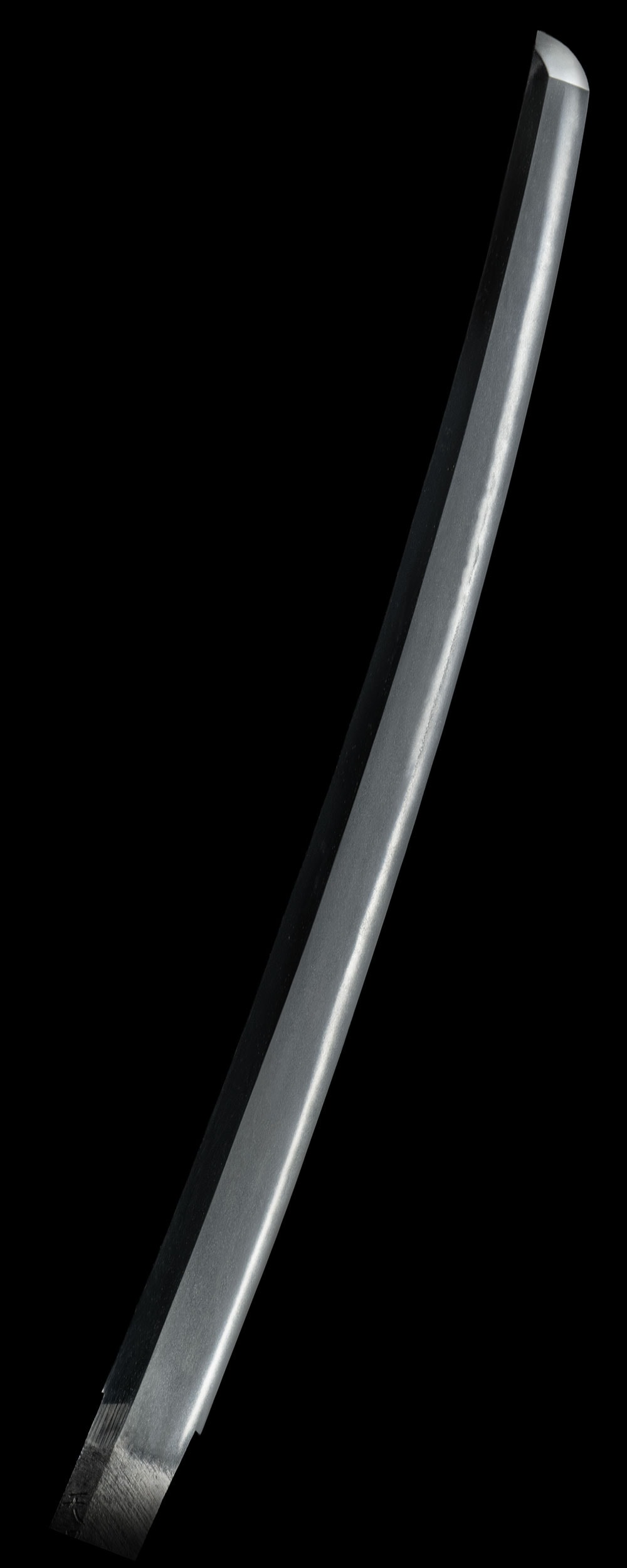
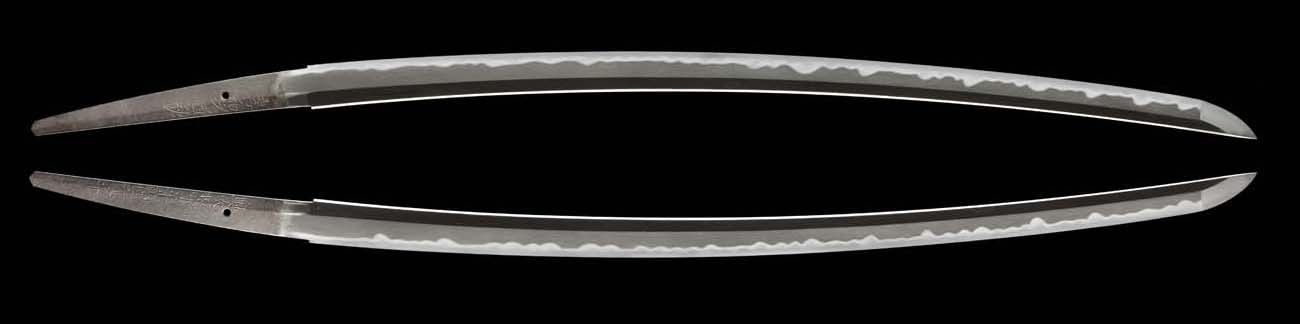
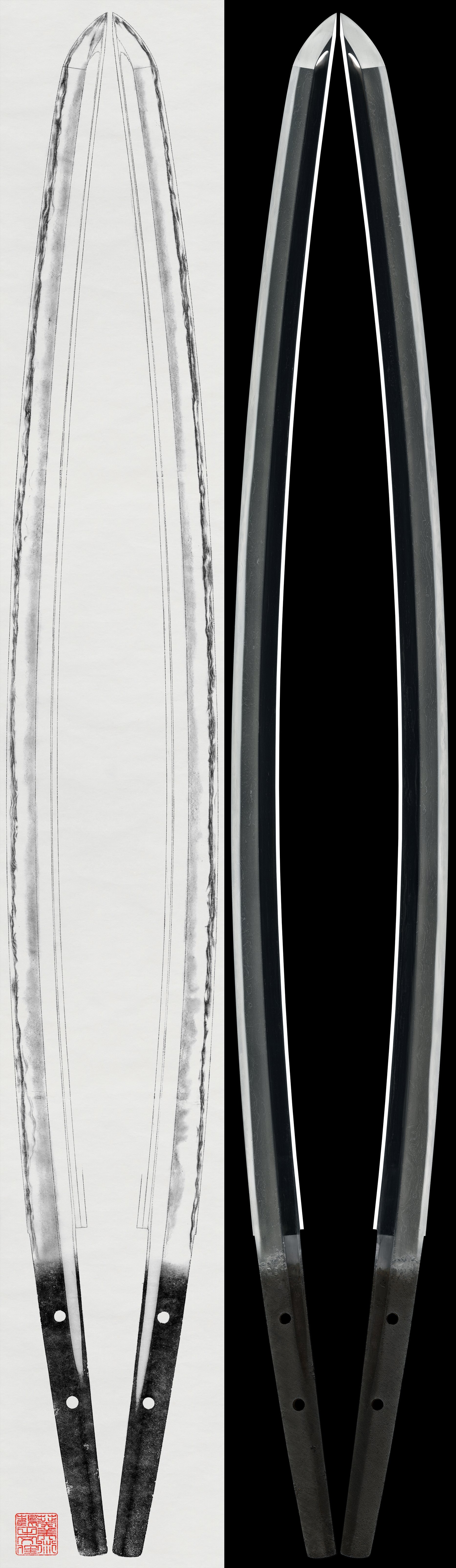
Every blade on this record of Yasuari is an , signed , three of them cutting the long Satsushu-ju Ippei Fujiwara Yasuari toward the with a thick chisel and dated Meiwa 3 (1766). Yasuari was born in Hoei 5 (1708) as the second son of Nakamura Kiyofusa, and because Ippei Yasuyo, the founder of the Satsuma Ippei line, had no biological heir, he was taken as adopted son in Kyoho 8 (1723) at the age of sixteen. When Yasuyo died at forty-nine in Kyoho 13 (1728), Yasuari succeeded to the headship of the line at twenty-one, and he led it until his own death at seventy in An'ei 6 (1777). The published sources note that he first signed Yasuji, that he undertook and on his master's behalf, and that joint works between the two survive, so that telling his own hand from Yasuyo's is itself a matter of connoisseurship.
His characteristic hand inherits Yasuyo's manner closely. The body is broad in and thick in , full in and high in the , the stout, robust construction of the province. Over a tightly packed he tempers a -based hand into which he sets and somewhat pointed , the deep and the thick with mixed and gathering unevenly. Through the run and , and in the upper half faint -like effects drift into the . On the fifteenth-session the runs straight into a small and the carries an imozuru, the long unbroken thread of -lines that is the celebrated Satsuma-no-imozuru of the province's schools. The deep- carried in coarse , rather than any clove-flower, is the spine of his recognition.
The beneath is the constant. It is a , well compacted and at times tending toward a , plain-grain look, into which forms thickly, mixed with rougher and fine , the steel taking a darkish cast. Over it the runs straight, turning back in a small or, on one piece, thick with in a -like manner, the point swept with . The is , finished with a kuri- tip and file marks, with a single ; the carries the long signature toward the and the a date inscription, the tang-finish itself among the features the published sources read as extremely close to Yasuyo.
The published sources read two faces within this small signed record. In his ordinary range the work is calmer: a wide with a slight tendency in the upper half, narrowing below into a shallow , the whole carrying unevenly distributed over a turning somewhat plain, a piece the judges read as an ordinary level of workmanship in both and that nonetheless "clearly exemplifies the characteristic style of Satsuma ". Against this stands his foremost manner, the mixed with and , deep in and thick in , with , and drifting , the dark and full of . Of one such the published sources say it "approaches the level of his adoptive father Yasuyo, and stands among the foremost superior works within Yasuari's oeuvre"; of another, that it is "extremely close to Yasuyo".
What sets him within his province is exactly the closeness the judges name and the small distance they then measure. He is read first against Yasuyo, whose broad thick , dark and -laden he shares so nearly that the published sources reach for the line again and again. His individuality is located not in a different style but in a quieter handling of the one. Compared to Yasuyo, the published sources find, the activity within the is calmer, and the shows in places a tendency to tighten, features through which "Yasuari's individuality can be discerned, and which may be regarded as his particular flavor". His own deep- , his dark -laden and his swept are the grounded traits that place him, the second-generation custodian of the Ippei manner within the Satsuma tradition rather than a maker of a separate school.
For the collector he is a comparatively rare name, his own extant works few even within the Satsuma school, since his period of working alongside Yasuyo was short and much of his early labor went into and for his master. He has no National Treasures and no Important Cultural Properties; his record on this account runs entirely through the tier, where four of his works are held, all , signed dated to Meiwa 3. The published sources call the finest of them a superior piece comparable to his adoptive father, the highest praise the school's own commentary affords a second-generation hand. The blades carry no recorded provenance, descending instead through private collections in Japan and abroad. Most designated blades, including those in private hands, are held rather than traded, and a signed Yasuari of his foremost manner comes to market only rarely and with patience, a document of how the Ippei line carried its founder's - into a second generation.