NihontoWatch MonNihontoWatchBETA
MarketEncyclopedia
NihontoWatch Mon

NihontoWatchBETA

Market
Encyclopedia
Overview·Kantei·Designations·Provenance·Work Types·Signatures·Lineage·School
OverviewKanteiDesignationsProvenanceWork TypesSignaturesLineageSchool
  1. Schools
  2. Umetada
  3. Shigeyoshi

Umetada Shigeyoshi

重義

Jūyō
Vol. 23, No. 548 · Tsuba

Umetada Shigeyoshi

重義

4 ranked works

SchoolUmetadaTraditionShintoTypeTosogu MakerCodeUME004
1Tokubetsu Jūyō3Jūyō Tōken

Overview

Shigeyoshi was a metalsmith of the school active from the 'ei through Genroku eras, residing in Nishijin, Yamashiro Province. He signed his works as Shichizaemon Tachibana Shigeyoshi, with the family name alternatively rendered as Umechū. Inheriting the carving methods of the school founder Myoju, Shigeyoshi carried forward and refined the distinctive pictorial idiom of the lineage. Multiple craftsmen appear to have worked under the name Shigeyoshi across Kyoto, , and Akashi, and their precise identities and interrelationships remain incompletely resolved, though the core figure is firmly associated with the Nishijin workshop and high-ranking patronage.

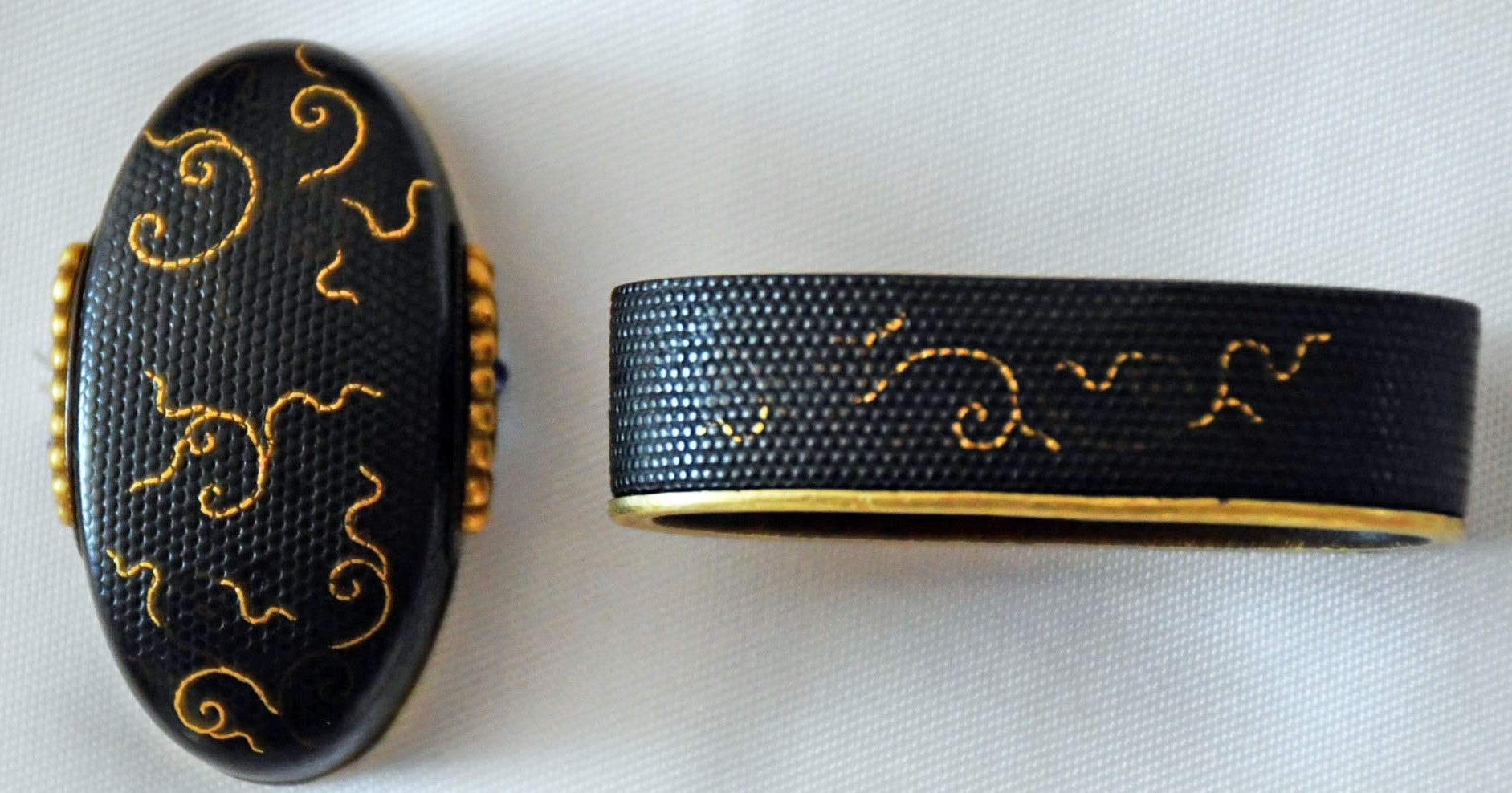
Shigeyoshi commanded a formidable range of metalworking techniques. His employ grounds finished in both polished () and stone-textured () surfaces, ornamented through - (applied inlay), - (flat inlay), (undercut relief), and (gold color application). He worked fluently in multiple metals including gold, silver, , and brass, often combining them within a single composition to achieve the chuya (day-and-night) two-tone effect characteristic of his output. His complete demonstrate mastery of the full suite of fitting types, from and to , , and , unified by consistent ground treatment and decorative vocabulary.

Shigeyoshi's surviving works reveal an artist of refined sensibility who synthesized the tradition of sophisticated inlay with an elegant decorative vision suited to the tastes of powerful warrior houses. His textile-derived designs of linked shippo, arabesque, and patterns reflect his Nishijin milieu, the heart of Kyoto's silk-weaving district, while his heraldic compositions bearing the kuyo- and other family crests served the Hosokawa and Asano clans. His output represents a high point of the urbane, pictorial manner within the school and constitutes important material for the study of early-to-mid period accoutrements.

Kantei

3 descriptive axes: material (shakudo, brass and suaka grounds, worked stone-grain or polished) x technique (flat inlay, applied-device inlay and colour-inlay carrying the Umetada slightly-raised manner) x themes (seasonal flowers, arabesque and emblematic devices in a pictorial sense). His load-bearing distinguishers against the house head Myoju are the finer, more precise manner the records set against Myoju's openness, and the single hitsu-ana on a full-round tsuba that one record calls a feature seen now and then in his work. With only four pieces both are single-source tells, hedged and scoped.

Shigeyoshi, common name Shichizaemon and of the Tachibana uji, is a metalwork artist of the school who lived at Nishijin in Kyoto and was active from about the 'ei to the Genroku years of the early-to-mid period. He signs Shichizaemon Tachibana Shigeyoshi, cutting the school name either as or, sometimes, as the variant character Baichu read the way. The records say he carried on the carving methods of the founder Myoju and, driving high inlay technique, unfolded the school's own elegant pictorial-style patterning, though the openness of Myoju's age is lost and a finer, more precise manner shown in its place. His grounds are , brass and ; his hand is flat inlay, applied-device inlay and colour-inlay. The corpus is very thin, four pieces, so his tells are read low-n and honestly.

Diagnostic discriminators

the corpus sets him against Myoju as having lost the openness of the founder's age in exchange for a finer, more precise manner; this is the documented discriminator against the house head, on 1 of 4 pieces, single-source and scoped to his late, minute work

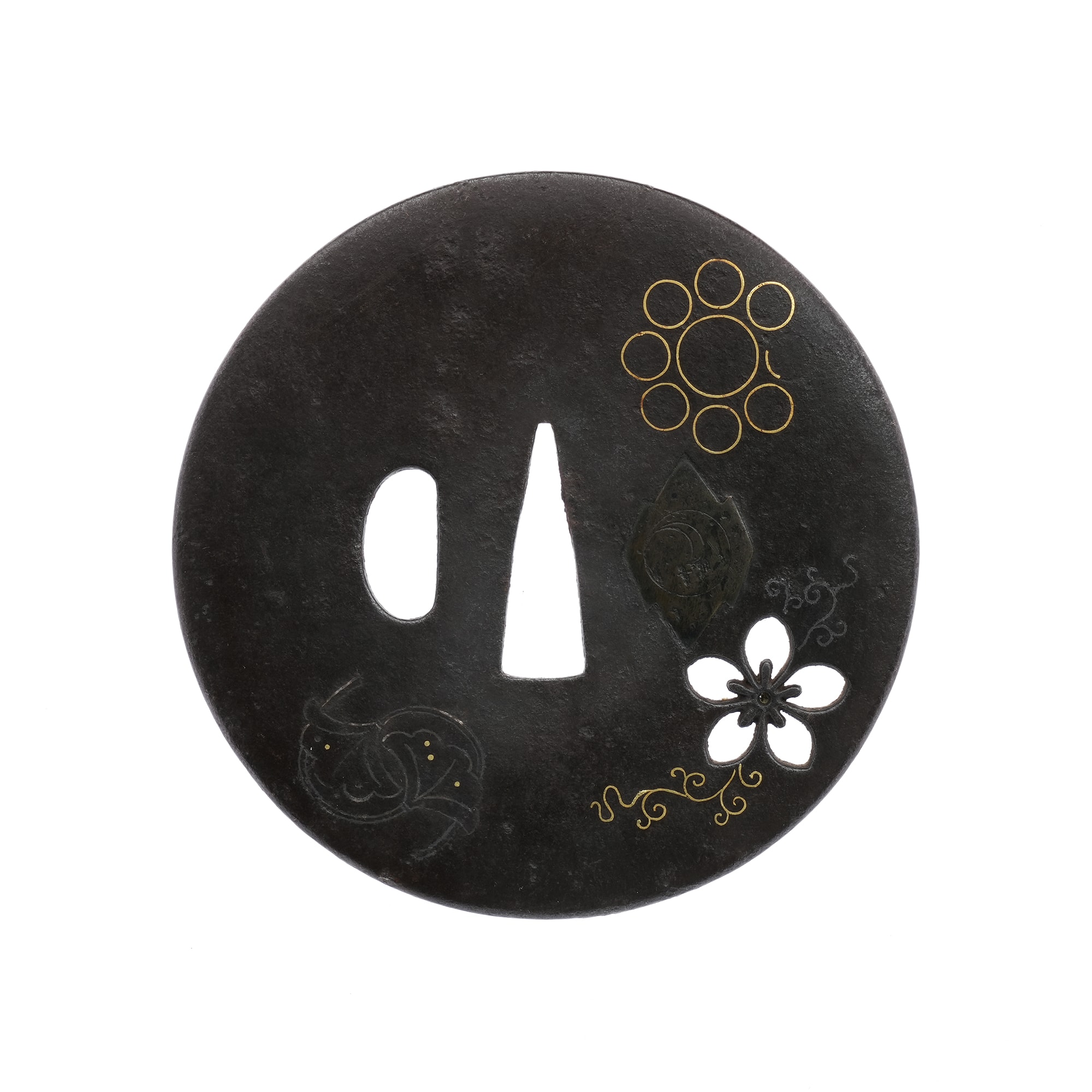
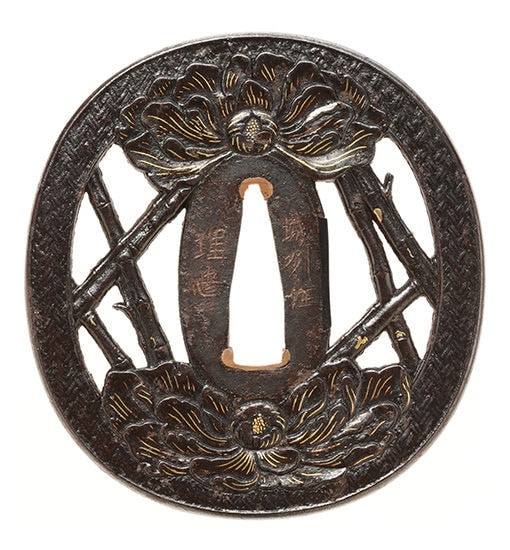
the full-round tsuba with a single hitsu-ana is named in one setsumei as a characteristic of this maker (同工にまま見る特色); the only other tsuba in the corpus is両櫃 (both hitsu filled), so n is 1 of 4 and the tell is single-source

Material (grounds)

above all, polished or worked stone-grain, with brass and ; the fittings add and a day-and-night ground. The grounds are the soft-metal field of a Kyoto kinko, carrying inlay rather than relief.

Technique (inlay)

Inlay is his hand: flat inlay of gold, silver, and brass, applied-device inlay, and colour-inlay, with relief work on the fittings. The records note the manner of letting the inlaid pattern stand a little above the ground.

Themes (devices)

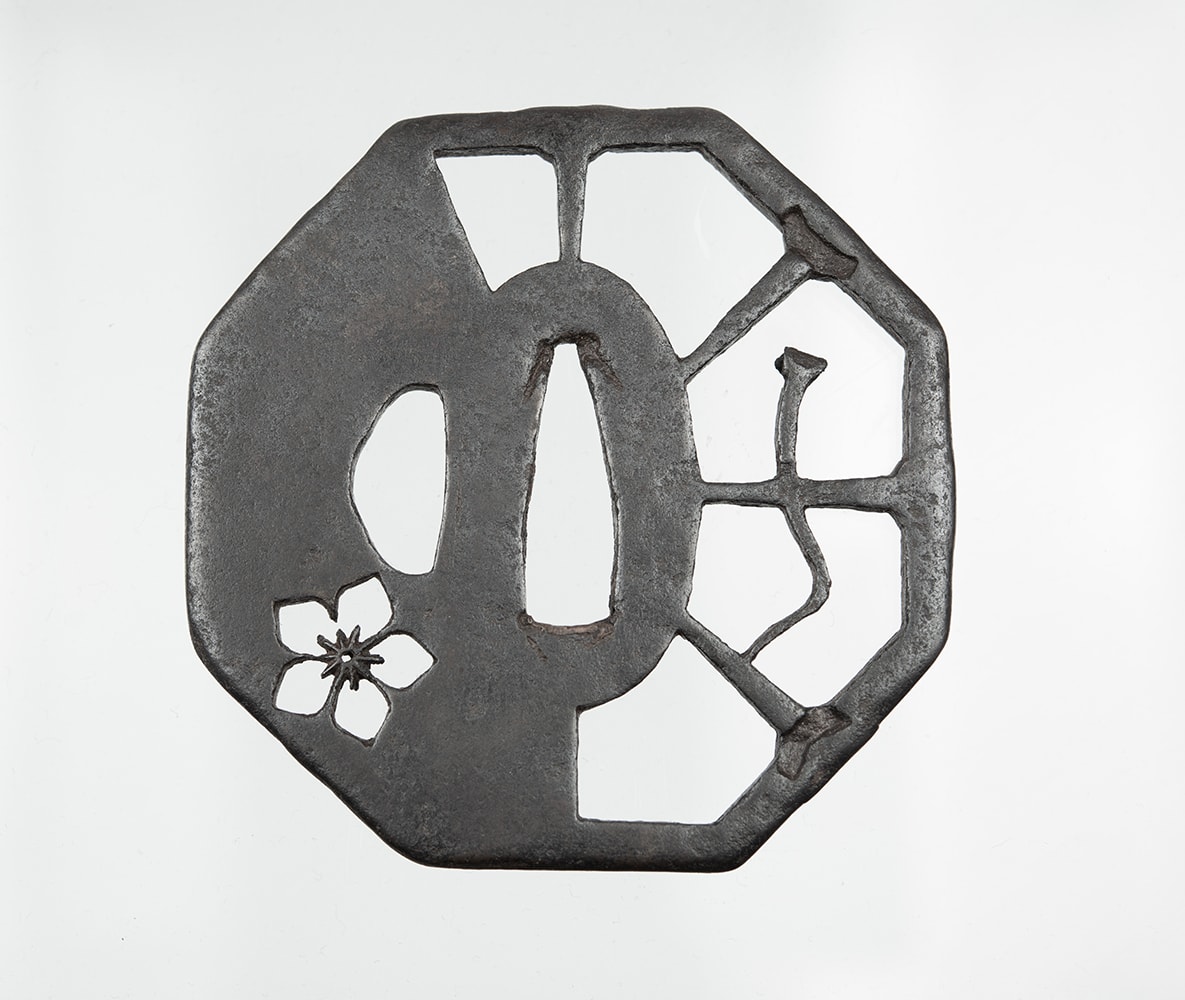
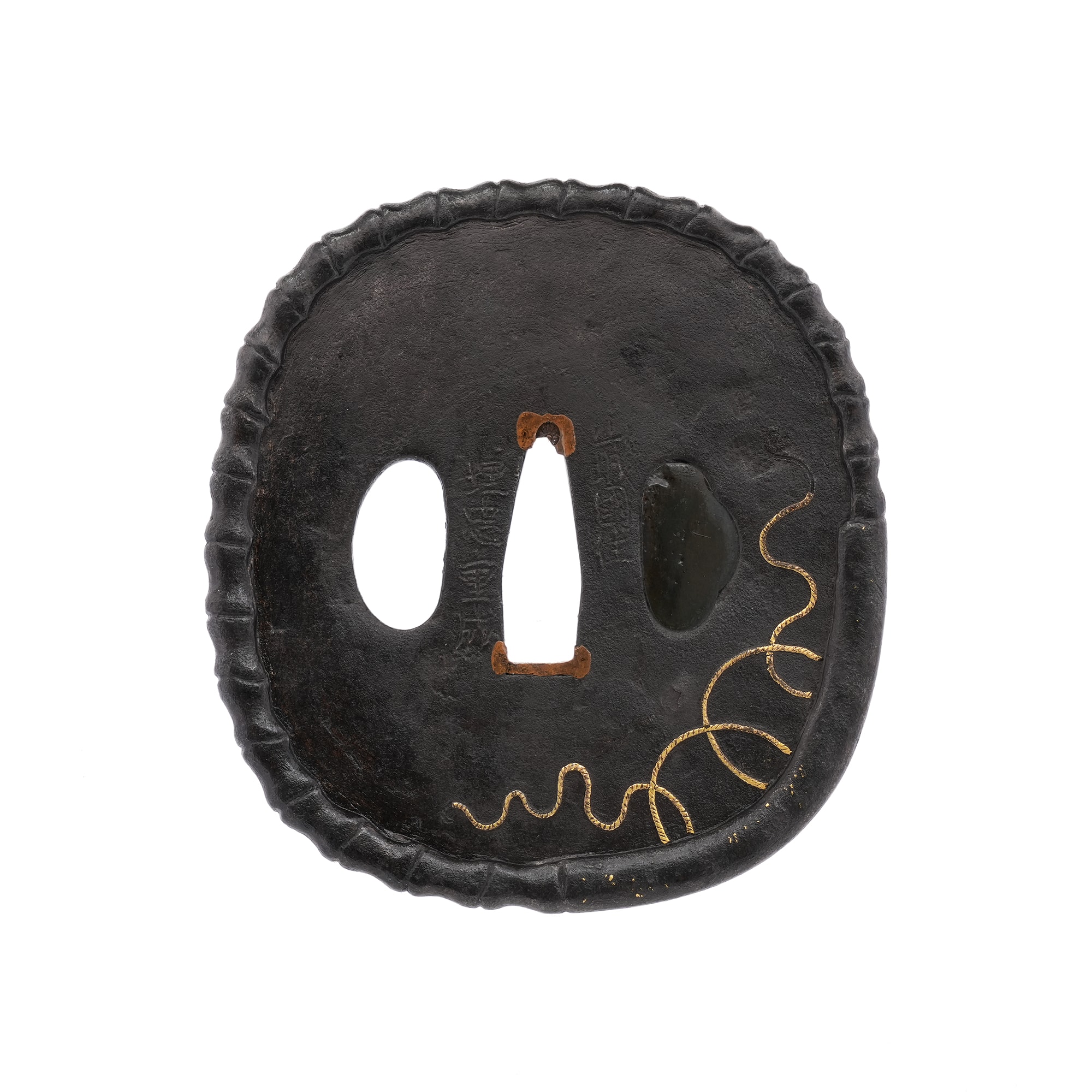
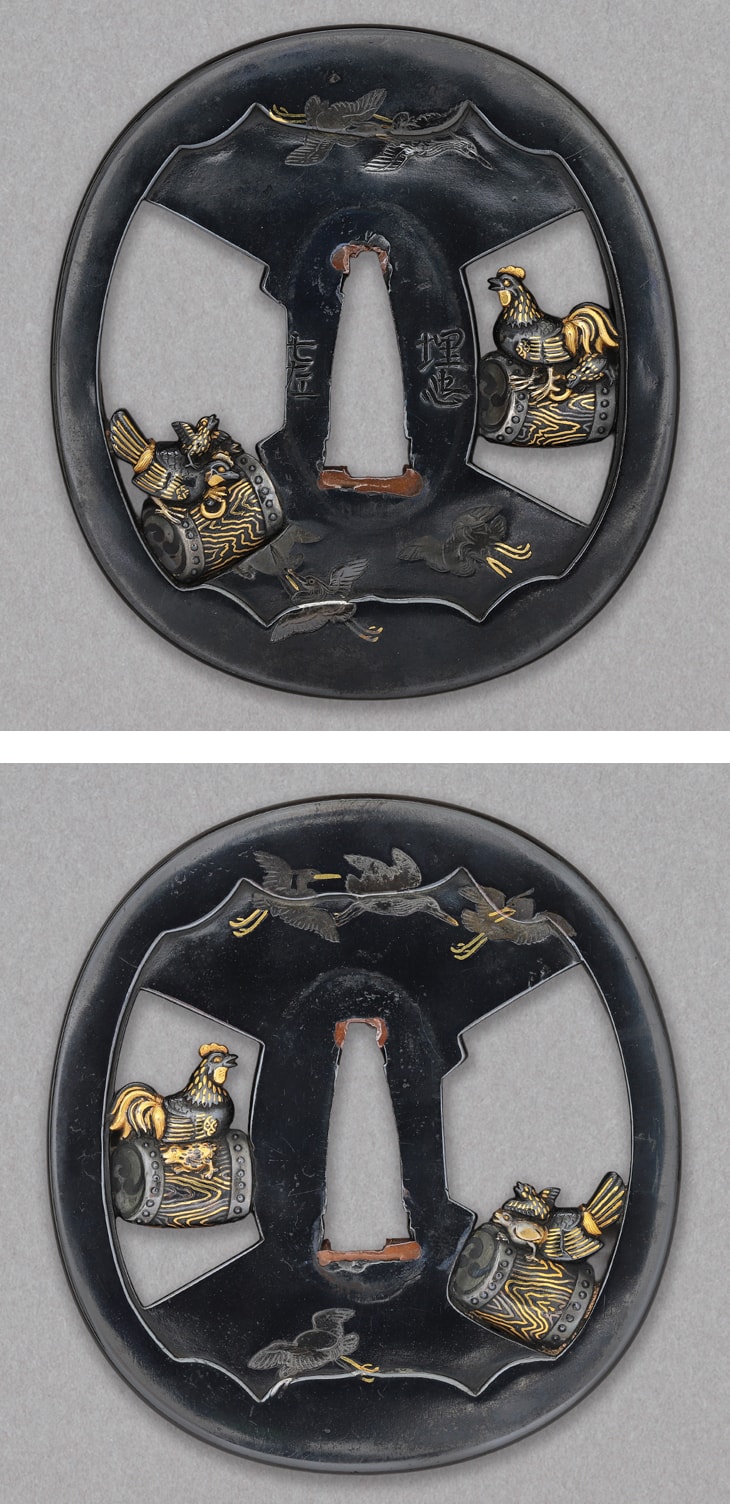
His subjects are few in the corpus: seasonal flowers set as round flower-devices, arabesque and flowing-water patterns inlaid on a brass field, and the kuyo crest of the Hosokawa scattered across the fittings as an emblematic, made-to-order design. One record divides his work into a pictorial-style mode.

Pictorial-style devicesless firmly established

Seasonal flowers and arabesque composed in a pictorial sense on the soft-metal field, the elegant patterning the records tie to the manner carried down from Myoju.

Full iconography

Signature chronology

Recorded signatures

Documentary note

He signs Shichizaemon Tachibana Shigeyoshi, cutting the school name as or as the variant character Baichu read the way, and on the fittings the residence form Joshu-Nishijin Shigeyoshi without a ; on one the common name Shichizaemon is cut alone. The records caution that several metalwork artists used the name Shichizaemon, that the most famous of them is Shigeyoshi, and that Shigeyoshi -makers were several in mid- Kyoto, and Akashi, their details not yet clear; one record therefore questions whether a Shichizaemon piece is his hand. Unsigned fittings are attributed to him by the matching crest commission.

Scholarship

His pieces are praised as completely realizing, with fine inlay, the design proper to the Umetada of Nishijin, the town famed for its woven silk; the elegant pictorial patterning is read as inherited from Myoju.

Designations

Kokuhō—
Jūyō Bunkazai—
Jūyō Bijutsuhin—
Gyobutsu—
Tokubetsu Jūyō1
Jūyō Tōken3

Elite Standing

0.00 across 4 designated works

Top 100% among makers

Provenance

3 documented provenances across certified works by Shigeyoshi

Provenance Standing

3 works held in elite collections across 3 documented provenances

Top 70% among makers

Raw score: 1.94 / 10

Work Types

Distribution across 4 ranked works

Tsuba
375%
Other
125%

Signatures

Signature types across 4 ranked works

Currently Available

Lineage

Shigeyoshi
Student
  1. 1.Yoshihira美平2 for sale2designated

Umetada School

Other artisans of the Umetada school

  1. 1.Myoju明寿43designated
  2. 2.Umetada❀忠7designated
  3. 3.Jusai寿斎1designated
  4. 4.Shichizaemon七左衛門1designated
  5. 5.Shichiza七左1designated
  6. 6.Mitsutada光忠6designated

Shigeyoshi

Shigeyoshi(重義) was a maker of Japanese sword fittings (tōsōgu) of the Umetada school.

The work follows the Shinto tradition.

Designated works by Shigeyoshi include 1 Tokubetsu Jūyō, 3 Jūyō.