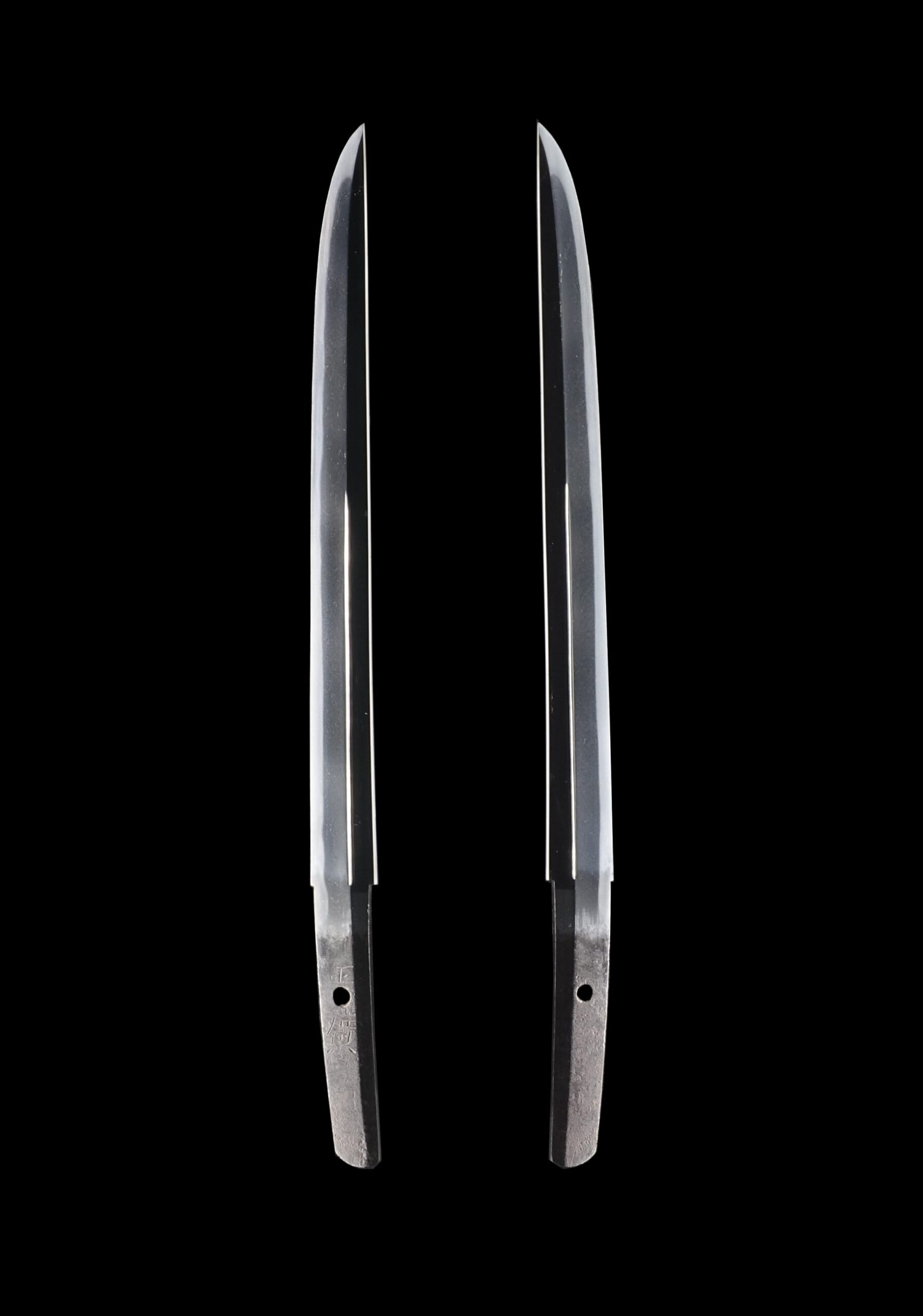
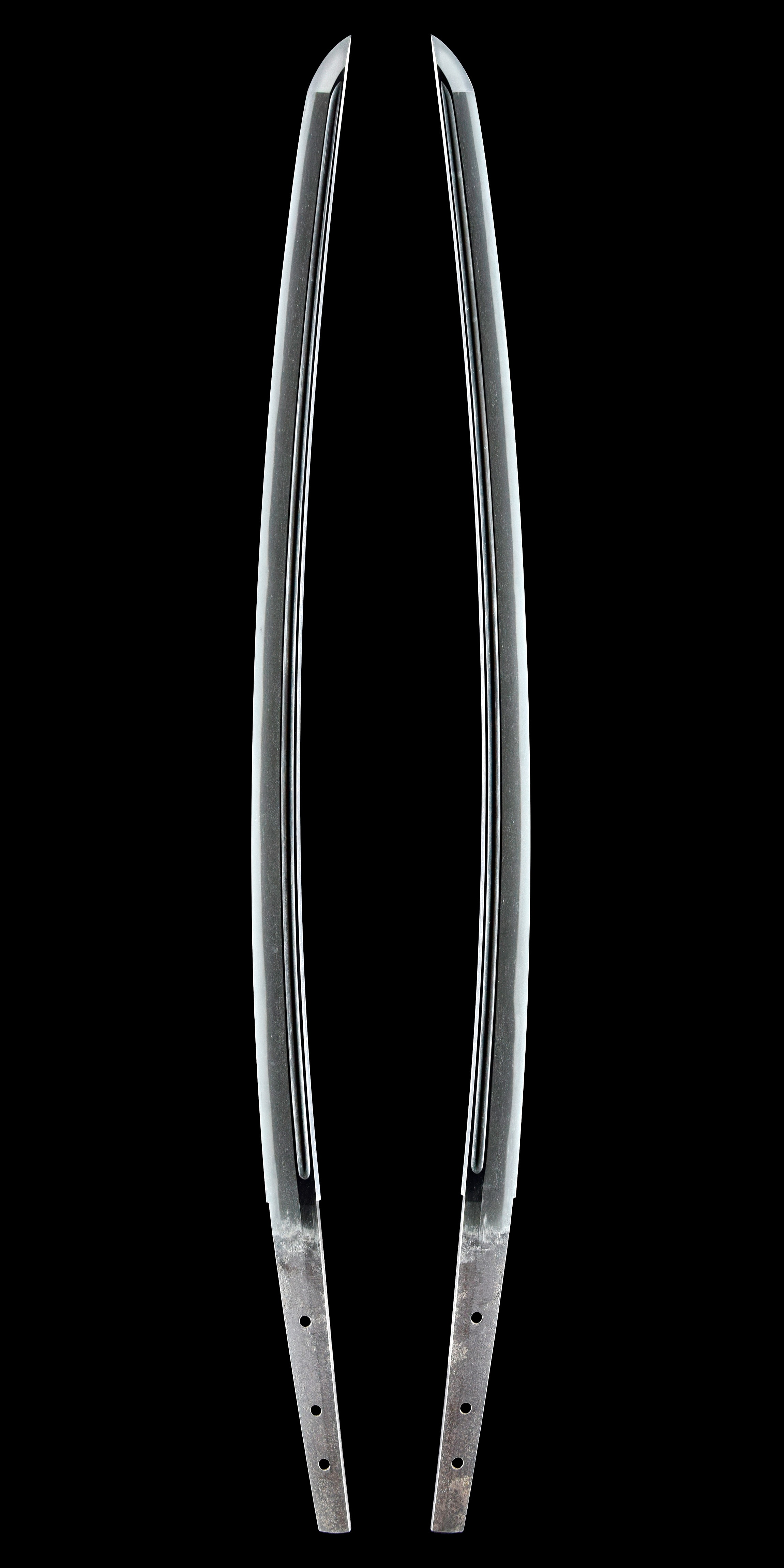
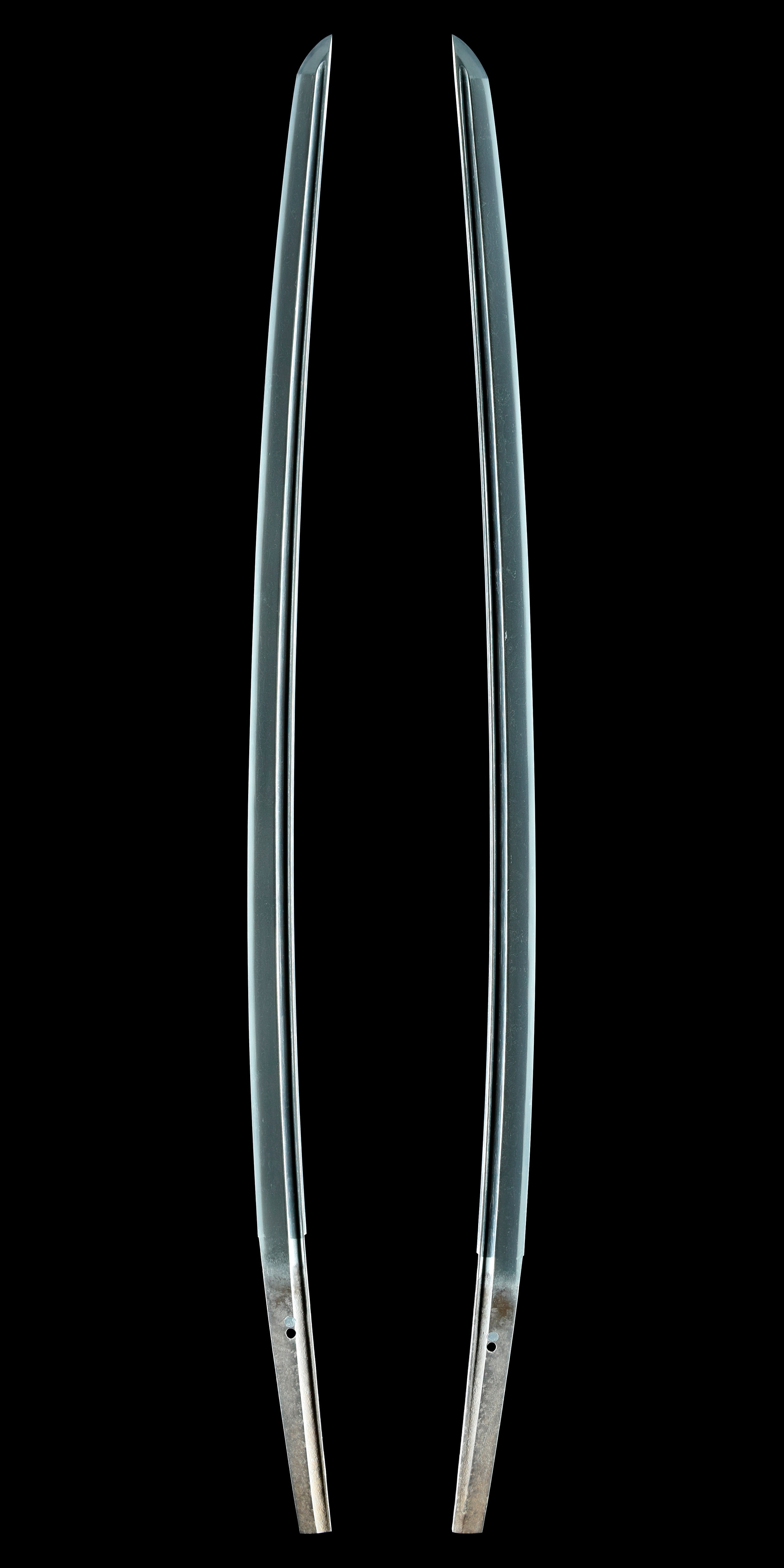
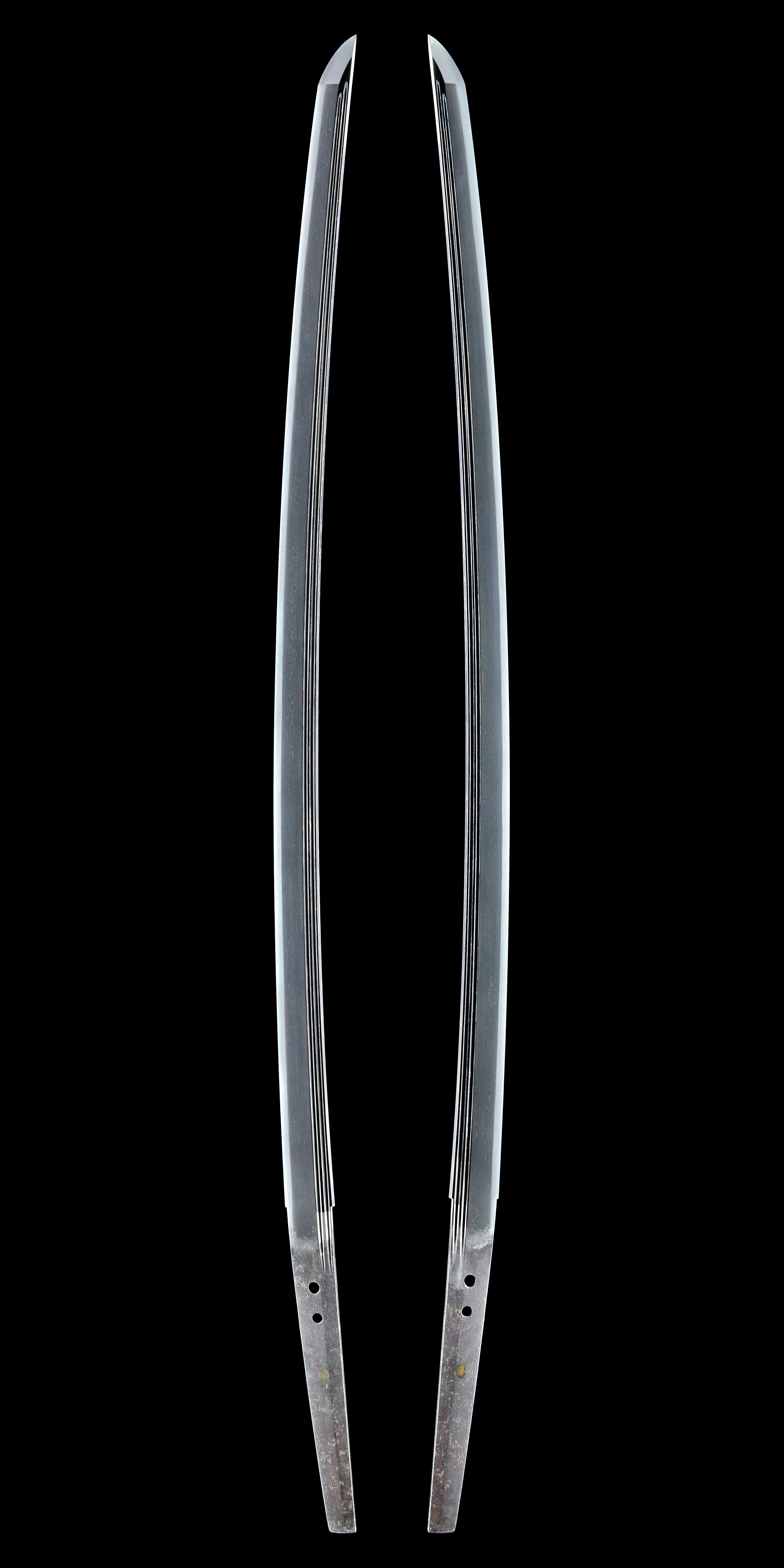
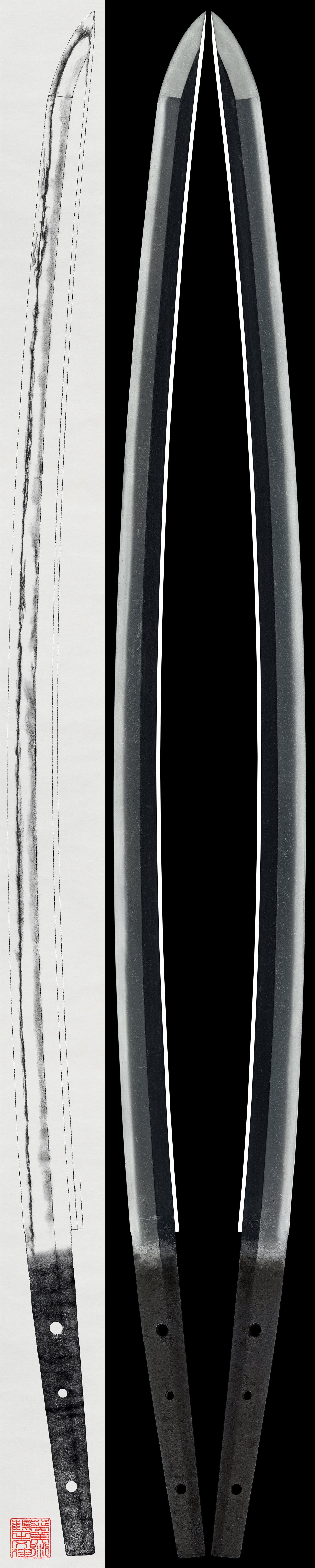
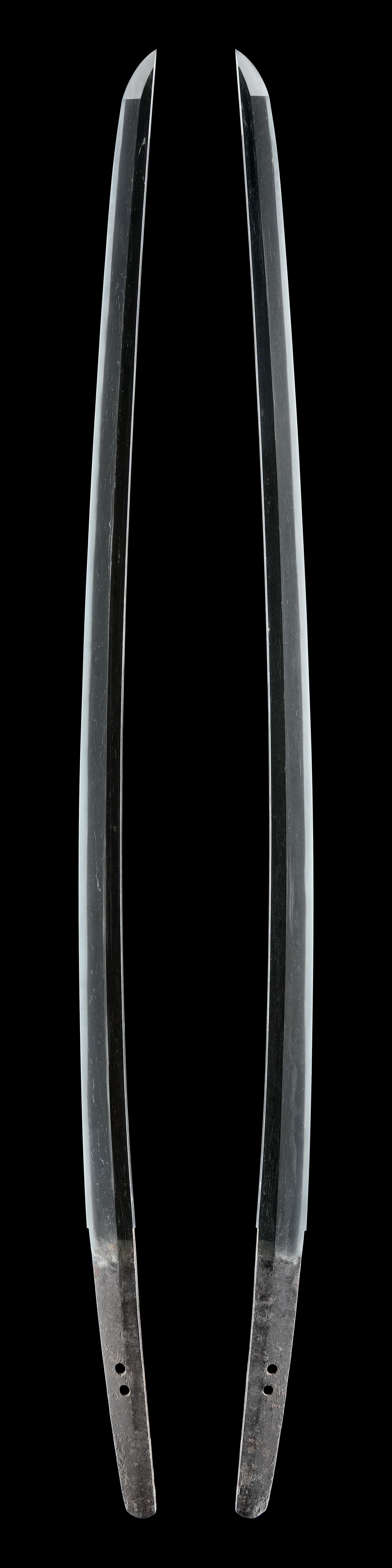
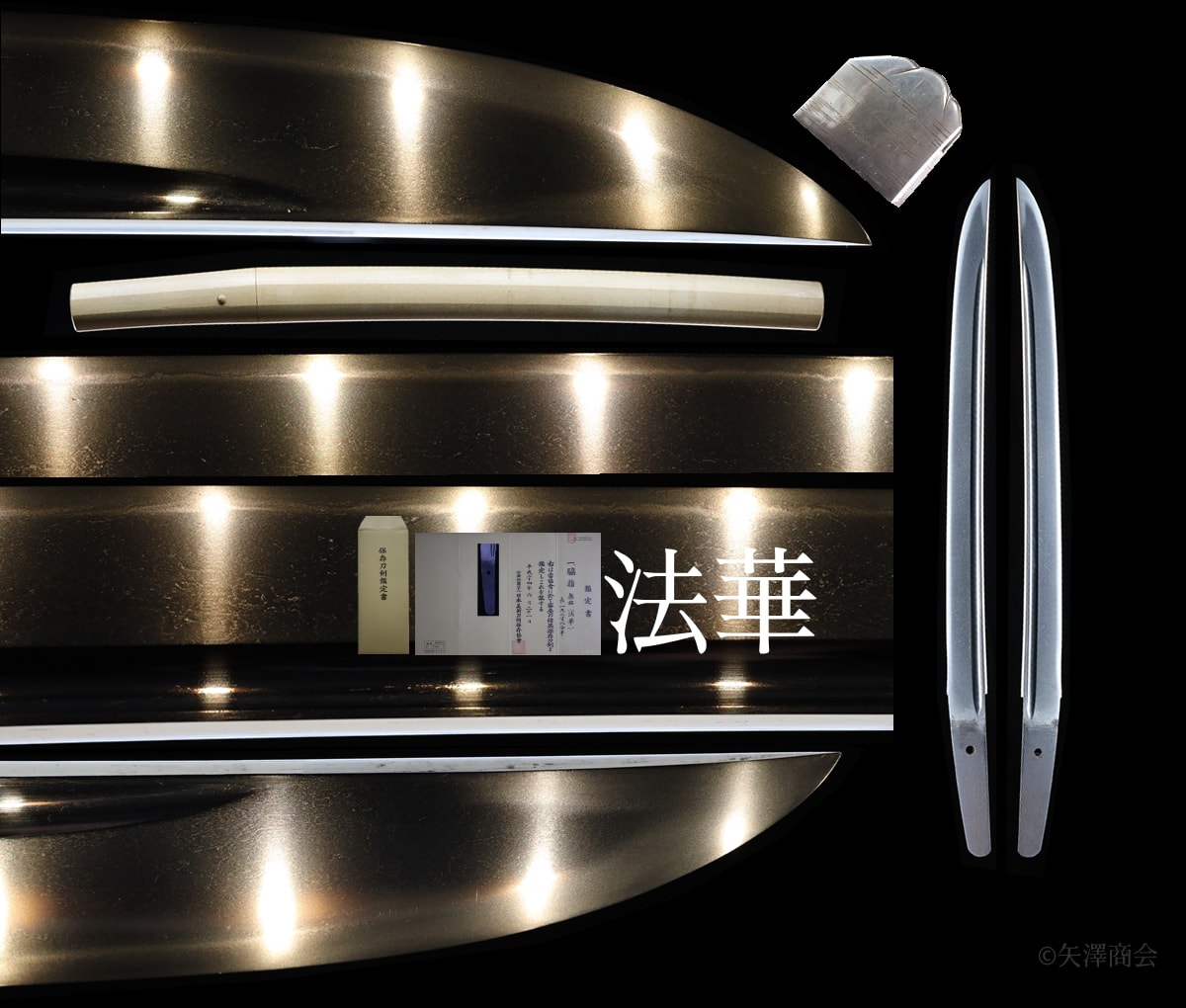
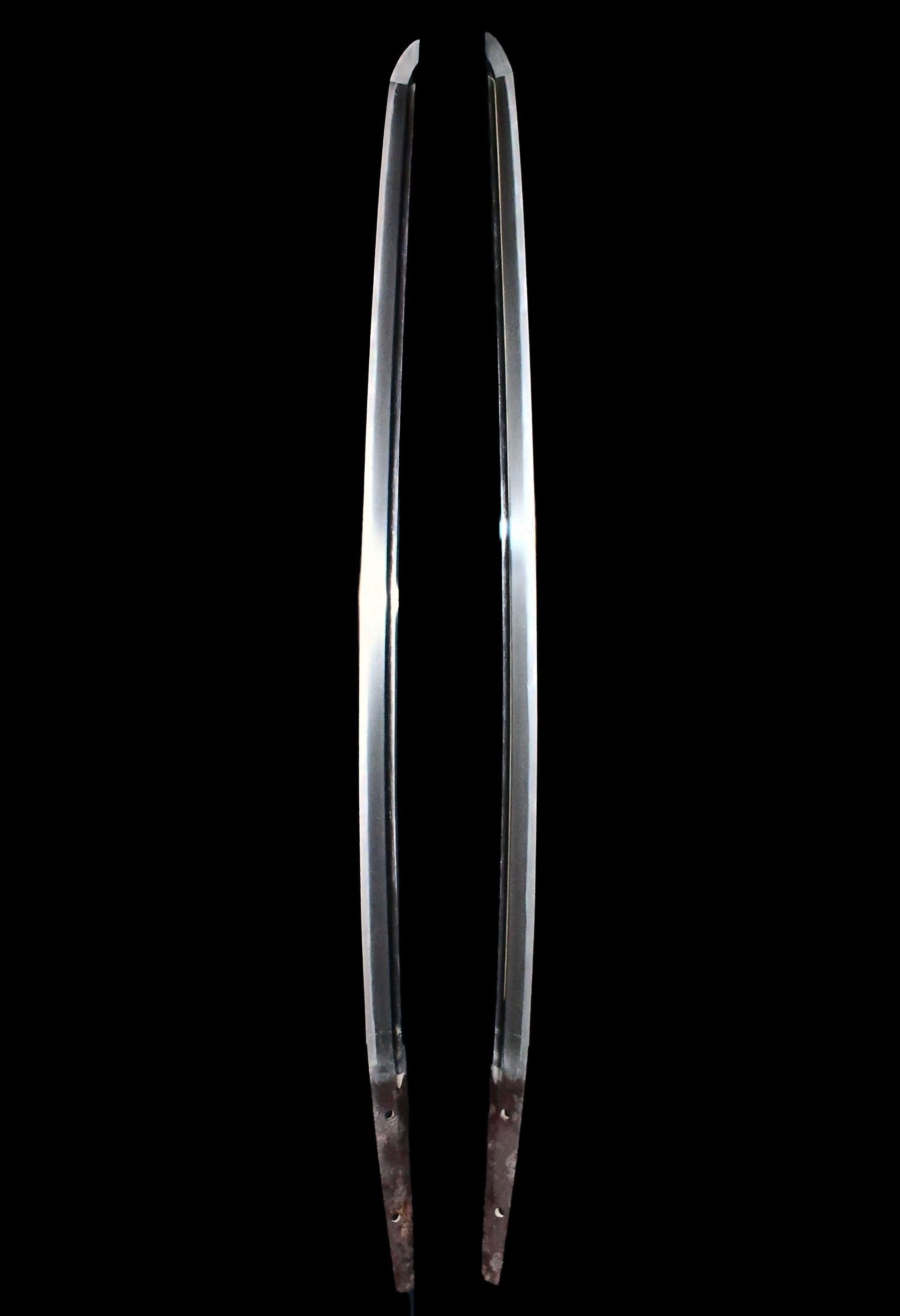
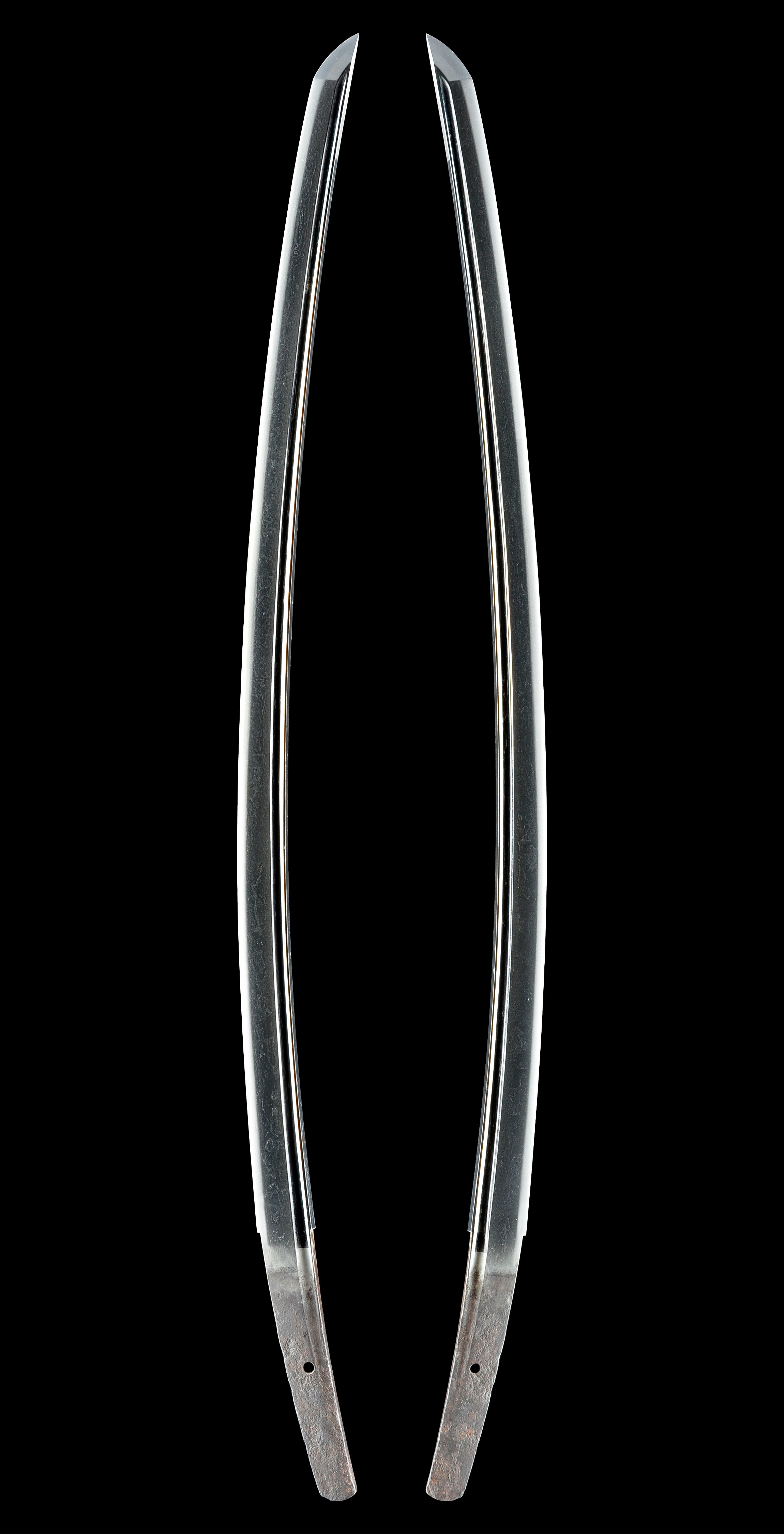
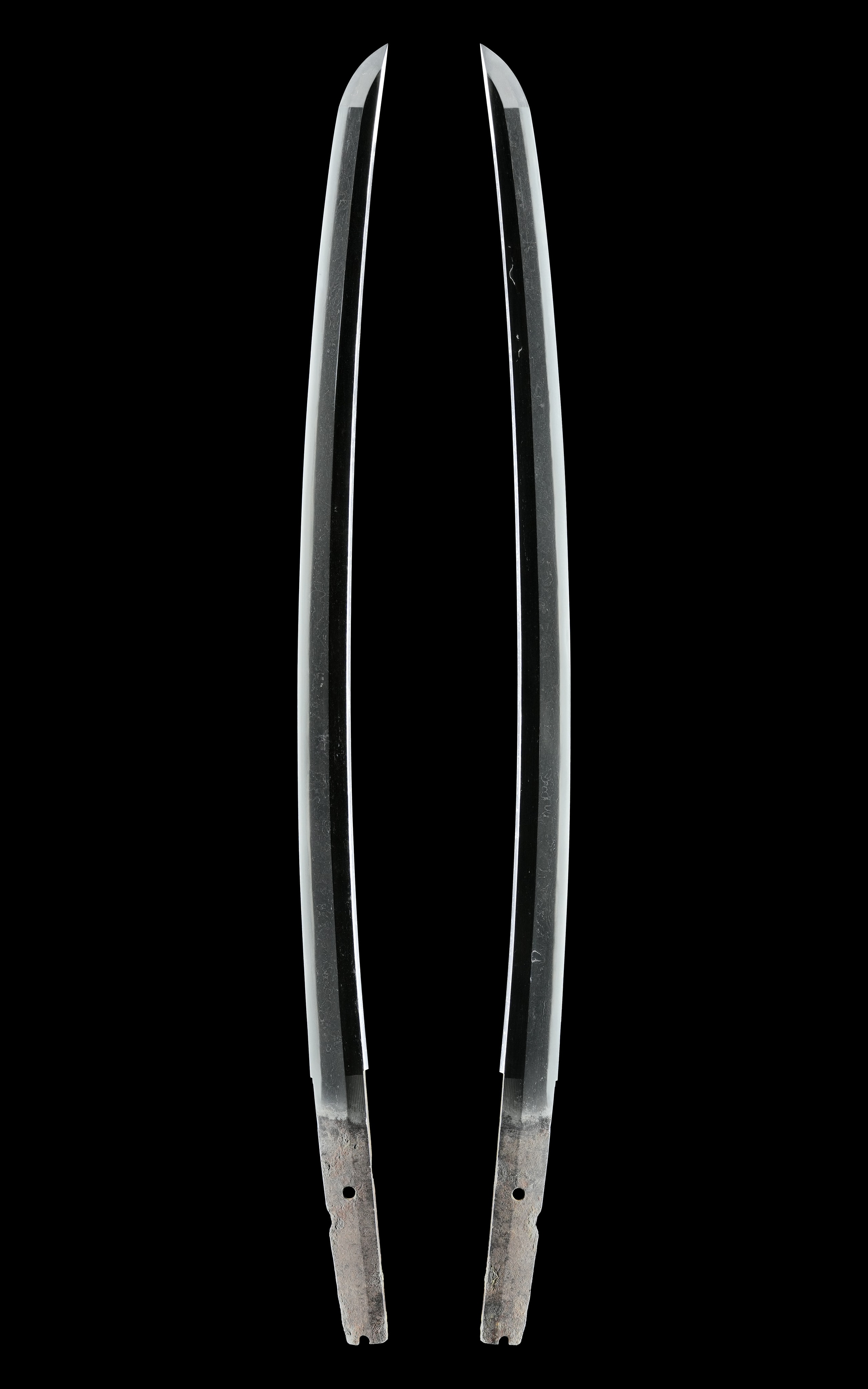
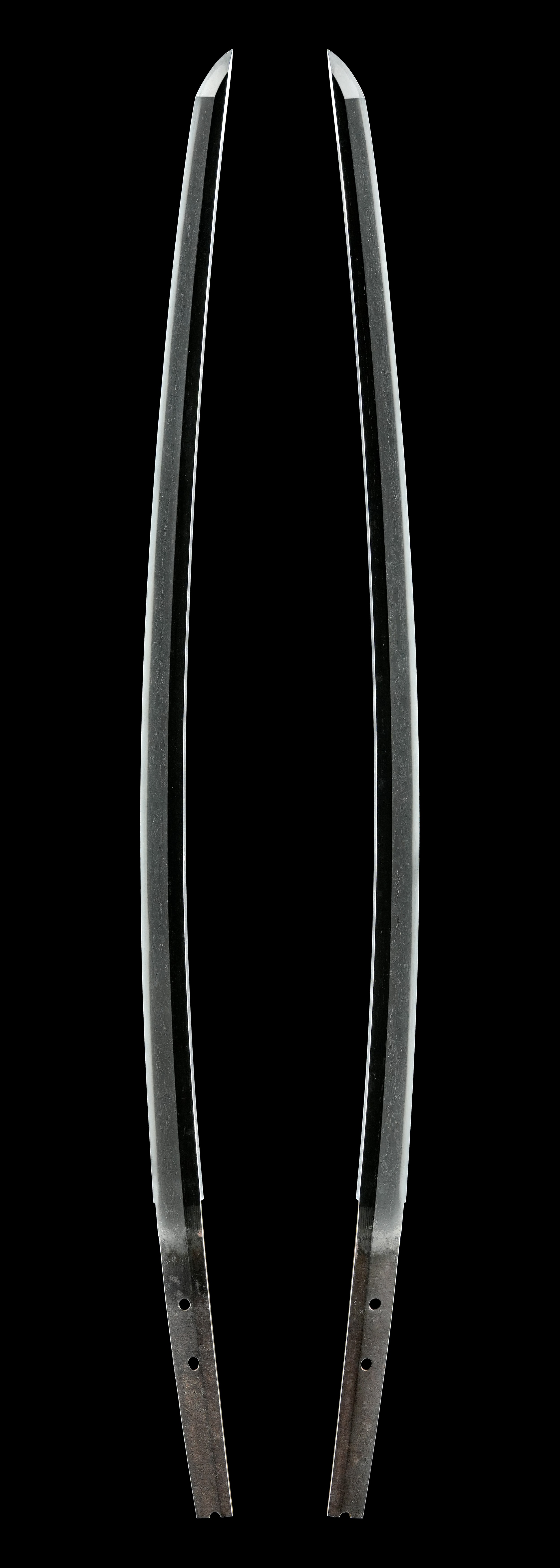
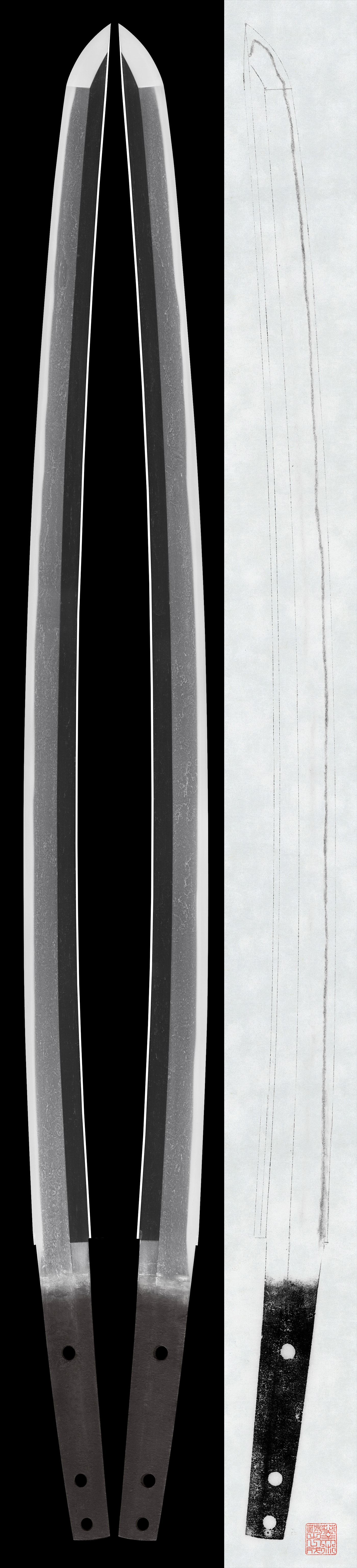
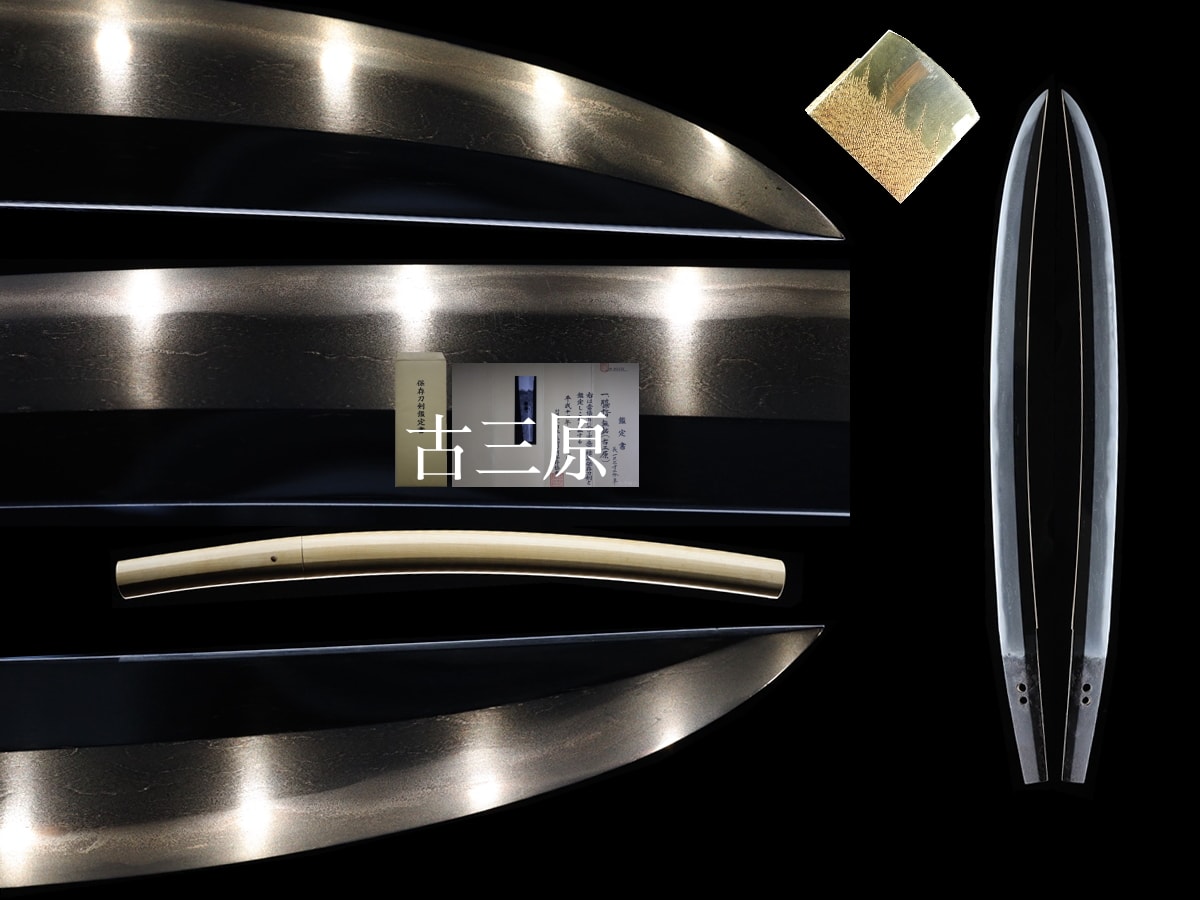
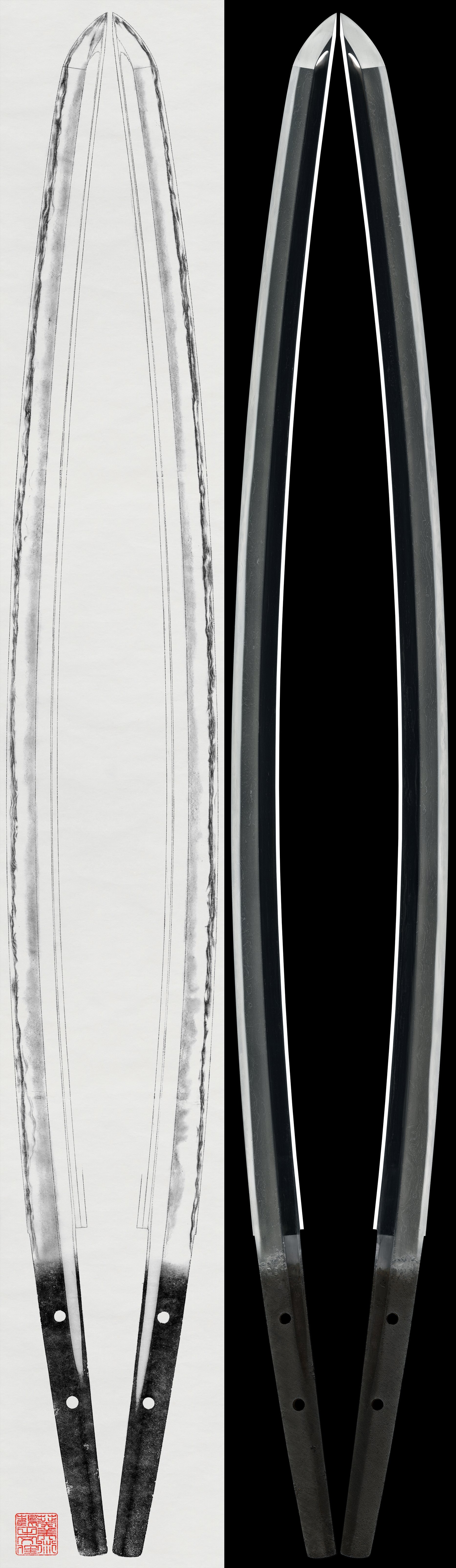
Shigeyasu signed his blades Bishu-ju Shigeyasu, a five-character residence inscription that the published sources read as Bingo Province, and the few of his works that carry a date fall within a narrow span of the period: a of Joji 2 (1363), a of 2 (1369), and another dated piece of 6 (1373). He is one of the Bingo wakimono of the fourteenth century, placed by the earlier designations among the hands and by the fuller commentaries among the smiths of the Hokke Ichijo line, and his name belongs to a small group whose surviving signed work is so scarce that each dated blade is treated as documentary material. The published sources note plainly that 現存する有銘の作は極めて少ない, extant signed works by him are extremely few, and it is on that handful of pieces that his hand has to be read.
His characteristic manner is a fine, low, gentle , a (細直刃) carrying slight and a tight with , the temper held deliberately quiet and shallow rather than worked into display. Set beneath it is the feature that most distinguishes his work, an that flows strongly toward and tends to stand a little (流れ肌, 柾がか), over which a whitish reflection rises, the (白け映り) of Bingo steel. The published sources gather these into a portrait of the school's temperament, describing a forged of mixed with flowing (流れ肌) that raises a whitish cast and a somewhat sticky surface, a low and gentle , and a that finishes , and they read in the whole a 大和気質, a Yamato-derived temperament carried in Bingo work. On one the resemblance is close enough that the judges remark it is 手掻物などにも粉れるような出来, workmanship that at first glance might be confused with a piece, before they settle it with the Ko- hand.
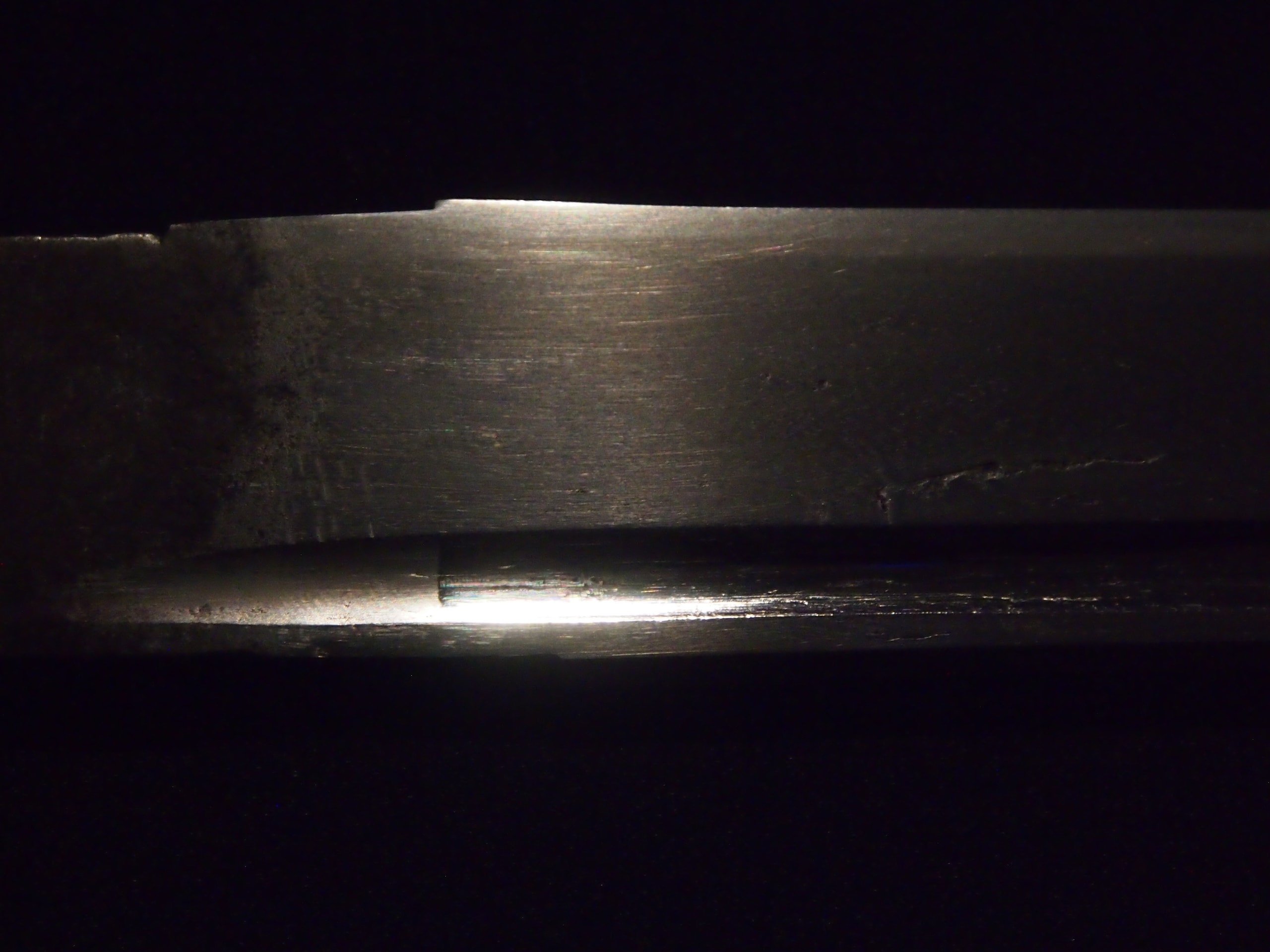
The on which all of this rests is an , at times tightened to and at times opened with (大板目) and , the grain flowing toward the edge and tending to , with (地沸) gathering and, on the more robust blades, fine and a -like patchiness; the steel can take on a slightly blackish tone, and over it stands the whitish reflection that marks the Bingo . The answers the quiet temper below, running straight into a (小丸) or, on the , sweeping into a (焼詰) turn, with on one a faintly pointed return. The construction is of its period: and of slightly elongated, (寸延び) proportions, wide in the and thin in the , the shallow, a large-bodied shape that the published sources read as the period character of the middle . Carving appears as (護摩箸) cut on both faces of one , and on the a -bi (薙刀樋) finished with long companion grooves.
Because the record holds only a small number of blades, all of them signed and all designated at the level, his work is read less through datable phases than through two manners on one Bingo . The first and prevailing one is the calm just described, the typical hand of the Hokke and smiths. The second, seen at its fullest on the latest of the dated pieces, tempers a mixed , round-headed and with a little , the crests tending to align, entering and adhering well; along the run (ほつれ) and (打のけ) that pass at places into a (二重刃) appearance, with and (砂流し) frequent and the sinking. That broader, more active face shows that the hand could work beyond the restrained when the blade called for it.
What sets Shigeyasu apart is best drawn from his own grounded traits rather than by contrast: his is the quiet, low of a Bingo wakimono smith, read in the flowing -tinged and the standing reflection, and closed at the point by a or a turn. The school placement is itself a matter of record, for the published sources, following the Kokon Meizukushi, present the Bingo Hokke Ichijo line as a genealogy distinct from the tradition, give its founder as Sukekuni, and name Ichijo, Kaneyasu, Shigeyasu, Shigeie and Nobukane among its smiths, while the earlier papers had read Shigeyasu as a or Ko- hand. A late signed with the character 康 in place of 安, Bishu-ju Shigeyasu, has no entry in the standard reference works, and the judges assign it to the Hokke tradition by its residence inscription and its Bingo workmanship, an adjacent name within the one austere school.
Shigeyasu is an uncommon name on the designated record. Five of his blades are held at , every one of them signed, with none rising to the level or the higher designation tiers, and no provenance of named owners is recorded among them. These signed pieces are the only ones a private collector could realistically hope to encounter, and with so few in existence one appears only rarely and as a notable event rather than a regular offering; a dated, signed blade by him, filling as it does a gap the reference works leave open, is sought as much for its documentary value as for its quality. The judges' own summations give the measure of that value. Of the the published sources say the workmanship in both and 三原派の特色をよく示しており, clearly displays the characteristic features of the school; of the Joji-dated they call it a piece of high documentary value that plainly expresses the features of Bingo work; and of the 2 they note that it conveys a 渋い味わい, a subdued and austere flavor, and that the latest of the dated pieces serves as 銘鑑の欠を補う好資料, useful material that helps make good the lack of documentation in the reference works. A signed blade by Shigeyasu offers, in a single scarce Bingo hand, the quiet Yamato-tinged of the Hokke line set over a flowing, -lit .