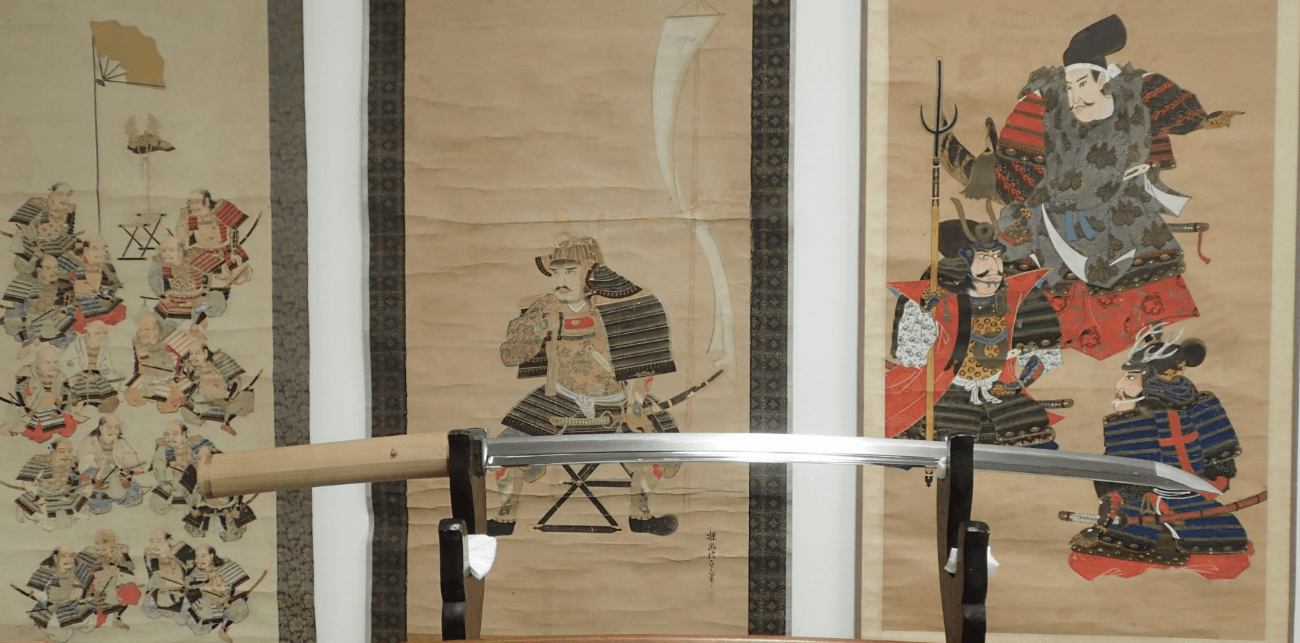
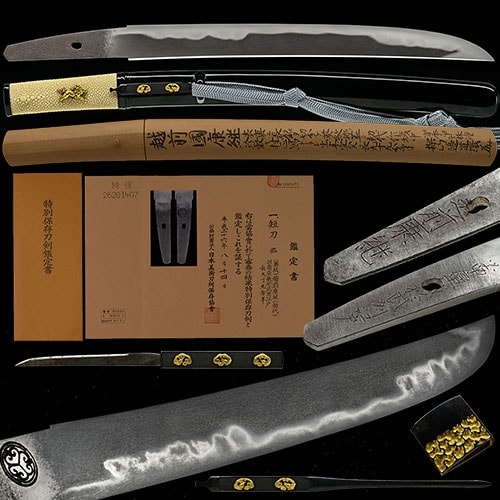
On the tang of a broad now in the thirty-seventh session, below the toward the , runs a long signature reading no Shimosaka Sadatsugu, and on the reverse a - crest is cut above the added inscription Jūdō oyobi tabitabi massai kore nari, the cutting-test boast that this sword has severed stacked bodies and is a blade for the latter age. That combination of marks fixes the smith. Sadatsugu is the first-generation Shimosaka no Kami Sadatsugu, an early maker of the Yasutsugu milieu in Province. No dated work by him has yet been seen, and the published sources place him at no later than the Keichō era on the evidence of his workmanship and the manner of his signature alone. They read him as one of the most influential close associates of the first-generation Yasutsugu, the head of the Shimosaka group, calling him 'one of Yasutsugu's most influential near attendants': his Shimosaka signature closely echoes Yasutsugu's own, his blades carry the massai- inscription, and like Yasutsugu he was a favored smith of Honda Hida no Kami Narishige, the senior hereditary retainer of the house whose - crest appears cut on the tang.
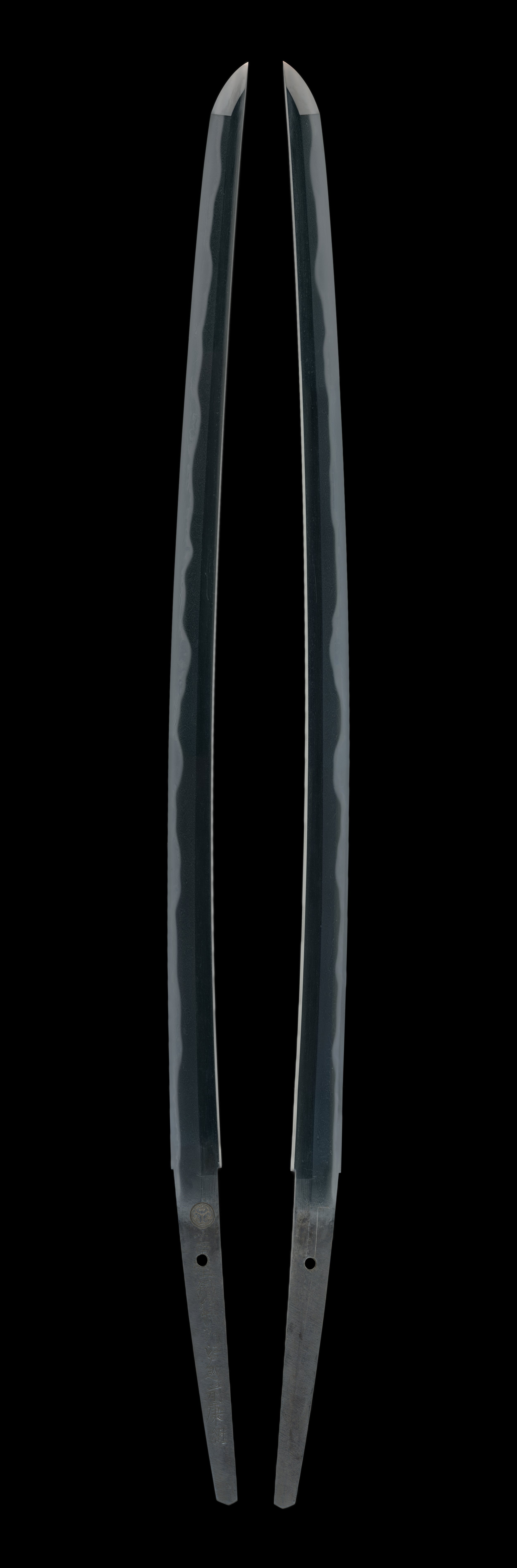
What the published sources return to, blade after blade, is the prominence of his . They state that among the numerous smiths of the -Seki group his point of especial interest is precisely this, 「丁子が目立っているところにその見どころが窺える」, and on another , set directly against his model, that 「丁字が目立つ刃文に貞次の個性がうかがわれる」, that it is in a where the stands out more conspicuously than Yasutsugu's that Sadatsugu's individuality is perceived. His temper is a taken as the principal theme, mixed with , gunome-chōji and pointed , and in places a slightly -like detachment. Long enter vigorously, sometimes thick, with intermingled, the deep, the adhering well and clustering into uneven passages, and through the steps of the run fine and . appears across the , the crescent-moon-shaped variety that the published sources note is also met with in Yasutsugu's work, and around the shows along the back. The tends toward , subdued and at points roughened, a quiet band beneath a busy temper.
His is an mixed with that stands and opens, tending to flow into , the conspicuous overall rather than tight. Over it adheres and fine enter, and the steel carries a blackish cast that the published sources call kitaguni-mono-like, 「北国物らしい肌合を示し」, the dark provincial of the Hokuriku country. It is this somber, active , descended through the many -Seki smiths from the Seki tradition, against which the and the of the are thrown into relief. The answers the temper below it: a that turns in with a sharp or rounded point, the deep and long, brushing into , and on one blade crossing the in before it returns. Where the runs straight to a the is read as showing a -like, -tinged flavor, the inheritance of the -Seki line surfacing in the point.
Within so small a designated body the published sources still draw a quieter register. On the earliest of his the upper half of the becomes a -toned temper mixed with , with appearing, while the rest opens into chōji- with and , the temper at its calmest coming close to the restrained Yasutsugu manner before the reasserts itself. The carving is the other constant. His blades carry kinai-bori of and take in the Shimosaka manner, and on the latest piece the published sources describe a composition that takes as its reference the -and-bamboo carving of a famed - attributed to Sadamune and expands it across the whole blade of a stoutly built sword, with the tempering fired into a brilliant, animated so as not to be overwhelmed by it, the whole 「一際賑やかな作品に仕上がっている」, finished into an especially lively and bustling work. That no two of his five designated blades carry a date keeps his chronology a matter read from the steel rather than written on the tang.
He is placed by the line itself rather than by an independent reputation. The published sources name his as descended from the Seki tradition and his steel and uneven , with the showing a -like flavor and the darkish , as well expressing the characteristics of this group, the -tinged manner of the -Seki smiths. Against that shared his own tell is the , the feature they repeatedly contrast with Yasutsugu's quieter temper, and the kinai-bori, the massai- inscription and the Narishige crest, the documentary marks that bind him to Yasutsugu's circle. His individuality, as the published commentary frames it, is not a departure from the Shimosaka idiom but the brightest and most -laden expression of it, a smith who worked at Yasutsugu's side and tempered a more animated than his master.
Sadatsugu is rated Jō- in the Fujishiro ranking, the mark of a sound master rather than a great name. Five of his blades hold the rank of -, with no National Treasure or Important Cultural Property among them and nothing in the higher tier, so his record is that of a respected provincial smith of the Yasutsugu group. Provenance beyond the Honda Narishige patronage read from the crest is thin in the designated record, with no house or museum named among his blades, so the honest account is of a body held quietly in private hands. For a collector his work is among the rarer encounters of the makers. Only five stand on the official record, every one of them signed, which fixes the name with a certainty that attributions cannot, and a signed Shimosaka Sadatsugu of this quality comes to light only from time to time and with patience, a landmark of the Yasutsugu circle when one does.