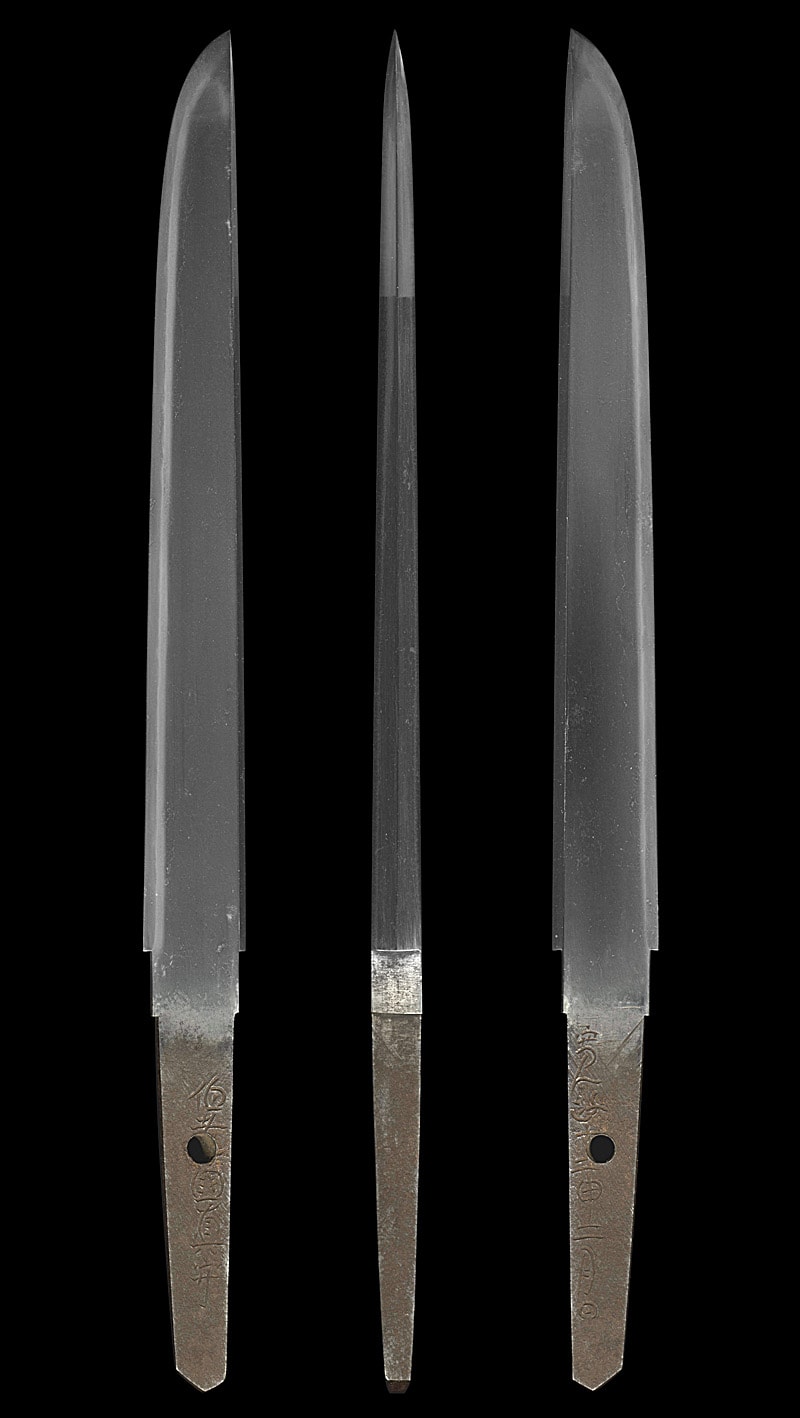
Among the oldest curved swords on record, those signed in the six characters Hoki Ohara Sanemori form a small and precious group: of all the smiths gathered under his name in the catalogue, the published sources say plainly that "a signed work by Sanemori, traditionally transmitted as a son of Yasutsuna, is rare". He worked at Ohara in Hoki at the close of the period, and he is the second master of Ko-Hoki (古伯耆), standing beside his father Yasutsuna in the founding stratum of the Japanese . Beginning with Yasutsuna, the published commentary records, Sanemori together with Aritsuna, Sadatsuna, Yasuie and Sanekage make up the line collectively called Ko-Hoki, which flourished from the late into the early period. His blades reach us in two registers: the signed and cut in their large six-character , and the mostly unsigned blades that the returns to him as Ohara Sanemori.
His hand is best read first as an archaic form that looks, at a glance, like . The is slender, the curvature high and seated at the waist with , the narrow against the blade width and the full, the whole tapering to a small , what the published sources call a slender, small-pointed silhouette "more frequently seen in this smith's work than in his father Yasutsuna's". Over this the temper is a base undulating shallowly, with leading and , and pointed elements mingling so that the whole pattern stays small in scale. Within it the lies thick, and run frequently, and drifting with the occasional gather along the crests of the temper, the often clouded or subdued. His own short threads of accompany the , a working written for him and not for his father.
The carries the rustic weight of the school. The forging is mixed with large , and a flowing , standing open in large pattern; thick adheres, enters, and patchy with a rises over a steel of darkish tone. From these very features the published sources draw the school's defining distinction: that although the manner resembles contemporaneous , on close view the standing , the and , the clouded and frequent and "differ somewhat in taste from and take on a more rustic flavor". The runs straight to a small , often swept in , and on the not infrequently tempered out to a ; some blades carry -otoshi above the , and or a with are cut at the waist on the carved pieces.
What sets Sanemori apart within his own school is a matter of scale. Where his father's runs larger, the published commentary repeatedly marks his as smaller in pattern: in Honma's words, "compared with Yasutsuna, Sanemori's work is generally somewhat more slender, and the smaller-patterned irregularity of its temper is the point to see; though transmitted as Yasutsuna's son, the manner is, if anything, somewhat more archaic". The returns to the observation on blade after blade, that in the small-patterned irregularity "the points of interest belonging to Ohara Sanemori within the line can be discerned". The signature itself is a register of its own: where the other Ko-Hoki smiths sign in two characters, "Sanemori has comparatively many long signatures, and the manner of inscription is not uniform", the six-character cut large with a thick chisel.
His place is fixed by both ends of the lineage. Upstream he is transmitted as the son of Yasutsuna, the head of Ko-Hoki, carrying his father's manner one generation on at the close of the period; downstream he heads, with Yasutsuna, the Ohara group beside Aritsuna, Sadatsuna, Yasuie and Sanekage, and it is to his name that the attributions of archaic unsigned blades gather. Because genuine signed pieces are so few and their signatures vary, the published sources caution that "which form is correct cannot readily be decided" and call for further study; yet the unsigned blades are accepted to him precisely on the shared tell, the standing well- , the deep , and a that does not gather into neatness but, the commentary says, in "an artless, unaffected unsophistication that instead conveys an ancient fragrance". It is the eye that distinguishes him from the more polished and reads the unsigned back to his hand.
The designated record under his name is small and almost entirely held. Of the works on the official record three are , one is an Important Cultural Property, and a further group reaches ; he has no National Treasure. The Tokuju of 2006, densely forged and bearing the rare added character Katsu, is recorded as resembling the transmitted in the Tsuchiya family, lords of the Tsuchiura domain, now in the Tsuchiura City Museum, and its carved waist parallels the Important Cultural Property at the Kishu Toshogu in Wakayama, a key reference for the character of Sanemori's . A signed recorded in the Bijutsuhin passed through the Tokugawa family, in the hands of Tokugawa Iesato, and is published in the Nihonto Taikan and other reference works; one blade was "formerly treasured by Baron Miyoji". A privately held Sanemori is among the rarest things a collector could encounter, the signed work scarcer still; an unsigned of recorded whereabouts comes to light only from time to time, and a landmark when it does.