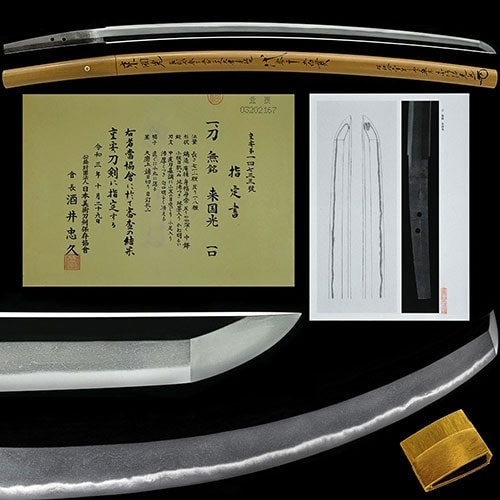
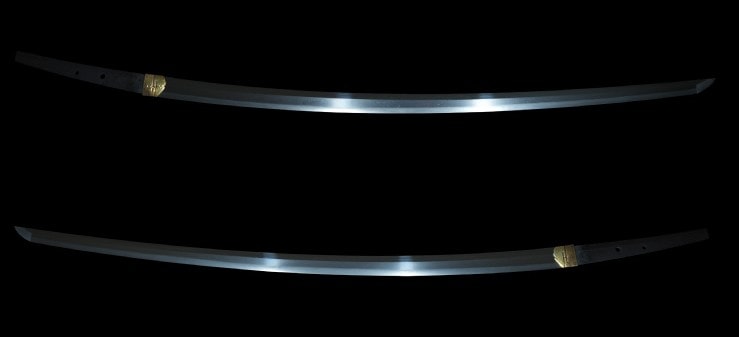
Mitsukane of Yamashiro, active at the end of the period, is recorded as a pupil of Kunitoshi and, in the 's recurring phrase, "a smith apart within the school". Tradition gives him a chapter as well: he is said to have gone to and studied under Nagamitsu, and on the order of events the published sources are precise, observing that "most transmitted records state that he first studied under Nagamitsu and afterwards entered the school of Kunitoshi". He lived and worked at Tozu in Omi, whence the name Tozu (戸津来), and by the legend the texts repeat in nearly every designation he withdrew to forge at the Konpon Chudo, the central hall of Enryaku- on Mt. Hiei, whence the name by which he is best known, Chudo (中堂来). He signed with the two characters Mitsukane alone, never crowning the signature with the character . About scarcity the record is emphatic: "examples encountered are extremely few; there are no , only ", and the signed work is confined to .
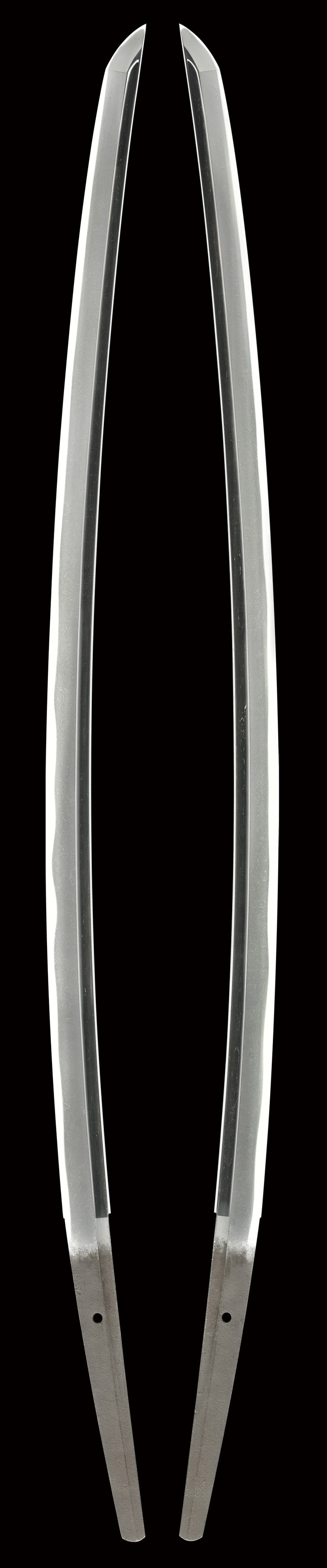
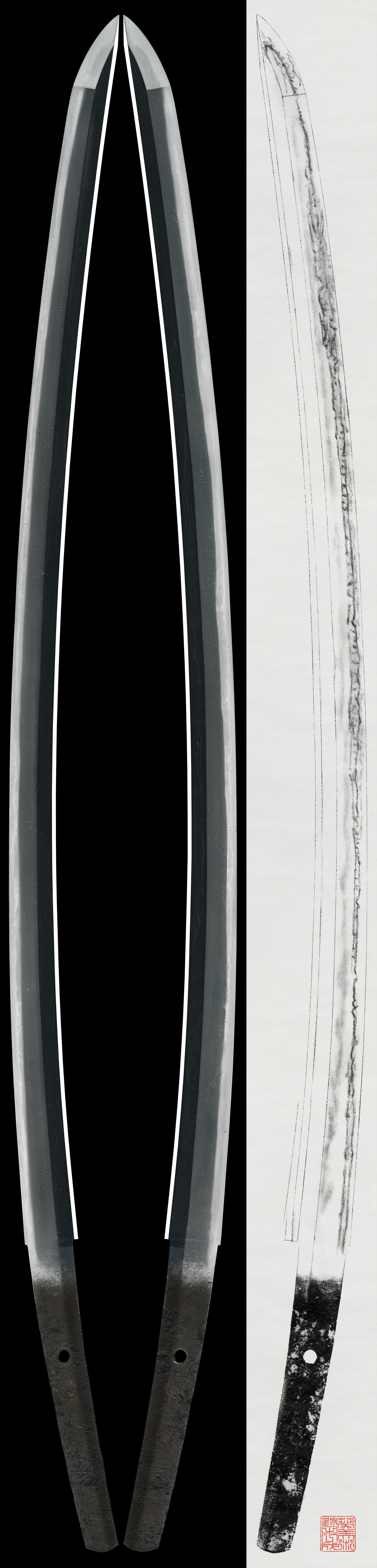
The build announces him before the steel does. His are with , somewhat elongated and often a little wide in the , with , and the published sources fix the construction in a standing formula, naming "the thick and sturdy construction" together with a "whose roundness is large and whose returns wide, deep and long" among the features to see. The oldest commentary in the corpus already treats both points as his habit, writing that "there is rather more variation within the than in his teacher Kunitoshi, and the of the is as a rule long". The itself is a in the manner of his teacher, though one designation adds that he "burns a wider than Kunitoshi's". Into the quiet line mix , a feeling of or , and ; and enter, the runs deep, lies thickly, and and fine work through a that stays bright and clear.
The is the declared tell, and the states it almost verbatim across the later texts: the of this smith "has as its special quality that the is laid on exceptionally thickly so that it looks strong, and the loose, weak texture called - is in general rare in him". The is a finely packed , mixing flowing toward the or along the edge and a touch of larger at the ; the sits dust-fine and thick, a rises, and the steel is bright. One designation widens the contrast to the whole school, finding that "the is stronger and clearer than that of Kunitoshi or Kunimitsu" and naming that strength a point to see. The old literature reached the judgment in its own words: the quotes the text Nyote-hikisho (如手引抄) to the effect that, compared with Kunitoshi, the color of his is bluer and clear to the bottom, the fine and vivid, "like the of Yoshimitsu". appear on a few pieces, paired with a stout , or a on the with on the .
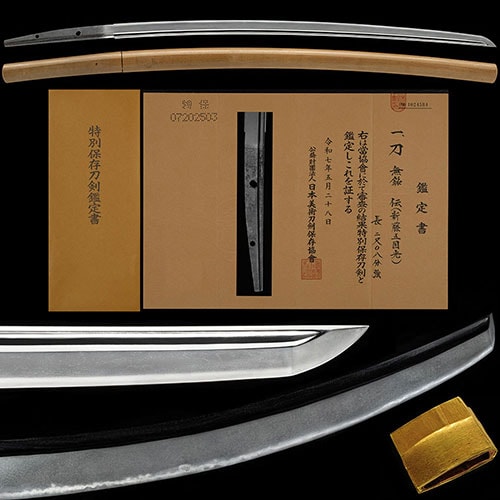
Against this mainstream the texts set exactly one exception, rehearsed in nearly every designation: "there exists one single work that burns a -ba led by , of a kind that underwrites the theory that he was Nagamitsu's pupil", the -Mitsukane, an Important Cultural Property whose at first sight recalls . The oldest text in the corpus names the teacher as Kagemitsu rather than Nagamitsu, judging works of this group "almost the image of Kagemitsu, though stronger than Kagemitsu in the of and "; the later texts settle on Nagamitsu. The surviving record divides as well by signature. The signed pieces are slender in a fine , while the broad wide- examples are the larger unsigned works, among them a carrying not a signature but a , the house's red-lacquer attribution reading Mitsukane with Hon'a and a , whose the judges "an accomplishment surpassing even the signed Mitsukane"; the document of its old scabbard records that the fifth shogun Tsunayoshi presented it in Enpo 8 (1680) to mark his son Tokumatsu's move to the Nishinomaru of castle.
In he stands as the strong pole of the school. Where the school's quiet can ride on a soft, loose , his carries laid on thickly over a tight ; where his teacher's are slender, his run thicker in the and a little longer in the body; the is wider, the movement within it greater, and the rounder, its deeper and longer. The literature reaches past his own school for the comparison, likening the fineness and vividness of his upward to Yoshimitsu rather than across to his fellows. The texts name no pupils and no continuing line, and his manner closes with him; what remains is a small, coherent body of in which, as the published sources put it of the best examples, the typical manner of Chudo Mitsukane is displayed to the letter.
Fifteen designated works stand on the official record: four Important Cultural Properties, among them the -Mitsukane and a signed transmitted in the Date family, three , and eight , eleven blades in all in the and tiers; five of the fifteen are signed, ten unsigned. The provenance recorded against them runs through the great houses of the period. The Kuwayama Mitsukane, an listed in the Kyoho -cho, takes its name from Kuwayama Iga-no-kami Motoharu, passed to the third shogun Iemitsu, was granted by him to Maeda Toshitsune, and descended thereafter in the Maeda family; it stands today among his . The descends from the Tokugawa main line. Of recorded whereabouts, his blades rest with the Tokyo National Museum, the Fukuyama Art Museum and the Kurokawa Research Institute, with one in private hands. The four Important Cultural Properties are patrimony, preserved where they are; the eleven blades of the and tiers are what a collector could in principle encounter, and for a smith whose surviving examples the published sources themselves call extremely few, one reaching the market is a rare event.