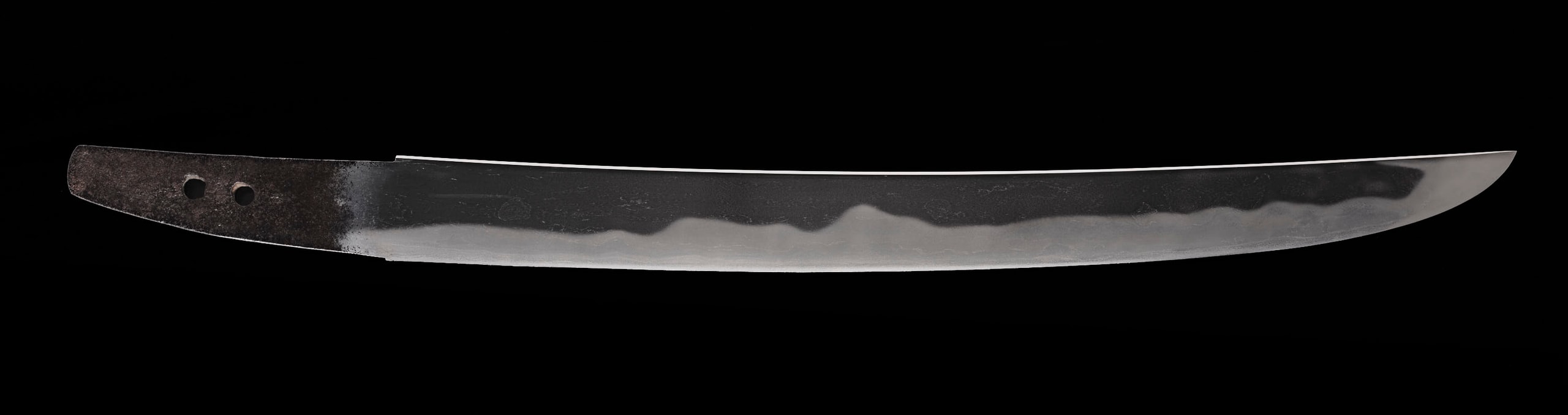
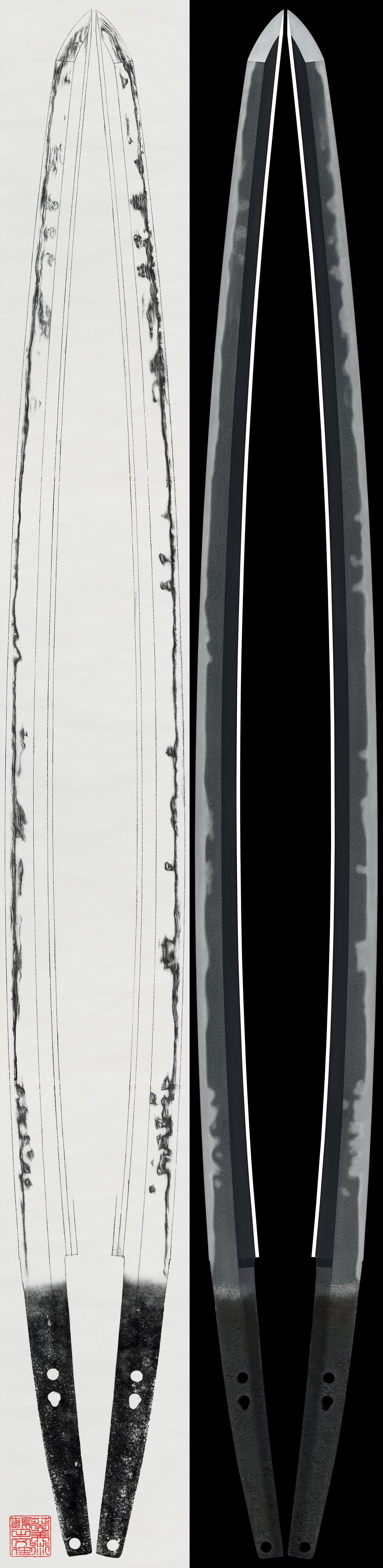
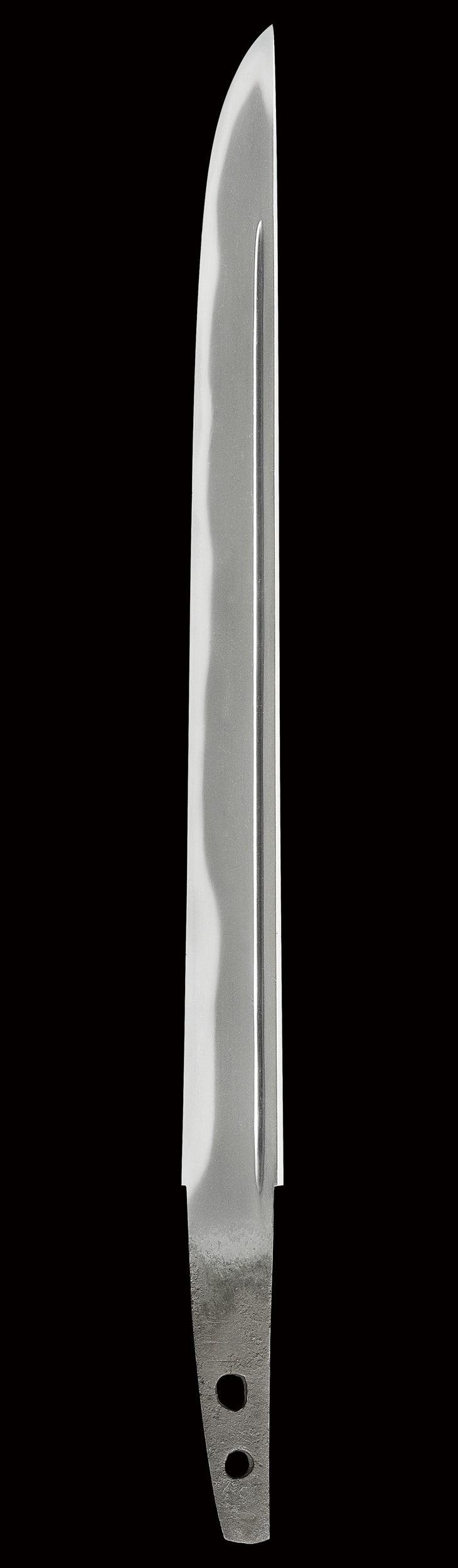
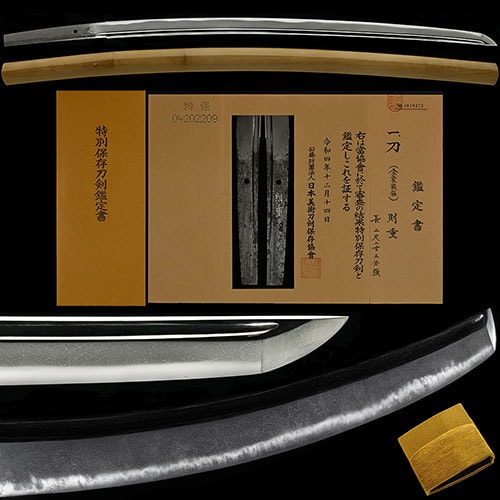
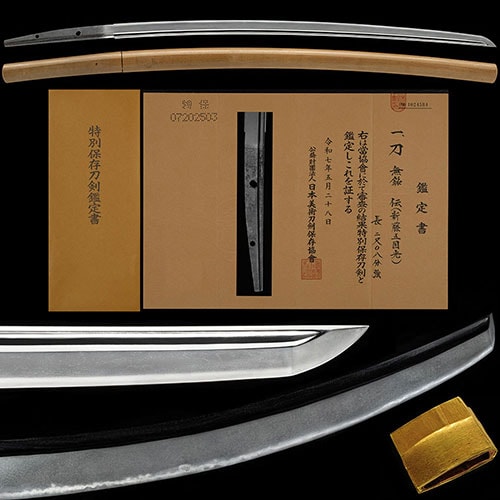
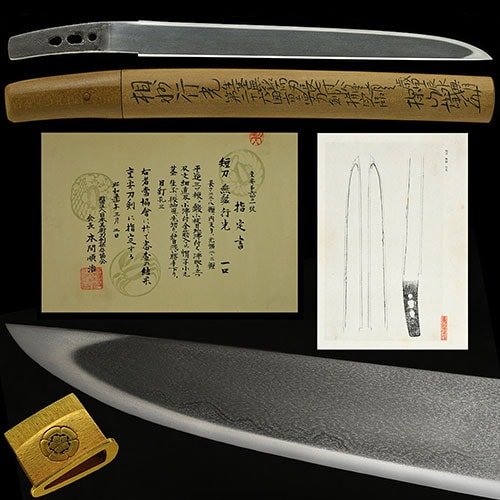
His National Treasure is the Heshikiri Hasebe, the long held by the Kuroda of Fukuoka, and the published sources reach for it when they want to fix his standing: among the unsigned works whose quality "compels assent to a direct connection with Masamune", the Heshikiri stands first. Hasebe Kunishige is the head of the Hasebe school, the tradition carried out of and resettled in Kyoto, at Gojo-bomon Inokuma, and he is counted in the old reckoning among the Masamune-juttetsu. The published record now favours a route for the school in which its "home province was Yamato", that it matured in , and that it settled last in the capital; the Yamato substrate is exactly what shows through the manner in his steel. With the school the Hasebe are named as the pair that represent the Yamashiro smiths of , and within his own line Kunishige and Kuninobu, transmitted as his younger brother or his pupil, are the two representative hands.
The hand the published sources describe and then repeat almost word for word, text after text, is set against the smiths Hiromitsu and Akihiro, who worked the flamboyant in the years. takes and as the base of its , and its "thrusts up and returns with a pointed tendency"; Hasebe builds instead from mixed with , and his is "large and round", the return burned far down so that it runs straight on into the . That much is the surface of the . Beneath it lies the single sharpest tell, which the texts name in nearly every entry: in the forging a strain "uncommon in shows conspicuously toward the edge side and the ridge side", the Yamato grain surfacing where work shows none. To these the published sources add the very thin of his construction as a habitual trait.
His is , standing out across the surface, the -yori and flowing into and , with thick and entering; on the broadest pieces it carries a -like tone. Over it the temper is mixed with , and entering, the deep, thick, and running frequently and long, until , and worked over and carry the whole into . The runs with , rounded, the return burned far down. The carvings are and , , and grooves cut near the . The form is the period itself: with , wide in , thin in , with a shallow , which the published sources read as the very build of a .
The work divides into four manners. The mainstream is the wide, thin, and with the full just described. Beside it the texts expressly flag a quieter, rarer pole: his style "takes as its type, but rarely" one sees a or a shallow large , the edge fraying into and , the only slight; of one such piece a published source remarks that the workmanship "at a glance suggests an upper-rank hand", and notes that this is not uncommon for Kunishige. His -length work survives almost wholly as , the attribution carried by a the texts read as the brush of Mitsutsune; on these the is a florid with and a -like element, the tempered overall. Last is the body of signed work: most pieces carry Hasebe Kunishige in five characters near the centre of the , the -gamae at times enclosing gyoku or o, and the differing signatures with the spread of dates lead the published sources to an old theory of several smiths of one name working as a succession of generations. Reliably signed are the rarest of all; the texts call "surviving examples of signed extremely few", prizing the handful that remain, slender and older in tone, as study material.
What sets him apart is best read against the pair he worked beside, and it is his own grounded traits that draw the line. His -and- , his round with its long return into the , and above all the at the -yori and separate him from the -and- and pointed of Hiromitsu and Akihiro. The published sources read his quality high in the tradition: the of the shogunal house they acclaim as "a superior piece attributed to this smith, overflowing with vigour", and the rare as showing the high-rank - character at its best. The Heshikiri itself, an blade whose original signature survives as a , is cited again and again as the work whose excellence confirms the Masamune connection, the foundation of his place among the juttetsu. His dated pieces begin at Bunwa 4 (1355), the reliably oldest, which the published sources call "the touchstone of Hasebe study"; an older Jowa-dated exists but is held still to need research, so the Bunwa 4 piece anchors the chronology, with later dates running through Enbun, Joji, and into Eiwa.
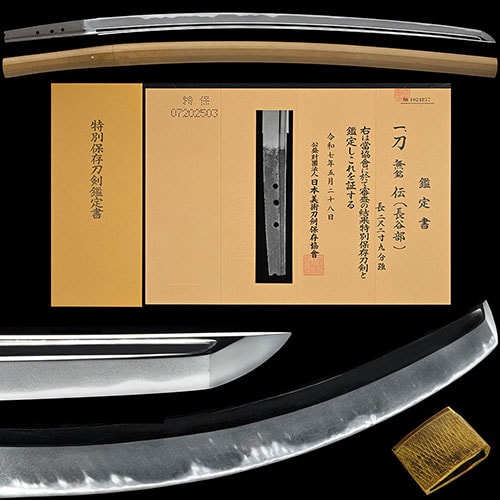
He is Jo-jo in Fujishiro's grading, with a Toko Taikan valuation of 1,000. The weight of designation behind his name is heavy: his one National Treasure, the Heshikiri Hasebe, sits above three Important Cultural Properties and Important Art Objects, and beneath them forty-seven blades stand in the and tiers. The National Treasure and the Important Cultural Properties are patrimony, preserved as heritage and never to trade; the institutional holders recorded against his name include Atsuta Jingu, the Tokyo and Kyoto National Museums and the Tokugawa Art Museum. His descend in the Tokugawa shogunal house, recorded as shogunal transmissions. The roll runs through the houses: a was received by the founding lord Honda Yasutoshi "when Shogun Hidetada made his official visit to Zeze Castle on the fourteenth day of the ninth month of Genna 3" and descended in the Honda house thereafter; a Jubi of Enbun 2 passed in the Naruse house, lords of Inuyama; and the Heshikiri itself was long held by the Kuroda of . Several of his blades carry . What a private collector may realistically encounter is one of the or of the tradeable tier, and even those reach the market only from time to time; a signed Hasebe Kunishige is a landmark when one appears, and the National Treasure and the great pieces are held, not traded.