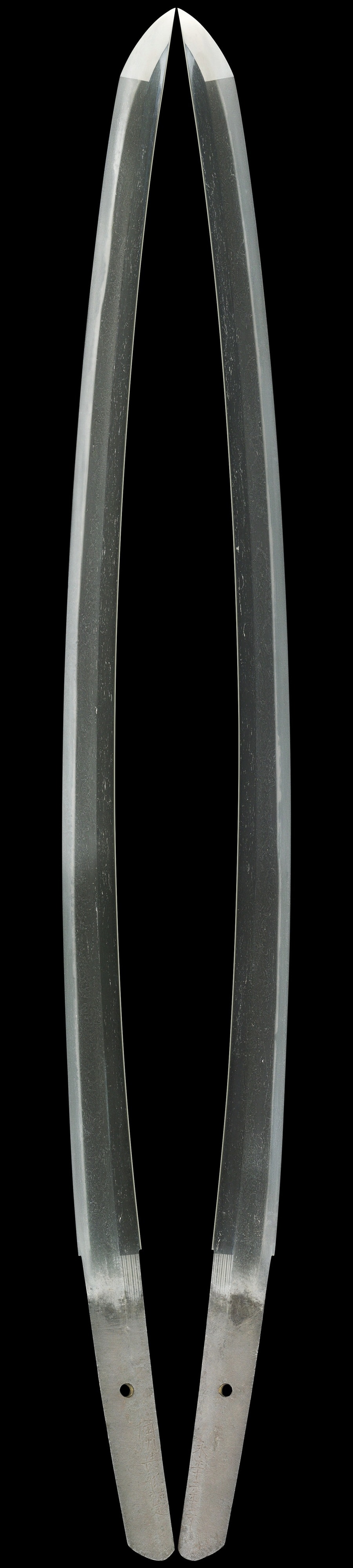
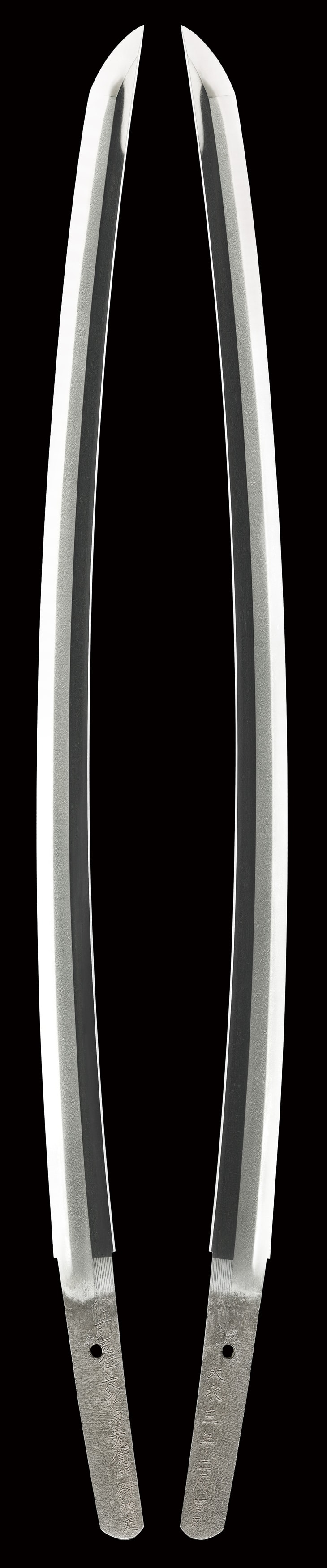
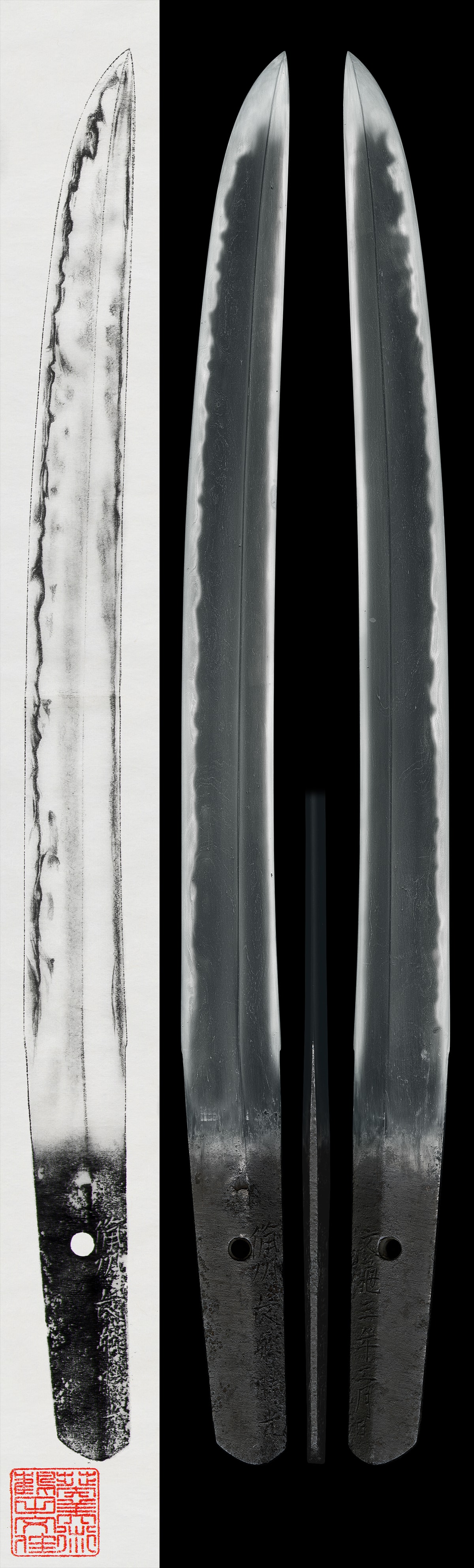
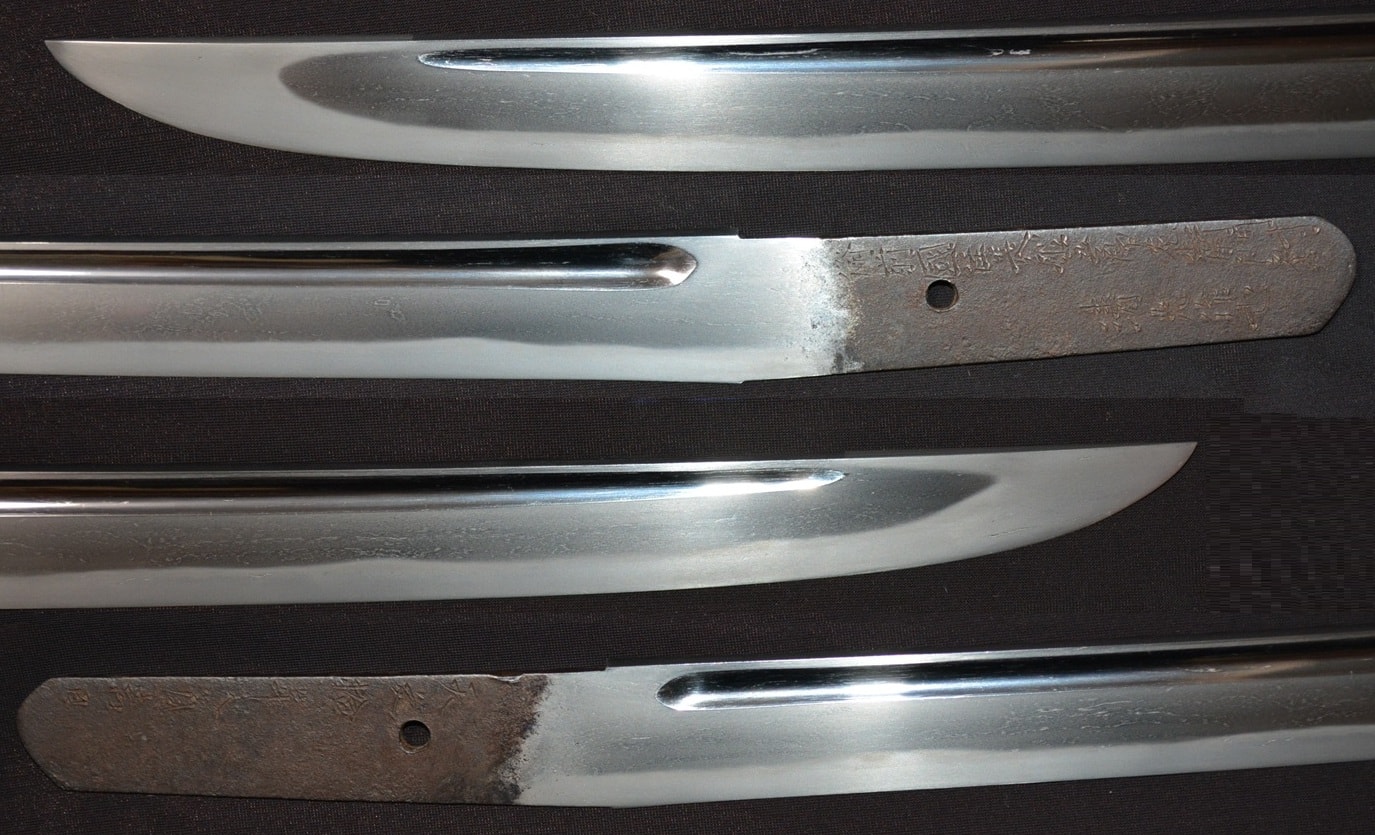
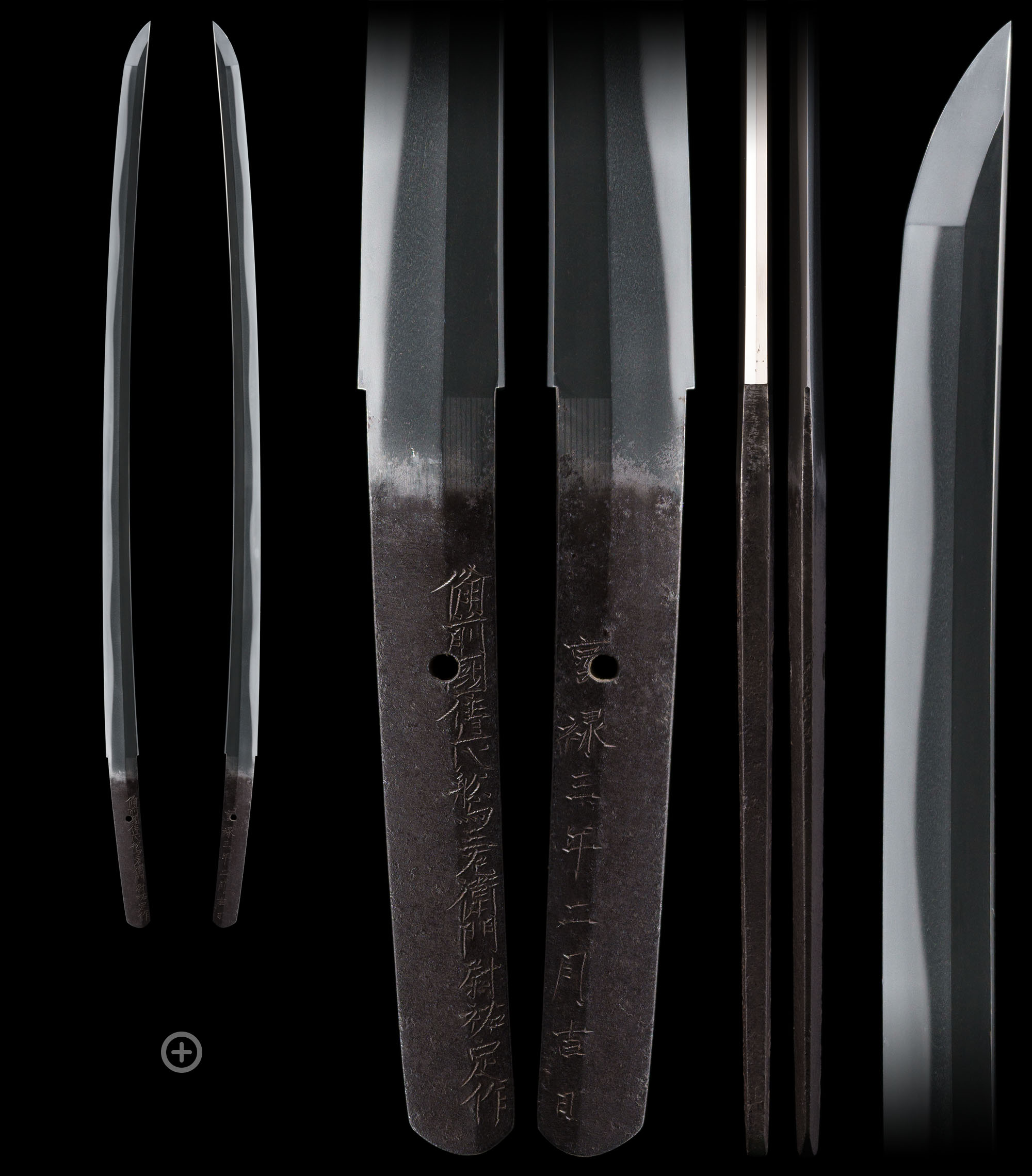
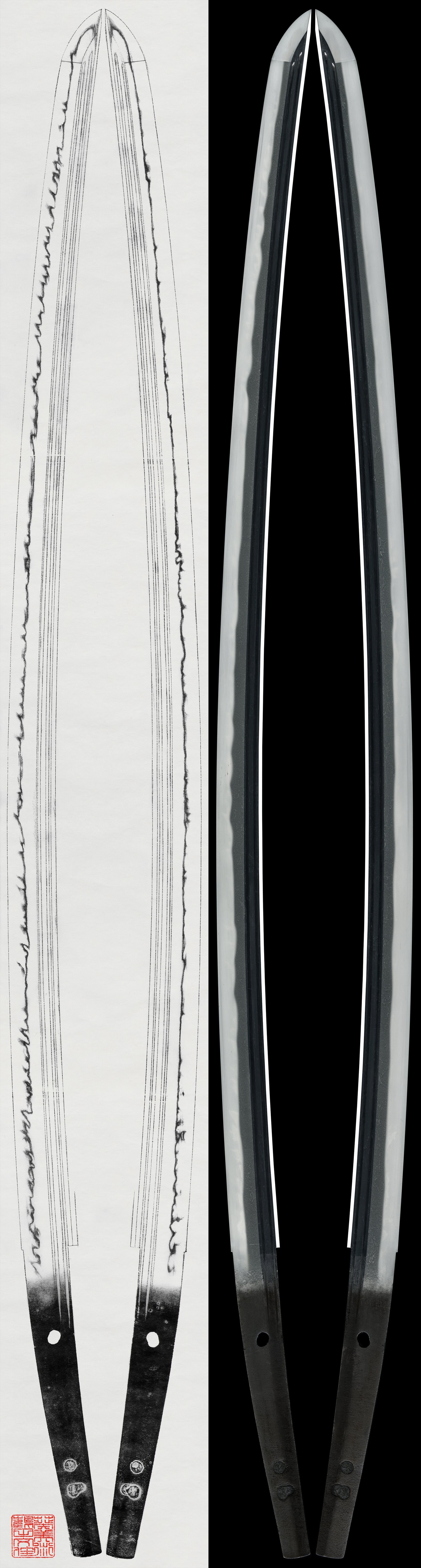
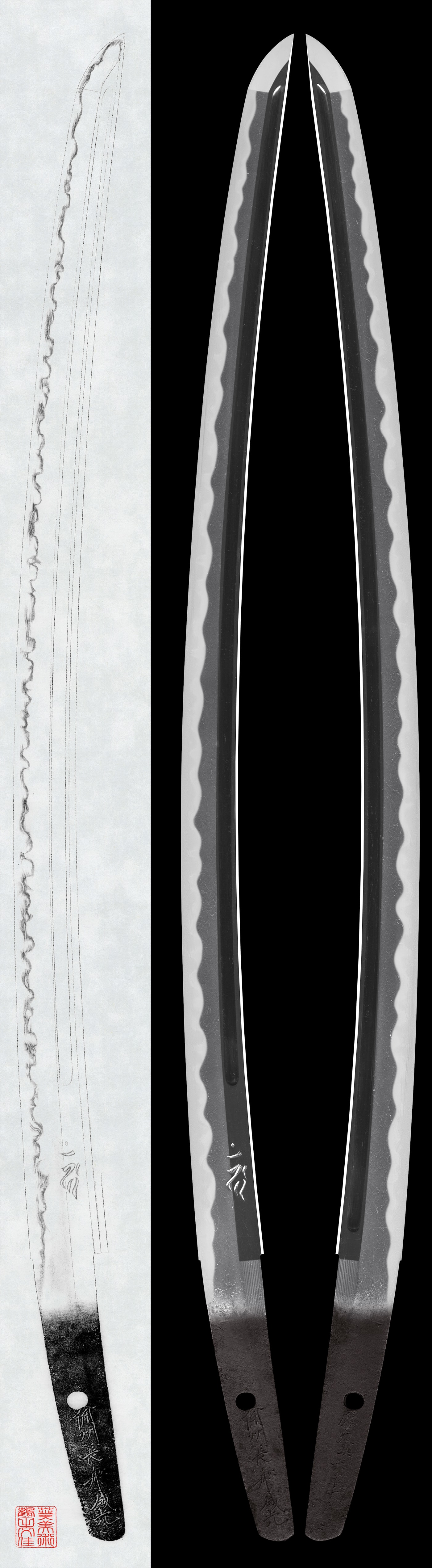
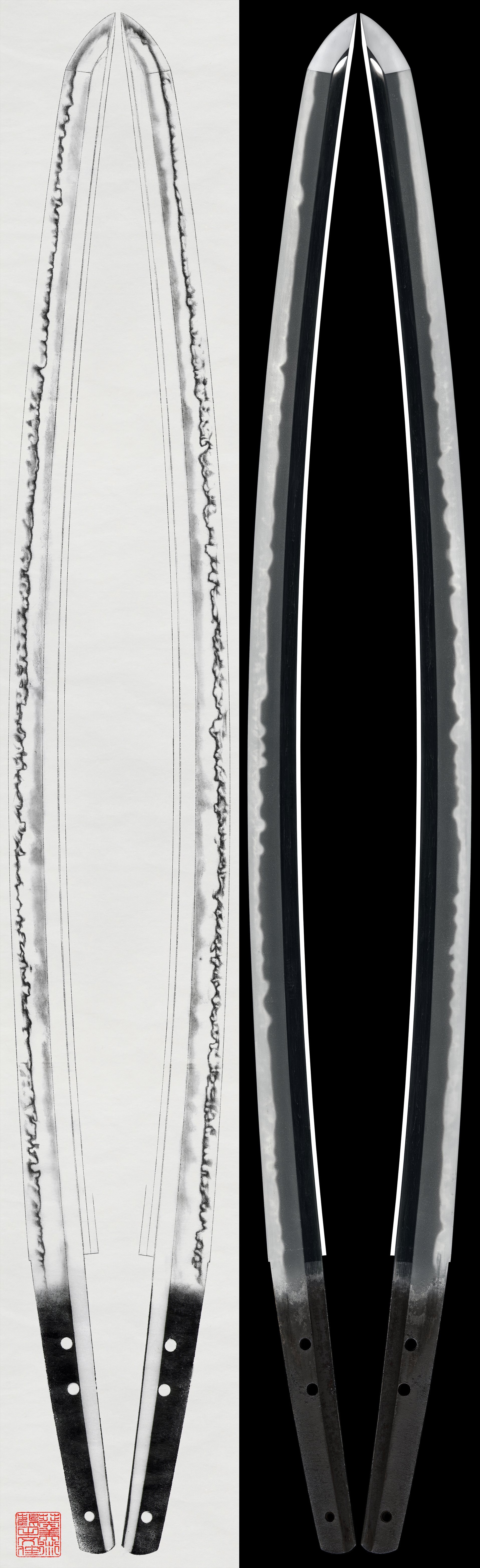
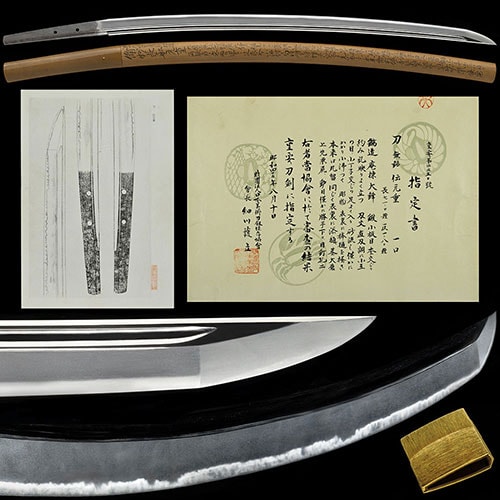
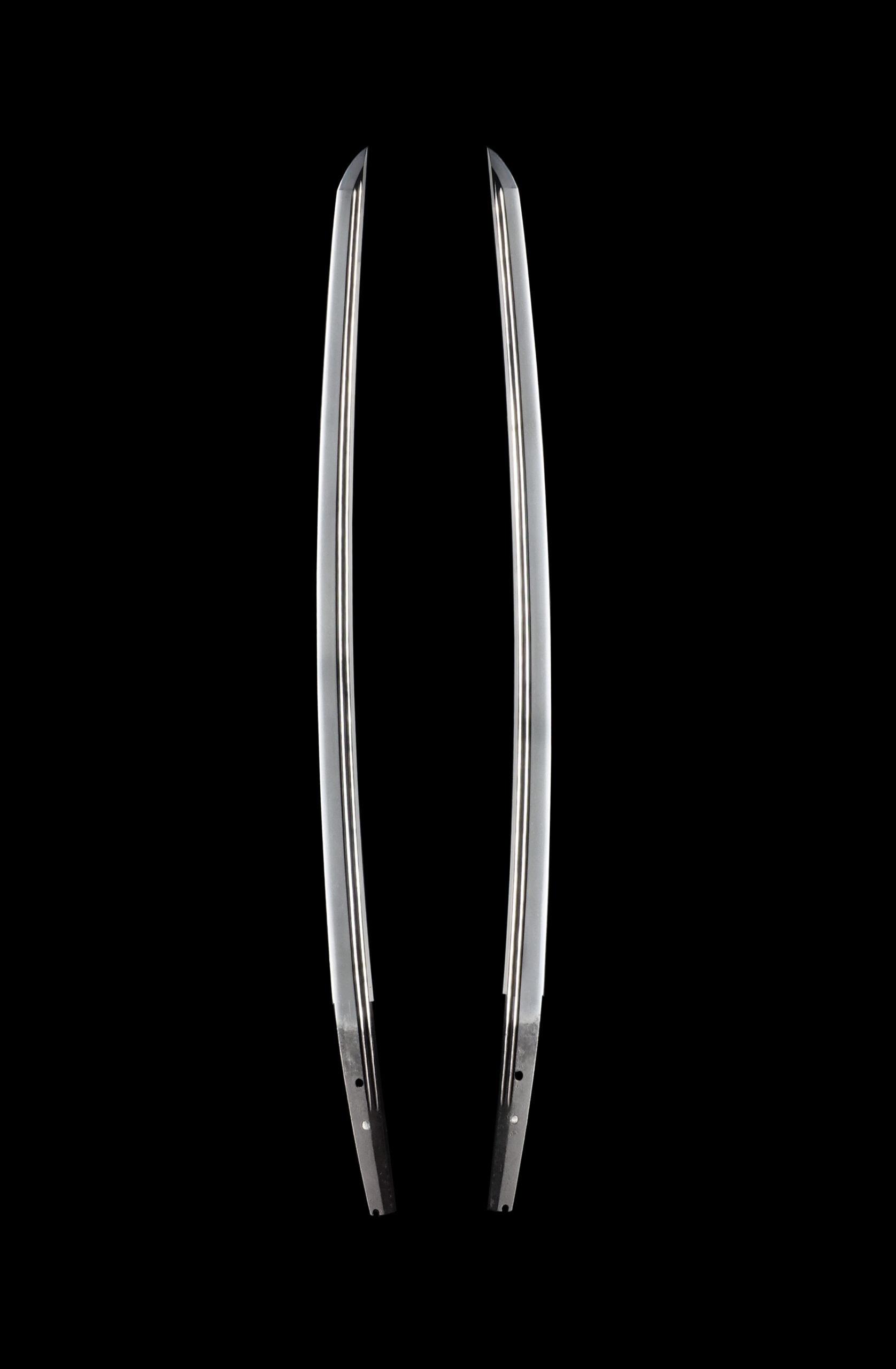
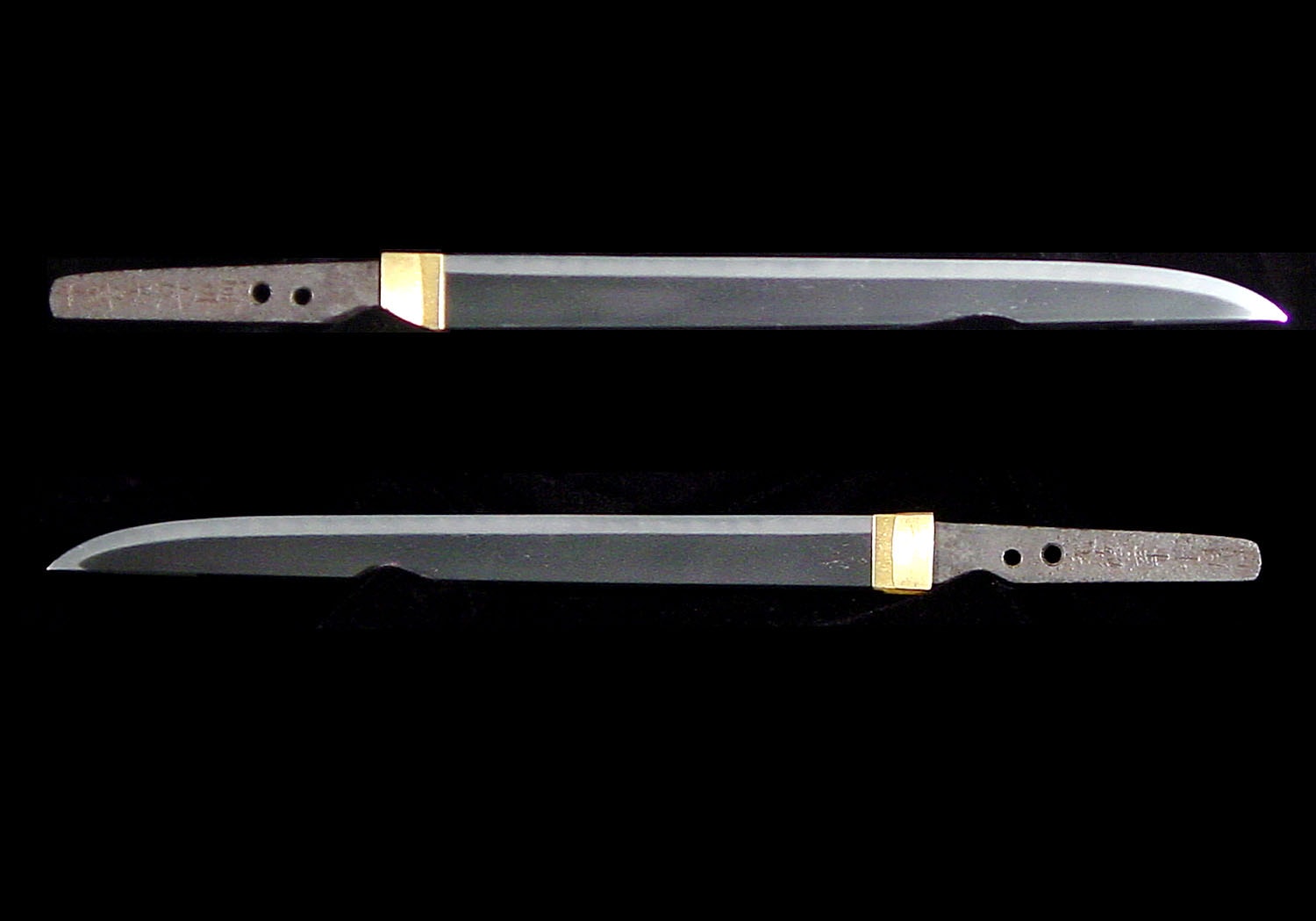
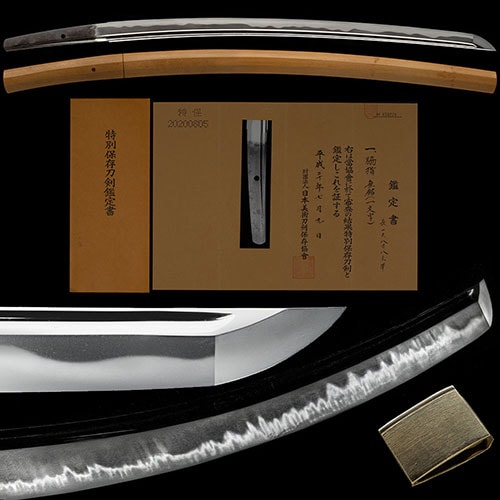
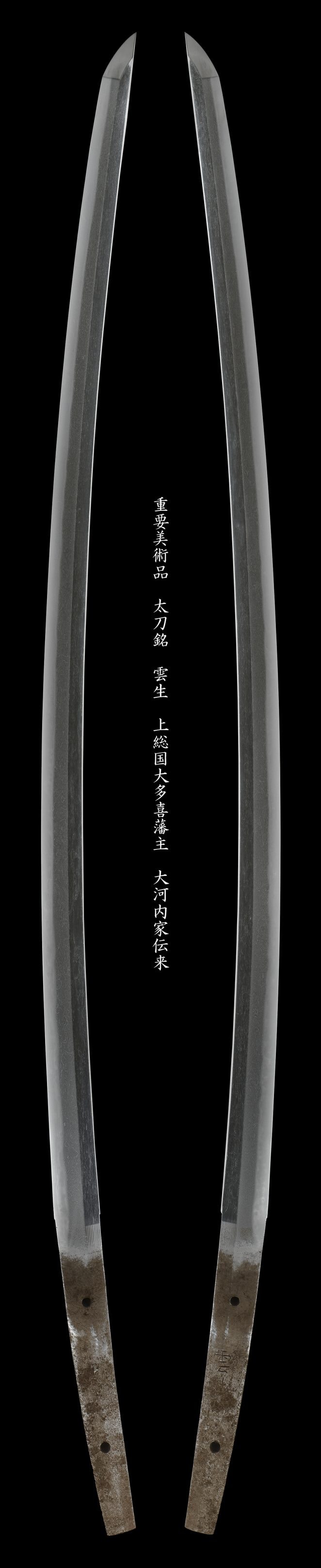
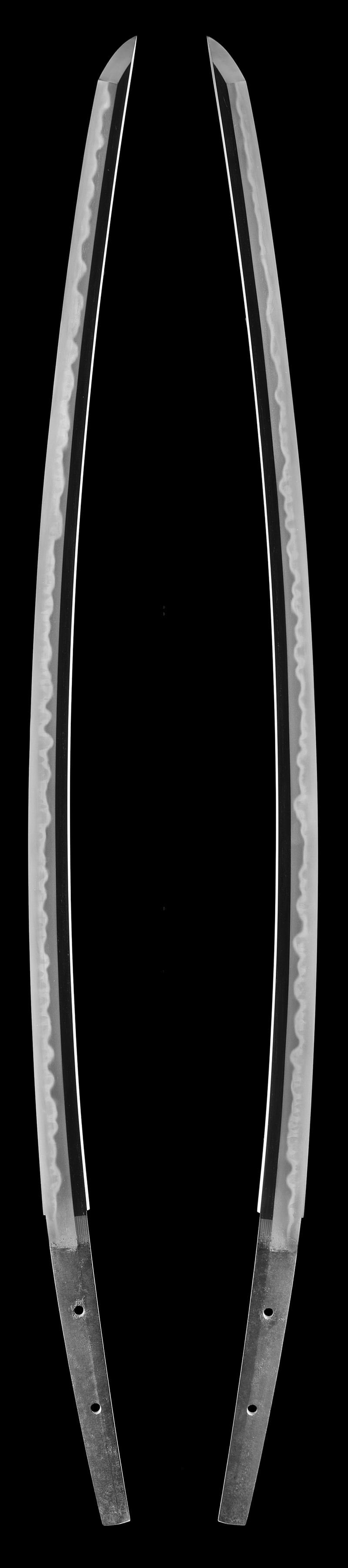
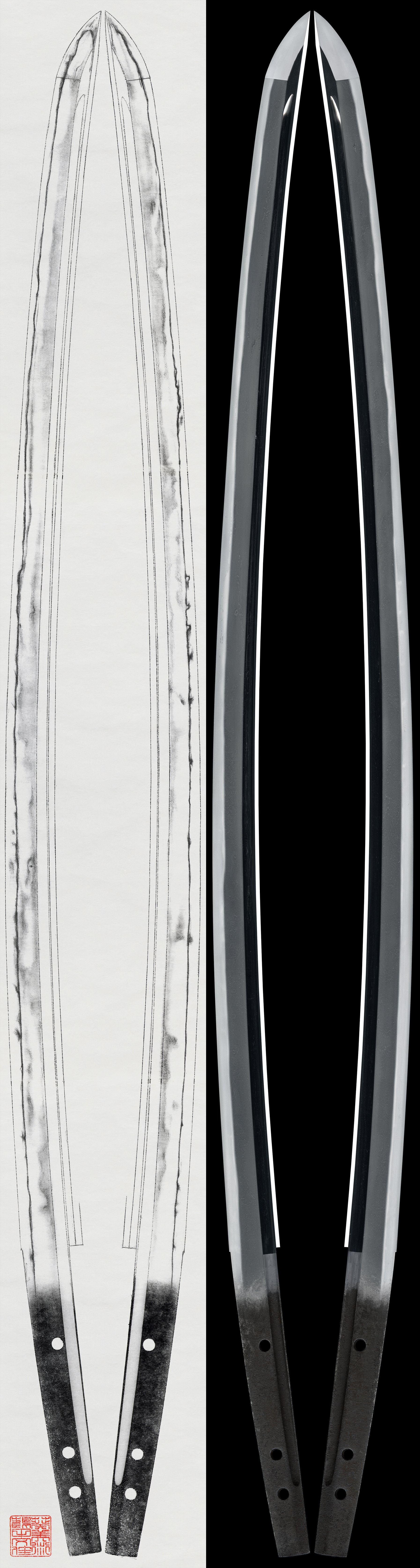
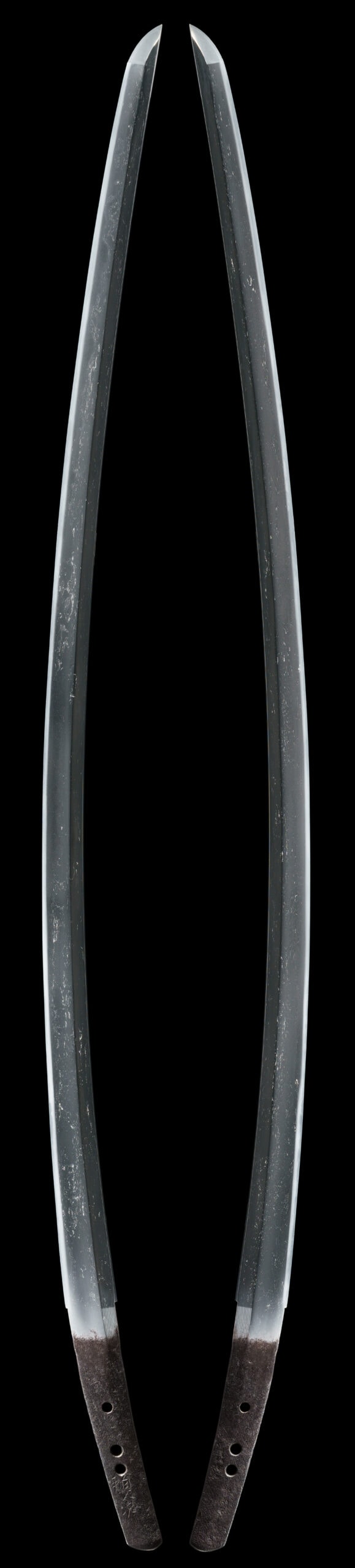
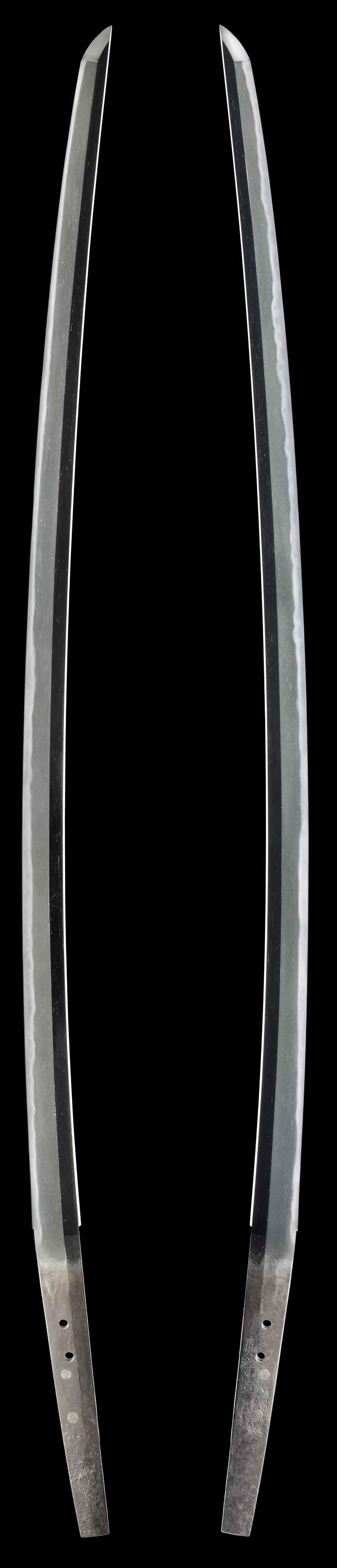
The single piece that anchors Kiyomitsu on record is the dated Tenmon twenty-three (1554) and signed at full length " no ju Kiyomitsu," raised to in 2014, a broad, deep-curved that carries no byname yet which the published sources read, from the breadth of its signature, as the work of Gorōzaemon-no-jō. He is one of the leading names of , the term used for the late- workshops and their output collectively, and within that crowded field he is almost wholly knowable: every blade here carries an tang with a long signature and a date, most of them clustered in the Tenmon years between 1532 and 1555. The published record lists as many as ten smiths who signed Kiyomitsu in this period, bearing the bynames Gorōzaemon-no-jō, Magouemon-no-jō, Yosozaemon-no-jō, Hikobei and Magobei, and singles out Gorōzaemon-no-jō and Magouemon-no-jō as the two superior hands. It is the first, the Tenmon-dated Gorōzaemon, whose work fills this record, and whom the published sources place at the head of a line that runs on into a second generation of the byname in the Eiroku and Tenshō years.
His reputation rests first on . The published sources name him, with Tadamitsu, as the master of the straight temper among the smiths, and call the wide the very signboard of the Kiyomitsu house. His characteristic blade is a thick, sturdy , broad in the body with the heavy and the high, -zori standing toward a that extends a little, over which he lays a wide mixed with small and small . Within it the and enter freely, and the abundant the sources record as his typical tell, with fine and running and the bright and clear. A robust shape tempered in this manner, with the edge well worked and the shining, is what the published sources call the true heart of the smith who excelled at the straight temper.
The beneath that temper is as much a part of his recognition. He forges a packed and with mixed in, applied in fine grain, entering, and a faint standing pale over the surface. The published sources distinguish his from that of Tadamitsu and of Yosozaemon Sukesada by its tendency to stand a little more, an in which the shows, so that on the run of his blades the is the slightly more open one of the three. The exception is telling: on his finest pieces, including the , the sources remark that the is unusually well packed and refined by contrast with his common work, its quality lifting those blades above the rest. The returns in a small round with a sweep of , and on the straight-tempered blades runs straight to that small round, in places pointing or doubling toward the back.
Against that calm register he forges two showier manners, and the published sources treat them as fully typical of him rather than as departures. The first is a whose mark is the , the opened at the base, mixed with and small over a base, and well in and running, which the sources read as bringing him near Yosozaemon-no-jō Sukesada, the other great hand. The second is : the temper taken high, with and small , entering and running strongly until the whole edge takes a form, the laid strongly and running. Here the published sources name a structural tell: is generally thick in the , but a blade tempered in is necessarily made thinner, so the thinned construction itself is the feature to watch, sometimes joined by a the school occasionally shows. The flamboyance appears on a blade and on a wide , the form varying while the hand stays constant.
What sets Gorōzaemon-no-jō apart within is read through his own work rather than by contrast. His bright wide with its abundant is the manner the sources tie to his name, the calmest of his three registers, while the and the -and- extend his range toward Sukesada and toward the showy late- taste; Tadamitsu shares the but not the , Sukesada the but not the straight temper held at full breadth. Several of his blades carry order-inscriptions that fix him in time and place, among them one forged below Tatsuno castle in Harima, which the published sources value as documentary evidence of the smith's movements, and one whose patron Masahide was a commander of the Urakami faction. The broad, deeply curved shapes, made for the wars of the period, are themselves part of the reading; the sources note of a wide that the temper of the warring age shows plainly even in its bearing.
The weight of designation behind his name is steady rather than vast. One of his blades holds the rank and eighteen more are , with nothing on record in the highest designated tiers, so his is a record built in the upper-middle reaches of designation rather than at its summit. The Tōkō Taikan values him in the middle range of the masters, and his provenance, where it is recorded, runs through houses of consequence: one descends from the Matsudaira house of Shinobu, and another from the swordsmith-scholar Masahide. Genuine signed, dated Gorōzaemon-no-jō blades survive in fair number for a name, and an , signed example in its original form, of the kind the published sources hold up as an outstanding piece of his hand, is among the more attainable of the great late- smiths for a collector who waits, the tier appearing from time to time, the single a landmark when it does.