NihontoWatch MonNihontoWatchBETA
MarketEncyclopedia
NihontoWatch Mon

NihontoWatchBETA

Market
Encyclopedia
Overview·Kantei·Designations·Work Types·Signatures
OverviewKanteiDesignationsWork TypesSignatures
  1. Schools
  2. Higo Kinko
  3. Shimizu
  4. Jingo

Shimizu Jingo

甚五

Tokujū
Vol. 24, No. 75 · Tsuba

Shimizu Jingo

甚五

14 ranked works

ProvinceHigoEraEarly–Mid Edo (1599–1710)SchoolHigo Kinko>ShimizuTraditionHigoSpecialtiestsuba, inlayTypeTosogu MakerCodeSMZ001
2Tokubetsu Jūyō12Jūyō Tōken

Overview

Shimizu Jingo, also read Shimizu Jingo (志水甚五), was the founder of the Shimizu lineage, one of the four principal houses — alongside Hayashi, Hirata, and Nishigaki — that constitute the orthodox mainline of metalwork. Said to have been a nephew of Hirata Hikozo, the first-generation Jingo entered the service of Hosokawa Sansai Tadaoki, the cultured renowned equally for military prowess and mastery of the tea ceremony as a leading disciple of Sen no Rikyu. When Hosokawa Tadatoshi was enfeoffed with 540,000 at Kumamoto following the dispossession of the Kato family in 'ei 9 (1632), Sansai retired to Yatsushiro Castle in Province. Jingo accompanied Hirata Hikozo in following Sansai to Yatsushiro, where he established his workshop and began producing the distinctive guard forms that would define his school for generations. No signed works by the first generation are known; attribution rests on connoisseurship of his highly individual manner, and the Jingo line continued to prosper as a major lineage well into the mid- period.

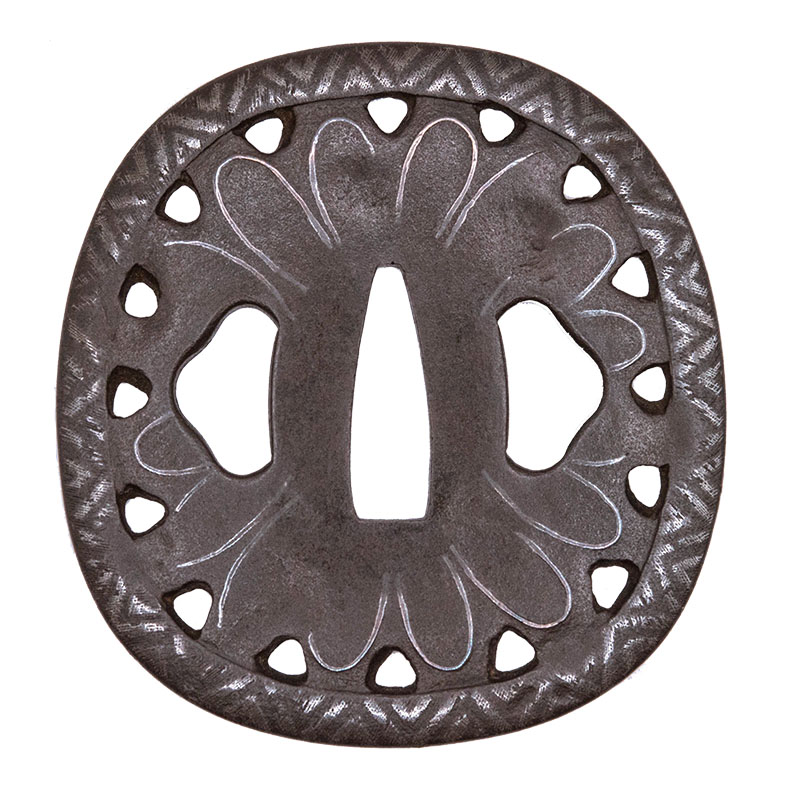
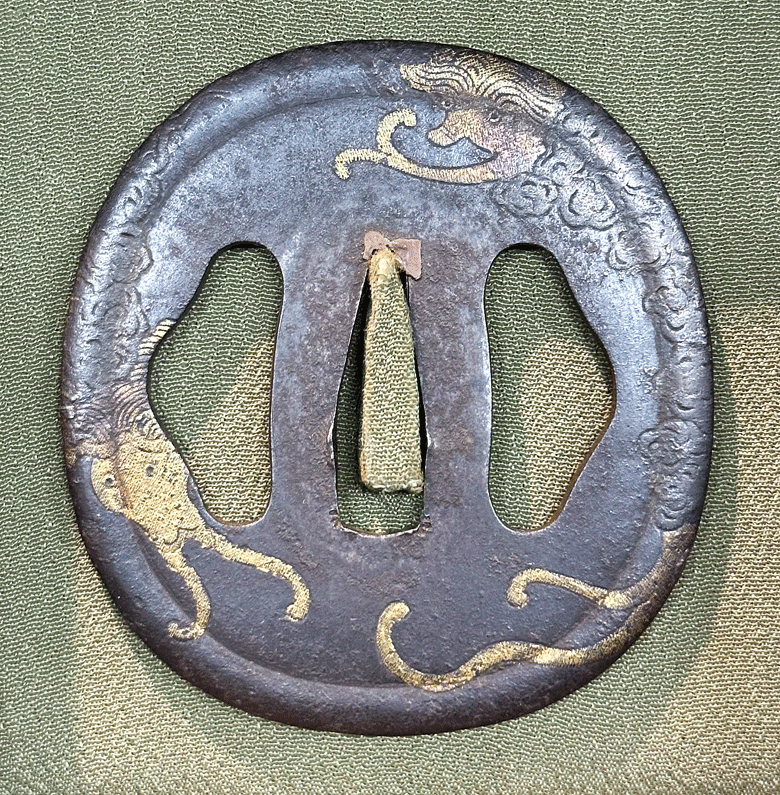
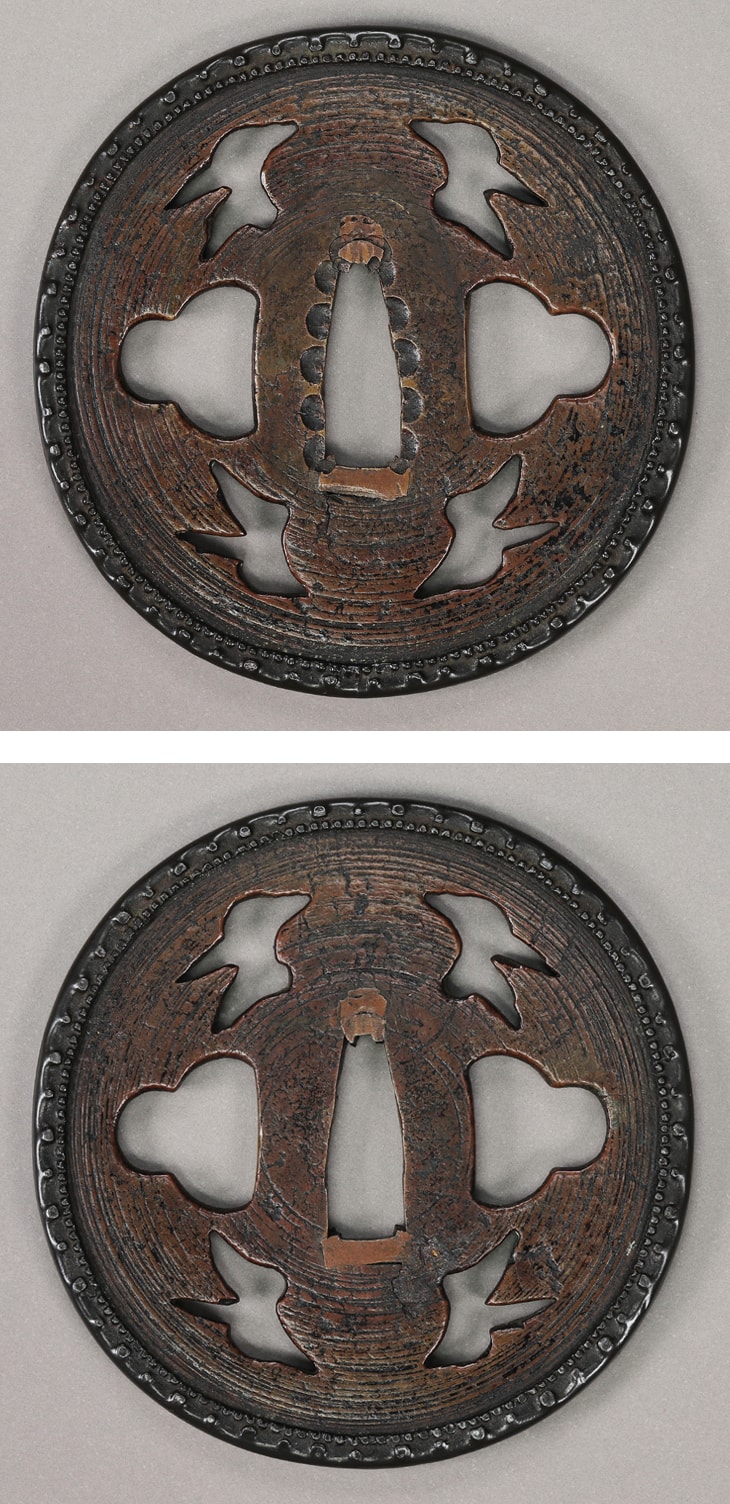
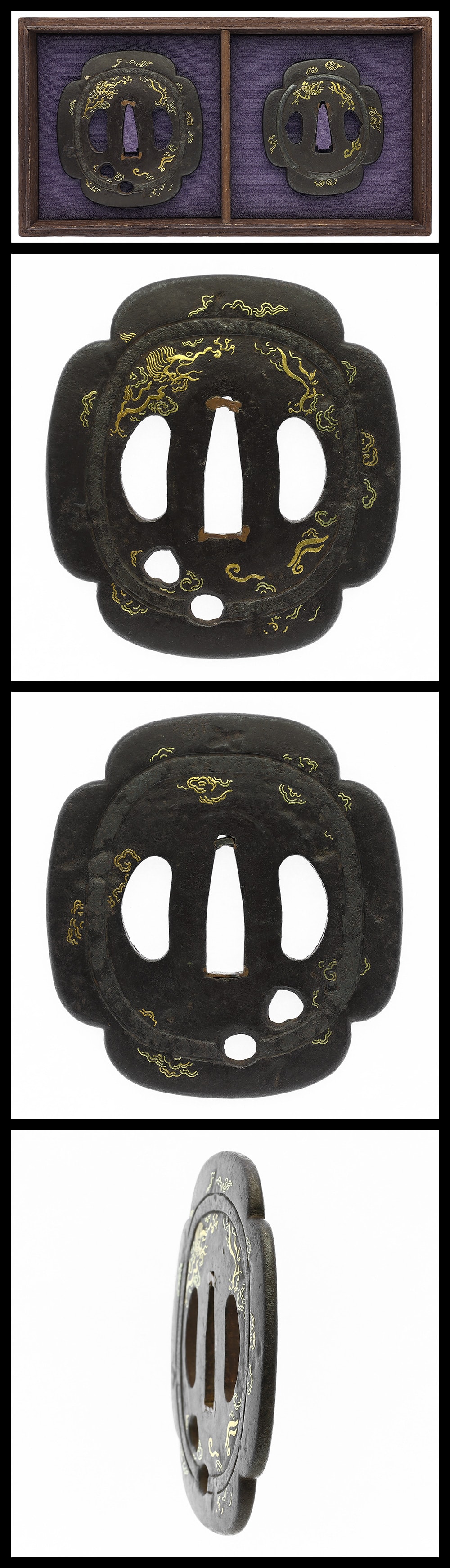
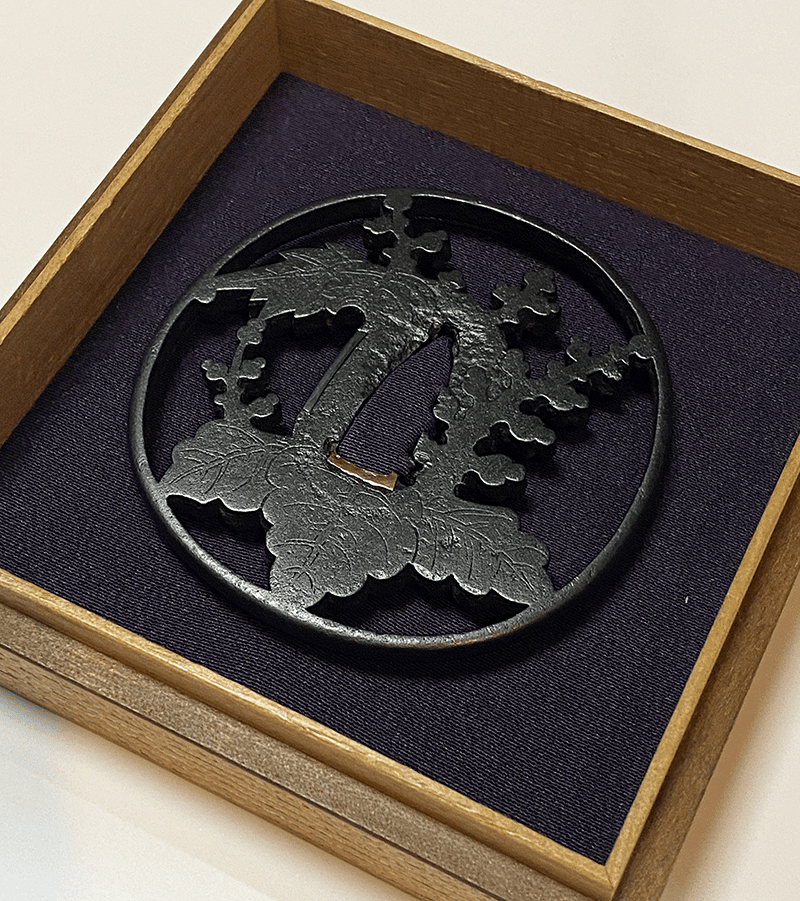
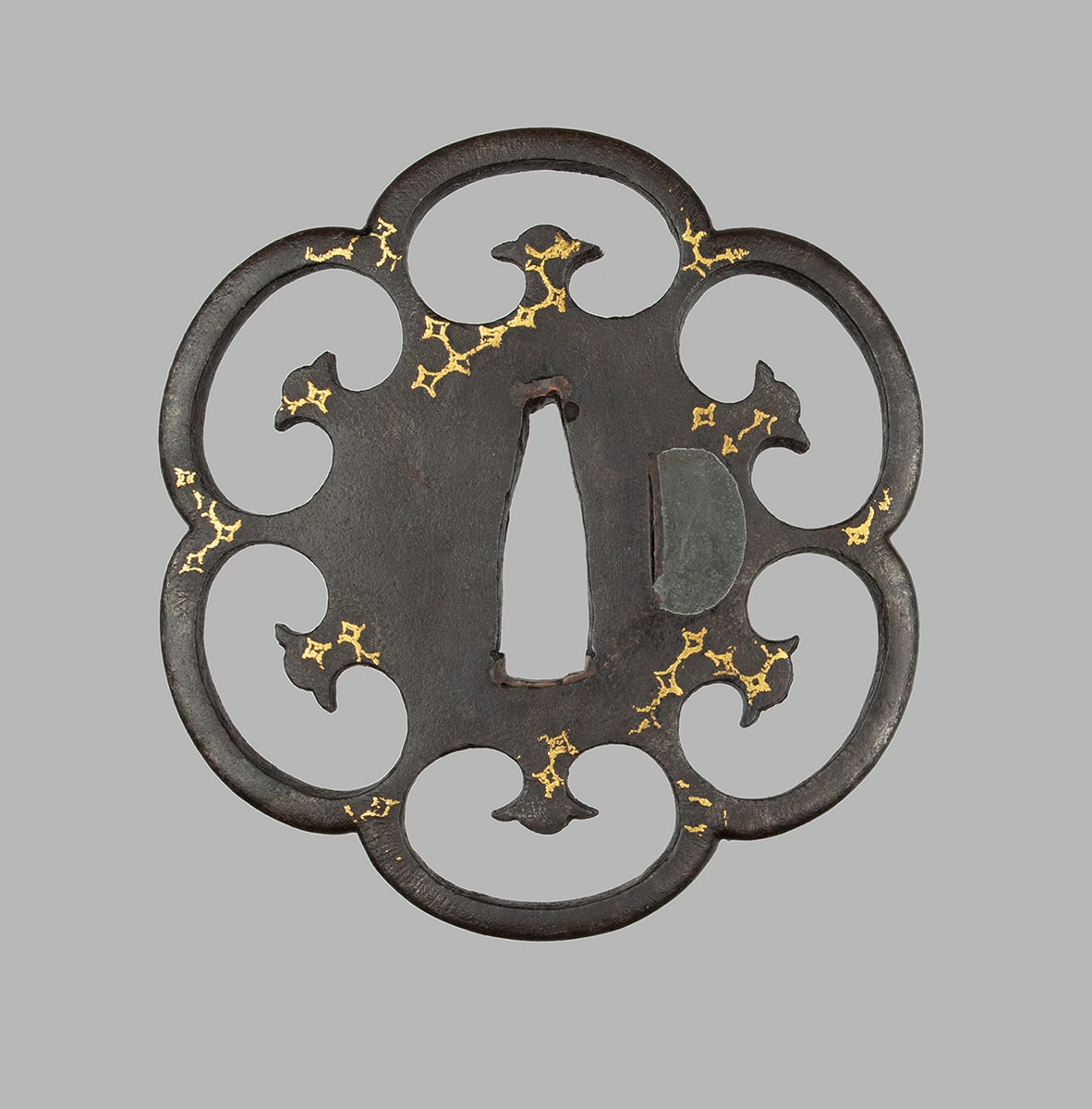
Among metalworkers, Jingo's technical manner exhibits the most intense individuality. His preferred medium was an iron plate finished in — a hammered ground augmented by a fired surface treatment known as — upon which he executed large-scale pictorial compositions in brass -, a flush-inlay technique that he elevated to an art of exceptional boldness. His characteristic forms include the (rounded-square) and (flared) silhouettes, and his decorative repertoire extended to (raised relief carving), (hairline engraving), silver (cloth-pattern inlay), and occasional black lacquer coating. The hallmark of his compositional method lies in a deliberate asymmetry between obverse and reverse: on the front, he renders his subjects — raptors, owls, roosters, rain dragons, octopi — with commanding scale and forceful presence; on the reverse, he intentionally reserves broad expanses of open space, arranging motifs in diminished scale with subdued coloring and softer modeling. Though this contrast may at first appear unbalanced, it is precisely through this tension that Jingo achieves an overall harmony imbued with a profound sense of , the quiet, austere beauty central to the Hosokawa aesthetic tradition.

Jingo's achievement stands apart within the metalworking tradition as the fullest artistic expression of the shibumi — understated elegance — cultivated under Sansai's personal guidance. His pictorial approach, likely modeled on the inlay conventions of the Heianjo school yet far surpassing them in boldness and scale, introduced a painterly sensibility to iron guard-making that remained without parallel. The owl perched in a pine, the eagle with talons clenched upon a branch, the rain dragon twisting across a hammered ground — these became iconic subjects inseparable from Jingo's name. Designation records consistently praise the extraordinary force of his artistic vision: a manner in which, to borrow the classical phrase invoked by the , "great skill appears clumsy" — seemingly artless yet transcending ordinary expectation. His works fuse martial vigor with contemplative restraint, embodying the warrior-aesthete ideal that Sansai himself personified.

Kantei

3 descriptive axes: material (the fired, hammered iron plate) x technique (brass and copper applied-design inlay, with nunome and sukidashi relief) x themes (bold birds of prey, owls, cocks and dragons on the face, against an open reverse). His load-bearing discriminators against the neighbouring Hayashi and Nishigaki iron hands, whose art is sukashi openwork, are the brass applied-design inlay that the records call his own and the bold raptor subject most associated with his name.

The first-generation Shimizu Jingo is the founder of the Shimizu (Jingo) line, which the records count with the Hayashi, Hirata and Nishigaki houses as one of the four mainstream schools of metalwork, all of whose founders were taken into the service of the Hosokawa lord Sansai Tadaoki and taught by him. Said to be the nephew of Hirata Hikozo, he moved with Hikozo to Yatsushiro when Sansai retired there about 'ei 9 (1632). The records name him the most singular of all the makers: his art is a hammered, fired iron plate on which large, bold birds of prey, owls, cocks and dragons are set in brass applied-design inlay (shinchu -) across the face, with the reverse deliberately left open and the design set small, so that a dynamic front and a still back resolve into a deeply quiet whole. His given name is recorded once as Nihei; almost all of his accepted work is unsigned.

Diagnostic discriminators

the records call the brass applied-design inlay his most characteristic and incomparable manner, likely learned from Heianjo-zogan but distinguished by its bold figures, set against the openwork (sukashi) that defines the neighbouring Higo iron houses; the explicit shinchu-suemon-zogan phrase appears on 8 of 14 objects and brass inlay of some form on 11 of 14

the eagle and hawk on pine are named the subject most bound to his name (Jingo to ieba), the warrior spirit entrusted to the raptor and set off against an open reverse; raptor pieces run to 9 of 14 objects here

Material (the iron plate)

A fired, hammered iron ground, the records calling it --jitate, well-forged in the better pieces though an uneven iron is named a weakness of the line; a few late guards are worked instead in a hammered (refined-copper) ground.

Technique

Applied-design inlay (-) above all, the device cut separately and set onto the plate, here above all in brass and sometimes ; nunome overlay in gold and silver and a relief are added on a number of pieces, with hairline engraving finishing the bird and the branch.

Themes (bold figural devices)

Birds of prey above all, with owls, cocks and dragons, set large and bold on the face, accompanied by pine; the reverse carries a sparse crescent moon, a branch-tip or an empty field, the front and back composed as a deliberate asymmetry that the records read as the heart of his manner.

Birds of prey

The eagle, hawk and other raptors on pine, the subject the records say is what one thinks of at the name Jingo, the warrior spirit entrusted to the bird.

Full iconography

Signature chronology

Placement
Recorded signatures

Documentary note

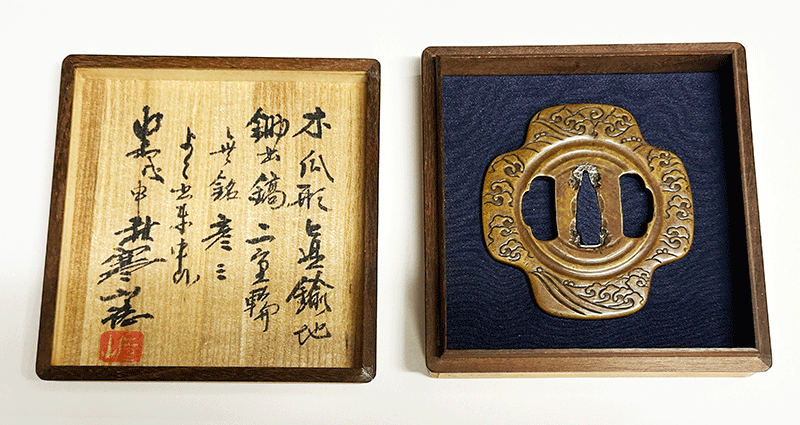
Almost all accepted work of the first generation is unsigned ( Jingo); the records state plainly that neither the first nor the second generation left signed pieces, and the attribution rests on the iron, the brass applied-design inlay and the bold composition. One late-designation guard in this corpus is recorded as signed Jingo, but the two-character go is an inherited name carried across the generations, so a Jingo mark cannot by itself date a generation; the profile is scoped to the first generation by the documented iron and devices rather than by the signature. His given name is recorded once as Nihei.

Scholarship

His deliberately asymmetric front and back, a dynamic face against a quiet open reverse, are read as the heart of his manner and a uniquely deep, still elegance.

Designations

Kokuhō—
Jūyō Bunkazai—
Jūyō Bijutsuhin—
Gyobutsu—
Tokubetsu Jūyō2
Jūyō Tōken12

Elite Standing

0.10 across 14 designated works

Top 13% among makers

Work Types

Distribution across 14 ranked works

Tsuba
14100%

Signatures

Signature types across 14 ranked works

Currently Available

Jingo

Jingo(甚五) was a maker of Japanese sword fittings (tōsōgu) of the Shimizu school in Higo province, active during the Early–Mid Edo (1599–1710) period.

The work follows the Higo tradition.

Designated works by Jingo include 2 Tokubetsu Jūyō, 12 Jūyō.