NihontoWatch MonNihontoWatchBETA
MarketEncyclopedia
NihontoWatch Mon

NihontoWatchBETA

Market
Encyclopedia
Overview·Kantei·Designations·Work Types·Signatures·Lineage·School
OverviewKanteiDesignationsWork TypesSignaturesLineageSchool
  1. Schools
  2. Hikone
  3. Soten

Hikone Soten

宗典

Jūyō
Vol. 46, No. 228 · Tsuba

Hikone Soten

宗典

10 ranked works

ProvinceOmiEraEnpō–Kan'en (1679–1751)PeriodEdoSchoolHikoneTraditionKinkoGeneration1stTeacherSelf-taught (school founder)Specialtiestsuba, menuki, kozuka, fuchi-kashiraTypeTosogu MakerCodeMIP001
10Jūyō Tōken

Overview

Mogarashi Nyudo Soten, also known by the surname Kitagawa, was originally from Kyoto and later settled at Nakayabu in Hikone, Omi Province. According to the Kisho, he became a retained craftsman of the Kawakita family, a hereditary vassal house of the Hikone domain, and thereupon adopted the Kitagawa surname. His earliest signature name is recorded as Hidenori, and one source states that he initially trained under the Goto family, citing the Kinko Soran for the existence of works signed "made by Kitagawa Hidenori, a disciple of the Goto." He is regarded as the founder of the distinctive carving manner known as Hikone-bori, and his lineage is connected to the traditions of . There were reportedly two generations using the name; from extant works bearing age inscriptions, it is known that the first generation was born in Joo 1 (1652), with a period of activity spanning from the early through the mid- period.

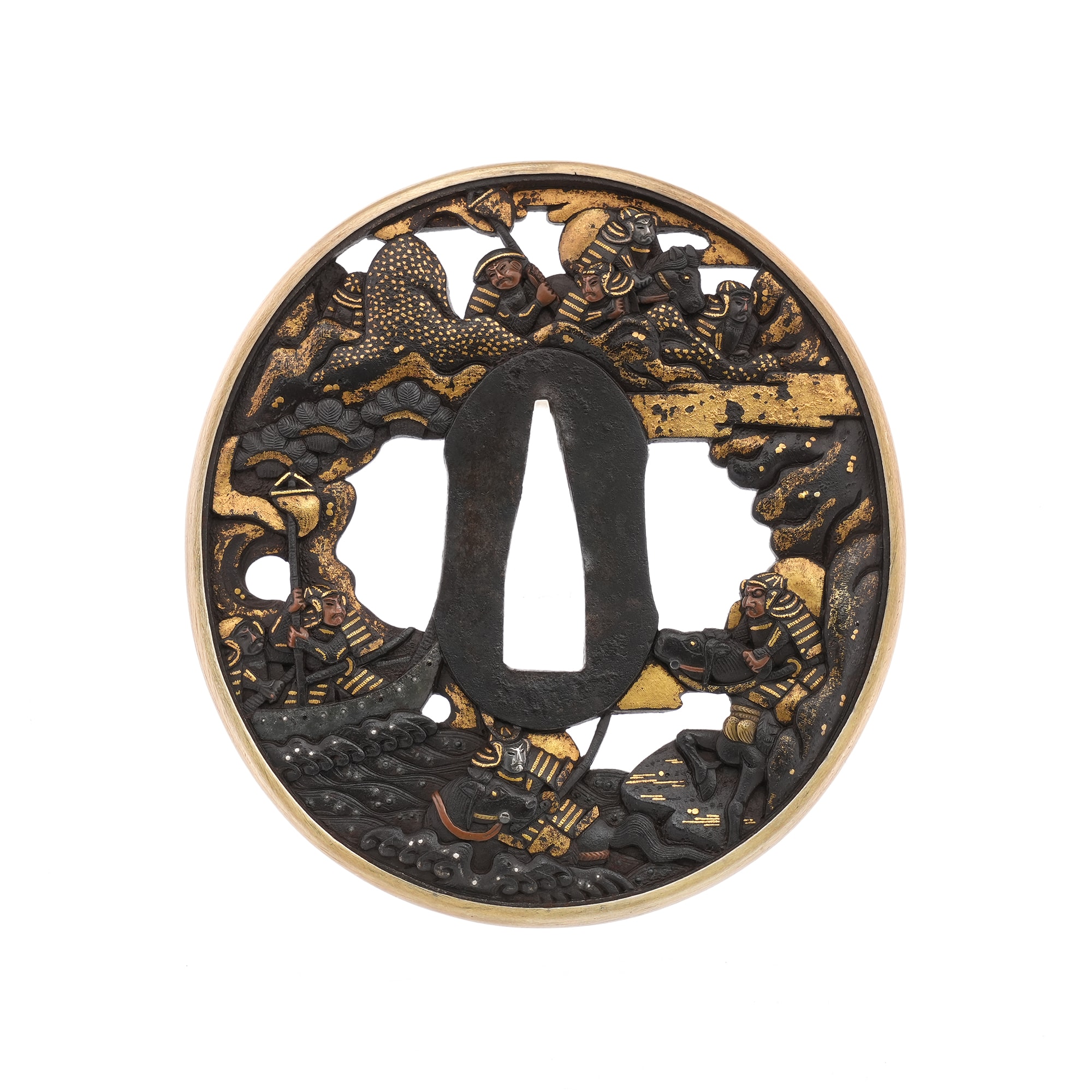
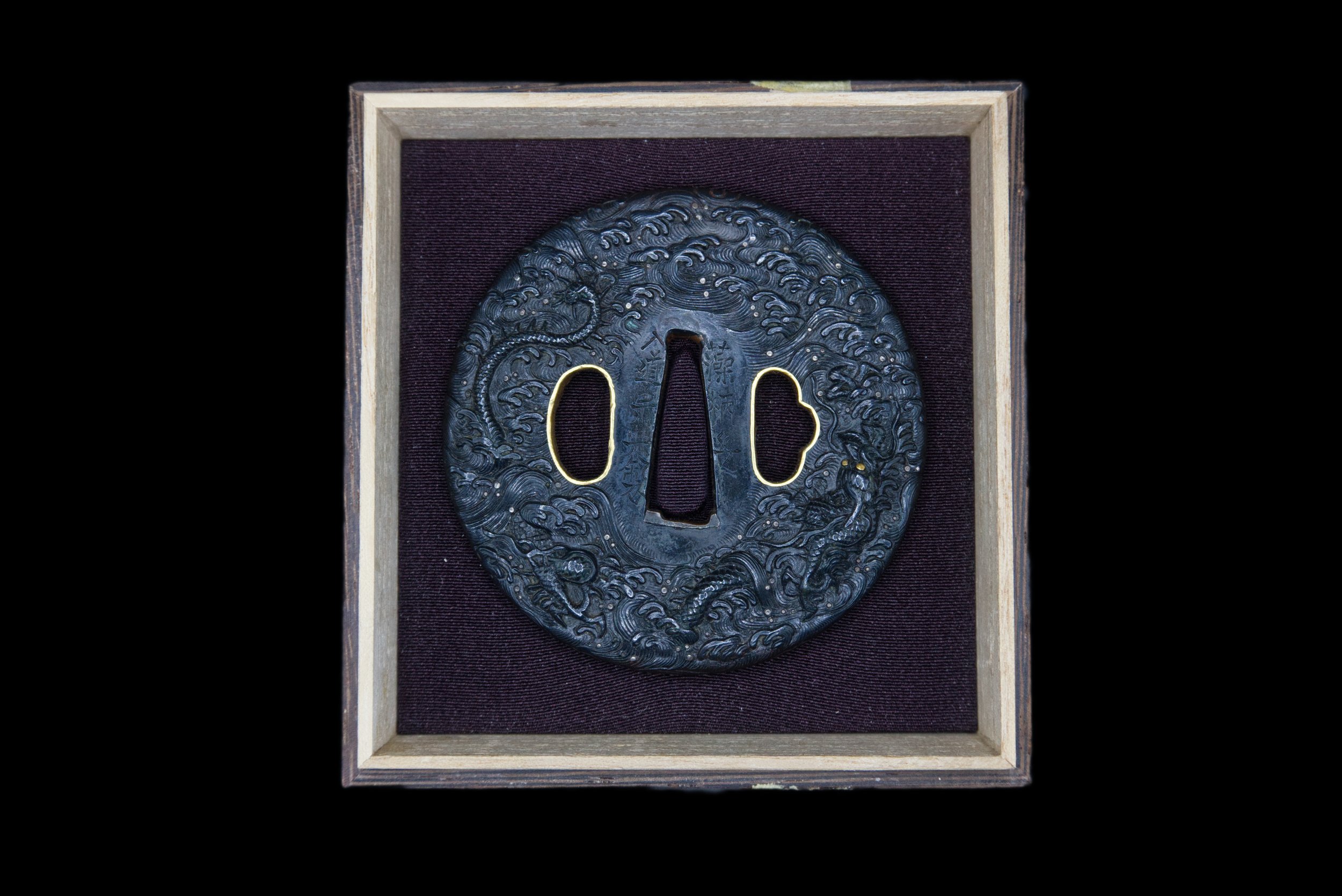
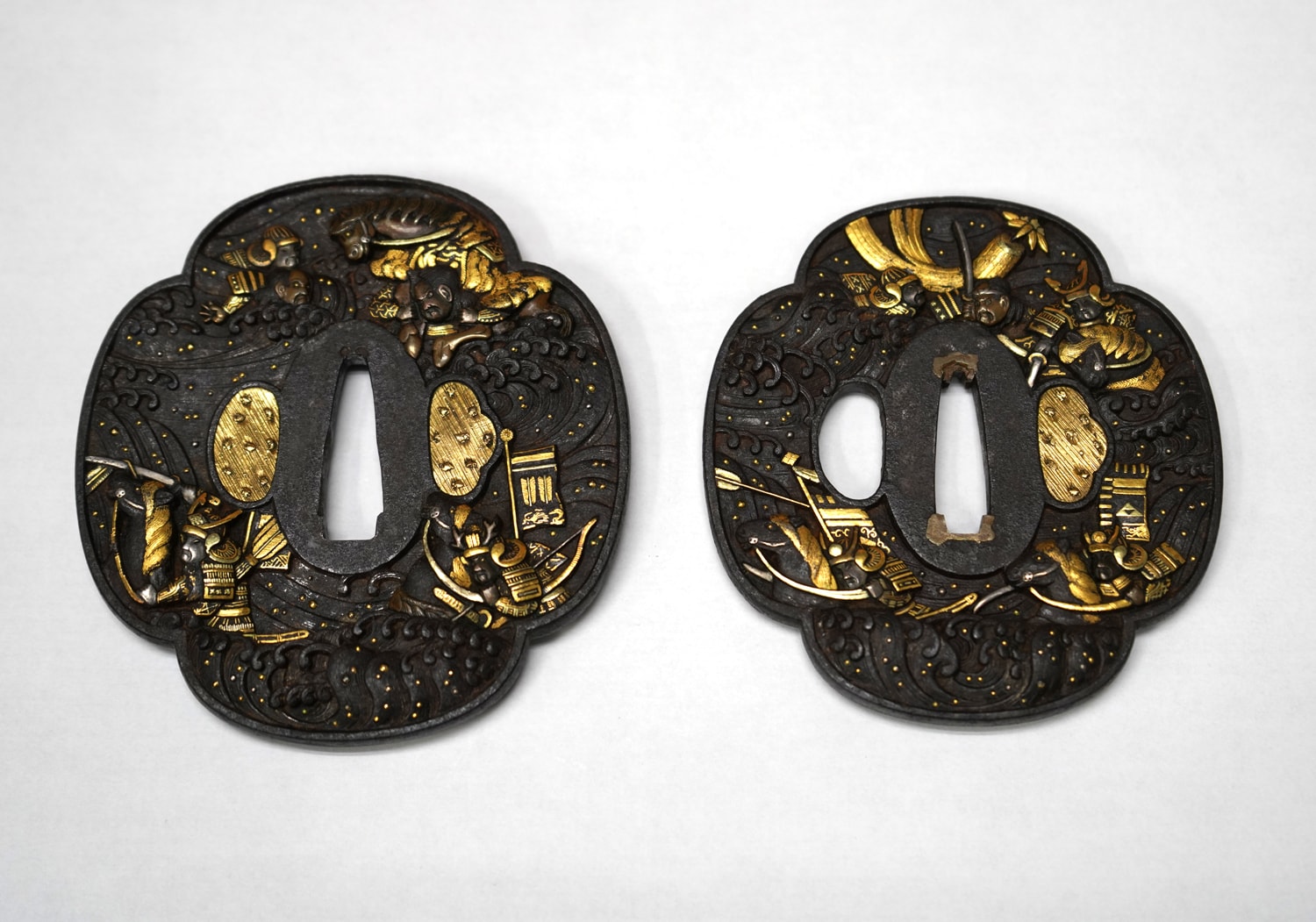
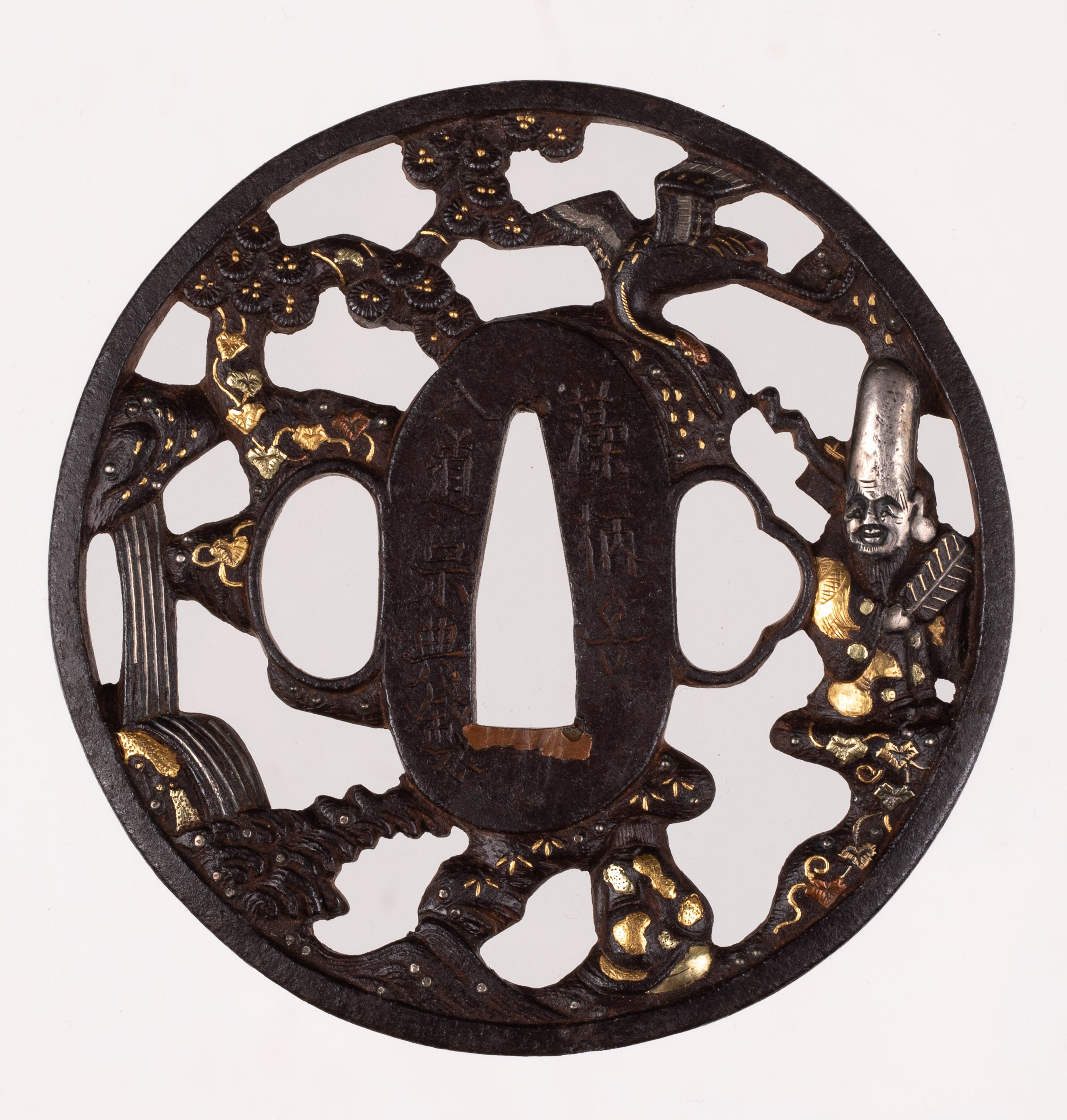
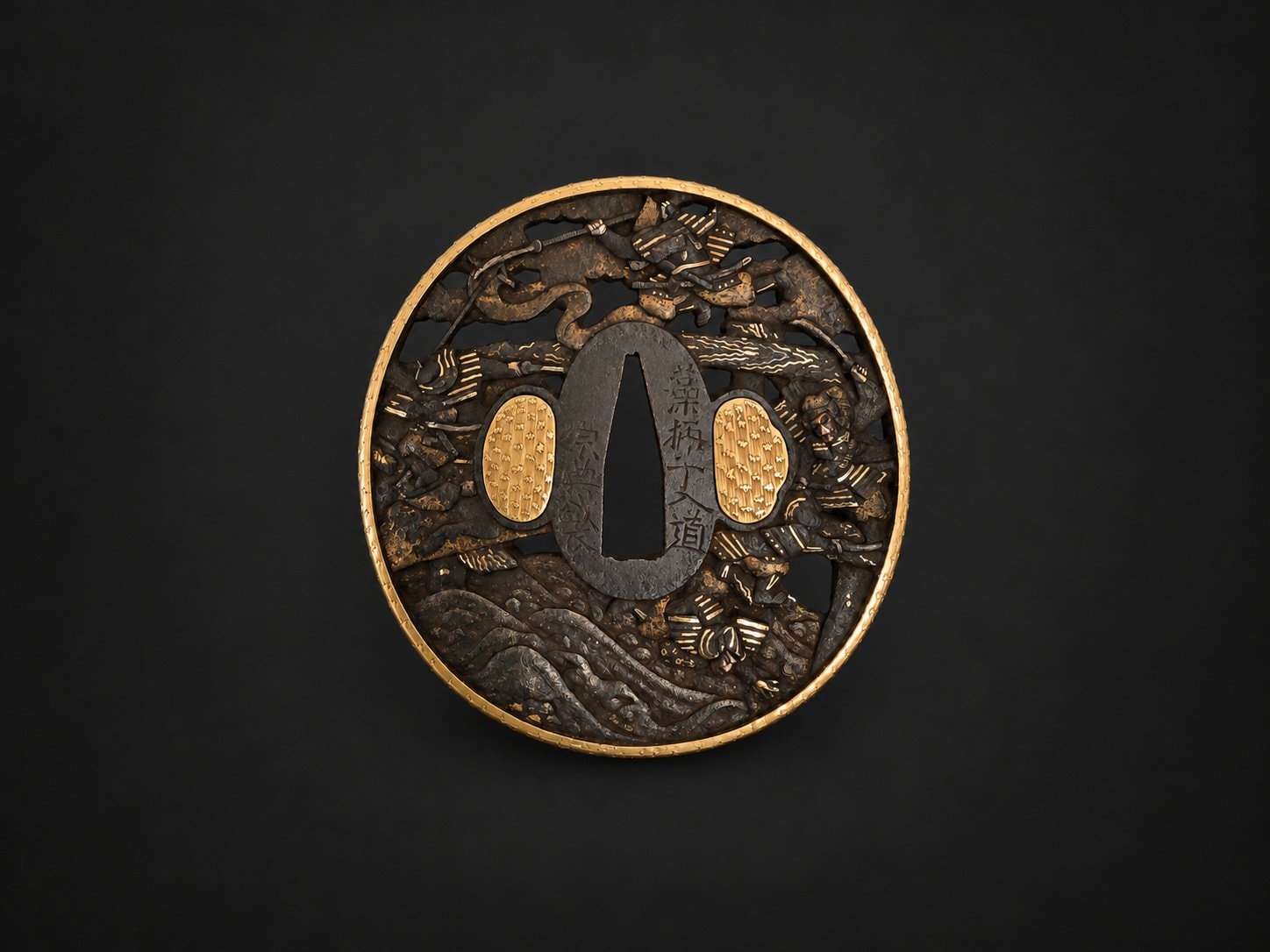
Soten's characteristic technique is -- richly modeled high-relief carving executed on generously proportioned iron plates, further enlivened through employing gold, silver, , and . The notes that even among the gold applications, "multiple types of gold are used," producing expansive pictorial fields of considerable chromatic variety. His subjects encompass warriors, Daoist immortals, elder sages at elegant gatherings, and flowers-and-birds compositions, rendered across the entirety of both surfaces. Alongside these iron works, the recognizes that "many fine works are to be found" among his pieces, including plates with high-relief seaweed-and-shell or wave-ground compositions that display a pronounced Goto-like flavor.

The 's evaluative language for Soten converges on a single defining quality: a "bustling and brilliant unfolding" that constitutes "precisely what S\u014dten excelled at." This animated, celebratory manner is repeatedly described as the artist's "distinctive forte" and "particular strength," one that "has long captivated connoisseurs" and "attracted many admirers." Crucially, when executed by Soten's own hand, this profusion is "remarkably free of any sense of overstatement," achieving instead what the terms "true dignity." The handling of the chisel is characterized as "broad-minded and unhurried," drawing the viewer into a world of yugen. Because of his overwhelming fame, later makers frequently adopted his signature on subsequent Hikone-carved works -- a testament to the enduring authority of his name, and a reminder that authentic examples, with their grand pictorial construction and superb preservation, occupy a position of singular distinction within the tradition.

Kantei

3 descriptive axes: material (the iron plate his work most often uses, with shakudo a frequent second ground) x technique (full deep high relief carving filled with many-coloured inlay and applied colour, zogan-iroe) x themes (densely composed figural subjects: warriors, Chinese sages and immortals, the eight views of Omi). The deep relief, the colour and the iron ground are the school FOUNDATION, shared by every Hikone-bori hand and by the imitators; the load-bearing separators the records give for the genuine first-generation master against the mass of later Hikone-bori and souvenir forgeries are the age-dated self-signature and the no-openwork solid-plate composition the masterworks favour.

Soten, who signed under the literary go Soheishi, is named the founder of Hikone-bori, the dense figural carving of Hikone in Omi province. By the Kisho he was originally a man of Kyoto who later settled in Hikone; taken into service of the Kawakita family among the Hikone domain retainers he changed his surname to Kitagawa and is said to have first signed Hidenori, with the common name Zengoro. The records say his work descends from and shows both a Goto and a character. His art is above all the iron plate, the ground he uses most often, worked in a full, deeply modelled high relief carving () and filled across the whole face with figural subjects, warriors, Chinese sages and immortals, the eight views of Omi, set off in many-coloured inlay and applied colour (-). The two-character go is inherited (two generations are recorded) and, because the name became so famous, was forged onto a great mass of later Hikone-bori and souvenir-grade pieces; the records secure the genuine first-generation master by the age-dated self-signature (gyonen-) and the iron, and place the masterworks in the no-openwork solid-plate guards rather than the school's commoner openwork. This profile is built on ten guards and so is scoped honestly.

Diagnostic discriminators

the records say the name became so famous that later Hikone-bori, down to coarse souvenir pieces, were widely cut with the Soheishi-Soten signature; against this the age-dated self-signature (行年七十二歳 / 行年七十歳 製), giving the master's own age, is read as the precious and typical mark of a genuine first-generation self-signed work (宗典自身銘の典型的な出来口), and from the dated ages the first generation is said to have been born in 1652. It appears on 3 of these 10 guards, so it is a low-n but documentary first-generation separator; the deep relief, colour and iron ground it accompanies are a Hikone-bori foundation shared by the imitators and so are kept as ground and register, not as a tell

two of these setsumei make the same point in different words: Juyo 24-560 says the school's guards are most often openwork (透彫) but that the solid no-openwork plate (無透の板鐔) holds his relatively superior works, and Juyo 46-228 likewise reads the school as mostly niku-bori ji-sukashi (肉彫地透) while placing the masterpieces in the guards with no openwork (透しのない高彫象嵌色絵). This is a connoisseurship separator the records draw between Soten and the wider school, but it is stated on only 2 of the 10 guards here, so it is flagged low-n; the cite is to the one guard that literally carries the 板鐔 phrasing

Material (the iron plate)

An iron ground above all, the records calling iron the metal he uses most often, the plate full and generous and on the better guards carrying a settled patina; , frequently worked in , is his frequent second ground and the records say it too produces many fine works, with (refined copper) and used for inlaid accents.

Technique

A full, deeply modelled high relief carving (), at times worked up from the ground as , filling the whole face; the relief is finished in many-coloured inlay and applied colour ( and ), several kinds of gold among them, with applied-design elements () set into the better guards. The rim is most often left as a squared or dressed with a gold .

Themes (densely composed figural subjects)

Figural subjects above all, set densely across the whole face: warriors, Chinese sages and immortals at refined play, the eight views of Omi, with bird-and-flower and shorebird subjects among them. The records call the iron-ground warrior design his most common, and read the crowded, festive composition, kept from excess by the master's hand, as the heart of his manner.

Figural subjects

Warriors, Chinese sages and immortals filling the face, the iron-ground warrior the records name his commonest design.

Bird-and-flower and shorebirdsless firmly established

Spring-and-autumn bird-and-flower and crowds of plover over breaking waves, carried in the dense relief.

Full iconography

Signature chronology

Recorded signatures

Documentary note

By the Kisho Soten was originally from Kyoto, later settling in Hikone in Omi and called the founder of Hikone-bori; taken into service of the Kawakita house among the Hikone domain retainers he changed his surname to Kitagawa and is said to have first signed Hidenori, with the common name Zengoro. His signature is the two-character go Soten carried under the literary go Soheishi, most often as Soheishi (Kitagawa) nyudo Soten sei with the locative Goshu Hikone (Nakayabu) ju, on two guards accompanied by a and on three by an age-dating gyonen-. Two generations of the name are recorded, and from the dated works the first generation is said to have been born in Joo 1 (1652), active from the early into the mid period. Because the go is inherited and was widely forged onto later Hikone-bori and souvenir guards, a Soten mark cannot by itself date a generation: this profile is scoped to the genuine first generation by the age-dated self-signature and the documented iron rather than by the bare name.

Scholarship

One setsumei (Juyo 53-190) says that because of his very fame the Soten signature came to be cut even onto later Hikone-bori works said to be souvenir-grade and coarse, so that the genuine first-generation hand is a matter careful study must separate from the mass that bears his name.

Designations

Kokuhō—
Jūyō Bunkazai—
Jūyō Bijutsuhin—
Gyobutsu—
Tokubetsu Jūyō—
Jūyō Tōken10

Elite Standing

0.07 across 10 designated works

Top 19% among makers

Work Types

Distribution across 10 ranked works

Tsuba
990%
Other
110%

Signatures

Signature types across 10 ranked works

Currently Available

Lineage

Soten
Students (3)
  1. 1.Kanenori包教1 for sale3designated
  2. 2.Munehide宗秀
  3. 3.Munekata宗賢

Hikone School

Other artisans of the Hikone school

  1. 1.Kanenori包教1 for sale3designated

Soten

Soten(宗典) was a maker of Japanese sword fittings (tōsōgu) of the Hikone school in Omi province, active during the Enpō–Kan'en (1679–1751) period.

The work follows the Kinko tradition.

Designated works by Soten include 10 Jūyō.