NihontoWatch MonNihontoWatchBETA
MarketEncyclopedia
NihontoWatch Mon

NihontoWatchBETA

Market
Encyclopedia
Overview·Kantei·Designations·Provenance·Work Types·Signatures·Lineage·School
OverviewKanteiDesignationsProvenanceWork TypesSignaturesLineageSchool
  1. Schools
  2. Hirata-Edo
  3. Harunari

Hirata-Edo Harunari

春就

Jūyō
Vol. 56, No. 62 · Tsuba

Hirata-Edo Harunari

春就

6 ranked works

ProvinceEdoEraLate Edo (?–1840)SchoolHirata-EdoTraditionKinkoGeneration8th gen (Edo Hirata shippō)TeacherNarisukeSpecialtiestsuba, kozuka, menuki, fuchi-kashira, inlayTypeTosogu MakerCodeHIR005
6Jūyō Tōken

Overview

Hirata Harunari was the eighth-generation master of the Hirata school, a lineage founded by Hirata Donin (also recorded as Hirata Michihito), who was celebrated for expressing the sumptuous beauty of -period art in sword fittings through the medium of shippo (cloisonne enamel). As hereditary specialists in service to the shogunate, the Hirata house transmitted its enameling techniques across successive generations. Harunari stands out as an especially accomplished artisan within that lineage: unlike other heads of the family, he did not confine himself to the hereditary shippo alone but also practiced chokin (metal carving), and for that reason left behind works employing a wide variety of methods. Following Harunari, the Hirata family continued to make full use of its inherited cloisonne expertise, undertaking the production of decorations and orders for the Meiji government.

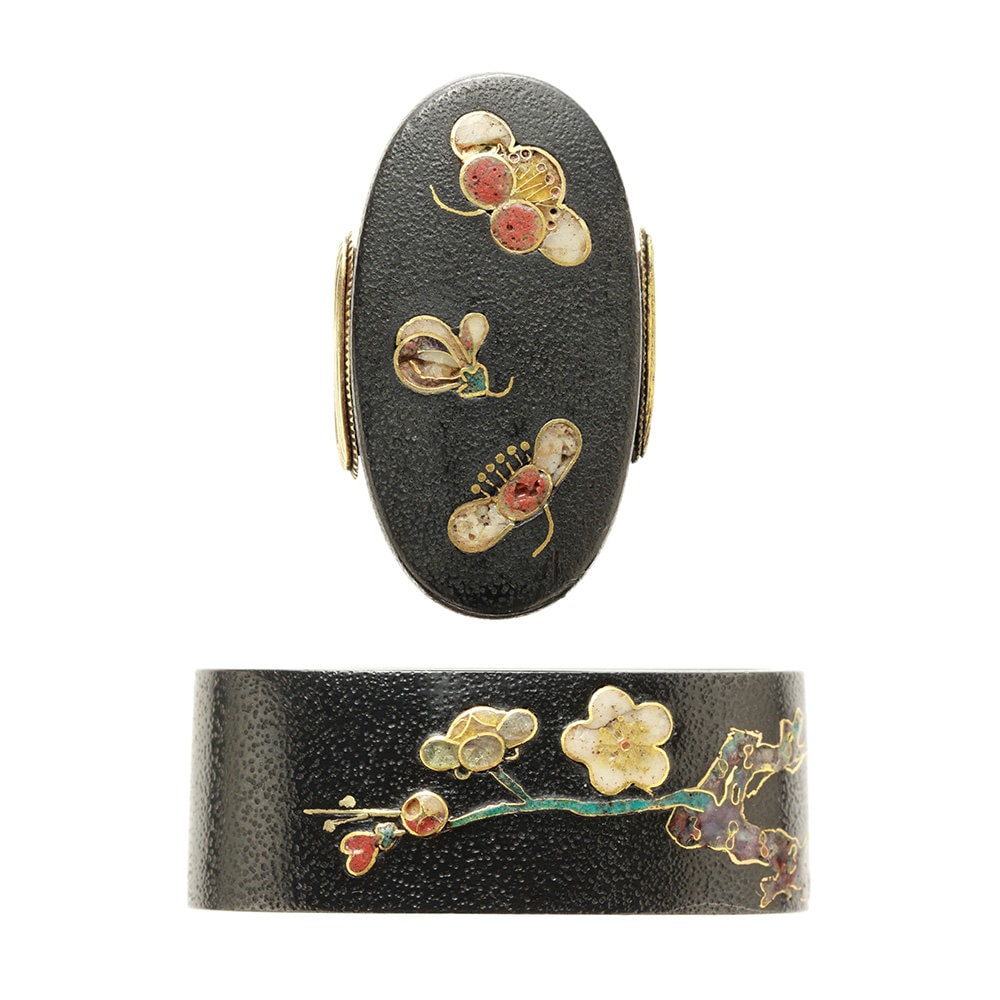
Harunari's shippo work employs predominantly gold cloisonne, yielding an elegant effect; many of his pieces are, in every respect, exceptionally beautiful. His gold-wire cloisonne inlays (kinsen shippo ) are arranged with remarkable effect, producing enamel tonalities that are highly transparent and clear -- a quality that distinguishes late-period Hirata work from the earlier manner, in which doro shippo was heaped up in thicker relief. In works combining cloisonne with carving, his is executed through precise and accurate chisel handling, and a range of colored metals -- gold, silver, , and -- is employed so that even the finest details are rendered with exactitude. Among his oeuvre there are also works that do not employ shippo at all, yet are executed with finely controlled workmanship -- neat, delicate, and painstakingly thorough.

The has consistently recognized Harunari as a maker whose output gathers together the very essence of shippo inlay while simultaneously demonstrating crisp, masterful carving skill. His pieces are described as exceptionally dignified in tone, and his best works stand as excellent demonstrations of the high technical level attained by this maker. That Harunari was thoroughly conversant with multiple techniques -- uniting the Hirata tradition of cloisonne with extremely meticulous metal-carving work -- places him in a singular position within the late -period tosogu world, an artisan whose versatility elevated the hereditary art of his house to its fullest expression.
Kantei

3 descriptive axes: material (the polished shakudo and ishime-ground enamel fields of the house, beside the nanako grounds of standard kinko carving) x technique (the inherited cloisonne enamel inlay, frequently in gold-wire enamel, set beside takabori colour-inlay, suemon-zogan and yobori carving) x themes (the enamel devices of the house, beside the carved figural and auspicious subjects of his metalwork). His load-bearing discriminator is the carving (chokin) itself, the practice the records say set him apart from the enamel-only Hirata heads; the gold-wire cloisonne enamel inlay is his characteristic execution of the family technique.

Hirata Harunari is the eighth head of the Hirata school of cloisonne enamel (shippo) on the sword fitting, the line founded by Donin that served the Tokugawa down the generations as a single-heir secret and, after his time, turned its enamel craft to making the medals of the Meiji state. The records call him an outstanding craftsman of his house, and single him out from the other Hirata heads on one point: unlike his enamel-only forebears, Harunari did not work the family enamel alone but also took up carving (chokin), which the records say he learned at the Bakufu-employed Yasuda house. He thus left work in many techniques, the inherited cloisonne enamel beside colour-inlay, yobori and . He signs his own art-name 平田春就 with a clearly, and the records say his signed work is comparatively common, so he can be told apart by his signature where the early Hirata heads, who share a common given-name, cannot.

Diagnostic discriminators

his load-bearing separator: the records state plainly that, unlike the other Hirata heads, Harunari did not work the family enamel alone but also did carving (chokin), which he is said to have learned at the Bakufu-employed Yasuda house, so that he left work in many techniques (takabori colour-inlay, yobori menuki, kinmon kozuka); this is what tells him apart from his enamel-only line, not from kinko at large

enamel drawn within fine gold-wire cloisons, set on the shakudo ishime ground and scattered with detailed devices; named a point of his rim and field work, the characteristic way the family enamel appears in his hand

cloisonne enamel inlay is the founding mark of the Hirata house, near-universal in this corpus; it separates Harunari and his house from ordinary kinko, but it is a house foundation shared by every Hirata head, not a separator from his own line (his genuine separator within the house is his carving)

Material (grounds)

The grounds are the enamel fields of the house, worked as an ishime ground, beside the - and grounds of standard kinko carving; and brass appear on his guards.

Technique (enamel and carving)

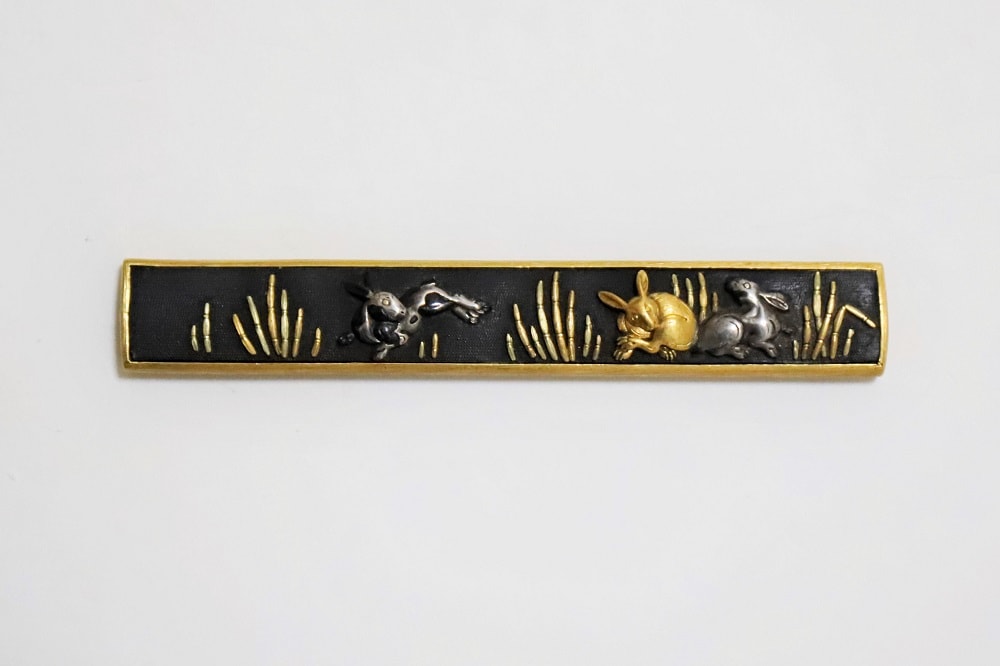
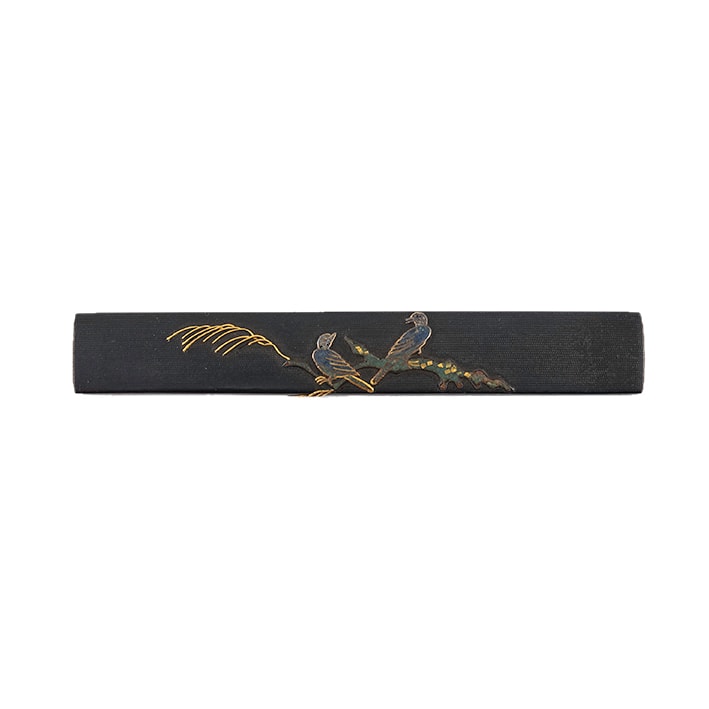
The inherited cloisonne enamel inlay above all, frequently drawn in gold-wire enamel; set beside the carving he also took up, the with colour-inlay, the - applied-relief inlay and the yobori , with the relief on his guards.

Themes (subjects)

Across this small corpus his subjects are varied, falling into two modes: the enamel devices of the house (the rain-dragon and flowers, the paired sea-cucumber, treasure-emblems and crests) and the carved figural and auspicious subjects of his metalwork (the two immortals with the tiger, the dancing crane, the pine-bamboo-crane-tortoise of a felicitous mounting).

Enamel devicesless firmly established

The decorative subjects carried in the family enamel: the rain-dragon and scattered flowers, the paired sea-cucumber, treasure-emblems and crests.

Carved figural and auspicious subjectsless firmly established

The subjects of his carving hand: the two Chinese immortals attended by a tiger, the dancing crane, and the pine-bamboo-crane-tortoise of a felicitous formal mounting.

Full iconography

Signature chronology

Placement
Recorded signatures

Documentary note

Unlike the early Hirata heads, who are barely ever signed and share the family given-name so that generation cannot be told from the inscription, Harunari signs his own art-name 平田春就 with a , and the records say his signed work is comparatively common; on a the given name is split as a (春 / 就). His house enamel is attributed within the line, but his hand is identified by this clear self-signature and by the carving he alone among the heads took up: the records note he learned chokin at the Bakufu-employed Yasuda house and so made yobori , colour-inlay and beside the family enamel.

Scholarship

One record reads his clear, high-transparency enamel as a mark of the late Hirata school, drawing a line apart from the thick opaque doro-shippo built up in relief by the early Hirata generations (a single-source kantei point in this corpus, on his guard work).

The records place the Hirata enamel that begins with Donin within the luxuriant decorative beauty of the Momoyama age, the taste his late-house work continues.

Designations

Kokuhō—
Jūyō Bunkazai—
Jūyō Bijutsuhin—
Gyobutsu—
Tokubetsu Jūyō—
Jūyō Tōken6

Elite Standing

0.04 across 6 designated works

Top 25% among makers

Provenance

1 documented provenance across certified works by Harunari

Provenance Standing

1 works held in elite collections across 1 documented provenances

Top 96% among makers

Raw score: 1.83 / 10

Work Types

Distribution across 6 ranked works

Other
350%
Tsuba
233%
Fuchi-Kashira
117%

Signatures

Signature types across 6 ranked works

Currently Available

Lineage

TeacherNarisuke
Harunari
Students (2)
  1. 1.Narimasa就将1 for sale2designated
  2. 2.Haruhiro春寛1designated

Hirata-Edo School

Other artisans of the Hirata-Edo school

  1. 1.Donin道仁1 for sale31designated
  2. 2.Narisuke就亮1designated
  3. 3.Haruhiro春寛1designated
  4. 4.Nariyuki就行1designated
  5. 5.Shigekata重賢1designated
  6. 6.Haruyuki春行1designated
  7. 7.Narikazu就一2designated
  8. 8.Narimasa就将1 for sale2designated

Harunari

Harunari(春就) was a maker of Japanese sword fittings (tōsōgu) of the Hirata-Edo school in Edo province, active during the Late Edo (?–1840) period.

The work follows the Kinko tradition.

Designated works by Harunari include 6 Jūyō.