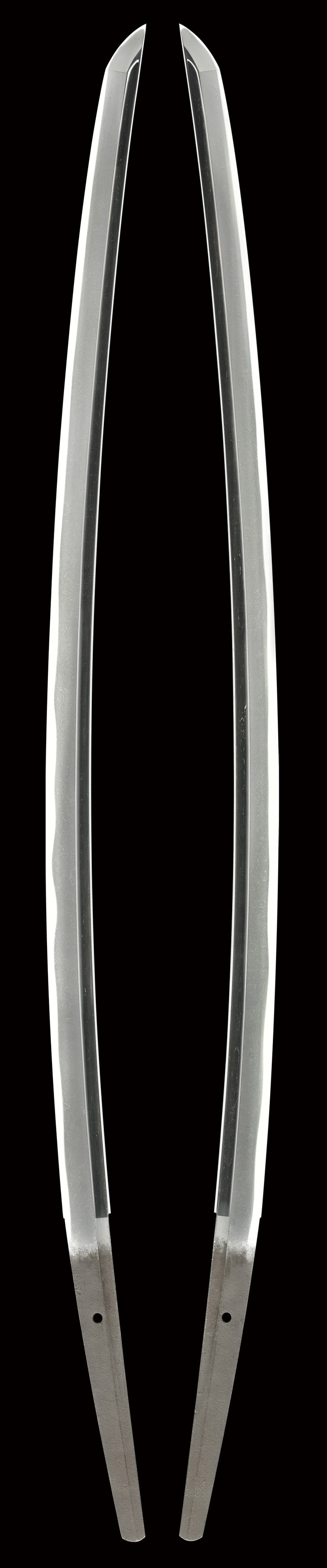
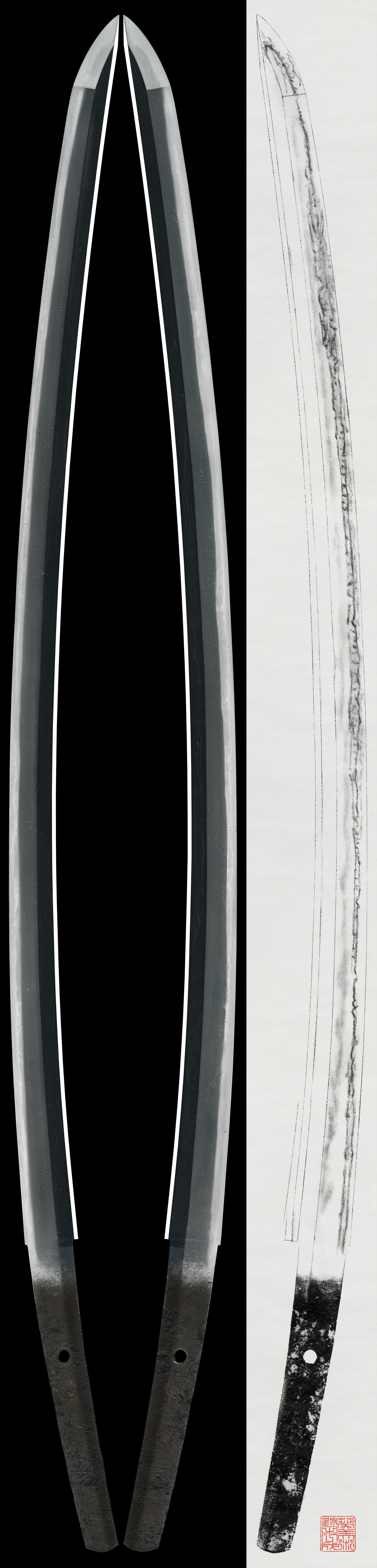
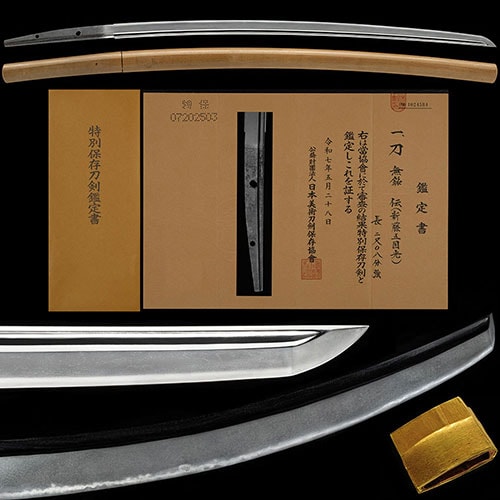
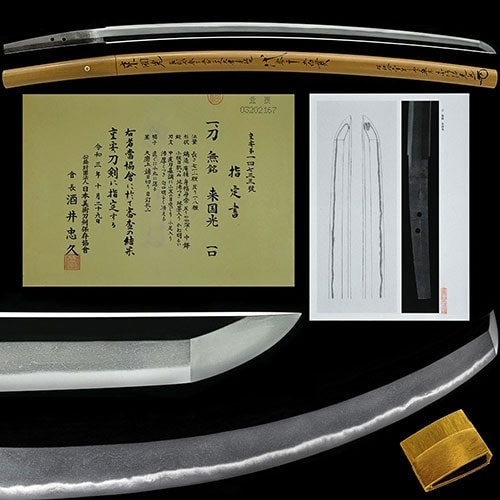
Go-Toba-in is not a swordsmith in the ordinary sense but the Retired Emperor Go-Toba (後鳥羽上皇), the sovereign of the early period who made the forge an imperial practice. The published sources state the tradition consistently: he selected the , the appointed smiths of his rotation, organized them into alternating shifts at the cloistered palace, and had swords forged there, and among these works the blades for which the Emperor himself performed the tempering are termed or gosaku. The record is old. The writes that his summoning of the master craftsmen of his day and his personal quenching of blades "has long been known from classical sword treatises, beginning with the Meizukushi" in the Kanchi-in manuscript, and the modern study Go-Toba-in -ko collects the recorded works.
The defining mark is the chrysanthemum. The works are called because at the base of the , within the , they bear a finely incised sixteen- or twenty-four-petal chrysanthemum crest, and where the tang survives intact the worn of the crest is still legible. The style, by contrast, is never his alone: the published sources repeat that the workmanship differs with the smith who served as the Emperor's counterpart on each occasion, some works resembling the Ko-, some in a manner, and some close to the working range of . What binds the group is the hallmark of the program: "in general they show (焼落し), and from that area a -like effect often appears." At the dropped temper the weakens, so that at first glance the blade can suggest a retempered piece, and the published record is explicit that it is not. Among the surviving examples the sources distinguish a Kyoto style and a style.
The quiet side of the corpus is carried by the handed down in the Yamauchi family, bearing the over a cipher-like character cut diagonally beneath it. The blade is slender, with high and , inclining forward toward a small . Its is mixed with and flowing , the grain standing somewhat, with and , and toward the base a diagonal -like reflection rises. The temper is dropped above the with a -like flare; above it the runs in a tone with shallow , mixing , and a feeling. Small enter and lie close to the edge, the whole well covered in with and ; the is with , strong in . The published sources place this work close to the Ko- school and read off the program's and the -like at the base. The added beneath the crest has no other recorded parallel among , "a precious piece of documentary material," and the blade carries a Kojo of Enpo 1 (1673) valuing it at 150 .
The flamboyant side is the of the hatamoto Kuroda family, judged by the published sources to have had a smith as the counterpart. It is a dignified blade of nearly standard width with a marked taper, ample , high curvature with and , and a . Here the is a well forged , the dust-fine, and a vivid stands out clearly. The is high, a flamboyant with and , -dominant with and an overall slanting tendency; mingle near the heads of the temper, and the is tight, bright and clear. are cut above the grooves, with on the . The and are so robust (頗る健体) that the commentary records sensing a freshness at first glance, and it concludes that overall it is a splendid work and that the traditional attribution to kiku-gosaku may reasonably be accepted. The - attributed to the group continue this manner, mixed with , deep in with , and , the ; on these the shortening has removed the and the , and the appraisal rests on the archaic tone of the and . Of the Matsudaira blade Honma recorded that the attribution is appropriate and the workmanship good.
He left no pupils, and there is no downstream school. The lineage of a kiku-gosaku runs sideways, back to the school of the smith who attended the Emperor, and it is that resemblance, Ko-, or , joined to the crest, the and the , that defines the group for appraisal. The published record also sets out the designated company these blades keep: among kiku-gosaku are a blade of the imperial collection and Important Cultural Properties from the former Matsudaira, Owari Tokugawa and Hayashibara collections, every one carrying the chrysanthemum cut into the tang.
Eleven designated works stand on record: four Important Cultural Properties, two blades recorded in the imperial collection, two Bijutsuhin, two and one . Nine carry recorded provenance, and the roll is what an emperor's hand would lead one to expect. The Kuroda was bestowed by Tokugawa Ieyasu on Kuroda Naotsuna in 1614 and was maintained every year through the period by the shogunal sword office; the Itsukushima Shrine is by shrine tradition a former possession of Ouchi Yoshitaka, dedicated by Mori Motonari, and suffered in the fire of Meiji 20 (1887); other blades passed through the Yamauchi, the Matsudaira and Matsudaira, the Kujo and the Imperial Family, and one came down from Uesugi Kagekatsu. Of recorded whereabouts the works rest at Itsukushima Shrine, the Tokyo and Kyoto National Museums and the Kurokawa Institute. The Important Cultural Properties and the imperial pieces are patrimony and will not trade; what remains to the private sphere is the small and tier, three blades in all, so that a kiku-gosaku, the chrysanthemum of Go-Toba's own forge, coming into open hands is among the rarest encounters the field affords.